

Electrophysiological Immunity to Plasmodiophora Brassicae Infection of Gaoshan Brassica Rapa under Various Selenite Levels


Article Information
Abstract
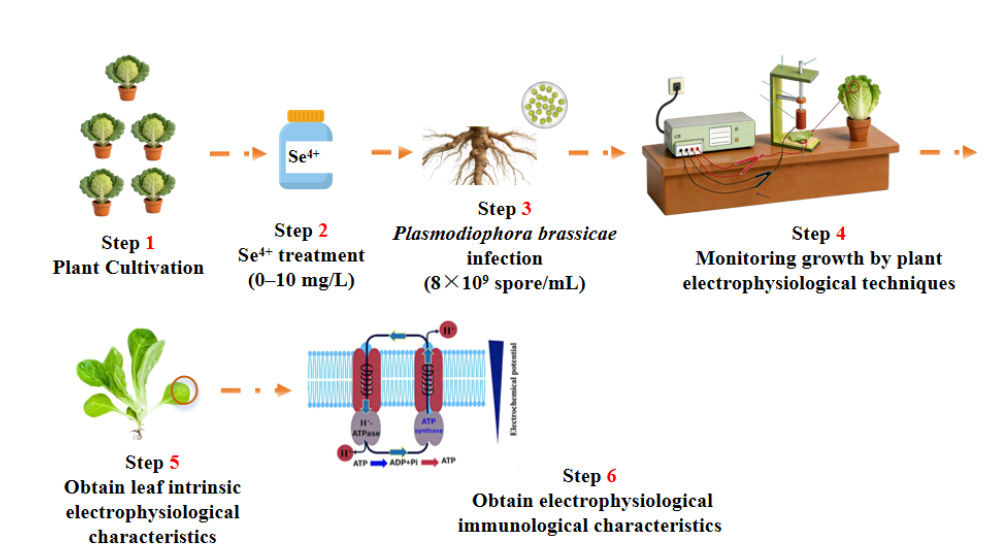
Enshi is a high-incidence area for Plasmodiophora brassicae infection in Brassica rapa in China; however, the differential immunomodulatory effects of selenite (Se\(^{4+}\)) on the infection of Brassica rapa by the Plasmodiophora brassicae (Pb) remain unclear. In this study, Enshi Gaoshan Brassica rapa (GBr) was selected. Pre-treatment with 0–10 mg/L Se\(^{4+}\) was applied, followed by artificial inoculation with Plasmodiophora brassicae spores (8×10\(^9\) spore/mL). Growth characteristics, photosynthesis, and electrophysiological and nutritional metabolic features of GBr leaves were measured. The results indicate that electrophysiological techniques provide more significant distinctions. S2 (1.25 mg/L Se\(^{4+}\)) was identified as the optimal immune concentration. Compared to the CK, S2 exhibited a 1.2 fold increase in \(\Delta G_r\), a 19.5 fold increase in \(\Delta G_z\), and a 2.5 fold increase in Metabolic activity (MA). S4 (5 mg/L Se\(^{4+}\)) was the immune compensation concentration; compared to CK, S4 exhibited increased WRT (1.4 fold), Nutrient active translocation capacity (NAC) (1.9 fold), and \(\Delta G\) (4 fold), achieving immune compensation. Therefore, electrophysiological indicators (\(\Delta G_r\), \(\Delta G_z\), MA, WRT, NAC) showed 30%–50% higher sensitivity than traditional photosynthetic parameters, highlighting the advantages of electrophysiological methods for early, non-destructive monitoring. This study provides innovative smart agricultural technical support for elucidating the immunity of differential Se\(^{4+}\).
Graphical Abstract
Keywords
Data Availability Statement
Funding
Conflicts of Interest
AI Use Statement
Ethical Approval and Consent to Participate
References
- Liu, W., Dai, Z., Jia, J., Li, X., Zhu, H., Kan, X., & Zhu, B. (2025). Comparative physiological and transcriptomic analyses identify computationally predicted key genes and regulatory pathways in non-heading Chinese cabbage under heat stress. BMC Plant Biology, 25(1), 1042.
[CrossRef] [Google Scholar] - Wei, X., Du, Y., Zhang, W., Zhao, Y., Yang, S., Su, H., ... & Yuan, Y. (2024). Comparative metabolome and transcriptome analysis reveals the defense mechanism of Chinese Cabbage (Brassica rapa L. ssp. pekinensis) against plasmodiophora brassicae infection. International Journal of Molecular Sciences, 25(19), 10440.
[CrossRef] [Google Scholar] - Ge, W., Lv, M., Feng, H., Wang, X., Zhang, B., Li, K., ... & Ji, R. (2023). Analysis of the role of BrRPP1 gene in Chinese cabbage infected by Plasmodiophora brassicae. Frontiers in plant science, 14, 1082395.
[CrossRef] [Google Scholar] - Zhang, Y., Yu, H., Zhao, T., Hussain, I., Ma, X., Wang, Y., ... & Yu, X. (2024). Integrated management of clubroot in zhejiang province, China. Agronomy, 14(2), 377.
[CrossRef] [Google Scholar] - Zhu, S., Sun, S., Zhao, W., Yang, X., Mao, H., Sheng, L., & Chen, Z. (2024). Utilizing transcriptomics and proteomics to unravel key genes and proteins of Oryza sativa seedlings mediated by selenium in response to cadmium stress. BMC Plant Biology, 24(1), 360.
[CrossRef] [Google Scholar] - Li, Q., Xian, L., Yuan, L., Lin, Z., Chen, X., Wang, J., & Li, T. (2023). The use of selenium for controlling plant fungal diseases and insect pests. Frontiers in Plant Science, 14, 1102594.
[CrossRef] [Google Scholar] - Hou, X., Wang, Z., & Peng, M. (2025). Selenium compounds and their bioactivities: molecular mechanisms and prospects for functional food and therapeutic applications. Plants, 14(17), 2622.
[CrossRef] [Google Scholar] - Wang, Z., Li, N., Zhou, X., Wei, S., Zhu, Y., Li, M., ... & Cheng, S. (2024). Optimization of fermentation parameters to improve the biosynthesis of selenium nanoparticles by Bacillus licheniformis F1 and its comprehensive application. BMC microbiology, 24(1), 271.
[CrossRef] [Google Scholar] - Zhang, Q., Xing, D., Wu, Y., Zhao, K., Wang, J., & Mao, R. (2024). Effects of Low-Phosphorus Stress on Use of Leaf Intracellular Water and Nutrients, Photosynthesis, and Growth of Brassica napus L. Horticulturae, 10(8), 821.
[CrossRef] [Google Scholar] - Yu, R., Wu, Y., & Xing, D. (2021). Can electrophysiological parameters substitute for growth, and photosynthetic parameters to characterize the response of mulberry and paper mulberry to drought?. Plants, 10(9), 1772.
[CrossRef] [Google Scholar] - Gu, X., Xia, A., Wu, Y., Gratien, T., Fan, J., Wang, C., ... & Song, X. (2025). Electrophysiological sensors reveal silicon–selenium interaction of dynamic leaf intracellular water–nutrient metabolism in rice under cadmium stress. Plant Signaling & Behavior, 20(1), 2547384.
[CrossRef] [Google Scholar] - Xia, A., Wu, Y., Zhai, K., Xiang, D., Li, L., Qin, Z., & Twagirayezu, G. (2025). Plant electrophysiological parameters represent leaf intracellular water–nutrient metabolism and immunoregulations in Brassica rapa during Plasmodiophora infection. Plants, 14(15), 2337.
[CrossRef] [Google Scholar] - Kang, H., Lin, Z., Yuan, X., Shi, Y., Xie, X., Li, L., ... & Chai, A. (2024). The occurrence of clubroot in cruciferous crops correlates with the chemical and microbial characteristics of soils. Frontiers in Microbiology, 14, 1293360.
[CrossRef] [Google Scholar] - Struck, C., Rüsch, S., & Strehlow, B. (2022). Control strategies of clubroot disease caused by Plasmodiophora brassicae. Microorganisms, 10(3), 620.
[CrossRef] [Google Scholar] - Petitpas, M., Lapous, R., Le Duc, M., Lariagon, C., Lemoine, J., Langrume, C., ... & Jubault, M. (2024). Environmental conditions modulate the effect of epigenetic factors controlling the response of Arabidopsis thaliana to Plasmodiophora brassicae. Frontiers in plant science, 15, 1245545.
[CrossRef] [Google Scholar] - Zhou, R., Qin, X., Hou, J., & Liu, Y. (2024). Research progress on Brassicaceae plants: a bibliometrics analysis. Frontiers in Plant Science, 15, 1285050.
[CrossRef] [Google Scholar] - Sun, S. N., Liu, F., Zeng, L. Y., Chen, W., Ren, L., Xu, L., & Fang, X. P. (2022). Infection process and physiological and biochemical differences between clubroot-resistant and-susceptible varieties of radish. Chinese Journal of Oil Crop Sciences, 44(3), 642-651.
[CrossRef] [Google Scholar] - Auer, S., & Ludwig-Müller, J. (2023). Biocontrol of clubroot disease: how successful are endophytic fungi and bacteria?. European Journal of Plant Pathology, 167(4), 433-451.
[CrossRef] [Google Scholar] - Majidi, A., Shahhoseini, R., Salehi-Arjmand, H., & Roosta, H. R. (2025). Effect of Hoagland’s nutrient solution strengths and sodium silicate on growth, yield and biochemical parameters of Carla (Momordica charantia L.) under hydroponic conditions. Scientific Reports, 15(1), 7838.
[CrossRef] [Google Scholar] - Wang, Y., Rao, C., Huang, L., Wu, J., Sun, P., Zhan, J., ... & He, X. (2023). Effects of organic selenium and nanoselenium on drought stress of pak choi (Brassica chinensis var. pekinensis. cv.‘Suzhouqing’) and its transcriptomic analysis. Agronomy, 14(1), 78.
[CrossRef] [Google Scholar] - Khalofah, A., Migdadi, H., & El-Harty, E. (2021). Antioxidant enzymatic activities and growth response of quinoa (Chenopodium quinoa willd) to exogenous selenium application. Plants, 10(4), 719.
[CrossRef] [Google Scholar] - Vadillo, J. M., Campillo, C., Millán, S., & Prieto, H. (2025). Evaluation of Nitrogen Nutritional Status in Broccoli, Processing Tomato, and Processing Pepper Under Different Fertilization Regimes in Open Fields in Extremadura. Horticulturae, 11(7), 733.
[CrossRef] [Google Scholar] - Wang, L., Zhong, Y., Ma, R., Li, H., & Liu, T. (2025). Comprehensive Evaluation of Phenotypic Traits in Vegetable Faba Bean (Vicia faba L.) Germplasms Based on Multivariate Statistical Methods. Journal of Food Quality, 2025(1), 1621073.
[CrossRef] [Google Scholar] - Wang, Y., Sun, P., Nie, M., Zhan, J., Huang, L., Wu, J., ... & Li, X. (2025). Integration of metabolomics and transcriptomics analyses reveals the effects of nano-selenium on pak choi. Scientific reports, 15(1), 11215.
[CrossRef] [Google Scholar] - Van Haeverbeke, M., De Baets, B., & Stock, M. (2023). Plant impedance spectroscopy: a review of modeling approaches and applications. Frontiers in Plant Science, 14, 1187573.
[CrossRef] [Google Scholar] - Wang, Y., Tan, G., Chen, J., Wu, J., Liu, S., & He, X. (2023). Effects of foliar spraying of organic selenium and nano-selenium fertilizer on pak choi (Brassica chinensis var. pekinensis. cv.‘Suzhouqing’) under low temperature stress. Agriculture, 13(11), 2140.
[CrossRef] [Google Scholar] - Lu, M., Song, Y., & Jin, G. (2025). Trait variation across different life history stages of trees and its impact on net photosynthetic rate. Frontiers in Plant Science, 16, 1657142.
[CrossRef] [Google Scholar] - Zhao, Y., & Chen, H. (2025). Water and Nitrogen Use Strategies and Their Influencing Mechanisms in Typical Desert Shrubs of the Qaidam Basin, Qinghai–Tibet Plateau, China. Plants, 14(24), 3828.
[CrossRef] [Google Scholar] - Patiño-Ruiz, M. F., Anshari, Z. R., Gaastra, B., Slotboom, D. J., & Poolman, B. (2024). Chemiosmotic nutrient transport in synthetic cells powered by electrogenic antiport coupled to decarboxylation. Nature Communications, 15(1), 7976.
[CrossRef] [Google Scholar] - An, L., Mao, Y., Huang, D., Leng, Y., & Chen, X. (2025). Selenium in tea plant cultivation: bioavailability, uptake, metabolism, and physiological regulation. Frontiers in Plant Science, 16, 1718992.
[CrossRef] [Google Scholar] - Sun, P., Ge, G., Sun, L., Bao, J., Zhao, M., Hao, J., ... & Jia, Y. (2025). Metabolomics combined with physiology and transcriptomics reveal the regulation of key nitrogen metabolic pathways in alfalfa by foliar spraying with nano-selenium. Journal of Nanobiotechnology, 23(1), 7.
[CrossRef] [Google Scholar] - Deng, C. L., Liang, Y. E., Liao, J. Y., Lan, J. S., Saito, M. W., Chen, Y. X., ... & Zhan, X. J. (2025). Foliar application of chelated selenium modulated the chlorophyll metabolism, antioxidant capacity, and yield of rice under salt stress. American Journal of Plant Sciences, 16(5), 608–620.
[CrossRef] [Google Scholar] - Tangjaidee, P., Swedlund, P., Xiang, J., Yin, H., & Quek, S. Y. (2023). Selenium-enriched plant foods: Selenium accumulation, speciation, and health functionality. Frontiers in Nutrition, 9, 962312.
[CrossRef] [Google Scholar] - Khan, Z., Thounaojam, T. C., Chowdhury, D., & Upadhyaya, H. (2023). The role of selenium and nano selenium on physiological responses in plant: a review. Plant Growth Regulation, 100(2), 409-433.
[CrossRef] [Google Scholar] - Ullah, S., & Junjun, N. (2026). From signals to survival: exploring chemical, electrical, and acoustic communication mechanisms in plant adaptation to environmental stressors. Plant and Soil, 518(2), 1921-1946.
[CrossRef] [Google Scholar] - Yadav, S., Sharma, S., Sharma, K. D., Dhansu, P., Devi, S., Preet, K., ... & Kumar, A. (2023). Selenium mediated alterations in physiology of wheat under different soil moisture levels. Sustainability, 15(3), 1771.
[CrossRef] [Google Scholar] - Samynathan, R., Venkidasamy, B., Ramya, K., Muthuramalingam, P., Shin, H., Kumari, P. S., ... & Sivanesan, I. (2023). A recent update on the impact of nano-selenium on plant growth, metabolism, and stress tolerance. Plants, 12(4), 853.
[CrossRef] [Google Scholar] - Mechora, Š., Stibilj, V., Kreft, I., & Germ, M. (2014). The physiology and biochemical tolerance of cabbage to Se (VI) addition to the soil and by foliar spraying. Journal of plant nutrition, 37(13), 2157-2169.
[CrossRef] [Google Scholar] - Xia, A., Wu, Y., Qin, Z., Zhu, Y., Li, L., Xiao, J., ... & Xiang, J. (2024). Synergistic effects of bicarbonate and selenium on cadmium transport in karst-adaptable plants based on plant electrical signals. Agronomy, 14(1), 218.
[CrossRef] [Google Scholar]
Cite This Article
TY  - JOUR
AU  - Xia, Antong
AU  - Huang, Huakang
AU  - Mou, Nan
AU  - Fan, Jing
AU  - Zhai, Kun
AU  - Xiang, Dongshan
PY  - 2026
DA  - 2026/06/10
TI  - Electrophysiological Immunity to Plasmodiophora Brassicae Infection of Gaoshan Brassica Rapa under Various Selenite Levels
JO  - Journal of Plant Electrobiology
T2  - Journal of Plant Electrobiology
JF  - Journal of Plant Electrobiology
VL  - 1
IS  - 2
SP  - 108
EP  - 122
DO  - 10.62762/JPE.2026.316376
UR  - https://www.icck.org/article/abs/JPE.2026.316376
KW  - Plasmodiophora brassicae infection
KW  - Brassica rapa
KW  - electrophysiological nutrient metabolism
KW  - immune regulation
KW  - health effects of selenium
AB  - Enshi is a high-incidence area for Plasmodiophora brassicae infection in Brassica rapa in China; however, the differential immunomodulatory effects of selenite (Se\(^{4+}\)) on the infection of Brassica rapa by the Plasmodiophora brassicae (Pb) remain unclear. In this study, Enshi Gaoshan Brassica rapa (GBr) was selected. Pre-treatment with 0–10 mg/L Se\(^{4+}\) was applied, followed by artificial inoculation with Plasmodiophora brassicae spores (8×10\(^9\) spore/mL). Growth characteristics, photosynthesis, and electrophysiological and nutritional metabolic features of GBr leaves were measured. The results indicate that electrophysiological techniques provide more significant distinctions. S2 (1.25 mg/L Se\(^{4+}\)) was identified as the optimal immune concentration. Compared to the CK, S2 exhibited a 1.2 fold increase in \(\Delta G_r\), a 19.5 fold increase in \(\Delta G_z\), and a 2.5 fold increase in Metabolic activity (MA). S4 (5 mg/L Se\(^{4+}\)) was the immune compensation concentration; compared to CK, S4 exhibited increased WRT (1.4 fold), Nutrient active translocation capacity (NAC) (1.9 fold), and \(\Delta G\) (4 fold), achieving immune compensation. Therefore, electrophysiological indicators (\(\Delta G_r\), \(\Delta G_z\), MA, WRT, NAC) showed 30%–50% higher sensitivity than traditional photosynthetic parameters, highlighting the advantages of electrophysiological methods for early, non-destructive monitoring. This study provides innovative smart agricultural technical support for elucidating the immunity of differential Se\(^{4+}\).
SN  - 3071-6268
PB  - Institute of Central Computation and Knowledge
LA  - English
ER  -
@article{Xia2026Electrophy,
  author = {Antong Xia and Huakang Huang and Nan Mou and Jing Fan and Kun Zhai and Dongshan Xiang},
  title = {Electrophysiological Immunity to Plasmodiophora Brassicae Infection of Gaoshan Brassica Rapa under Various Selenite Levels},
  journal = {Journal of Plant Electrobiology},
  year = {2026},
  volume = {1},
  number = {2},
  pages = {108-122},
  doi = {10.62762/JPE.2026.316376},
  url = {https://www.icck.org/article/abs/JPE.2026.316376},
  abstract = {Enshi is a high-incidence area for Plasmodiophora brassicae infection in Brassica rapa in China; however, the differential immunomodulatory effects of selenite (Se\(^{4+}\)) on the infection of Brassica rapa by the Plasmodiophora brassicae (Pb) remain unclear. In this study, Enshi Gaoshan Brassica rapa (GBr) was selected. Pre-treatment with 0–10 mg/L Se\(^{4+}\) was applied, followed by artificial inoculation with Plasmodiophora brassicae spores (8×10\(^9\) spore/mL). Growth characteristics, photosynthesis, and electrophysiological and nutritional metabolic features of GBr leaves were measured. The results indicate that electrophysiological techniques provide more significant distinctions. S2 (1.25 mg/L Se\(^{4+}\)) was identified as the optimal immune concentration. Compared to the CK, S2 exhibited a 1.2 fold increase in \(\Delta G\_r\), a 19.5 fold increase in \(\Delta G\_z\), and a 2.5 fold increase in Metabolic activity (MA). S4 (5 mg/L Se\(^{4+}\)) was the immune compensation concentration; compared to CK, S4 exhibited increased WRT (1.4 fold), Nutrient active translocation capacity (NAC) (1.9 fold), and \(\Delta G\) (4 fold), achieving immune compensation. Therefore, electrophysiological indicators (\(\Delta G\_r\), \(\Delta G\_z\), MA, WRT, NAC) showed 30\%–50\% higher sensitivity than traditional photosynthetic parameters, highlighting the advantages of electrophysiological methods for early, non-destructive monitoring. This study provides innovative smart agricultural technical support for elucidating the immunity of differential Se\(^{4+}\).},
  keywords = {Plasmodiophora brassicae infection, Brassica rapa, electrophysiological nutrient metabolism, immune regulation, health effects of selenium},
  issn = {3071-6268},
  publisher = {Institute of Central Computation and Knowledge}
}
Article Metrics
Publisher's Note
ICCK stays neutral with regard to jurisdictional claims in published maps and institutional affiliations.
Rights and Permissions