


Neuroscience-Inspired Plant Electrophysiology: From Signal Decoding to Plant-Computer Interfaces




Article Information
Abstract
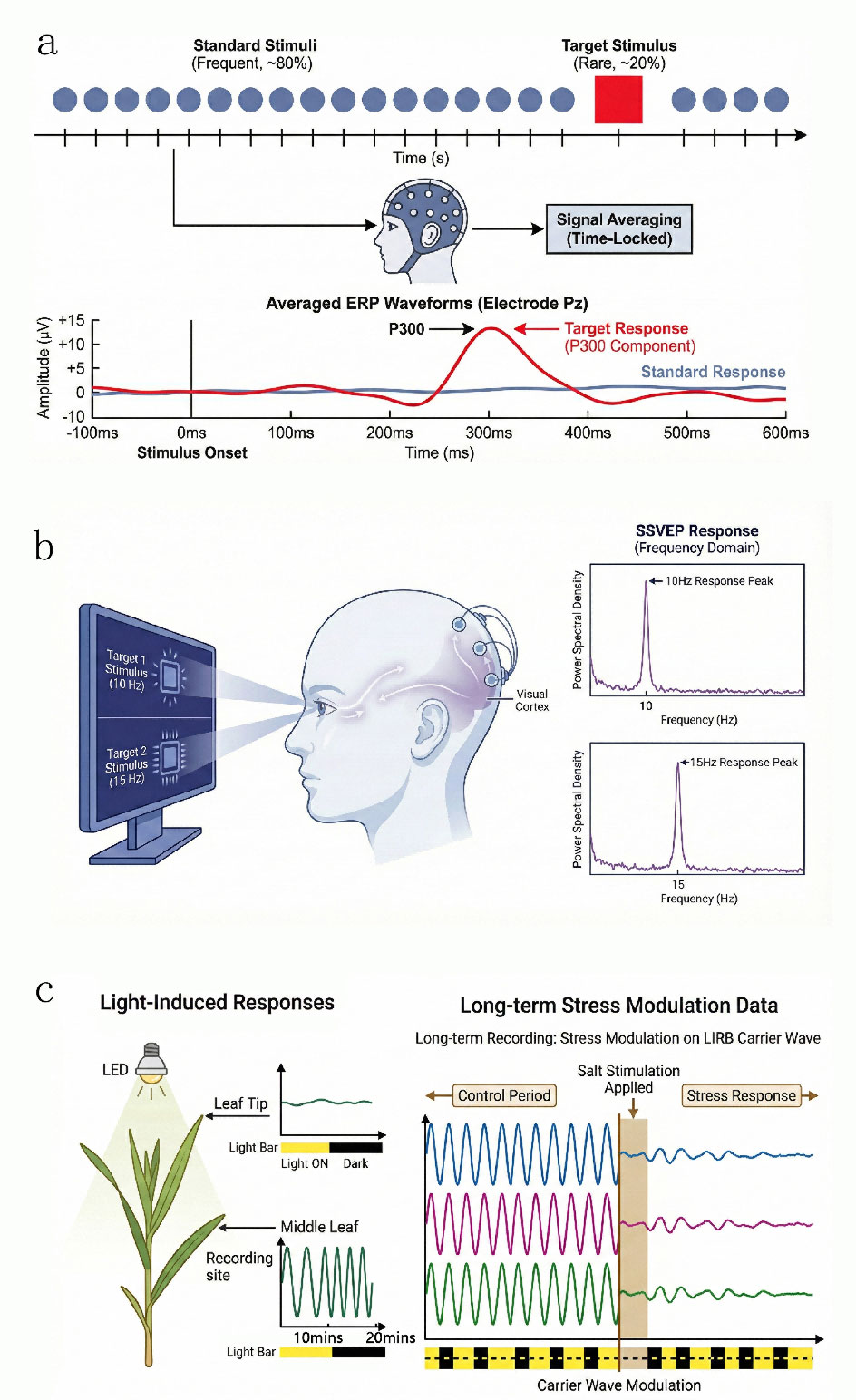
Plant electrophysiology is undergoing a profound paradigm shift from traditional phenomenological observation to systemic signal decoding, with mature methodologies from computational neuroscience and brain-computer interface technologies providing critical theoretical and engineering support for this interdisciplinary evolution. This review first systematically summarizes the evolution of flexible wearable electrodes and ultra-high impedance amplification hardware systems tailored to the ultra-slow signal dynamics and continuous morphological growth characteristics of plants. Second, we discuss the application pathways of introducing standardized sequential evoked paradigms from neuroscience—such as steady-state visual evoked potentials and event-related potentials—into the plant domain. This aims to replace traditional destructive stimuli with non-invasive, reproducible rhythmic stimulation to acquire data with high signal-to-noise ratios. In the dimension of data analysis, we explore modeling strategies that incorporate physics-informed neural networks and multi-modal heterogeneous sensor fusion technologies under the constraint of sample scarcity, aiming to resolve the equifinality problem inherent in single-modality electrical signal decoding. Building upon this decoding foundation, this paper proposes the construction of a bidirectional Plant-Computer Interface architecture, exploring the engineering feasibility of utilizing the plant itself as an active sensory node to directly drive closed-loop regulation within agricultural environments. Establishing cross-species standardized open-source datasets and unified hardware/software testing benchmarks will be the core driving force in overcoming current data fragmentation. Ultimately, the deep integration of multidisciplinary approaches will lay a rigorous scientific foundation for precision agricultural resource management and the development of next-generation bio-inspired intelligent hardware.
Graphical Abstract
Keywords
Data Availability Statement
Funding
Conflicts of Interest
AI Use Statement
Ethical Approval and Consent to Participate
References
- Sanderson, J. B. (1872). Note on the Electrical Phenomena Which Accompany Irritation of the Leaf of Dionaea muscipula. Proceedings of the Royal Society of London, 495-496.
[CrossRef] [Google Scholar] - Brenner, E. D., Stahlberg, R., Mancuso, S., Vivanco, J., Baluška, F., & Van Volkenburgh, E. (2006). Plant neurobiology: an integrated view of plant signaling. Trends in plant science, 11(8), 413-419.
[CrossRef] [Google Scholar] - Stahlberg, R. (2006). Historical overview on plant neurobiology. Plant Signaling & Behavior, 1(1), 6-8.
[CrossRef] [Google Scholar] - Shepherd, V. A. (2012). At the roots of plant neurobiology. In Plant electrophysiology: Methods and cell electrophysiology (pp. 3-43). Berlin, Heidelberg: Springer Berlin Heidelberg.
[CrossRef] [Google Scholar] - Davies, E. (2006). Electrical signals in plants: facts and hypotheses. In Plant electrophysiology: theory and methods (pp. 407-422). Berlin, Heidelberg: Springer Berlin Heidelberg.
[CrossRef] [Google Scholar] - Yan, X., Wang, Z., Huang, L., Wang, C., Hou, R., Xu, Z., & Qiao, X. (2009). Research progress on electrical signals in higher plants. Progress in Natural Science, 19(5), 531-541.
[CrossRef] [Google Scholar] - Li, J. H., Fan, L. F., Zhao, D. J., Zhou, Q., Yao, J. P., Wang, Z. Y., & Huang, L. (2021). Plant electrical signals: A multidisciplinary challenge. Journal of Plant Physiology, 261, 153418.
[CrossRef] [Google Scholar] - Fromm, J., & Lautner, S. (2007). Electrical signals and their physiological significance in plants. Plant, cell & environment, 30(3), 249-257.
[CrossRef] [Google Scholar] - Baluška, F., & Mancuso, S. (2009). Plant neurobiology: from sensory biology, via plant communication, to social plant behavior. Cognitive processing, 10(Suppl 1), 3-7.
[CrossRef] [Google Scholar] - Baluška, F., Mancuso, S., Volkmann, D., & Barlow, P. (2009). The ‘root-brain’hypothesis of Charles and Francis Darwin: revival after more than 125 years. Plant signaling & behavior, 4(12), 1121-1127.
[CrossRef] [Google Scholar] - Kawano, T., Ushifusa, Y., Mancuso, S., Baluška, F., Sylvain-Bonfanti, L., Arbelet-Bonnin, D., & Bouteau, F. (2025). Plants have two minds as we do. Plant Signaling & Behavior, 20(1), 2474895.
[CrossRef] [Google Scholar] - Minorsky, P. V. (2024). The “plant neurobiology” revolution. Plant Signaling & Behavior, 19(1), 2345413.
[CrossRef] [Google Scholar] - Drew, B. J., Califf, R. M., Funk, M., Kaufman, E. S., Krucoff, M. W., Laks, M. M., ... & Van Hare, G. F. (2004). Practice standards for electrocardiographic monitoring in hospital settings: an American Heart Association scientific statement from the Councils on Cardiovascular Nursing, Clinical Cardiology, and Cardiovascular Disease in the Young: endorsed by the International Society of Computerized Electrocardiology and the American Association of Critical-Care Nurses. Circulation, 110(17), 2721-2746.
[CrossRef] [Google Scholar] - Benbadis, S. R., Beniczky, S., Bertram, E., MacIver, S., & Moshé, S. L. (2020). The role of EEG in patients with suspected epilepsy. Epileptic Disorders, 22(2), 143-155.
[CrossRef] [Google Scholar] - Koravand, A., Jutras, B., & Lassonde, M. (2013). Auditory event related potentials in children with peripheral hearing loss. Clinical Neurophysiology, 124(7), 1439-1447.
[CrossRef] [Google Scholar] - Lavazza, A., Balconi, M., Ienca, M., Minerva, F., Pizzetti, F. G., Reichlin, M., ... & Songhorian, S. (2025). Neuralink’s brain-computer interfaces: medical innovations and ethical challenges. Frontiers in Human Dynamics, 7, 1553905.
[CrossRef] [Google Scholar] - Wang, Z. Y., Qin, X. H., Li, J. H., Fan, L. F., Zhou, Q., Wang, Y. Q., ... & Huang, L. (2019). Highly reproducible periodic electrical potential changes associated with salt tolerance in wheat plants. Environmental and Experimental Botany, 160, 120-130.
[CrossRef] [Google Scholar] - Wang, Z., Fan, L., Wang, Y., Li, J., Zhou, Q., Huang, L., & Wang, Z. (2018). Selection of recording pattern of plant surface electrical signal based on analysis of electrical characteristics. Transactions of the Chinese Society of Agricultural Engineering, 34(5), 137-143. https://www.ingentaconnect.com/content/tcsae/tcsae/2018/00000034/00000005/art00018
[Google Scholar] - Zhai, J., Li, A., Dong, H., Jin, X., Luo, B., & Wang, X. (2025). Ion-selective electrodes: innovations for precision in vivo plant ion monitoring. Microchimica Acta, 192(11), 1-26.
[CrossRef] [Google Scholar] - Zhou, J., Fan, P., Zhou, S., Pan, Y., & Ping, J. (2025). Machine learning-assisted implantable plant electrophysiology microneedle sensor for plant stress monitoring. Biosensors and Bioelectronics, 271, 117062.
[CrossRef] [Google Scholar] - Yang, Y., He, T., Ravindran, P., Wen, F., Krishnamurthy, P., Wang, L., ... & Lee, C. (2024). All-organic transparent plant e-skin for noninvasive phenotyping. Science Advances, 10(7), eadk7488.
[CrossRef] [Google Scholar] - Taniguchi, H., Akiyama, K., & Fujie, T. (2020). Biopotential measurement of plant leaves with ultra-light and flexible conductive polymer nanosheets. Bulletin of the Chemical Society of Japan, 93(8), 1007-1013.
[CrossRef] [Google Scholar] - Zhou, S., Zhou, J., Pan, Y., Wu, Q., & Ping, J. (2024). Wearable electrochemical sensors for plant small-molecule detection. Trends in Plant Science, 29(2), 219-231.
[CrossRef] [Google Scholar] - Kroeger, J. H., Zerzour, R., & Geitmann, A. (2011). Regulator or driving force? The role of turgor pressure in oscillatory plant cell growth. PloS one, 6(4), e18549.
[CrossRef] [Google Scholar] - Wang, Z. Y., Li, J. H., Zhou, Q., Gao, X. Y., Fan, L. F., Wang, Y. Q., ... & Huang, L. (2018). Multi-channel system for simultaneous in situ monitoring of ion flux and membrane potential in plant electrophysiology. IEEE Access, 7, 4688-4697.
[CrossRef] [Google Scholar] - Nelson, M. J., Pouget, P., Nilsen, E. A., Patten, C. D., & Schall, J. D. (2008). Review of signal distortion through metal microelectrode recording circuits and filters. Journal of neuroscience methods, 169(1), 141-157.
[CrossRef] [Google Scholar] - Bera, T. K., Bera, S., Kar, K., & Mondal, S. (2016). Studying the variations of complex electrical bio-impedance of plant tissues during boiling. Procedia Technology, 23, 248-255.
[CrossRef] [Google Scholar] - Tsuchida, T. N., Acharya, J. N., Halford, J. J., Kuratani, J. D., Sinha, S. R., Stecker, M. M., ... & Drislane, F. W. (2016). American clinical neurophysiology society: EEG guidelines introduction. Journal of Clinical Neurophysiology, 33(4), 301-302.
[CrossRef] [Google Scholar] - Masi, E., Ciszak, M., Stefano, G., Renna, L., Azzarello, E., Pandolfi, C., ... & Mancuso, S. (2009). Spatiotemporal dynamics of the electrical network activity in the root apex. Proceedings of the National Academy of Sciences, 106(10), 4048-4053.
[CrossRef] [Google Scholar] - Zhang, Y., Yuan, Y., Duan, H., Zhu, P., & Mao, Y. (2025). Bionic hydrogel-based stretchable devices for bioelectronics applications. Journal of Bionic Engineering, 22(3), 982-1013.
[CrossRef] [Google Scholar] - Wang, H., Zhang, Y., He, X., Zuo, F., Yang, Y., Yan, P., ... & He, S. (2023). Wettability of liquid metals on PEDOT: PSS for soft electronics. Applied Surface Science, 609, 155410.
[CrossRef] [Google Scholar] - Lee, G., Hossain, O., Jamalzadegan, S., Liu, Y., Wang, H., Saville, A. C., ... & Wei, Q. (2023). Abaxial leaf surface-mounted multimodal wearable sensor for continuous plant physiology monitoring. Science Advances, 9(15), eade2232.
[CrossRef] [Google Scholar] - Felle, H. H., & Zimmermann, M. R. (2007). Systemic signalling in barley through action potentials. Planta, 226(1), 203-214.
[CrossRef] [Google Scholar] - Ognard, J., El Hajj, G., Verma, O., Ghozy, S., Kadirvel, R., Kallmes, D. F., & Brinjikji, W. (2025). Advances in endovascular brain computer interface: Systematic review and future implications. Journal of Neuroscience Methods, 420, 110471.
[CrossRef] [Google Scholar] - Niedermeyer, E., & da Silva, F. L. (Eds.). (2005). Electroencephalography: basic principles, clinical applications, and related fields. Lippincott Williams & Wilkins.
[Google Scholar] - Steinmetz, N. A., Koch, C., Harris, K. D., & Carandini, M. (2018). Challenges and opportunities for large-scale electrophysiology with Neuropixels probes. Current opinion in neurobiology, 50, 92-100.
[CrossRef] [Google Scholar] - Mudrilov, M., Ladeynova, M., Grinberg, M., Balalaeva, I., & Vodeneev, V. (2021). Electrical signaling of plants under abiotic stressors: transmission of stimulus-specific information. International Journal of Molecular Sciences, 22(19), 10715.
[CrossRef] [Google Scholar] - Yao, J. P., Wang, Z. Y., de Oliveira, R. F., Wang, Z. Y., & Huang, L. (2021). A deep learning method for the long-term prediction of plant electrical signals under salt stress to identify salt tolerance. Computers and Electronics in Agriculture, 190, 106435.
[CrossRef] [Google Scholar] - Stett, A., Egert, U., Guenther, E., Hofmann, F., Meyer, T., Nisch, W., & Haemmerle, H. (2003). Biological application of microelectrode arrays in drug discovery and basic research. Analytical and bioanalytical chemistry, 377(3), 486-495.
[CrossRef] [Google Scholar] - Rubehn, B., Bosman, C., Oostenveld, R., Fries, P., & Stieglitz, T. (2009). A MEMS-based flexible multichannel ECoG-electrode array. Journal of neural engineering, 6(3), 036003.
[CrossRef] [Google Scholar] - Mohammed, A. H., Cabrerizo, M., Pinzon, A., Yaylali, I., Jayakar, P., & Adjouadi, M. (2023). Graph neural networks in EEG spike detection. Artificial Intelligence in Medicine, 145, 102663.
[CrossRef] [Google Scholar] - Iannetti, G. D., Hughes, N. P., Lee, M. C., & Mouraux, A. (2008). Determinants of laser-evoked EEG responses: pain perception or stimulus saliency?. Journal of neurophysiology, 100(2), 815-828.
[CrossRef] [Google Scholar] - Sukhova, E., Yudina, L., Kozlova, E., & Sukhov, V. (2024). Preliminary Treatment by Exogenous 24-Epibrassinolide Influences Burning-Induced Electrical Signals and Following Photosynthetic Responses in Pea (Pisum sativum L.). Plants, 13(23), 3292.
[CrossRef] [Google Scholar] - Yudina, L., Popova, A., Zolin, Y., Sukhova, E., & Sukhov, V. (2023). Local action of increased pressure induces hyperpolarization electrical signals and influences photosynthetic light reactions in wheat plants. Plants, 12(13), 2570.
[CrossRef] [Google Scholar] - Shabala, S., & Newman, I. (1999). Light-induced changes in hydrogen, calcium, potassium, and chloride ion fluxes and concentrations from the mesophyll and epidermal tissues of bean leaves. Understanding the ionic basis of light-induced bioelectrogenesis. Plant Physiology, 119(3), 1115-1124.
[CrossRef] [Google Scholar] - Shabala, S., Demidchik, V., Shabala, L., Cuin, T. A., Smith, S. J., Miller, A. J., ... & Newman, I. A. (2006). Extracellular Ca2+ ameliorates NaCl-induced K+ loss from Arabidopsis root and leaf cells by controlling plasma membrane K+-permeable channels. Plant physiology, 141(4), 1653-1665.
[CrossRef] [Google Scholar] - Li, J., Yue, Y., Wang, Z., Zhou, Q., Fan, L., Chai, Z., ... & Huang, L. (2019). Illumination/darkness-induced changes in leaf surface potential linked with kinetics of ion fluxes. Frontiers in plant science, 10, 1407.
[CrossRef] [Google Scholar] - Lim, C. L., Gordon, E., Rennie, C., Wright, J. J., Bahramali, H., Li, W. M., ... & Morris, J. G. L. (1999). Dynamics of SCR, EEG, and ERP activity in an oddball paradigm with short interstimulus intervals. Psychophysiology, 36(5), 543-551.
[CrossRef] [Google Scholar] - Wang, Y., Chen, X., Gao, X., & Gao, S. (2016). A benchmark dataset for SSVEP-based brain–computer interfaces. IEEE Transactions on Neural Systems and Rehabilitation Engineering, 25(10), 1746-1752.
[CrossRef] [Google Scholar] - Li, Y., Bin, G., Gao, X., Hong, B., & Gao, S. (2011, April). Analysis of phase coding SSVEP based on canonical correlation analysis (CCA). In 2011 5th international IEEE/eMBS conference on neural engineering (pp. 368-371). IEEE.
[CrossRef] [Google Scholar] - Amiri, S., Rabbi, A., Azinfar, L., & Fazel-Rezai, R. (2013). A review of P300, SSVEP, and hybrid P300/SSVEP brain-computer interface systems. In R. Fazel-Rezai (Ed.), Brain-Computer Interface Systems - Recent Progress and Future Prospects. IntechOpen.
[CrossRef] [Google Scholar] - Lamti, H. A., Khelifa, M. M. B., Alimi, A. M., & Gorce, P. (2014, August). Influence of mental fatigue on P300 and SSVEP during virtual wheelchair navigation. In 2014 36th Annual International Conference of the IEEE Engineering in Medicine and Biology Society (pp. 1255-1258). IEEE.
[CrossRef] [Google Scholar] - Kwak, N. S., Müller, K. R., & Lee, S. W. (2015). A lower limb exoskeleton control system based on steady state visual evoked potentials. Journal of neural engineering, 12(5), 056009.
[CrossRef] [Google Scholar] - Kelly, S. P., Lalor, E. C., Reilly, R. B., & Foxe, J. J. (2005). Visual spatial attention tracking using high-density SSVEP data for independent brain-computer communication. IEEE Transactions on Neural Systems and Rehabilitation Engineering, 13(2), 172-178.
[CrossRef] [Google Scholar] - Chapman, R. M., & Bragdon, H. R. (1964). Evoked responses to numerical and non-numerical visual stimuli while problem solving. Nature, 203(4950), 1155-1157.
[CrossRef] [Google Scholar] - Picton, T. W., Lins, O. G., & Scherg, M. (1995). The recording and analysis of event-related potentials. Handbook of neuropsychology, 10, 3-73. https://www.researchgate.net/publication/247966238
[Google Scholar] - Kutas, M., & Federmeier, K. D. (2011). Thirty years and counting: finding meaning in the N400 component of the event-related brain potential (ERP). Annual review of psychology, 62(1), 621-647.
[CrossRef] [Google Scholar] - Krusienski, D. J., Sellers, E. W., McFarland, D. J., Vaughan, T. M., & Wolpaw, J. R. (2008). Toward enhanced P300 speller performance. Journal of neuroscience methods, 167(1), 15-21.
[CrossRef] [Google Scholar] - de Munck, J. C., Vijn, P. C., & da Silva, F. L. (1992). A random dipole model for spontaneous brain activity. IEEE transactions on biomedical engineering, 39(8), 791-804.
[CrossRef] [Google Scholar] - Li, J., & Zhang, L. (2012). Active training paradigm for motor imagery BCI. Experimental brain research, 219(2), 245-254.
[CrossRef] [Google Scholar] - Shabala, S. N., Newman, I. A., & Morris, J. (1997). Oscillations in H+ and Ca2+ ion fluxes around the elongation region of corn roots and effects of external pH. Plant Physiology, 113(1), 111-118.
[CrossRef] [Google Scholar] - Gallé, A., Lautner, S., Flexas, J., & Fromm, J. (2015). Environmental stimuli and physiological responses: the current view on electrical signalling. Environmental and Experimental Botany, 114, 15-21.
[CrossRef] [Google Scholar] - Hedrich, R., & Kreuzer, I. (2026). The power of ionic movements in plants. New Phytologist, 249(5), 2232-2240.
[CrossRef] [Google Scholar] - Zimmermann, M. R., & Mithöfer, A. (2013). Electrical long-distance signaling in plants. In Long-distance systemic signaling and communication in plants (pp. 291-308). Berlin, Heidelberg: Springer Berlin Heidelberg.
[CrossRef] [Google Scholar] - de Carvalho Oliveira, T. F., Costa, Á. V. L., Posso, D. A., Reissig, G. N., & Souza, G. M. (2025). Time dispersion analysis of features as a tool for investigating plant electrophysiology: A case study using moderate magnetic field in bean plants: TF de Carvalho Oliveira et al. Journal of Biological Physics, 51(1), 28.
[CrossRef] [Google Scholar] - Zimmermann, M. R., Maischak, H., Mithofer, A., Boland, W., & Felle, H. H. (2009). System potentials, a novel electrical long-distance apoplastic signal in plants, induced by wounding. Plant physiology, 149(3), 1593-1600.
[CrossRef] [Google Scholar] - Qin, X. H., Wang, Z. Y., Yao, J. P., Zhou, Q., Zhao, P. F., Wang, Z. Y., & Huang, L. (2020). Using a one-dimensional convolutional neural network with a conditional generative adversarial network to classify plant electrical signals. Computers and Electronics in Agriculture, 174, 105464.
[CrossRef] [Google Scholar] - Bennett, C. M., Miller, M. B., & Wolford, G. L. (2009). Neural correlates of interspecies perspective taking in the post-mortem Atlantic Salmon: an argument for multiple comparisons correction. Neuroimage, 47(Suppl 1), S125. https://www.psychology.mcmaster.ca/bennett/psy710/readings/BennettDeadSalmon.pdf
[Google Scholar] - Poldrack, R. A., & Gorgolewski, K. J. (2014). Making big data open: data sharing in neuroimaging. Nature neuroscience, 17(11), 1510-1517.
[CrossRef] [Google Scholar] - Wong, S., Simmons, A., Rivera‐Villicana, J., Barnett, S., Sivathamboo, S., Perucca, P., ... & O'Brien, T. J. (2023). EEG datasets for seizure detection and prediction—A review. Epilepsia Open, 8(2), 252-267.
[CrossRef] [Google Scholar] - Delorme, A., & Makeig, S. (2004). EEGLAB: an open source toolbox for analysis of single-trial EEG dynamics including independent component analysis. Journal of neuroscience methods, 134(1), 9-21.
[CrossRef] [Google Scholar] - Chen, J., Chen, J., Zhang, D., Sun, Y., & Nanehkaran, Y. A. (2020). Using deep transfer learning for image-based plant disease identification. Computers and electronics in agriculture, 173, 105393.
[CrossRef] [Google Scholar] - Huang, L., Peng, Z. J., Yao, J. P., Liu, J. J., Li, Y., Zheng, H. Y., & Wang, Z. Plant Electrical Signal Research Based on Physics-Informed Neural Networks. Available at SSRN 4385927. https://dx.doi.org/10.2139/ssrn.4385927
[Google Scholar] - Chang, C., & Chen, J. E. (2021). Multimodal EEG-fMRI: advancing insight into large-scale human brain dynamics. Current opinion in biomedical engineering, 18, 100279.
[CrossRef] [Google Scholar] - Codina, T., Blankertz, B., & Lühmann, A. V. (2025). Multimodal fNIRS–EEG sensor fusion: Review of data-driven methods and perspective for naturalistic brain imaging. Imaging Neuroscience, 3, IMAG-a.
[CrossRef] [Google Scholar] - Zhu, F., Zhang, J., Dang, R., Hu, B., & Wang, Q. (2025). MTNet: Multimodal transformer network for mild depression detection through fusion of EEG and eye tracking. Biomedical signal processing and control, 100, 106996.
[CrossRef] [Google Scholar] - Liu, H., Lou, T., Zhang, Y., Wu, Y., Xiao, Y., Jensen, C. S., & Zhang, D. (2024). EEG-based multimodal emotion recognition: A machine learning perspective. IEEE Transactions on Instrumentation and Measurement, 73, 1-29.
[CrossRef] [Google Scholar] - Banerji, S., Hõrak, H., Torop, J., & Huynh, T. P. (2024). Unravelling the secrets of plants: emerging wearable sensors for plants signals and physiology. Advanced Sensor Research, 3(3), 2300023.
[CrossRef] [Google Scholar] - Khanuja, S. P., Darokar, M. P., Mishra, S., Gangwar, A., Shasany, A. K., Kumar, T. S., ... & Kumar, S. (2001). Development of a novel plant system as biosensor for detecting environmental hazards and bioactive molecules through distinct responses. Journal of environmental pathology, toxicology and oncology, 20(1), 15–22.
[CrossRef] [Google Scholar] - Volkov, A. G., & Ranatunga, D. R. A. (2006). Plants as environmental biosensors. Plant signaling & behavior, 1(3), 105-115.
[CrossRef] [Google Scholar] - Al Harthy, S., Sadati, S. H., Girerd, C., Kim, S., Mondini, A., Wu, Z., ... & Bergeles, C. (2025). Tip-Growing Robots: Design, Theory, Application. IEEE transactions on robotics: a publication of the IEEE Robotics and Automation Society, 41, 5511-5532.
[CrossRef] [Google Scholar] - Blumenschein, L. H., Coad, M. M., Haggerty, D. A., Okamura, A. M., & Hawkes, E. W. (2020). Design, modeling, control, and application of everting vine robots. Frontiers in Robotics and AI, 7, 548266.
[CrossRef] [Google Scholar] - Del Dottore, E., Mondini, A., Rowe, N., & Mazzolai, B. (2024). A growing soft robot with climbing plant–inspired adaptive behaviors for navigation in unstructured environments. Science Robotics, 9(86), eadi5908.
[CrossRef] [Google Scholar]
Cite This Article
TY  - JOUR
AU  - Wang, Ziyang
AU  - Yang, Fangmei
AU  - Zhang, Ruihang
AU  - Zhao, Dongjie
PY  - 2026
DA  - 2026/06/30
TI  - Neuroscience-Inspired Plant Electrophysiology: From Signal Decoding to Plant-Computer Interfaces
JO  - Journal of Plant Electrobiology
T2  - Journal of Plant Electrobiology
JF  - Journal of Plant Electrobiology
VL  - 1
IS  - 2
SP  - 123
EP  - 140
DO  - 10.62762/JPE.2026.744863
UR  - https://www.icck.org/article/abs/JPE.2026.744863
KW  - plant electrophysiology
KW  - plant-computer interface
KW  - multi-modal fusion
KW  - signal decoding
KW  - plant-in-the-loop
KW  - soft robotics
AB  - Plant electrophysiology is undergoing a profound paradigm shift from traditional phenomenological observation to systemic signal decoding, with mature methodologies from computational neuroscience and brain-computer interface technologies providing critical theoretical and engineering support for this interdisciplinary evolution. This review first systematically summarizes the evolution of flexible wearable electrodes and ultra-high impedance amplification hardware systems tailored to the ultra-slow signal dynamics and continuous morphological growth characteristics of plants. Second, we discuss the application pathways of introducing standardized sequential evoked paradigms from neuroscience—such as steady-state visual evoked potentials and event-related potentials—into the plant domain. This aims to replace traditional destructive stimuli with non-invasive, reproducible rhythmic stimulation to acquire data with high signal-to-noise ratios. In the dimension of data analysis, we explore modeling strategies that incorporate physics-informed neural networks and multi-modal heterogeneous sensor fusion technologies under the constraint of sample scarcity, aiming to resolve the equifinality problem inherent in single-modality electrical signal decoding. Building upon this decoding foundation, this paper proposes the construction of a bidirectional Plant-Computer Interface architecture, exploring the engineering feasibility of utilizing the plant itself as an active sensory node to directly drive closed-loop regulation within agricultural environments. Establishing cross-species standardized open-source datasets and unified hardware/software testing benchmarks will be the core driving force in overcoming current data fragmentation. Ultimately, the deep integration of multidisciplinary approaches will lay a rigorous scientific foundation for precision agricultural resource management and the development of next-generation bio-inspired intelligent hardware.
SN  - 3071-6268
PB  - Institute of Central Computation and Knowledge
LA  - English
ER  -
@article{Wang2026Neuroscien,
  author = {Ziyang Wang and Fangmei Yang and Ruihang Zhang and Dongjie Zhao},
  title = {Neuroscience-Inspired Plant Electrophysiology: From Signal Decoding to Plant-Computer Interfaces},
  journal = {Journal of Plant Electrobiology},
  year = {2026},
  volume = {1},
  number = {2},
  pages = {123-140},
  doi = {10.62762/JPE.2026.744863},
  url = {https://www.icck.org/article/abs/JPE.2026.744863},
  abstract = {Plant electrophysiology is undergoing a profound paradigm shift from traditional phenomenological observation to systemic signal decoding, with mature methodologies from computational neuroscience and brain-computer interface technologies providing critical theoretical and engineering support for this interdisciplinary evolution. This review first systematically summarizes the evolution of flexible wearable electrodes and ultra-high impedance amplification hardware systems tailored to the ultra-slow signal dynamics and continuous morphological growth characteristics of plants. Second, we discuss the application pathways of introducing standardized sequential evoked paradigms from neuroscience—such as steady-state visual evoked potentials and event-related potentials—into the plant domain. This aims to replace traditional destructive stimuli with non-invasive, reproducible rhythmic stimulation to acquire data with high signal-to-noise ratios. In the dimension of data analysis, we explore modeling strategies that incorporate physics-informed neural networks and multi-modal heterogeneous sensor fusion technologies under the constraint of sample scarcity, aiming to resolve the equifinality problem inherent in single-modality electrical signal decoding. Building upon this decoding foundation, this paper proposes the construction of a bidirectional Plant-Computer Interface architecture, exploring the engineering feasibility of utilizing the plant itself as an active sensory node to directly drive closed-loop regulation within agricultural environments. Establishing cross-species standardized open-source datasets and unified hardware/software testing benchmarks will be the core driving force in overcoming current data fragmentation. Ultimately, the deep integration of multidisciplinary approaches will lay a rigorous scientific foundation for precision agricultural resource management and the development of next-generation bio-inspired intelligent hardware.},
  keywords = {plant electrophysiology, plant-computer interface, multi-modal fusion, signal decoding, plant-in-the-loop, soft robotics},
  issn = {3071-6268},
  publisher = {Institute of Central Computation and Knowledge}
}
Article Metrics
Publisher's Note
ICCK stays neutral with regard to jurisdictional claims in published maps and institutional affiliations.
Rights and Permissions

