
Volume 1, Issue 1, PWU Journal of Research, Innovation, and Transformation
Volume 1, Issue 1, 2025
Submit Manuscript Edit a Special Issue
Article QR Code
Article QR Code
Scan the QR code for reading
Popular articles
PWU Journal of Research, Innovation, and Transformation, Volume 1, Issue 1, 2025: 12-27

Open Access | Research Article | 10 February 2026
Cardiovascular Patient’s Nutrition Assessment Web Application with Hybrid Recommender System for Malabon Hospital and Medical Clinic
1 School of Arts and Sciences, Philippine Women’s University, Manila 1743, Philippines
* Corresponding Author: Menchita F. Dumlao, [email protected]
ARK: ark:/57805/jrit.2025.397682
Received: 19 October 2025, Accepted: 24 January 2026, Published: 10 February 2026  
Abstract
This paper presents the design and development of a Cardiovascular Patients’ Nutrition Assessment Web Application with a Hybrid Recommender System, developed for Malabon Hospital and Medical Clinic. The primary objective of the system is to support both patients and healthcare providers in monitoring nutritional status and improving dietary management for individuals with cardiovascular conditions. The application was implemented using the Laravel framework and features a simple, user-friendly interface that facilitates interaction among patients, clinicians, and nutritionists. The recommender system integrates rule-based logic with intelligent recommendation techniques to generate personalized meal plans that align with clinical guidelines and individual patient profiles. The evaluation of the system focused on black box testing conducted under controlled conditions using simulated data. While this approach confirms the reliability, efficiency, and functional correctness of key system features—such as user registration, authentication, survey processing, and recommendation generation—it is important to note that the results reflect performance in a simulated environment rather than real-world clinical deployment. Overall, the study demonstrates the feasibility of a technology-supported nutrition management system tailored to a local healthcare setting, highlighting its potential to enhance patient engagement, support clinical decision-making, and contribute to more effective, localized cardiovascular nutrition management in clinical practice.

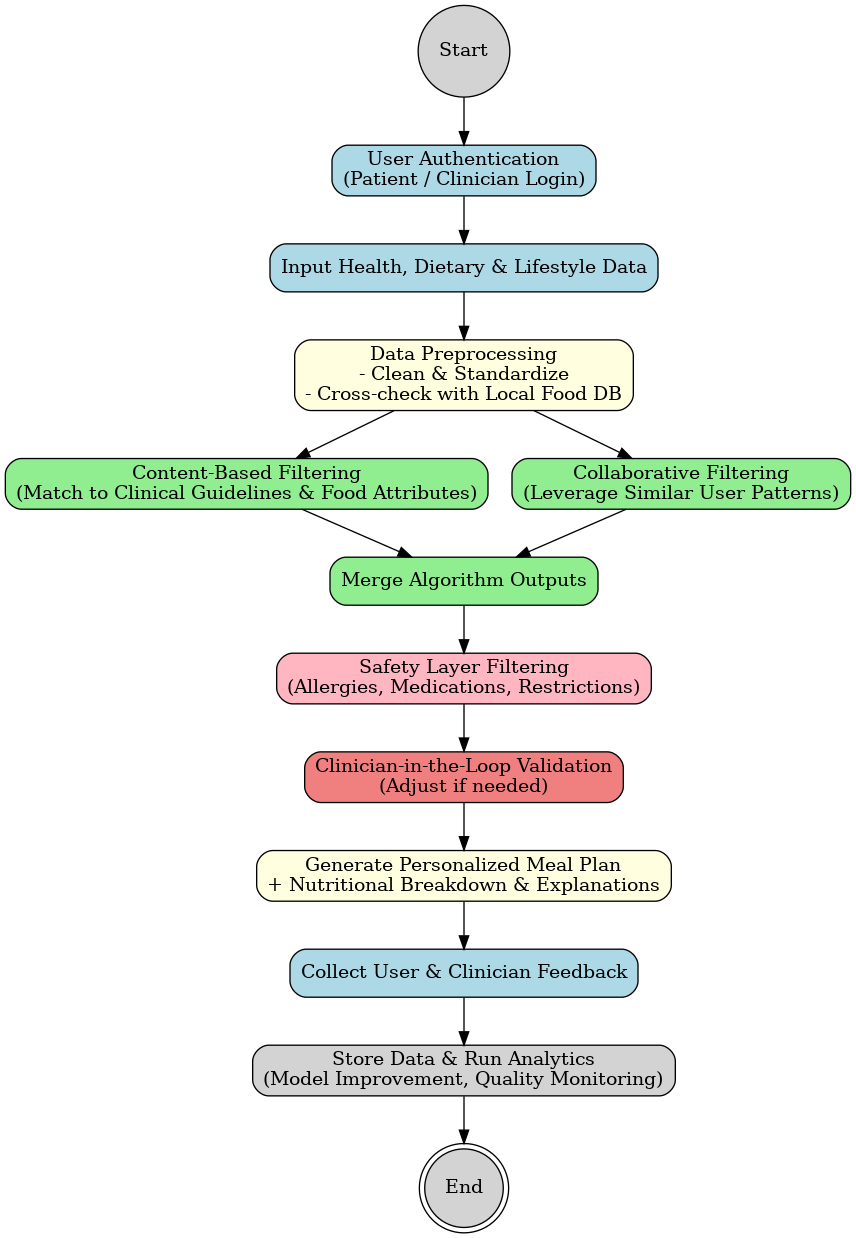
Graphical Abstract
Cardiovascular Patient’s Nutrition Assessment Web Application with Hybrid Recommender System for Malabon Hospital and Medical Clinic

Keywords
nutrition assessment
hybrid recommender system
Web application

Data Availability Statement
Data will be made available on request.

Funding
This work was supported without any funding.

Conflicts of Interest
The authors declare no conflicts of interest.

AI Use Statement
The authors declare that no generative AI was used in the preparation of this manuscript.

Ethical Approval and Consent to Participate
This study was reviewed and approved by the Ethics Review Board of Philippine Women’s University (ERB Protocol Number: ERB2025\_144). Written informed consent was obtained from all participants prior to data collection, in accordance with institutional guidelines and ethical standards for research involving human subjects. All participants were informed of the purpose, procedures, potential risks, and benefits of the study, and were assured that their participation was voluntary. They were given the right to withdraw at any time without any consequences. Confidentiality and privacy of participants’ information were maintained throughout the study, with all data anonymized and securely stored. Any results reported are presented in aggregate form to prevent identification of individual participants. Special considerations were made to ensure cultural sensitivity and respect for local practices in nutrition and healthcare. The study adhered to ethical principles in line with international standards for research involving human subjects, ensuring that both patient care and professional guidelines were fully respected during the evaluation of the Patient Nutrition Assessment Web Application with Hybrid Recommender System.

References
  1. Ahmed, E., Oumer, M., & Hassan, M. (2025). Diabetes-focused food recommender system (DFRS) to enabling digital health. PLOS Digital Health, 4(2), e0000530.
    [CrossRef]   [Google Scholar]
  2. Zuppinger, C., Taffé, P., Burger, G., Badran-Amstutz, W., Niemi, T., Cornuz, C., ... & Gonseth Nusslé, S. (2022). Performance of the digital dietary assessment tool MyFoodRepo. Nutrients, 14(3), 635.
    [CrossRef]   [Google Scholar]
  3. Angeles-Agdeppa, I., & Custodio, M. R. S. (2020). Food sources and nutrient intakes of Filipino working adults. Nutrients, 12(4), 1009.
    [CrossRef]   [Google Scholar]
  4. Battineni, G., Chintalapudi, N., Amenta, F., & Sagaro, G. G. (2022). A fair and safe usage drug recommendation system in medical emergencies by a stacked ANN. Algorithms, 15(6), 186.
    [CrossRef]   [Google Scholar]
  5. Blanchard, C. M., Chin, M. K., Gilhooly, C. H., Barger, K., Matuszek, G., Miki, A. J., Côté, R. G., Eldridge, A. L., Green, H., Mainardi, F., Mehers, D., Ronga, F., Steullet, V., & Das, S. K. (2021). Evaluation of PIQNIQ, a novel mobile application for capturing dietary intake. The Journal of Nutrition, 151(5), 1347–1356.
    [CrossRef]   [Google Scholar]
  6. Bondevik, J. N., Bennin, K. E., Babur, Ö., & Ersch, C. (2023). A systematic review on food recommender systems. Expert Systems with Applications, 238, 122166.
    [CrossRef]   [Google Scholar]
  7. Campbell, J. L., Schofield, G., Tiedt, H. R., & Zinn, C. Artificial Intelligence Applications for Assessing Ultra-Processed Food Consumption: A Scoping Review. British Journal of Nutrition, 1-32.
    [CrossRef]   [Google Scholar]
  8. Chotwanvirat, P., Prachansuwan, A., Sridonpai, P., & Kriengsinyos, W. (2024). Advancements in using AI for dietary assessment based on food images: Scoping review. Journal of Medical Internet Research, 26, e51432.
    [CrossRef]   [Google Scholar]
  9. Dong, X., Yun, B., Pakarinen, A., Zheng, Z., Niu, H., Jin, T., Yuan, C., & Wang, J. (2026). Diet‑related health recommender systems for patients with chronic health conditions: Scoping review. Journal of Medical Internet Research, 28, e77726.
    [CrossRef]   [Google Scholar]
  10. Cresswell, K., Domínguez Hernández, A., Williams, R., & Sheikh, A. (2022). Key challenges and opportunities for cloud technology in health care: Semistructured interview study. JMIR Human Factors, 9(1), e31246.
    [CrossRef]   [Google Scholar]
  11. Amiri, M., Li, J., & Hasan, W. (2023). Personalized flexible meal planning for individuals with diet-related health concerns: System design and feasibility validation study. JMIR Formative Research, 7, e46434.
    [CrossRef]   [Google Scholar]
  12. Deniz-Garcia, A., Fabelo, H., Rodriguez-Almeida, A. J., Zamora-Zamorano, G., Castro-Fernandez, M., Alberiche Ruano, M. D. P., ... & WARIFA Consortium. (2023). Quality, usability, and effectiveness of mHealth apps and the role of artificial intelligence: current scenario and challenges. Journal of Medical Internet Research, 25, e44030.
    [CrossRef]   [Google Scholar]
  13. Richey, R. C., & Klein, J. D. (2007). Design and development research: Methods, strategies, and issues (1st ed.). Routledge.
    [CrossRef]   [Google Scholar]
  14. Santiago Fernandez, R., Sharifnia, A. M., & Khalil, H. (2025). Umbrella reviews: A methodological guide. European Journal of Cardiovascular Nursing, 24(6), 996–1002.
    [CrossRef]   [Google Scholar]
  15. Department of Health & Department of Science and Technology. (2016). A briefer on the Philippine eHealth strategic framework and plan: Deliverables, 2016 and beyond. https://www.pchrd.dost.gov.ph/wp-content/uploads/2022/03/plenary-philippine-ehealth-strategic-framework-and-plan.pdf
    [Google Scholar]
  16. Haoues, M., Mokni, R., & Sellami, A. (2023). Machine learning for mHealth apps quality evaluation: An approach based on user feedback analysis. Software Quality Journal, 31, 1179–1209.
    [CrossRef]   [Google Scholar]
  17. Hyzy, M., Bond, R., Mulvenna, M., Bai, L., Dix, A., Leigh, S., & Hunt, S. (2022). System Usability Scale benchmarking for digital health apps: Meta-analysis. JMIR mHealth and uHealth, 10(8), e37290.
    [CrossRef]   [Google Scholar]
  18. Kirk, D., Kok, E., Tufano, M., Tekinerdogan, B., Feskens, E. J. M., & Camps, G. (2022). Machine learning in nutrition research. Advances in Nutrition, 13(6), 2573–2589.
    [CrossRef]   [Google Scholar]
  19. Kokol, P., Blažun Vošner, H., Kokol, M., & Završnik, J. (2022). The quality of digital health software: Should we be concerned? Digital Health, 8, 20552076221109055.
    [CrossRef]   [Google Scholar]
  20. O’Connor, C., Leyritana, K., Doyle, A. M., Birdthistle, I., Lewis, J. J., Gill, R., & Salvaña, E. M. (2022). Delivering an mHealth adherence support intervention for patients with HIV: Mixed-methods process evaluation of the Philippines Connect for Life study. JMIR Formative Research, 6(8), e37163.
    [CrossRef]   [Google Scholar]
  21. Ricci, F., Rokach, L., & Shapira, B. (Eds.). (2022). Recommender systems handbook (latest ed.). Springer.
    [CrossRef]   [Google Scholar]
  22. Ronchieri, E., & Canaparo, M. (2023). Assessing the impact of software quality models in healthcare software systems. Health Systems, 12(1), 85–97.
    [CrossRef]   [Google Scholar]
  23. Rostami, M., Farrahi, V., Ahmadian, S., Jalali, S. M. J., & Oussalah, M. (2023). A novel healthy and time-aware food recommender system using attributed community detection. Expert Systems with Applications, 221, 119719.
    [CrossRef]   [Google Scholar]
  24. Sun, Y., Zhou, J., Ji, M., Pei, L., & Wang, Z. (2023). Development and evaluation of health recommender systems: Systematic scoping review and evidence mapping. Journal of Medical Internet Research, 25, e38184.
    [CrossRef]   [Google Scholar]
  25. Trattner, C., & Elsweiler, D. (2019). An evaluation of recommendation algorithms for online recipe portals. In Proceedings of the 4th International Workshop on Health Recommender Systems (HealthRecSys 2019) at RecSys 2019.
    [Google Scholar]
  26. Wahlqvist, M. L. (2020). Benefit–risk and cost ratios in sustainable food and health policy: Changing and challenging trajectories. Asia Pacific Journal of Clinical Nutrition, 29(1), 1–8.
    [CrossRef]   [Google Scholar]
  27. World Health Organization. (2004). Global strategy on diet, physical activity and health. World Health Organization. https://www.who.int/publications/i/item/9241592222
    [Google Scholar]
  28. Xu, Z., Gu, Y., Xu, X., Topaz, M., Guo, Z., Kang, H., ... & Li, J. (2024). Developing a personalized meal recommendation system for Chinese older adults: observational cohort study. JMIR Formative Research, 8(1), e52170.
    [CrossRef]   [Google Scholar]
  29. Zheng, J., Wang, J., Shen, J., & An, R. (2024). Artificial intelligence applications to measure food and nutrient intakes: Scoping review. Journal of Medical Internet Research, 26, e54557.
    [CrossRef]   [Google Scholar]

Cite This Article
APA Style
Soliman, M. A., & Dumlao, M. F. (2026). Cardiovascular Patient’s Nutrition Assessment Web Application with Hybrid Recommender System for Malabon Hospital and Medical Clinic. PWU Journal of Research, Innovation, and Transformation, 1(1), 12–27. https://doi.org/10.62762/JRIT.2025.397682
Export Citation
RIS Format
Compatible with EndNote, Zotero, Mendeley, and other reference managers
RIS format data for reference managers
TY  - JOUR
AU  - Soliman, Marvic Alejo
AU  - Dumlao, Menchita F.
PY  - 2026
DA  - 2026/02/10
TI  - Cardiovascular Patient’s Nutrition Assessment Web Application with Hybrid Recommender System for Malabon Hospital and Medical Clinic
JO  - PWU Journal of Research, Innovation, and Transformation
T2  - PWU Journal of Research, Innovation, and Transformation
JF  - PWU Journal of Research, Innovation, and Transformation
VL  - 1
IS  - 1
SP  - 12
EP  - 27
DO  - 10.62762/JRIT.2025.397682
UR  - https://www.icck.org/article/abs/JRIT.2025.397682
KW  - nutrition assessment
KW  - hybrid recommender system
KW  - Web application
AB  - This paper presents the design and development of a Cardiovascular Patients’ Nutrition Assessment Web Application with a Hybrid Recommender System, developed for Malabon Hospital and Medical Clinic. The primary objective of the system is to support both patients and healthcare providers in monitoring nutritional status and improving dietary management for individuals with cardiovascular conditions. The application was implemented using the Laravel framework and features a simple, user-friendly interface that facilitates interaction among patients, clinicians, and nutritionists. The recommender system integrates rule-based logic with intelligent recommendation techniques to generate personalized meal plans that align with clinical guidelines and individual patient profiles. The evaluation of the system focused on black box testing conducted under controlled conditions using simulated data. While this approach confirms the reliability, efficiency, and functional correctness of key system features—such as user registration, authentication, survey processing, and recommendation generation—it is important to note that the results reflect performance in a simulated environment rather than real-world clinical deployment. Overall, the study demonstrates the feasibility of a technology-supported nutrition management system tailored to a local healthcare setting, highlighting its potential to enhance patient engagement, support clinical decision-making, and contribute to more effective, localized cardiovascular nutrition management in clinical practice.
SN  - pending
PB  - Institute of Central Computation and Knowledge
LA  - English
ER  - 
BibTeX Format
Compatible with LaTeX, BibTeX, and other reference managers
BibTeX format data for LaTeX and reference managers
@article{Soliman2026Cardiovasc,
  author = {Marvic Alejo Soliman and Menchita F. Dumlao},
  title = {Cardiovascular Patient’s Nutrition Assessment Web Application with Hybrid Recommender System for Malabon Hospital and Medical Clinic},
  journal = {PWU Journal of Research, Innovation, and Transformation},
  year = {2026},
  volume = {1},
  number = {1},
  pages = {12-27},
  doi = {10.62762/JRIT.2025.397682},
  url = {https://www.icck.org/article/abs/JRIT.2025.397682},
  abstract = {This paper presents the design and development of a Cardiovascular Patients’ Nutrition Assessment Web Application with a Hybrid Recommender System, developed for Malabon Hospital and Medical Clinic. The primary objective of the system is to support both patients and healthcare providers in monitoring nutritional status and improving dietary management for individuals with cardiovascular conditions. The application was implemented using the Laravel framework and features a simple, user-friendly interface that facilitates interaction among patients, clinicians, and nutritionists. The recommender system integrates rule-based logic with intelligent recommendation techniques to generate personalized meal plans that align with clinical guidelines and individual patient profiles. The evaluation of the system focused on black box testing conducted under controlled conditions using simulated data. While this approach confirms the reliability, efficiency, and functional correctness of key system features—such as user registration, authentication, survey processing, and recommendation generation—it is important to note that the results reflect performance in a simulated environment rather than real-world clinical deployment. Overall, the study demonstrates the feasibility of a technology-supported nutrition management system tailored to a local healthcare setting, highlighting its potential to enhance patient engagement, support clinical decision-making, and contribute to more effective, localized cardiovascular nutrition management in clinical practice.},
  keywords = {nutrition assessment, hybrid recommender system, Web application},
  issn = {pending},
  publisher = {Institute of Central Computation and Knowledge}
}

Article Metrics
Citations:

Crossref

0

Scopus

0

Web of Science

0
Article Access Statistics:
Views: 69
PDF Downloads: 10

Publisher's Note
ICCK stays neutral with regard to jurisdictional claims in published maps and institutional affiliations.

Rights and Permissions
CC BY Copyright © 2026 by the Author(s). Published by Institute of Central Computation and Knowledge. This article is an open access article distributed under the terms and conditions of the Creative Commons Attribution (CC BY) license (https://creativecommons.org/licenses/by/4.0/), which permits use, sharing, adaptation, distribution and reproduction in any medium or format, as long as you give appropriate credit to the original author(s) and the source, provide a link to the Creative Commons licence, and indicate if changes were made.
PWU Journal of Research, Innovation, and Transformation

PWU Journal of Research, Innovation, and Transformation

ISSN: pending (Online)

Email: [email protected]

Portico

Portico

All published articles are preserved here permanently:
https://www.portico.org/publishers/icck/