

Energy-Efficient AIoT Solutions: A Critical Review of Power Consumption Models, Machine Learning-Based Energy Optimization, and Deployment Strategies for Sustainable IoT Networks



Article Information
Abstract
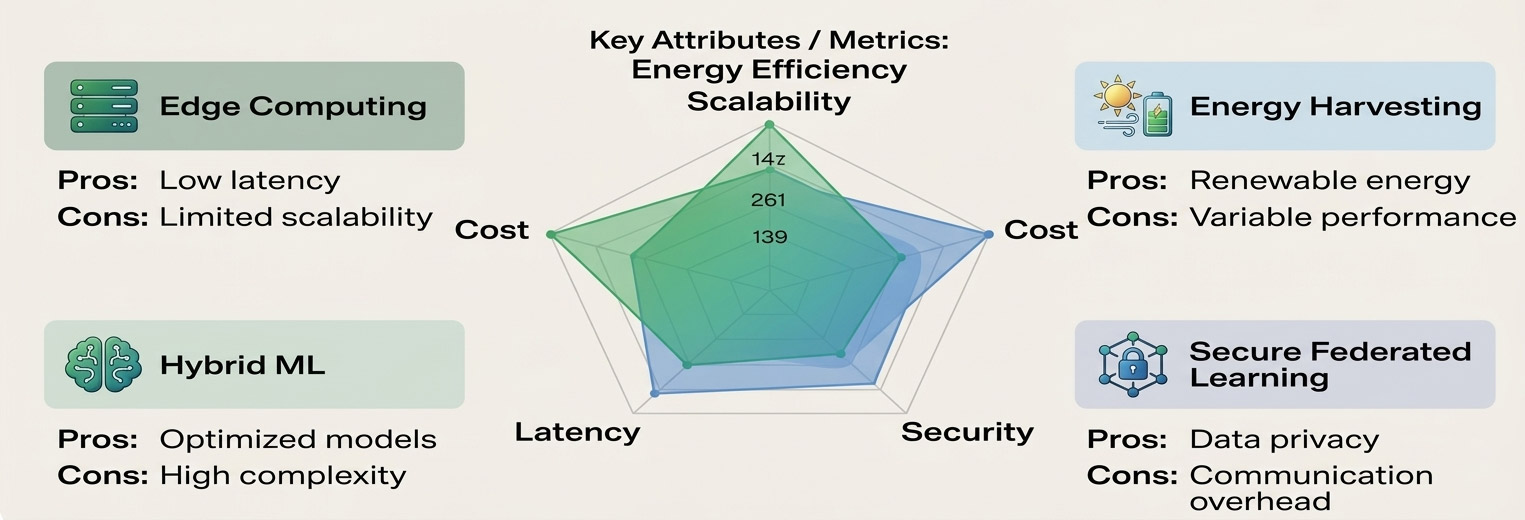
The integration of artificial intelligence and the Internet of Things (AIoT) enables advanced edge computing but creates significant energy challenges for resource-constrained devices. To address these challenges, this paper introduces a novel comparative taxonomy and a systematic gap analysis matrix that directly maps hardware-aware TinyML paradigms to network-layer scheduling in sustainable AIoT systems. Synthesizing recent empirical studies (2023–2026) on power consumption models for IoT edge devices, machine learning techniques for energy optimization, and sustainable deployment strategies, we demonstrate that additive and regression-based models achieve low prediction error (MAPE 4–8%) on single-board computers. Furthermore, hybrid deep learning and reinforcement learning approaches, combined with model compression and hierarchical edge-fog-cloud architectures, achieve 20–45% energy savings. Key challenges identified include hardware heterogeneity, training overhead, and the critical performance gap between laboratory environments and real-world deployments. Finally, future research directions focus on hardware-aware TinyML frameworks, federated learning paradigms, and energy-carbon co-optimization metrics to establish truly sustainable IoT networks.
Graphical Abstract
Keywords
Data Availability Statement
Funding
Conflicts of Interest
AI Use Statement
Ethical Approval and Consent to Participate
References
- Alahmari, S., & Alghamdi, I. (2025). A Comprehensive Survey on Energy-Efficient and Privacy-Preserving Federated Learning for Edge Intelligence and IoT. Results in Engineering, 107849.
[CrossRef] [Google Scholar] - Baliyar Singh, R. K., Dash, J. K., & Reddy, K. H. K. (2026). The role of Edge-AI in edge enabled IoT systems: A comprehensive performance analysis. Peer-to-Peer Networking and Applications, 19(1), 35.
[CrossRef] [Google Scholar] - Bhushan, C. M., Koppuravuri, P., Prasanthi, N., Gazi, F., Hussain, M. M., Abdussami, M., ... & Faizi, J. (2025). Deploying TinyML for energy-efficient object detection and communication in low-power edge AI systems. Scientific reports, 15(1), 44299.
[CrossRef] [Google Scholar] - Thakur, D., Guzzo, A., Fortino, G., & Das, S. K. (2025). GRACE-FL: Green Resource-Aware Communication-Efficient Federated Learning. IEEE Transactions on Artificial Intelligence, 7(6), 3221-3236.
[CrossRef] [Google Scholar] - Fanariotis, A., Orphanoudakis, T., Kotrotsios, K., Fotopoulos, V., Keramidas, G., & Karkazis, P. (2023). Power efficient machine learning models deployment on edge IoT devices. Sensors, 23(3), 1595.
[CrossRef] [Google Scholar] - Kanso, H., Noureddine, A., & Exposito, E. (2023). Automated power modeling of computing devices: Implementation and use case for Raspberry Pis. Sustainable Computing: Informatics and Systems, 37, 100837.
[CrossRef] [Google Scholar] - Kasioulis, M., Symeonides, M., Pallis, G., & Dikaiakos, M. D. (2023, August). Power estimation models for edge computing devices. In European Conference on Parallel Processing (pp. 257-269). Cham: Springer Nature Switzerland.
[CrossRef] [Google Scholar] - Muhoza, A. C., Bergeret, E., Brdys, C., & Gary, F. (2023). Power consumption reduction for IoT devices thanks to Edge-AI: Application to human activity recognition. Internet of Things, 24, 100930.
[CrossRef] [Google Scholar] - Natarajan, Y., KR, S. P., Wadhwa, G., Choi, Y., Chen, Z., Lee, D. E., & Mi, Y. (2024). Enhancing building energy efficiency with IoT-driven hybrid deep learning models for accurate energy consumption prediction. Sustainability, 16(5), 1925.
[CrossRef] [Google Scholar] - Schizas, N., Karras, A., Karras, C., & Sioutas, S. (2022). TinyML for ultra-low power AI and large scale IoT deployments: A systematic review. Future Internet, 14(12), 363.
[CrossRef] [Google Scholar] - Singh, A. R., Sujatha, M. S., Kadu, A. D., Bajaj, M., Addis, H. K., & Sarada, K. (2025). A deep learning and IoT-driven framework for real-time adaptive resource allocation and grid optimization in smart energy systems. Scientific reports, 15(1), 19309.
[CrossRef] [Google Scholar] - Yauri, R., & Palomino, N. B. L. S. (2026). Performance analysis of classification models to determine the health status of edge computing devices. Bulletin of Electrical Engineering and Informatics, 15(3), 2505-2514.
[CrossRef] [Google Scholar]
Cite This Article
TY  - JOUR
AU  - Nahak, Manoswini
AU  - Jana, Atanu
AU  - Panda, Snehal
AU  - Singaravel, G.
AU  - Mallik, Sandipan
AU  - Swain, Kunjabihari
PY  - 2026
DA  - 2026/06/26
TI  - Energy-Efficient AIoT Solutions: A Critical Review of Power Consumption Models, Machine Learning-Based Energy Optimization, and Deployment Strategies for Sustainable IoT Networks
JO  - Next-Generation Computing Systems and Technologies
T2  - Next-Generation Computing Systems and Technologies
JF  - Next-Generation Computing Systems and Technologies
VL  - 2
IS  - 2
SP  - 51
EP  - 58
DO  - 10.62762/NGCST.2026.276719
UR  - https://www.icck.org/article/abs/NGCST.2026.276719
KW  - AIoT
KW  - energy efficiency
KW  - power consumption modeling
KW  - TinyML
KW  - edge computing
KW  - sustainable IoT
AB  - The integration of artificial intelligence and the Internet of Things (AIoT) enables advanced edge computing but creates significant energy challenges for resource-constrained devices. To address these challenges, this paper introduces a novel comparative taxonomy and a systematic gap analysis matrix that directly maps hardware-aware TinyML paradigms to network-layer scheduling in sustainable AIoT systems. Synthesizing recent empirical studies (2023–2026) on power consumption models for IoT edge devices, machine learning techniques for energy optimization, and sustainable deployment strategies, we demonstrate that additive and regression-based models achieve low prediction error (MAPE 4–8%) on single-board computers. Furthermore, hybrid deep learning and reinforcement learning approaches, combined with model compression and hierarchical edge-fog-cloud architectures, achieve 20–45% energy savings. Key challenges identified include hardware heterogeneity, training overhead, and the critical performance gap between laboratory environments and real-world deployments. Finally, future research directions focus on hardware-aware TinyML frameworks, federated learning paradigms, and energy-carbon co-optimization metrics to establish truly sustainable IoT networks.
SN  - 3070-3328
PB  - Institute of Central Computation and Knowledge
LA  - English
ER  -
@article{Nahak2026EnergyEffi,
  author = {Manoswini Nahak and Atanu Jana and Snehal Panda and G. Singaravel and Sandipan Mallik and Kunjabihari Swain},
  title = {Energy-Efficient AIoT Solutions: A Critical Review of Power Consumption Models, Machine Learning-Based Energy Optimization, and Deployment Strategies for Sustainable IoT Networks},
  journal = {Next-Generation Computing Systems and Technologies},
  year = {2026},
  volume = {2},
  number = {2},
  pages = {51-58},
  doi = {10.62762/NGCST.2026.276719},
  url = {https://www.icck.org/article/abs/NGCST.2026.276719},
  abstract = {The integration of artificial intelligence and the Internet of Things (AIoT) enables advanced edge computing but creates significant energy challenges for resource-constrained devices. To address these challenges, this paper introduces a novel comparative taxonomy and a systematic gap analysis matrix that directly maps hardware-aware TinyML paradigms to network-layer scheduling in sustainable AIoT systems. Synthesizing recent empirical studies (2023–2026) on power consumption models for IoT edge devices, machine learning techniques for energy optimization, and sustainable deployment strategies, we demonstrate that additive and regression-based models achieve low prediction error (MAPE 4–8\%) on single-board computers. Furthermore, hybrid deep learning and reinforcement learning approaches, combined with model compression and hierarchical edge-fog-cloud architectures, achieve 20–45\% energy savings. Key challenges identified include hardware heterogeneity, training overhead, and the critical performance gap between laboratory environments and real-world deployments. Finally, future research directions focus on hardware-aware TinyML frameworks, federated learning paradigms, and energy-carbon co-optimization metrics to establish truly sustainable IoT networks.},
  keywords = {AIoT, energy efficiency, power consumption modeling, TinyML, edge computing, sustainable IoT},
  issn = {3070-3328},
  publisher = {Institute of Central Computation and Knowledge}
}
Article Metrics
Publisher's Note
ICCK stays neutral with regard to jurisdictional claims in published maps and institutional affiliations.
Rights and Permissions
 Copyright © 2026 by the Author(s). Published by Institute of Central Computation and Knowledge. This article is an open access article distributed under the terms and conditions of the Creative Commons Attribution (CC BY) license (https://creativecommons.org/licenses/by/4.0/), which permits use, sharing, adaptation, distribution and reproduction in any medium or format, as long as you give appropriate credit to the original author(s) and the source, provide a link to the Creative Commons licence, and indicate if changes were made.


Portico
