

MinuteMaster: An AI-Powered Meeting Transcription and Scheduling System



Article Information
Abstract
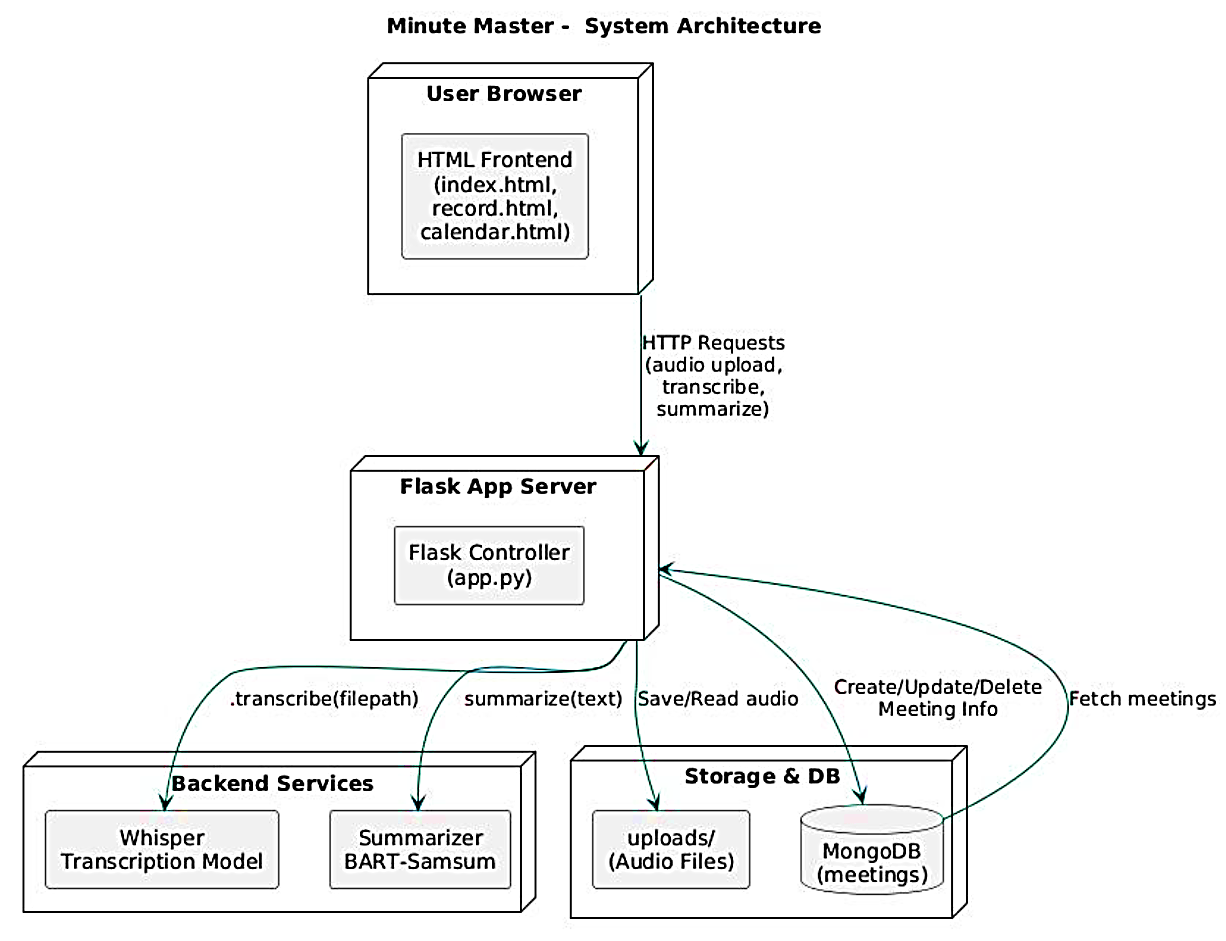
Taking notes during meetings sounds easy, but in reality, people often miss key points—especially when multiple people are talking. Managing follow-ups in separate apps only adds to the hassle. MinuteMaster was built to simplify this. It's a web app that brings transcription, speaker identification, summarization, and scheduling into one place. It uses Whisper for multilingual speech-to-text, pyannote.audio to identify who's speaking, and BART to turn long transcripts into clear, short summaries. A built-in calendar helps users manage meetings without switching apps. We tested it on 30 recordings across English, Hindi, Telugu, Tamil, and mixed languages. Transcription accuracy ranged from 76\% to 88\%, and summaries performed better than TextRank with a ROUGE-1 score of 0.48. In a study with 42 users, it received an average rating of 4.25/5. The system runs on Flask with MongoDB, making it simple to deploy and scale.
Graphical Abstract
Keywords
Data Availability Statement
Funding
Conflicts of Interest
AI Use Statement
Ethical Approval and Consent to Participate
References
- Murray, G., & Renals, S. (2008). Detecting Action Items in Meetings. In A. Popescu-Belis & R. Stiefelhagen (Eds.), Machine Learning for Multimodal Interaction (MLMI 2008), LNCS vol. 5237, pp. 208–213. Springer.
[CrossRef] [Google Scholar] - Zhu, C., Xu, R., Zeng, M., & Huang, X. (2020, November). A hierarchical network for abstractive meeting summarization with cross-domain pretraining. In Findings of the association for computational linguistics: EMNLP 2020 (pp. 194-203).
[CrossRef] [Google Scholar] - Narayan, S., Cohen, S. B., & Lapata, M. (2018, June). Ranking sentences for extractive summarization with reinforcement learning. In Proceedings of the 2018 Conference of the North American Chapter of the Association for Computational Linguistics: Human Language Technologies, Volume 1 (Long Papers) (pp. 1747-1759).
[CrossRef] [Google Scholar] - Zhong, M., Yin, D., Yu, T., Zaidi, A., Mutuma, M., Jha, R., ... & Radev, D. (2021, June). QMSum: A new benchmark for query-based multi-domain meeting summarization. In Proceedings of the 2021 Conference of the North American Chapter of the Association for Computational Linguistics: Human Language Technologies (pp. 5905-5921).
[CrossRef] [Google Scholar] - Hu, Y., Ganter, T., Deilamsalehy, H., Dernoncourt, F., Foroosh, H., & Liu, F. (2023, July). Meetingbank: A benchmark dataset for meeting summarization. In Proceedings of the 61st Annual Meeting of the Association for Computational Linguistics (Volume 1: Long Papers) (pp. 16409-16423).
[CrossRef] [Google Scholar] - Liu, Z., Ng, A., Lee, S., Aw, A. T., & Chen, N. F. (2019, December). Topic-aware pointer-generator networks for summarizing spoken conversations. In 2019 IEEE Automatic Speech Recognition and Understanding Workshop (ASRU) (pp. 814-821). IEEE.
[CrossRef] [Google Scholar] - Bredin, H., Yin, R., Coria, J. M., Gelly, G., Korshunov, P., Lavechin, M., ... & Gill, M. P. (2020, May). Pyannote.audio: neural building blocks for speaker diarization. In ICASSP 2020-2020 IEEE International conference on acoustics, speech and signal processing (ICASSP) (pp. 7124-7128). IEEE.
[CrossRef] [Google Scholar] - Shang, G., Ding, W., Zhang, Z., Tixier, A., Meladianos, P., Vazirgiannis, M., & Lorré, J. P. (2018, July). Unsupervised abstractive meeting summarization with multi-sentence compression and budgeted submodular maximization. In Proceedings of the 56th Annual Meeting of the Association for Computational Linguistics (Volume 1: Long Papers) (pp. 664-674).
[CrossRef] [Google Scholar] - Lewis, M., Liu, Y., Goyal, N., Ghazvininejad, M., Mohamed, A., Levy, O., ... & Zettlemoyer, L. (2020, July). BART: Denoising sequence-to-sequence pre-training for natural language generation, translation, and comprehension. In Proceedings of the 58th annual meeting of the association for computational linguistics (pp. 7871-7880).
[CrossRef] [Google Scholar] - Cohen, A., Kantor, A., Hilleli, S., & Kolman, E. (2021, August). Automatic rephrasing of transcripts-based action items. In Findings of the Association for Computational Linguistics: ACL-IJCNLP 2021 (pp. 2862-2873). https://aclanthology.org/2021.findings-acl.253.pdf
[Google Scholar] - Radford, A., Kim, J. W., Xu, T., Brockman, G., McLeavey, C., & Sutskever, I. (2023, July). Robust speech recognition via large-scale weak supervision. In International conference on machine learning (pp. 28492-28518). PMLR.
[Google Scholar]
Cite This Article
TY  - JOUR
AU  - Banik, Barnali Gupta
AU  - Yukitha, Pampari
AU  - Venna, Charan Sai
AU  - Tulasi, Puppala Mangala
PY  - 2026
DA  - 2026/08/25
TI  - MinuteMaster: An AI-Powered Meeting Transcription and Scheduling System
JO  - Next-Generation Computing Systems and Technologies
T2  - Next-Generation Computing Systems and Technologies
JF  - Next-Generation Computing Systems and Technologies
VL  - 2
IS  - 3
SP  - 70
EP  - 75
DO  - 10.62762/NGCST.2026.350184
UR  - https://www.icck.org/article/abs/NGCST.2026.350184
KW  - AI transcription
KW  - BART summarization
KW  - meeting automation
KW  - natural language processing
KW  - speaker diarization
AB  - Taking notes during meetings sounds easy, but in reality, people often miss key points—especially when multiple people are talking. Managing follow-ups in separate apps only adds to the hassle. MinuteMaster was built to simplify this. It's a web app that brings transcription, speaker identification, summarization, and scheduling into one place. It uses Whisper for multilingual speech-to-text, pyannote.audio to identify who's speaking, and BART to turn long transcripts into clear, short summaries. A built-in calendar helps users manage meetings without switching apps. We tested it on 30 recordings across English, Hindi, Telugu, Tamil, and mixed languages. Transcription accuracy ranged from 76\% to 88\%, and summaries performed better than TextRank with a ROUGE-1 score of 0.48. In a study with 42 users, it received an average rating of 4.25/5. The system runs on Flask with MongoDB, making it simple to deploy and scale.
SN  - 3070-3328
PB  - Institute of Central Computation and Knowledge
LA  - English
ER  -
@article{Banik2026MinuteMast,
  author = {Barnali Gupta Banik and Pampari Yukitha and Charan Sai Venna and Puppala Mangala Tulasi},
  title = {MinuteMaster: An AI-Powered Meeting Transcription and Scheduling System},
  journal = {Next-Generation Computing Systems and Technologies},
  year = {2026},
  volume = {2},
  number = {3},
  pages = {70-75},
  doi = {10.62762/NGCST.2026.350184},
  url = {https://www.icck.org/article/abs/NGCST.2026.350184},
  abstract = {Taking notes during meetings sounds easy, but in reality, people often miss key points—especially when multiple people are talking. Managing follow-ups in separate apps only adds to the hassle. MinuteMaster was built to simplify this. It's a web app that brings transcription, speaker identification, summarization, and scheduling into one place. It uses Whisper for multilingual speech-to-text, pyannote.audio to identify who's speaking, and BART to turn long transcripts into clear, short summaries. A built-in calendar helps users manage meetings without switching apps. We tested it on 30 recordings across English, Hindi, Telugu, Tamil, and mixed languages. Transcription accuracy ranged from 76\\% to 88\\%, and summaries performed better than TextRank with a ROUGE-1 score of 0.48. In a study with 42 users, it received an average rating of 4.25/5. The system runs on Flask with MongoDB, making it simple to deploy and scale.},
  keywords = {AI transcription, BART summarization, meeting automation, natural language processing, speaker diarization},
  issn = {3070-3328},
  publisher = {Institute of Central Computation and Knowledge}
}
Article Metrics
Publisher's Note
ICCK stays neutral with regard to jurisdictional claims in published maps and institutional affiliations.
Rights and Permissions
 Copyright © 2026 by the Author(s). Published by Institute of Central Computation and Knowledge. This article is an open access article distributed under the terms and conditions of the Creative Commons Attribution (CC BY) license (https://creativecommons.org/licenses/by/4.0/), which permits use, sharing, adaptation, distribution and reproduction in any medium or format, as long as you give appropriate credit to the original author(s) and the source, provide a link to the Creative Commons licence, and indicate if changes were made.

Portico
