

Scalable Trust through Strategic Verification: A Game-Theoretic Framework for Multi-Agent Systems



Article Information
Abstract
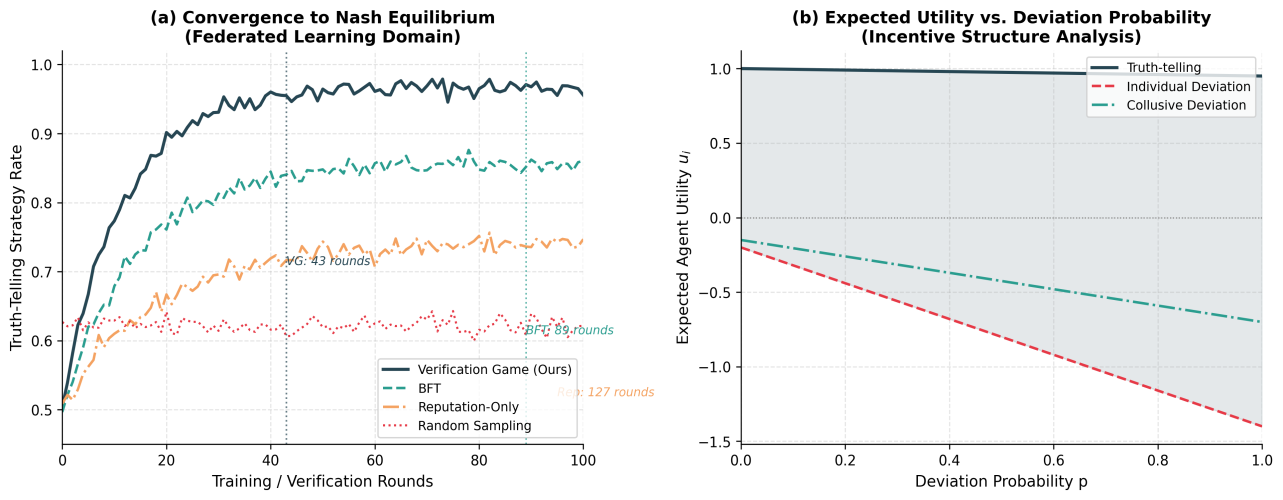
These days, many eco-systems related to federated learning, blockchain, self-driving cars, and scientific computing have many agents working together, each doing its own part. Using a single central system to check if all the agents are doing their work correctly is slow and gets more expensive as more agents are added. This paper introduces a new way called the Verification Game (VG). The agents don’t depend on a central system. The agents check each other’s work. If the agents are honest, they get rewards, so telling the truth is the best option. This type of method also saves a lot of computing power because it doesn’t check every single task. We also came up with a method called Adaptive Strategic Verification (ASV) that figures out which agent’s work should be checked. It saves the computing resources because only selected tasks are verified, not everything. From the year 2020 to 2025 we tested six real-world systems. These included things like learning systems where the data is shared across devices, groups of self-driving cars, blockchain networks, big computer clusters, supply chains, and websites that monitor the content. On average, the system could spot the problems up to 97.3% of the time and only used about a quarter of the computing power needed by central systems. Agents learned to be honest within 31–48 rounds (or equivalent time, mean approximately 40 rounds) depending on domain. Even when most agents tried to cheat together, the system was able to stop collusion. Overall, this approach helps to lots of agents that work together fairly without depending on a central system. It makes building large and reliable systems easier.
Graphical Abstract
Keywords
Data Availability Statement
Funding
Conflicts of Interest
AI Use Statement
Ethical Approval and Consent to Participate
References
- Myerson, R. B. (1981). Optimal auction design. Mathematics of operations research, 6(1), 58-73.
[CrossRef] [Google Scholar] - Parkes, D. C., & Shneidman, J. (2004, July). Distributed implementations of Vickrey-Clarke-Groves mechanisms. In Proceedings of the Third International Joint Conference on Autonomous Agents and Multiagent Systems, 2004. AAMAS 2004. (pp. 261-268). IEEE.
[CrossRef] [Google Scholar] - Gneiting, T., & Raftery, A. E. (2007). Strictly proper scoring rules, prediction, and estimation. Journal of the American statistical Association, 102(477), 359-378.
[CrossRef] [Google Scholar] - Nisan, N., & Ronen, A. (1999, May). Algorithmic mechanism design. In Proceedings of the thirty-first annual ACM symposium on Theory of computing (pp. 129-140). https://dl.acm.org/doi/pdf/10.1145/301250.301287
[Google Scholar] - Radanovic, G., Faltings, B., & Jurca, R. (2016). Incentives for effort in crowdsourcing using the peer truth serum. ACM Transactions on Intelligent Systems and Technology (TIST), 7(4), 1-28.
[CrossRef] [Google Scholar] - Lamport, L., Shostak, R., & Pease, M. (2019). The Byzantine generals problem. In Concurrency: the works of leslie lamport (pp. 203-226).
[CrossRef] [Google Scholar] - Pillutla, K., Kakade, S. M., & Harchaoui, Z. (2022). Robust aggregation for federated learning. IEEE Transactions on Signal Processing, 70, 1142-1154.
[CrossRef] [Google Scholar] - Yin, D., Chen, Y., Kannan, R., & Bartlett, P. (2018, July). Byzantine-robust distributed learning: Towards optimal statistical rates. In International conference on machine learning (pp. 5650-5659). Pmlr.
[Google Scholar] - Cao, X., Fang, M., Liu, J., & Gong, N. Z. (2020). Fltrust: Byzantine-robust federated learning via trust bootstrapping. arXiv preprint arXiv:2012.13995.
[CrossRef] [Google Scholar] - Blanchard, P., El Mhamdi, E. M., Guerraoui, R., & Stainer, J. (2017). Machine learning with adversaries: Byzantine tolerant gradient descent. Advances in Neural Information Processing Systems, 30, 118–128.
[Google Scholar] - Buterin, V. (2014). A next-generation smart contract and decentralized application platform. white paper, 3(37), 2-1. https://cryptorating.eu/whitepapers/Ethereum/Ethereum_white_paper.pdf
[Google Scholar] - Agarwal, A., Mandal, D., Parkes, D. C., & Shah, N. (2020). Peer prediction with heterogeneous users. ACM Transactions on Economics and Computation (TEAC), 8(1), 1-34.
[CrossRef] [Google Scholar] - Sabater, J., & Sierra, C. (2005). Review on computational trust and reputation models. Artificial intelligence review, 24(1), 33-60.
[CrossRef] [Google Scholar] - Miller, N., Resnick, P., & Zeckhauser, R. (2005). Eliciting informative feedback: The peer-prediction method. Management Science, 51(9), 1359-1373.
[CrossRef] [Google Scholar] - Waggoner, B., & Chen, Y. (2014, September). Output agreement mechanisms and common knowledge. In Proceedings of the AAAI Conference on Human Computation and Crowdsourcing (Vol. 2, pp. 220-226).
[CrossRef] [Google Scholar] - McMahan, B., Moore, E., Ramage, D., Hampson, S., & y Arcas, B. A. (2017, April). Communication-efficient learning of deep networks from decentralized data. In Artificial intelligence and statistics (pp. 1273-1282). Pmlr.
[Google Scholar] - Bagdasaryan, E., Veit, A., Hua, Y., Estrin, D., & Shmatikov, V. (2020, June). How to backdoor federated learning. In International conference on artificial intelligence and statistics (pp. 2938-2948). PMLR.
[Google Scholar] - Li, T., Sahu, A. K., Talwalkar, A., & Smith, V. (2020). Federated learning: Challenges, methods, and future directions. IEEE signal processing magazine, 37(3), 50-60.
[CrossRef] [Google Scholar] - El-Mhamdi, E. M., Farhadkhani, S., Guerraoui, R., Guirguis, A., Hoang, L. N., & Rouault, S. (2021). Collaborative learning in the jungle (decentralized, byzantine, heterogeneous, asynchronous and nonconvex learning). Advances in neural information processing systems, 34, 25044-25057.
[Google Scholar] - Karimireddy, S. P., He, L., & Jaggi, M. (2021, July). Learning from history for byzantine robust optimization. In International conference on machine learning (pp. 5311-5319). PMLR.
[Google Scholar] - Sun, L., Qian, J., & Chen, X. (2021). LDP-FL: Practical Private Aggregation in Federated Learning with Local Differential Privacy. In Proceedings of the Thirtieth International Joint Conference on Artificial Intelligence (pp. 1571-1578). International Joint Conferences on Artificial Intelligence Organization.
[CrossRef] [Google Scholar] - Gentry, C. (2009). A fully homomorphic encryption scheme (Doctoral dissertation, Stanford University). https://crypto.stanford.edu/craig/craig-thesis.pdf
[Google Scholar] - Evans, D., Kolesnikov, V., & Rosulek, M. (2018). A pragmatic introduction to secure multi-party computation. Foundations and Trends in Privacy and Security, 2(2-3), 70-246.
[CrossRef] [Google Scholar] - Manshaei, M. H., Zhu, Q., Alpcan, T., Bacşar, T., & Hubaux, J. P. (2013). Game theory meets network security and privacy. Acm Computing Surveys (Csur), 45(3), 1-39.
[CrossRef] [Google Scholar] - Roughgarden, T. (2016). Twenty lectures on algorithmic game theory. Cambridge University Press.
[CrossRef] [Google Scholar] - Gennaro, R., Gentry, C., & Parno, B. (2010, August). Non-interactive verifiable computing: Outsourcing computation to untrusted workers. In Annual Cryptology Conference (pp. 465-482). Berlin, Heidelberg: Springer Berlin Heidelberg.
[CrossRef] [Google Scholar] - Zheng, S., Trott, A., Srinivasa, S., Parkes, D. C., & Socher, R. (2022). The AI Economist: Taxation policy design via two-level deep multiagent reinforcement learning. Science advances, 8(18), eabk2607.
[CrossRef] [Google Scholar] - Doshi-Velez, F., Kortz, M., Budish, R., Bavitz, C., Gershman, S., O'Brien, D., ... & Wood, A. (2017). Accountability of AI under the law: The role of explanation. arXiv preprint arXiv:1711.01134.
[CrossRef] [Google Scholar] - Mguni, D., Jennings, J., Macua, S. V., Sison, E., Ceppi, S., & De Cote, E. M. (2019). Coordinating the crowd: Inducing desirable equilibria in non-cooperative systems. arXiv preprint arXiv:1901.10923.
[CrossRef] [Google Scholar]
Cite This Article
TY  - JOUR
AU  - Yogi, Manas Kumar
AU  - Kavya, Majji
PY  - 2026
DA  - 2026/06/17
TI  - Scalable Trust through Strategic Verification: A Game-Theoretic Framework for Multi-Agent Systems
JO  - Next-Generation Computing Systems and Technologies
T2  - Next-Generation Computing Systems and Technologies
JF  - Next-Generation Computing Systems and Technologies
VL  - 2
IS  - 2
SP  - 35
EP  - 50
DO  - 10.62762/NGCST.2026.430053
UR  - https://www.icck.org/article/abs/NGCST.2026.430053
KW  - multi-agent systems
KW  - game-theoretic verification
KW  - byzantine fault tolerance
KW  - federated learning security
AB  - These days, many eco-systems related to federated learning, blockchain, self-driving cars, and scientific computing have many agents working together, each doing its own part. Using a single central system to check if all the agents are doing their work correctly is slow and gets more expensive as more agents are added. This paper introduces a new way called the Verification Game (VG). The agents don’t depend on a central system. The agents check each other’s work. If the agents are honest, they get rewards, so telling the truth is the best option. This type of method also saves a lot of computing power because it doesn’t check every single task. We also came up with a method called Adaptive Strategic Verification (ASV) that figures out which agent’s work should be checked. It saves the computing resources because only selected tasks are verified, not everything. From the year 2020 to 2025 we tested six real-world systems. These included things like learning systems where the data is shared across devices, groups of self-driving cars, blockchain networks, big computer clusters, supply chains, and websites that monitor the content. On average, the system could spot the problems up to 97.3% of the time and only used about a quarter of the computing power needed by central systems. Agents learned to be honest within 31–48 rounds (or equivalent time, mean approximately 40 rounds) depending on domain. Even when most agents tried to cheat together, the system was able to stop collusion. Overall, this approach helps to lots of agents that work together fairly without depending on a central system. It makes building large and reliable systems easier.
SN  - 3070-3328
PB  - Institute of Central Computation and Knowledge
LA  - English
ER  -
@article{Yogi2026Scalable,
  author = {Manas Kumar Yogi and Majji Kavya},
  title = {Scalable Trust through Strategic Verification: A Game-Theoretic Framework for Multi-Agent Systems},
  journal = {Next-Generation Computing Systems and Technologies},
  year = {2026},
  volume = {2},
  number = {2},
  pages = {35-50},
  doi = {10.62762/NGCST.2026.430053},
  url = {https://www.icck.org/article/abs/NGCST.2026.430053},
  abstract = {These days, many eco-systems related to federated learning, blockchain, self-driving cars, and scientific computing have many agents working together, each doing its own part. Using a single central system to check if all the agents are doing their work correctly is slow and gets more expensive as more agents are added. This paper introduces a new way called the Verification Game (VG). The agents don’t depend on a central system. The agents check each other’s work. If the agents are honest, they get rewards, so telling the truth is the best option. This type of method also saves a lot of computing power because it doesn’t check every single task. We also came up with a method called Adaptive Strategic Verification (ASV) that figures out which agent’s work should be checked. It saves the computing resources because only selected tasks are verified, not everything. From the year 2020 to 2025 we tested six real-world systems. These included things like learning systems where the data is shared across devices, groups of self-driving cars, blockchain networks, big computer clusters, supply chains, and websites that monitor the content. On average, the system could spot the problems up to 97.3\% of the time and only used about a quarter of the computing power needed by central systems. Agents learned to be honest within 31–48 rounds (or equivalent time, mean approximately 40 rounds) depending on domain. Even when most agents tried to cheat together, the system was able to stop collusion. Overall, this approach helps to lots of agents that work together fairly without depending on a central system. It makes building large and reliable systems easier.},
  keywords = {multi-agent systems, game-theoretic verification, byzantine fault tolerance, federated learning security},
  issn = {3070-3328},
  publisher = {Institute of Central Computation and Knowledge}
}
Article Metrics
Publisher's Note
ICCK stays neutral with regard to jurisdictional claims in published maps and institutional affiliations.
Rights and Permissions
 Copyright © 2026 by the Author(s). Published by Institute of Central Computation and Knowledge. This article is an open access article distributed under the terms and conditions of the Creative Commons Attribution (CC BY) license (https://creativecommons.org/licenses/by/4.0/), which permits use, sharing, adaptation, distribution and reproduction in any medium or format, as long as you give appropriate credit to the original author(s) and the source, provide a link to the Creative Commons licence, and indicate if changes were made.


Portico
