

Waste Management and Circular Economy: A Comprehensive Review of AIoT Applications in Intelligent Waste Sorting, Data Analytics for Resource Recovery, and Sustainable Infrastructure Development



Article Information
Abstract
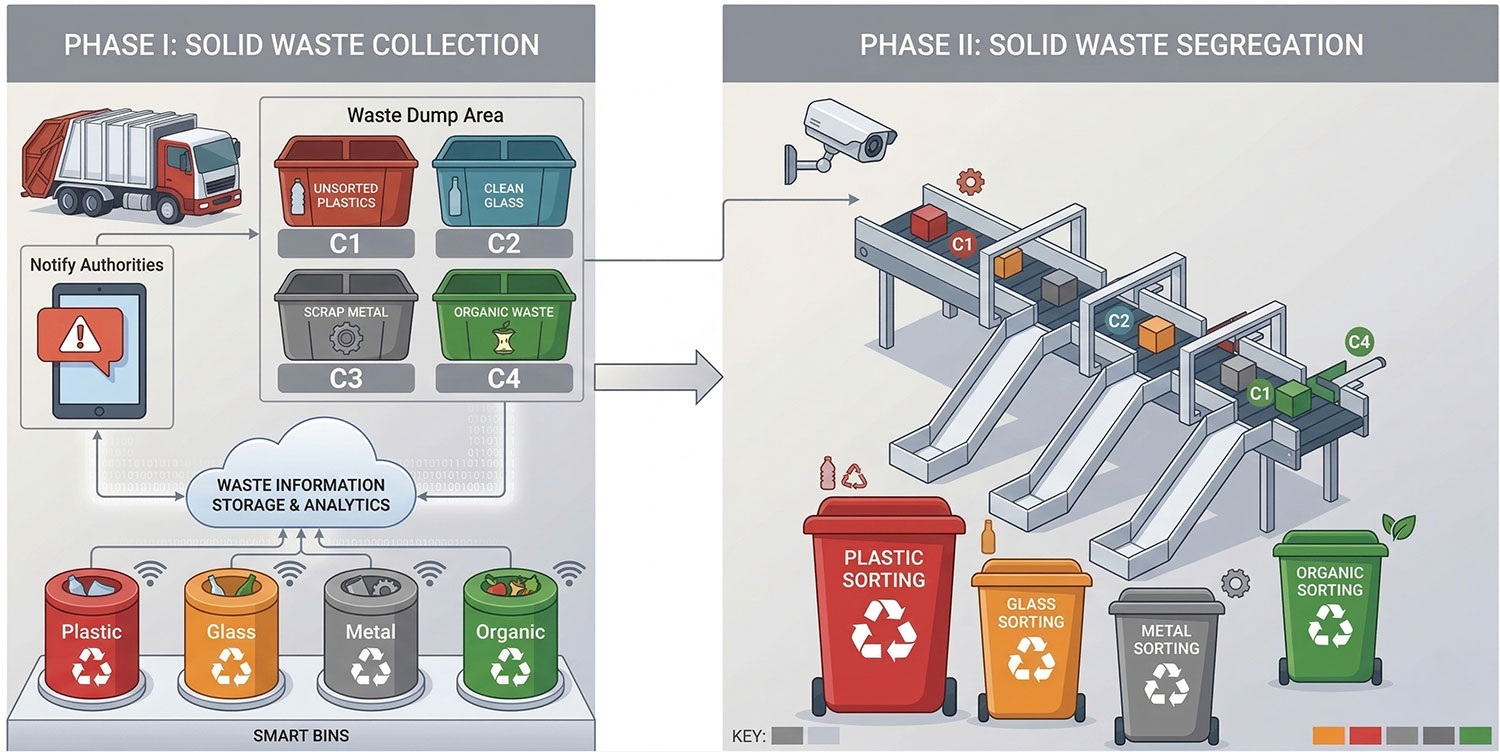
Artificial Intelligence of Things (AIoT) is transforming linear waste management into intelligent, data-driven solutions that support circular economy (CE) principles. This narrative review synthesizes peer-reviewed studies from 2020–2025 on AIoT applications across intelligent waste sorting, data analytics for resource recovery, and sustainable infrastructure development. The review examines IoT-enabled smart bins, computer-vision robotic sorting, machine learning classifiers (VGG-16/19: 97.11–99.7% accuracy, ResNet: 91.5–98.16%), predictive analytics, and graph-based route optimization. Reported improvements include up to 50% reduction in overflow events, 15.5–30% fuel savings, and 35.5% better bin utilization. These technologies enhance material recovery, reduce landfilling, and support closed-loop resource flows. Challenges—including high costs, data privacy, and limited model generalizability—are discussed alongside future directions such as edge-AI, blockchain, and multi-modal sensing. AIoT shows strong potential to advance UN SDGs 11 and 12, offering a roadmap for scalable urban circular economy transitions.
Graphical Abstract
Keywords
Data Availability Statement
Funding
Conflicts of Interest
AI Use Statement
Ethical Approval and Consent to Participate
References
- Lakhouit, A. (2025). Revolutionizing urban solid waste management with AI and IoT: A review of smart solutions for waste collection, sorting, and recycling. Results in Engineering, 25, 104018.
[CrossRef] [Google Scholar] - Anitha, R., & Parthiban, A. (2025). AI-IoT-graph synergy for smart waste management: a scalable framework for predictive, resilient, and sustainable urban systems. Frontiers in Sustainability, 6, 1675021.
[CrossRef] [Google Scholar] - Olawade, D. B., Fapohunda, O., Wada, O. Z., Usman, S. O., Ige, A. O., Ajisafe, O., & Oladapo, B. I. (2024). Smart waste management: A paradigm shift enabled by artificial intelligence. Waste Management Bulletin, 2(2), 244-263.
[CrossRef] [Google Scholar] - Baldo, D., Miozzo, M., Giusto, D., & Ghibaudi, M. (2021). A multi-layer LoRaWAN infrastructure for smart waste management. Sensors, 21(8), Article 2600.
[CrossRef] [Google Scholar] - Lampropoulos, G., Rahanu, H., Georgiadou, E., Siakas, D., & Siakas, K. (2024). Reconsidering a sustainable future through artificial intelligence of things (AIoT) in the context of circular economy. In Artificial Intelligence of Things for Achieving Sustainable Development Goals (pp. 1-20). Cham: Springer Nature Switzerland.
[CrossRef] [Google Scholar] - Ahmad, G., Aleem, F. M., Alyas, T., Abbas, Q., Nawaz, W., Ghazal, T. M., ... & Ibrahim, A. M. (2025). Intelligent waste sorting for urban sustainability using deep learning. Scientific reports, 15(1), 27078.
[CrossRef] [Google Scholar] - Alourani, A., Ashraf, M. U., & Aloraini, M. (2025). Smart waste management and classification system using advanced IoT and AI technologies. PeerJ Computer Science, 11, e2777.
[CrossRef] [Google Scholar] - Bernat, K. (2023). Post-consumer plastic waste management: from collection and sortation to mechanical recycling. Energies, 16(8), 3504.
[CrossRef] [Google Scholar] - Daas, A., Sari, B., Semchedine, F., & Amad, M. (2025). Optimizing waste management with integrated AIoT, edge computing, and LoRaWAN communication technologies. Internet of Things, 31, 101546.
[CrossRef] [Google Scholar] - Fang, B., Yu, J., Chen, Z., Osman, A. I., Farghali, M., Ihara, I., ... & Yap, P. S. (2023). Artificial intelligence for waste management in smart cities: a review. Environmental Chemistry Letters, 21(4), 1959-1989.
[CrossRef] [Google Scholar] - Lubongo, C., Bin Daej, M. A., & Alexandridis, P. (2024). Recent developments in technology for sorting plastic for recycling: The emergence of artificial intelligence and the rise of the robots. Recycling, 9(4), 59.
[CrossRef] [Google Scholar] - Gouskir, L., Abouhilal, A., Gouskir, M., Baslam, M., Belhouideg, S., & Hachimi, H. (2026). Revolutionizing urban waste systems: A comprehensive review of IoT, AI, and optimization techniques for smart waste management. International Journal of Advanced Computer Science and Applications, 17(5).
[CrossRef] [Google Scholar] - Sánchez-García, E., Martínez-Falcó, J., Marco-Lajara, B., & Manresa-Marhuenda, E. (2024). Revolutionizing the circular economy through new technologies: A new era of sustainable progress. Environmental Technology & Innovation, 33, 103509.
[CrossRef] [Google Scholar] - Adeleke, O., & Jen, T. C. (2025). Explainable AI and machine learning-based analysis of municipal solid waste generation rate: a South African case study. Waste Management, 206, 115036.
[CrossRef] [Google Scholar]
Cite This Article
TY  - JOUR
AU  - Panda, Snehal
AU  - Jana, Atanu
AU  - Nahak, Manoswini
AU  - Singaravel, G.
AU  - Mallik, Sandipan
AU  - Swain, Kunjabihari
PY  - 2026
DA  - 2026/06/30
TI  - Waste Management and Circular Economy: A Comprehensive Review of AIoT Applications in Intelligent Waste Sorting, Data Analytics for Resource Recovery, and Sustainable Infrastructure Development
JO  - Next-Generation Computing Systems and Technologies
T2  - Next-Generation Computing Systems and Technologies
JF  - Next-Generation Computing Systems and Technologies
VL  - 2
IS  - 2
SP  - 64
EP  - 69
DO  - 10.62762/NGCST.2026.790821
UR  - https://www.icck.org/article/abs/NGCST.2026.790821
KW  - AIoT
KW  - circular economy
KW  - intelligent waste sorting
KW  - resource recovery
KW  - sustainable infrastructure
KW  - smart waste management
KW  - predictive analytics
AB  - Artificial Intelligence of Things (AIoT) is transforming linear waste management into intelligent, data-driven solutions that support circular economy (CE) principles. This narrative review synthesizes peer-reviewed studies from 2020–2025 on AIoT applications across intelligent waste sorting, data analytics for resource recovery, and sustainable infrastructure development. The review examines IoT-enabled smart bins, computer-vision robotic sorting, machine learning classifiers (VGG-16/19: 97.11–99.7% accuracy, ResNet: 91.5–98.16%), predictive analytics, and graph-based route optimization. Reported improvements include up to 50% reduction in overflow events, 15.5–30% fuel savings, and 35.5% better bin utilization. These technologies enhance material recovery, reduce landfilling, and support closed-loop resource flows. Challenges—including high costs, data privacy, and limited model generalizability—are discussed alongside future directions such as edge-AI, blockchain, and multi-modal sensing. AIoT shows strong potential to advance UN SDGs 11 and 12, offering a roadmap for scalable urban circular economy transitions.
SN  - 3070-3328
PB  - Institute of Central Computation and Knowledge
LA  - English
ER  -
@article{Panda2026Waste,
  author = {Snehal Panda and Atanu Jana and Manoswini Nahak and G. Singaravel and Sandipan Mallik and Kunjabihari Swain},
  title = {Waste Management and Circular Economy: A Comprehensive Review of AIoT Applications in Intelligent Waste Sorting, Data Analytics for Resource Recovery, and Sustainable Infrastructure Development},
  journal = {Next-Generation Computing Systems and Technologies},
  year = {2026},
  volume = {2},
  number = {2},
  pages = {64-69},
  doi = {10.62762/NGCST.2026.790821},
  url = {https://www.icck.org/article/abs/NGCST.2026.790821},
  abstract = {Artificial Intelligence of Things (AIoT) is transforming linear waste management into intelligent, data-driven solutions that support circular economy (CE) principles. This narrative review synthesizes peer-reviewed studies from 2020–2025 on AIoT applications across intelligent waste sorting, data analytics for resource recovery, and sustainable infrastructure development. The review examines IoT-enabled smart bins, computer-vision robotic sorting, machine learning classifiers (VGG-16/19: 97.11–99.7\% accuracy, ResNet: 91.5–98.16\%), predictive analytics, and graph-based route optimization. Reported improvements include up to 50\% reduction in overflow events, 15.5–30\% fuel savings, and 35.5\% better bin utilization. These technologies enhance material recovery, reduce landfilling, and support closed-loop resource flows. Challenges—including high costs, data privacy, and limited model generalizability—are discussed alongside future directions such as edge-AI, blockchain, and multi-modal sensing. AIoT shows strong potential to advance UN SDGs 11 and 12, offering a roadmap for scalable urban circular economy transitions.},
  keywords = {AIoT, circular economy, intelligent waste sorting, resource recovery, sustainable infrastructure, smart waste management, predictive analytics},
  issn = {3070-3328},
  publisher = {Institute of Central Computation and Knowledge}
}
Article Metrics
Publisher's Note
ICCK stays neutral with regard to jurisdictional claims in published maps and institutional affiliations.
Rights and Permissions
 Copyright © 2026 by the Author(s). Published by Institute of Central Computation and Knowledge. This article is an open access article distributed under the terms and conditions of the Creative Commons Attribution (CC BY) license (https://creativecommons.org/licenses/by/4.0/), which permits use, sharing, adaptation, distribution and reproduction in any medium or format, as long as you give appropriate credit to the original author(s) and the source, provide a link to the Creative Commons licence, and indicate if changes were made.


Portico
