


Genome-wide Identification and Evolutionary Characterization of the Heat Shock Transcription Factor (HSF) Gene Family in Castanea Dentata and Their Functional Implications



Article Information
Abstract
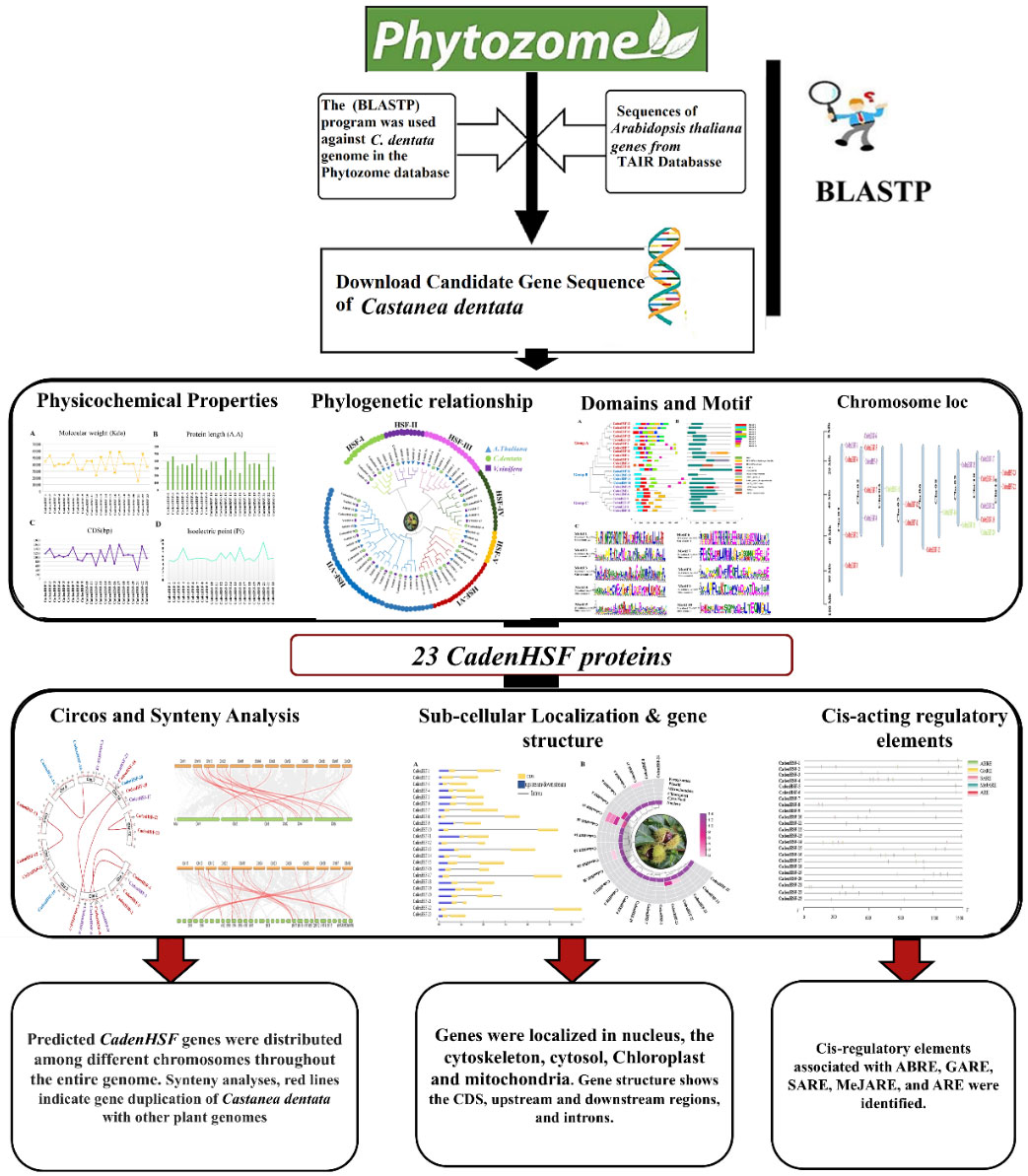
Heat shock transcription factors (HSFs) act as transcriptional regulators that mediate the defense responses against heat stress. Castanea dentata plays a major role in sustaining forest and landscape ecosystems and also exhibits medicinal properties. In this study, we identified 23 CadenHSFs genes from the genome of C. dentata. In silico approaches were employed to analyze gene structure, conserved domains, chromosomal locations, motif organization, comparative evolutionary analyses, synteny analyses, subcellular localization, and cis-regulatory element analysis. Cis-regulatory element analysis revealed that the promoters of CadenHSFs genes are associated with stress responses, light signaling, hormone pathways, and developmental processes. Phylogenetic analysis of the predicted HSF proteins from C. dentata, Arabidopsis thaliana, and Vitis vinifera showed that the 23 CadenHSFs genes were classified into seven distinct subgroups and three main classes (A, B, and C). Analyses of conserved domains, motifs, and gene structure indicated that these proteins share conserved characteristics within each group while displaying distinct features between groups. Synteny analysis identified both duplication events (including tandem repeats and segmental duplications). In silico subcellular localization results demonstrated that most CadenHSFs proteins were predominately localized in the nucleus. Our findings provide a robust foundation for further functional characterization of CadenHSFs genes and the genetic improvement of C. dentata.
Graphical Abstract
Keywords
Data Availability Statement
Funding
Conflicts of Interest
AI Use Statement
Ethical Approval and Consent to Participate
References
- Kopecká, R., Kameniarová, M., Černý, M., Brzobohatý, B., & Novák, J. (2023). Abiotic Stress in Crop Production. International Journal of Molecular Sciences, 24(7), 6603.
[CrossRef] [Google Scholar] - Herman, D. J., Knowles, L. O., & Knowles, N. R. (2017). Heat stress affects carbohydrate metabolism during cold-induced sweetening of potato (Solanum tuberosum L.). Planta, 245(3), 563-582.
[CrossRef] [Google Scholar] - Hasanuzzaman, M., Nahar, K., Alam, M. M., Roychowdhury, R., & Fujita, M. (2013). Physiological, biochemical, and molecular mechanisms of heat stress tolerance in plants. International journal of molecular sciences, 14(5), 9643-9684.
[CrossRef] [Google Scholar] - Yang, X., Zhu, W., Zhang, H., Liu, N., & Tian, S. (2016). Heat shock factors in tomatoes: genome-wide identification, phylogenetic analysis and expression profiling under development and heat stress. PeerJ, 4, e1961.
[CrossRef] [Google Scholar] - Yura, T., & Nakahigashi, K. (1999). Regulation of the heat-shock response. Current opinion in microbiology, 2(2), 153-158.
[CrossRef] [Google Scholar] - Sorger, P. K., & Pelham, H. R. (1988). Yeast heat shock factor is an essential DNA-binding protein that exhibits temperature-dependent phosphorylation. Cell, 54(6), 855-864.
[CrossRef] [Google Scholar] - Chidambaranathan, P., Jagannadham, P. T. K., Satheesh, V., Kohli, D., Basavarajappa, S. H., Chellapilla, B., ... & Srinivasan, R. (2018). Genome-wide analysis identifies chickpea (Cicer arietinum) heat stress transcription factors (Hsfs) responsive to heat stress at the pod development stage. Journal of plant research, 131(3), 525-542.
[CrossRef] [Google Scholar] - Lin, Y. X., Jiang, H. Y., Chu, Z. X., Tang, X. L., Zhu, S. W., & Cheng, B. J. (2011). Genome-wide identification, classification and analysis of heat shock transcription factor family in maize. BMC genomics, 12(1), 76.
[CrossRef] [Google Scholar] - Chung, E., Kim, K. M., & Lee, J. H. (2013). Genome-wide analysis and molecular characterization of heat shock transcription factor family in Glycine max. Journal of genetics and genomics, 40(3), 127-135.
[CrossRef] [Google Scholar] - Zhou, S., Zhang, P., Jing, Z., & Shi, J. (2013). Genome-wide identification and analysis of heat shock transcription factor family in cucumber (Cucumis sativus L.). Plant Omics, 6(6), 449-455. https://search.informit.org/doi/10.3316/informit.135177679654344{Link]
[Google Scholar] - Zhang, J., Liu, B., Li, J., Zhang, L., Wang, Y., Zheng, H., ... & Chen, J. (2015). Hsf and Hsp gene families in Populus: genome-wide identification, organization and correlated expression during development and in stress responses. BMC genomics, 16(1), 181.
[CrossRef] [Google Scholar] - Xue, G. P., Sadat, S., Drenth, J., & McIntyre, C. L. (2014). The heat shock factor family from Triticum aestivum in response to heat and other major abiotic stresses and their role in regulation of heat shock protein genes. Journal of experimental botany, 65(2), 539-557.
[CrossRef] [Google Scholar] - Huang, Y., Li, M. Y., Wang, F., Xu, Z. S., Huang, W., Wang, G. L., ... & Xiong, A. S. (2015). Heat shock factors in carrot: genome-wide identification, classification, and expression profiles response to abiotic stress. Molecular biology reports, 42(5), 893-905.
[CrossRef] [Google Scholar] - Zhu, X., Huang, C., Zhang, L., Liu, H., Yu, J., Hu, Z., & Hua, W. (2017). Systematic analysis of Hsf family genes in the Brassica napus genome reveals novel responses to heat, drought and high CO2 stresses. Frontiers in plant science, 8, 1174.
[CrossRef] [Google Scholar] - Shirasawa, K., Nishio, S., Terakami, S., Botta, R., Marinoni, D. T., & Isobe, S. (2021). Chromosome-level genome assembly of Japanese chestnut (Castanea crenata Sieb. et Zucc.) reveals conserved chromosomal segments in woody rosids. DNA Research, 28(5), dsab016.
[CrossRef] [Google Scholar] - Jacobs, D. F., Dalgleish, H. J., & Nelson, C. D. (2016). Synthesis of American chestnut (Castanea dentata) biological, ecological, and genetic attributes with application to forest restoration. Forest Health Initiative. Accessed online, 7. {https://www.mdsg.umd.edu/sites/default/files/files/Lesson%20Plans/american_chestnut_project/chestnut_synthesis.pdf
[Google Scholar] - Li, R., Sharma, A. K., Zhu, J., Zheng, B., Xiao, G., & Chen, L. (2022). Nutritional biology of chestnuts: A perspective review. Food Chemistry, 395, 133575.
[CrossRef] [Google Scholar] - Drăghici, L. R., Hădărugă, D. I., Bădoiu, B., Mitroi, C., David, I., Riviş, A., ... & Hădărugă, N. G. (2021). Nutritional values of edible chestnuts (Castanea species)—A short comparative review. J. Agroaliment. Process. Technol, 27, 553-564. https://journal-of-agroalimentary.ro/admin/articole/54997L80_Razvan-Draghici_27-4-S-_2021_553-564.pdf
[Google Scholar] - Guo, A. Y., Zhu, Q. H., Chen, X., & Luo, J. C. (2007). GSDS: a gene structure display server. Yi chuan= Hereditas, 29(8), 1023-1026.
[CrossRef] [Google Scholar] - Chen, C., Chen, H., Zhang, Y., Thomas, H. R., Frank, M. H., He, Y., & Xia, R. (2020). TBtools: an integrative toolkit developed for interactive analyses of big biological data. Molecular plant, 13(8), 1194-1202.
[CrossRef] [Google Scholar] - Horton, P., Park, K. J., Obayashi, T., Fujita, N., Harada, H., Adams-Collier, C. J., & Nakai, K. (2007). WoLF PSORT: protein localization predictor. Nucleic acids research, 35(suppl\_2), W585-W587.
[CrossRef] [Google Scholar] - Yu, C. S., Chen, Y. C., Lu, C. H., & Hwang, J. K. (2006). Prediction of protein subcellular localization. Proteins: Structure, Function, and Bioinformatics, 64(3), 643-651.
[CrossRef] [Google Scholar] - Noor, M., Mehar, I., Hussain, H., Gaafar, A. R. Z., Dabiellil, M., & Shah, T. A. (2025). Identification and analysis of functional regulatory elements and RNAi silencing genes in mandarin clementine (Citrus clementina). Journal of Plant Interactions, 20(1), 2503289.
[CrossRef] [Google Scholar] - Hussain, H., Alam, A., Mehar, I., Noor, M., Al-Dossary, O., Alsubaie, B., ... & Al-Khayri, J. M. (2025). Genome-wide identification and characterization of the WRKY gene family and their associated regulatory elements in fortunella hindsii. Evolutionary Bioinformatics, 21, 11769343241312740.
[CrossRef] [Google Scholar] - Jiang, L., Hu, W., Qian, Y., Ren, Q., & Zhang, J. (2021). Genome-wide identification, classification and expression analysis of the Hsf and Hsp70 gene families in maize. Gene, 770, 145348.
[CrossRef] [Google Scholar] - Duan, S., Liu, B., Zhang, Y., Li, G., & Guo, X. (2019). Genome-wide identification and abiotic stress-responsive pattern of heat shock transcription factor family in Triticum aestivum L. Bmc Genomics, 20(1), 257.
[CrossRef] [Google Scholar] - Gong, C., Pang, Q., Li, Z., Li, Z., Chen, R., Sun, G., & Sun, B. (2021). Genome-wide identification and characterization of Hsf and Hsp gene families and gene expression analysis under heat stress in eggplant (Solanum melongema L.). Horticulturae, 7(6), 149.
[CrossRef] [Google Scholar] - Li, P. S., Yu, T. F., He, G. H., Chen, M., Zhou, Y. B., Chai, S. C., ... & Ma, Y. Z. (2014). Genome-wide analysis of the Hsf family in soybean and functional identification of GmHsf-34 involvement in drought and heat stresses. BMC genomics, 15(1), 1009.
[CrossRef] [Google Scholar] - Qian, G., Meng, X., Wang, S., Mi, Y., Qin, Z., Liu, T., ... & Li, L. (2023). Genome-wide identification of HSF gene family and their expression analysis in vegetative tissue of young seedlings of hemp under different light treatments. Industrial Crops and Products, 204, 117375.
[CrossRef] [Google Scholar] - Movahedi, A., Hwarari, D., Dzinyela, R., Ni, S., & Yang, L. (2025). A close-up of regulatory networks and signaling pathways of MKK5 in biotic and abiotic stresses. Critical Reviews in Biotechnology, 45(2), 473-490.
[CrossRef] [Google Scholar] - Hussain, H., Fatima, N., Sajid, M., Mehar, I., Noor, M., Attia, K. A., ... & Shah, T. A. (2024). Genome-wide analysis and identification of nuclear factor Y gene family in switchgrass (Panicum virgatum L.). BMC genomics, 25(1), 1218.
[CrossRef] [Google Scholar] - Guo, M., Liu, J. H., Ma, X., Luo, D. X., Gong, Z. H., & Lu, M. H. (2016). The plant heat stress transcription factors (HSFs): structure, regulation, and function in response to abiotic stresses. Frontiers in plant science, 7, 114.
[CrossRef] [Google Scholar] - Li, Y., Gong, K., Wang, X., Sun, Z., & Ding, F. (2025). Heat Shock Transcription Factors as Central Integrators of Plant Stress Responses: From Thermotolerance to Multi-Stress Resilience. Biology, 14(12), 1800.
[CrossRef] [Google Scholar] - Scharf, K. D., Berberich, T., Ebersberger, I., & Nover, L. (2012). The plant heat stress transcription factor (Hsf) family: structure, function and evolution. Biochimica et Biophysica Acta (BBA)-Gene Regulatory Mechanisms, 1819(2), 104-119.
[CrossRef] [Google Scholar] - Liu, G., Chai, F., Wang, Y., Jiang, J., Duan, W., Wang, Y., ... & Wang, L. (2018). Genome-wide Identification and Classification of HSF Family in Grape, and Their Transcriptional Analysis under Heat Acclimation and Heat Stress. Horticultural Plant Journal, 4(4), 133-143.
[CrossRef] [Google Scholar] - Movahedi, A., Kadkhodaei, S., & Yang, L. (2024). Transcriptional regulation and posttranslational modifications in plant growth and development under abiotic stresses. Frontiers in Plant Science, 15, 1454335.
[CrossRef] [Google Scholar] - Ohama, N., Sato, H., Shinozaki, K., & Yamaguchi-Shinozaki, K. (2017). Transcriptional regulatory network of plant heat stress response. Trends in plant science, 22(1), 53-65.
[CrossRef] [Google Scholar]
Cite This Article
TY  - JOUR
AU  - Rehman, Kanza
AU  - Noor, Maryam
AU  - Mehar, Iqra
AU  - Nasir, Bukhtawer
AU  - Hussain, Hadia
PY  - 2026
DA  - 2026/06/07
TI  - Genome-wide Identification and Evolutionary Characterization of the Heat Shock Transcription Factor (HSF) Gene Family in Castanea Dentata and Their Functional Implications
JO  - Plant Innovation Journal
T2  - Plant Innovation Journal
JF  - Plant Innovation Journal
VL  - 1
IS  - 2
SP  - 58
EP  - 71
DO  - 10.62762/PIJ.2026.449234
UR  - https://www.icck.org/article/abs/PIJ.2026.449234
KW  - heat shock transcription factor (HSF)
KW  - castanea dentata
KW  - genome-wide analysis
KW  - abiotic stress
KW  - hormone signaling
AB  - Heat shock transcription factors (HSFs) act as transcriptional regulators that mediate the defense responses against heat stress. Castanea dentata plays a major role in sustaining forest and landscape ecosystems and also exhibits medicinal properties. In this study, we identified 23 CadenHSFs genes from the genome of C. dentata. In silico approaches were employed to analyze gene structure, conserved domains, chromosomal locations, motif organization, comparative evolutionary analyses, synteny analyses, subcellular localization, and cis-regulatory element analysis. Cis-regulatory element analysis revealed that the promoters of CadenHSFs genes are associated with stress responses, light signaling, hormone pathways, and developmental processes. Phylogenetic analysis of the predicted HSF proteins from C. dentata, Arabidopsis thaliana, and Vitis vinifera showed that the 23 CadenHSFs genes were classified into seven distinct subgroups and three main classes (A, B, and C). Analyses of conserved domains, motifs, and gene structure indicated that these proteins share conserved characteristics within each group while displaying distinct features between groups. Synteny analysis identified both duplication events (including tandem repeats and segmental duplications). In silico subcellular localization results demonstrated that most CadenHSFs proteins were predominately localized in the nucleus. Our findings provide a robust foundation for further functional characterization of CadenHSFs genes and the genetic improvement of C. dentata.
SN  - 3142-7596
PB  - Institute of Central Computation and Knowledge
LA  - English
ER  -
@article{Rehman2026Genomewide,
  author = {Kanza Rehman and Maryam Noor and Iqra Mehar and Bukhtawer Nasir and Hadia Hussain},
  title = {Genome-wide Identification and Evolutionary Characterization of the Heat Shock Transcription Factor (HSF) Gene Family in Castanea Dentata and Their Functional Implications},
  journal = {Plant Innovation Journal},
  year = {2026},
  volume = {1},
  number = {2},
  pages = {58-71},
  doi = {10.62762/PIJ.2026.449234},
  url = {https://www.icck.org/article/abs/PIJ.2026.449234},
  abstract = {Heat shock transcription factors (HSFs) act as transcriptional regulators that mediate the defense responses against heat stress. Castanea dentata plays a major role in sustaining forest and landscape ecosystems and also exhibits medicinal properties. In this study, we identified 23 CadenHSFs genes from the genome of C. dentata. In silico approaches were employed to analyze gene structure, conserved domains, chromosomal locations, motif organization, comparative evolutionary analyses, synteny analyses, subcellular localization, and cis-regulatory element analysis. Cis-regulatory element analysis revealed that the promoters of CadenHSFs genes are associated with stress responses, light signaling, hormone pathways, and developmental processes. Phylogenetic analysis of the predicted HSF proteins from C. dentata, Arabidopsis thaliana, and Vitis vinifera showed that the 23 CadenHSFs genes were classified into seven distinct subgroups and three main classes (A, B, and C). Analyses of conserved domains, motifs, and gene structure indicated that these proteins share conserved characteristics within each group while displaying distinct features between groups. Synteny analysis identified both duplication events (including tandem repeats and segmental duplications). In silico subcellular localization results demonstrated that most CadenHSFs proteins were predominately localized in the nucleus. Our findings provide a robust foundation for further functional characterization of CadenHSFs genes and the genetic improvement of C. dentata.},
  keywords = {heat shock transcription factor (HSF), castanea dentata, genome-wide analysis, abiotic stress, hormone signaling},
  issn = {3142-7596},
  publisher = {Institute of Central Computation and Knowledge}
}
Article Metrics
Publisher's Note
ICCK stays neutral with regard to jurisdictional claims in published maps and institutional affiliations.
Rights and Permissions
 Copyright © 2026 by the Author(s). Published by Institute of Central Computation and Knowledge. This article is an open access article distributed under the terms and conditions of the Creative Commons Attribution (CC BY) license (https://creativecommons.org/licenses/by/4.0/), which permits use, sharing, adaptation, distribution and reproduction in any medium or format, as long as you give appropriate credit to the original author(s) and the source, provide a link to the Creative Commons licence, and indicate if changes were made.

