Volume 2, Issue 1, Reservoir Science
Volume 2, Issue 1, 2026
Submit Manuscript Edit a Special Issue
Article QR Code
Article QR Code
Scan the QR code for reading
Popular articles
Reservoir Science, Volume 2, Issue 1, 2026: 34-51

Open Access | Research Article | 18 January 2026
Preliminary Investigation of Fracture Behavior during Carbon Dioxide Fracturing of Natural Hydrogen Reservoir with Hard-Core Imperfections
1 Atland Petro FZC, Sharjah 1377, United Arab Emirates
2 Guangzhou Gas Group Co., Ltd., Guangzhou 511436, China
* Corresponding Author: Shenglan Guo, [email protected]
ARK: ark:/57805/rs.2025.759326
Received: 15 November 2025, Accepted: 10 January 2026, Published: 18 January 2026  
Abstract
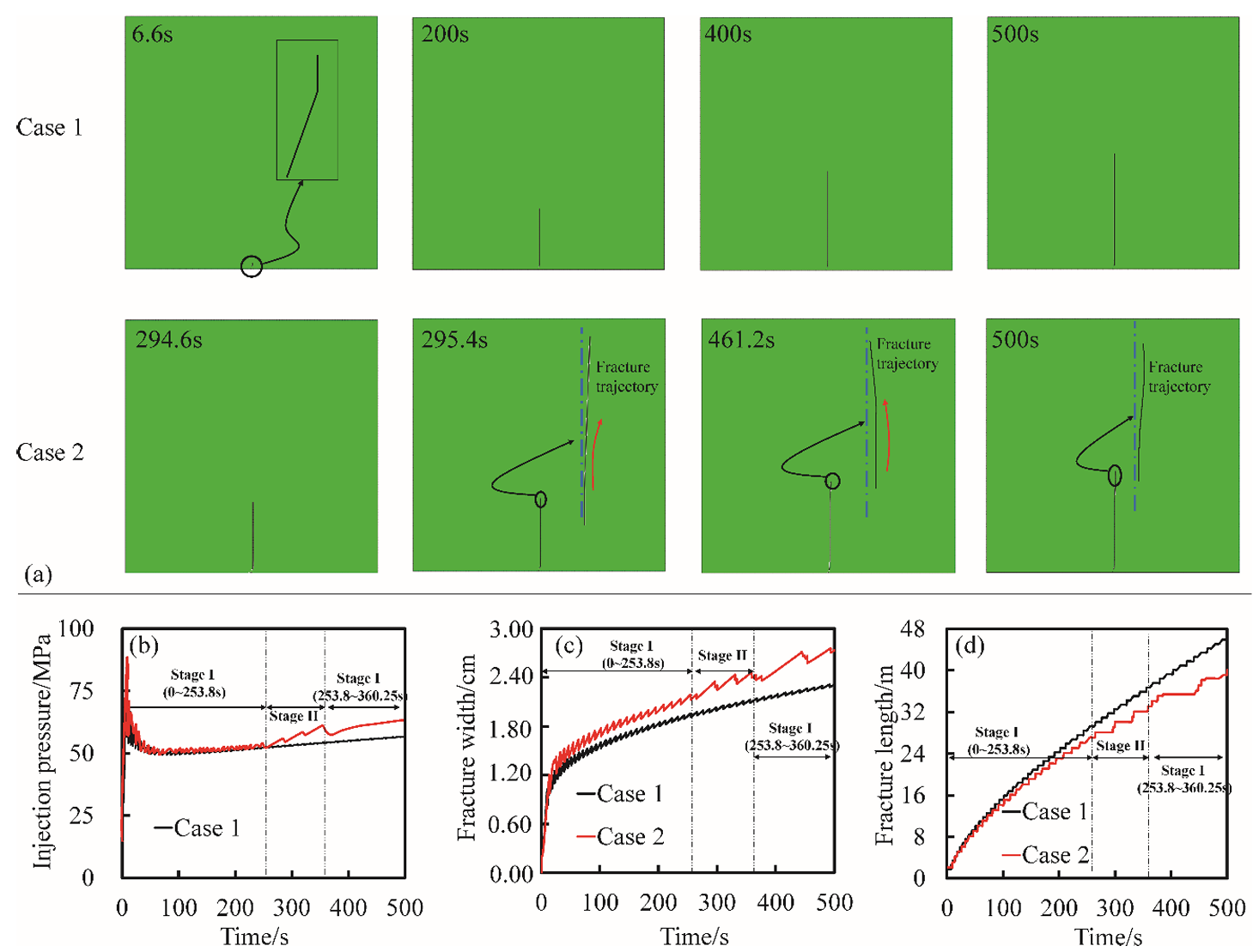
The low concentration and poor reservoir properties of natural hydrogen suggest that reservoir stimulation measures such as fracturing is required for its efficient development. Nevertheless, the presence of reservoir imperfections, including hard and soft cores, can significantly affect fracture behavior during the fracturing operations. Moreover, there is currently a lack of relevant simulation and experimental studies addressing these effects. In the present work, the effects and mechanisms of hard cores on fracture propagation in natural hydrogen reservoirs in the Songliao basin were numerically simulated. In addition, various factors affecting propagation behavior of fracture were also analyzed. The investigation results indicate that the presence of hard cores induces the fracture propagation mode from “straight-line dominated” to “path optimization” (obstacle-avoidance) pattern, which consequently decreases propagation efficiency. The final fracture length exhibits a reduction of 12.63% compared with that in the homogeneous reservoir case, accompanied by an increase of 18.49% in the final fracture width. Furthermore, higher hard core strength and leakage coefficients significantly decrease fracture propagation efficiency, promoting the development of wide, short fractures. This research offers a preliminary theoretical framework to support the stimulation and efficient development of imperfection-bearing natural hydrogen reservoirs.

Graphical Abstract
Preliminary Investigation of Fracture Behavior during Carbon Dioxide Fracturing of Natural Hydrogen Reservoir with Hard-Core Imperfections

Keywords
natural hydrogen
carbon dioxide-based fracturing
reservoir imperfection
fracture initiation
fracture propagation

Data Availability Statement
Data will be made available on request.

Funding
This work was supported without any funding.

Conflicts of Interest
Muhammad Usman Tahir is affiliated with the Atland Petro FZC, Sharjah 1377, United Arab Emirates, and Shenglan Guo is affiliated with the Guangzhou Gas Group Co., Ltd., Guangzhou 511436, China. The authors declare that these affiliations had no influence on the study design, data collection, analysis, interpretation, or the decision to publish, and that no other competing interests exist.

AI Use Statement
The authors declare that no generative AI was used in the preparation of this manuscript.

Ethical Approval and Consent to Participate
Not applicable.

References
  1. Zgonnik, V. (2020). The occurrence and geoscience of natural hydrogen: A comprehensive review. Earth-Science Reviews, 203, 103140.
    [CrossRef]   [Google Scholar]
  2. Epelle, E. I., Obande, W., Udourioh, G. A., Afolabi, I. C., Desongu, K. S., Orivri, U., ... & Okolie, J. A. (2022). Perspectives and prospects of underground hydrogen storage and natural hydrogen. Sustainable Energy & Fuels, 6(14), 3324-3343.
    [CrossRef]   [Google Scholar]
  3. Blay-Roger, R., Bach, W., Bobadilla, L. F., Reina, T. R., Odriozola, J. A., Amils, R., & Blay, V. (2024). Natural hydrogen in the energy transition: Fundamentals, promise, and enigmas. Renewable and Sustainable Energy Reviews, 189, 113888.
    [CrossRef]   [Google Scholar]
  4. Qingchao, L., Jingjuan, W., Qiang, L., Fuling, W., & Yuanfang, C. (2025). Sediment Instability Caused by Gas Production from Hydrate-Bearing Sediment in Northern South China Sea by Horizontal Wellbore: Sensitivity Analysis. Natural Resources Research, 1-33.
    [CrossRef]   [Google Scholar]
  5. Prinzhofer, A., Cissé, C. S. T., & Diallo, A. B. (2018). Discovery of a large accumulation of natural hydrogen in Bourakebougou (Mali). International Journal of Hydrogen Energy, 43(42), 19315-19326.
    [CrossRef]   [Google Scholar]
  6. Fochesato, M., Peter, C., Morandi, L., & Lygeros, J. (2024). Peak shaving with hydrogen energy storage: From stochastic control to experiments on a 4 MWh facility. Applied Energy, 376, 123965.
    [CrossRef]   [Google Scholar]
  7. Li, Q., Han, Y., Liu, X., Ansari, U., Cheng, Y., & Yan, C. (2022). Hydrate as a by-product in CO2 leakage during the long-term sub-seabed sequestration and its role in preventing further leakage. Environmental Science and Pollution Research, 29(51), 77737–77754.
    [CrossRef]   [Google Scholar]
  8. Hassanpouryouzband, A., Armitage, T., Cowen, T., Thaysen, E. M., McMahon, S., Hajibeygi, H., ... & Haszeldine, R. S. (2025). The search for natural hydrogen: a hidden energy giant or an elusive dream?. ACS Energy Letters, 10(8), 3887-3891.
    [CrossRef]   [Google Scholar]
  9. Arrouvel, C., & Prinzhofer, A. (2021). Genesis of natural hydrogen: New insights from thermodynamic simulations. International Journal of Hydrogen Energy, 46(36), 18780–18794.
    [CrossRef]   [Google Scholar]
  10. Prinzhofer, A., Moretti, I., Françolin, J., Pacheco, C., d'Agostino, A., Werly, J., & Rupin, F. (2019). Natural hydrogen continuous emission from sedimentary basins: The example of a Brazilian H2-emitting structure. International Journal of Hydrogen Energy, 44(12), 5676-5685.
    [CrossRef]   [Google Scholar]
  11. AlTammar, M. J., Agrawal, S., & Sharma, M. M. (2019). Effect of geological layer properties on hydraulic-fracture initiation and propagation: an experimental study. SPE Journal, 24(02), 757-794.
    [CrossRef]   [Google Scholar]
  12. Deng, P., Ma, H., Song, J., Peng, X., Zhu, S., Xue, D., Jiang, L., & Chen, Z. (2025). Carbon dioxide as cushion gas for large-scale underground hydrogen storage: Mechanisms and implications. Applied Energy, 388, 125622.
    [CrossRef]   [Google Scholar]
  13. Saeed, M., Jadhawar, P., & Bagala, S. (2023). Geochemical effects on storage gases and reservoir rock during underground hydrogen storage: A depleted North Sea oil reservoir case study. Hydrogen, 4(2), 323–337.
    [CrossRef]   [Google Scholar]
  14. Ellis, G. S., & Gelman, S. E. (2024). Model predictions of global geologic hydrogen resources. Science Advances, 10(50), eado0955.
    [CrossRef]   [Google Scholar]
  15. Dehghani, M. R., Ghazi, S. F., & Kazemzadeh, Y. (2024). Interfacial tension and wettability alteration during hydrogen and carbon dioxide storage in depleted gas reservoirs. Scientific Reports, 14(1), 11594.
    [CrossRef]   [Google Scholar]
  16. Liu, K., Zhu, W., & Pan, B. (2024). Feasibility of hydrogen storage in depleted shale gas reservoir: A numerical investigation. Fuel, 357(Part B), 129703.
    [CrossRef]   [Google Scholar]
  17. Muhammed, N. S., Haq, B., & Al Shehri, D. (2023). Role of methane as a cushion gas for hydrogen storage in depleted gas reservoirs. International Journal of Hydrogen Energy, 48(76), 29663–29681.
    [CrossRef]   [Google Scholar]
  18. Guo, T., Wang, X., Li, Z., Gong, F., Lin, Q., Qu, Z., Lv, W., Tian, Q., & Xie, Z. (2019). Numerical simulation study on fracture propagation of zipper and synchronous fracturing in hydrogen energy development. International Journal of Hydrogen Energy, 44(11), 5270–5285.
    [CrossRef]   [Google Scholar]
  19. Liang, X., Zhou, F., Liang, T., Wang, C., Wang, J., & Yuan, S. (2020). Impacts of low harm fracturing fluid on fossil hydrogen energy production in tight reservoirs. International Journal of Hydrogen Energy, 45(41), 21195–21204.
    [CrossRef]   [Google Scholar]
  20. Liu, X., Qu, Z., Guo, T., Tian, Q., Lv, W., Xie, Z., & Chu, C. (2019). An innovative technology of directional propagation of hydraulic fracture guided by radial holes in fossil hydrogen energy development. International Journal of Hydrogen Energy, 44(11), 5286–5302.
    [CrossRef]   [Google Scholar]
  21. Lu, Y., Li, H., Lu, C., Wu, K., Chen, Z., Wang, K., Luo, H., & Shan, J. (2019). The effect of completion strategy on fracture propagation from multiple cluster perforations in fossil hydrogen energy development. International Journal of Hydrogen Energy, 44(14), 7168–7180.
    [CrossRef]   [Google Scholar]
  22. Hosseini, S. I. M., Fahimpour, J., Ali, M., & Keshavarz, A. (2022). Capillary sealing efficiency analysis of caprocks: Implication for hydrogen geological storage. Energy & Fuels, 36(8), 4065–4075.
    [CrossRef]   [Google Scholar]
  23. Yin, H., Yang, C., Ma, H., & Shi, X. (2020). Stability evaluation of underground gas storage salt caverns with micro-leakage interlayer in bedded rock salt of Jintan, China. Acta Geotechnica, 15(3), 549–563.
    [CrossRef]   [Google Scholar]
  24. Shahmorad, Z., Salarirad, H., & Molladavoudi, H. (2016). A study on the effect of utilizing different constitutive models in the stability analysis of an underground gas storage within a salt structure. Journal of Natural Gas Science and Engineering, 33, 808–820.
    [CrossRef]   [Google Scholar]
  25. Wang, L., Jin, Z., Liu, Q., Liu, K., Meng, Q., Huang, X., Su, Y., & Zhang, Q. (2024). The occurrence pattern of natural hydrogen in the Songliao Basin, PR China: Insights on natural hydrogen exploration. International Journal of Hydrogen Energy, 50(Part A), 261–275.
    [CrossRef]   [Google Scholar]
  26. Lu, J., Muhammed, N. S., Okolie, J. A., & Epelle, E. I. (2025). A sensitivity study of hydrogen mixing with cushion gases for effective storage in porous media. Sustainable Energy & Fuels, 9(5), 1353–1370.
    [CrossRef]   [Google Scholar]
  27. Hosseini, M., Ali, M., Fahimpour, J., Keshavarz, A., & Iglauer, S. (2022). Basalt-H2-brine wettability at geo-storage conditions: Implication for hydrogen storage in basaltic formations. Journal of Energy Storage, 52, 104745.
    [CrossRef]   [Google Scholar]
  28. Li, Q., Li, Y., Cheng, Y., Li, Q., Wang, F., Wei, J., Liu, Y., Zhang, C., Song, B., Yan, C., & Ansari, U. (2018). Numerical simulation of fracture reorientation during hydraulic fracturing in perforated horizontal well in shale reservoirs. Energy Sources, Part A: Recovery, Utilization, and Environmental Effects, 40(15), 1807–1813.
    [CrossRef]   [Google Scholar]
  29. Zamehrian, M., & Sedaee, B. (2022). Underground hydrogen storage in a naturally fractured gas reservoir: The role of fracture. International Journal of Hydrogen Energy, 47(93), 39606–39618.
    [CrossRef]   [Google Scholar]
  30. Zeng, L., Sander, R., Chen, Y., & Xie, Q. (2024). Hydrogen storage performance during underground hydrogen storage in depleted gas reservoirs: A review. Engineering, 40, 211–225.
    [CrossRef]   [Google Scholar]
  31. Ismail, A., & Azadbakht, S. (2024). A comprehensive review of numerical simulation methods for hydraulic fracturing. International Journal for Numerical and Analytical Methods in Geomechanics, 48(5), 1433–1459.
    [CrossRef]   [Google Scholar]
  32. Ao, F., Qingchao, L., Qiang, L., Jingjuan, W., Fuling, W., & Chuanliang, Y. (2025). Numerical Simulation Investigation of Fracture Propagation Behavior Patterns and Sensitivity Factors of Oil Shale Reservoirs in the Xunyi Region Considering the Influence of Natural Fracture. Geofluids, 2025(1), 2762142.
    [CrossRef]   [Google Scholar]
  33. Li, L. C., Tang, C. A., Li, G., Wang, S. Y., Liang, Z. Z., & Zhang, Y. B. (2012). Numerical simulation of 3D hydraulic fracturing based on an improved flow-stress-damage model and a parallel FEM technique. Rock Mechanics and Rock Engineering, 45(5), 801–818.
    [CrossRef]   [Google Scholar]
  34. Hossain, M. M., & Rahman, M. K. (2008). Numerical simulation of complex fracture growth during tight reservoir stimulation by hydraulic fracturing. Journal of Petroleum Science and Engineering, 60(2), 86–104.
    [CrossRef]   [Google Scholar]
  35. Li, D. Q., Zhang, S. C., & Zhang, S. A. (2014). Experimental and numerical simulation study on fracturing through interlayer to coal seam. Journal of Natural Gas Science and Engineering, 21, 386–396.
    [CrossRef]   [Google Scholar]
  36. Zhao, Q., Lisjak, A., Mahabadi, O., Liu, Q., & Grasselli, G. (2014). Numerical simulation of hydraulic fracturing and associated microseismicity using finite-discrete element method. Journal of Rock Mechanics and Geotechnical Engineering, 6(6), 574–581.
    [CrossRef]   [Google Scholar]
  37. Wang, T., Guo, Z., Li, G., Ma, Z., Yong, Y., & Tian, S. (2023). Numerical simulation of three-dimensional fracturing fracture propagation in radial wells. Petroleum Exploration and Development, 50(3), 699–711.
    [CrossRef]   [Google Scholar]
  38. Guo, C., Xu, J., Wei, M., & Jiang, R. (2015). Experimental study and numerical simulation of hydraulic fracturing tight sandstone reservoirs. Fuel, 159, 334–344.
    [CrossRef]   [Google Scholar]
  39. Xu, B., Liu, Y., Wang, Y., Yang, G., Yu, Q., & Wang, F. (2018). A new method and application of full 3D numerical simulation for hydraulic fracturing horizontal fracture. Energies, 12(1), 48.
    [CrossRef]   [Google Scholar]
  40. Huang, L., Liao, X., Fan, M., Wu, S., Tan, P., & Yang, L. (2024). Experimental and numerical simulation technique for hydraulic fracturing of shale formations. Advances in Geo-Energy Research, 13(2), 83–88.
    [CrossRef]   [Google Scholar]
  41. Sun, J., & Schechter, D. (2015). Investigating the effect of improved fracture conductivity on production performance of hydraulically fractured wells: Field-case studies and numerical simulations. Journal of Canadian Petroleum Technology, 54(06), 442–449.
    [CrossRef]   [Google Scholar]
  42. Ren, Q., Li, L., Wang, J., Jiang, R., Li, M., & Feng, J. (2024). Dynamic evolution mechanism of the fracturing fracture system—Enlightenments from hydraulic fracturing physical experiments and finite element numerical simulation. Petroleum Science, 21(6), 3839–3866.
    [CrossRef]   [Google Scholar]
  43. Li, Y., Deng, J., Liu, W., Yan, W., Feng, Y., Cao, W., Wang, P., & Hou, Y. (2017). Numerical simulation of limited-entry multi-cluster fracturing in horizontal well. Journal of Petroleum Science and Engineering, 152, 443–455.
    [CrossRef]   [Google Scholar]
  44. Zeng, Q., & Yao, J. (2016). Numerical simulation of fracture network generation in naturally fractured reservoirs. Journal of Natural Gas Science and Engineering, 30, 430–443.
    [CrossRef]   [Google Scholar]
  45. Zhao, J., Wang, Z., Lin, R., Ren, L., Wu, J., & Wu, J. (2023). Numerical simulation of diverting fracturing for staged fracturing horizontal well in shale gas reservoir. Journal of Energy Resources Technology, 145(5), 053202.
    [CrossRef]   [Google Scholar]
  46. Liu, X., Qu, Z., Guo, T., Sun, Y., Wang, Z., & Bakhshi, E. (2019). Numerical simulation of non-planar fracture propagation in multi-cluster fracturing with natural fractures based on Lattice methods. Engineering Fracture Mechanics, 220, 106625.
    [CrossRef]   [Google Scholar]
  47. Lu, C., Ma, L., Li, Z., Huang, F., Huang, C., Yuan, H., & Guo, J. (2020). A novel hydraulic fracturing method based on the coupled CFD-DEM numerical simulation study. Applied Sciences, 10(9), 3027.
    [CrossRef]   [Google Scholar]
  48. Sanchez, E. C. M., Cordero, J. A. R., & Roehl, D. (2020). Numerical simulation of three-dimensional fracture interaction. Computers and Geotechnics, 122, 103528.
    [CrossRef]   [Google Scholar]

Cite This Article
APA Style
Tahir, M. U., & Guo, S. (2026). Preliminary Investigation of Fracture Behavior during Carbon Dioxide Fracturing of Natural Hydrogen Reservoir with Hard-Core Imperfections. Reservoir Science, 2(1), 34–51. https://doi.org/10.62762/RS.2025.759326
Export Citation
RIS Format
Compatible with EndNote, Zotero, Mendeley, and other reference managers
RIS format data for reference managers
TY  - JOUR
AU  - Tahir, Muhammad Usman
AU  - Guo, Shenglan
PY  - 2026
DA  - 2026/01/18
TI  - Preliminary Investigation of Fracture Behavior during Carbon Dioxide Fracturing of Natural Hydrogen Reservoir with Hard-Core Imperfections
JO  - Reservoir Science
T2  - Reservoir Science
JF  - Reservoir Science
VL  - 2
IS  - 1
SP  - 34
EP  - 51
DO  - 10.62762/RS.2025.759326
UR  - https://www.icck.org/article/abs/RS.2025.759326
KW  - natural hydrogen
KW  - carbon dioxide-based fracturing
KW  - reservoir imperfection
KW  - fracture initiation
KW  - fracture propagation
AB  - The low concentration and poor reservoir properties of natural hydrogen suggest that reservoir stimulation measures such as fracturing is required for its efficient development. Nevertheless, the presence of reservoir imperfections, including hard and soft cores, can significantly affect fracture behavior during the fracturing operations. Moreover, there is currently a lack of relevant simulation and experimental studies addressing these effects. In the present work, the effects and mechanisms of hard cores on fracture propagation in natural hydrogen reservoirs in the Songliao basin were numerically simulated. In addition, various factors affecting propagation behavior of fracture were also analyzed. The investigation results indicate that the presence of hard cores induces the fracture propagation mode from “straight-line dominated” to “path optimization” (obstacle-avoidance) pattern, which consequently decreases propagation efficiency. The final fracture length exhibits a reduction of 12.63% compared with that in the homogeneous reservoir case, accompanied by an increase of 18.49% in the final fracture width. Furthermore, higher hard core strength and leakage coefficients significantly decrease fracture propagation efficiency, promoting the development of wide, short fractures. This research offers a preliminary theoretical framework to support the stimulation and efficient development of imperfection-bearing natural hydrogen reservoirs.
SN  - 3070-2356
PB  - Institute of Central Computation and Knowledge
LA  - English
ER  - 
BibTeX Format
Compatible with LaTeX, BibTeX, and other reference managers
BibTeX format data for LaTeX and reference managers
@article{Tahir2026Preliminar,
  author = {Muhammad Usman Tahir and Shenglan Guo},
  title = {Preliminary Investigation of Fracture Behavior during Carbon Dioxide Fracturing of Natural Hydrogen Reservoir with Hard-Core Imperfections},
  journal = {Reservoir Science},
  year = {2026},
  volume = {2},
  number = {1},
  pages = {34-51},
  doi = {10.62762/RS.2025.759326},
  url = {https://www.icck.org/article/abs/RS.2025.759326},
  abstract = {The low concentration and poor reservoir properties of natural hydrogen suggest that reservoir stimulation measures such as fracturing is required for its efficient development. Nevertheless, the presence of reservoir imperfections, including hard and soft cores, can significantly affect fracture behavior during the fracturing operations. Moreover, there is currently a lack of relevant simulation and experimental studies addressing these effects. In the present work, the effects and mechanisms of hard cores on fracture propagation in natural hydrogen reservoirs in the Songliao basin were numerically simulated. In addition, various factors affecting propagation behavior of fracture were also analyzed. The investigation results indicate that the presence of hard cores induces the fracture propagation mode from “straight-line dominated” to “path optimization” (obstacle-avoidance) pattern, which consequently decreases propagation efficiency. The final fracture length exhibits a reduction of 12.63\% compared with that in the homogeneous reservoir case, accompanied by an increase of 18.49\% in the final fracture width. Furthermore, higher hard core strength and leakage coefficients significantly decrease fracture propagation efficiency, promoting the development of wide, short fractures. This research offers a preliminary theoretical framework to support the stimulation and efficient development of imperfection-bearing natural hydrogen reservoirs.},
  keywords = {natural hydrogen, carbon dioxide-based fracturing, reservoir imperfection, fracture initiation, fracture propagation},
  issn = {3070-2356},
  publisher = {Institute of Central Computation and Knowledge}
}

Article Metrics
Citations:

Crossref

0

Scopus

0

Web of Science

0
Article Access Statistics:
Views: 296
PDF Downloads: 117

Publisher's Note
ICCK stays neutral with regard to jurisdictional claims in published maps and institutional affiliations.

Rights and Permissions
CC BY Copyright © 2026 by the Author(s). Published by Institute of Central Computation and Knowledge. This article is an open access article distributed under the terms and conditions of the Creative Commons Attribution (CC BY) license (https://creativecommons.org/licenses/by/4.0/), which permits use, sharing, adaptation, distribution and reproduction in any medium or format, as long as you give appropriate credit to the original author(s) and the source, provide a link to the Creative Commons licence, and indicate if changes were made.
Reservoir Science

Reservoir Science

ISSN: 3070-2356 (Online)

Email: [email protected]

Portico

Portico

All published articles are preserved here permanently:
https://www.portico.org/publishers/icck/