
Volume 2, Issue 1, Reservoir Science
Volume 2, Issue 1, 2026
Submit Manuscript Edit a Special Issue
Article QR Code
Article QR Code
Scan the QR code for reading
Popular articles
Reservoir Science, Volume 2, Issue 1, 2026: 52-64

Open Access | Research Article | 26 January 2026
Mechanism of Penetration Rate Improvement in Hot Dry Rock Under the Coupling of Impact Load and Confining Pressure Release
1 School of Petroleum Engineering and Environmental Engineering, Yan'an University, Yan'an 716000, China
* Corresponding Author: Yandong Yang, [email protected]
ARK: ark:/57805/rs.2025.804345
Received: 17 September 2025, Accepted: 22 January 2026, Published: 26 January 2026  
Abstract
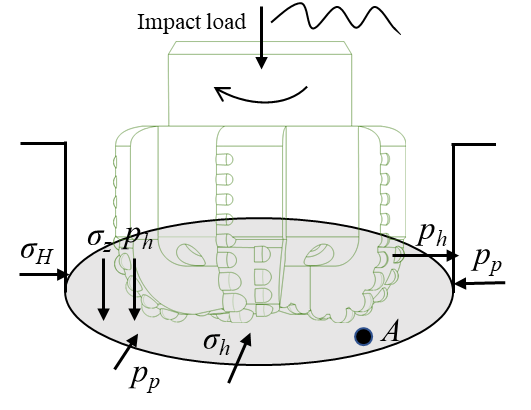
Deep geothermal resources are environmentally friendly and represent a highly competitive form of clean energy. However, low rock-breaking energy combined with high rock strength results in a low rate of penetration (ROP), which significantly restricts the efficient utilization of geothermal resources. Previous studies have shown that rock failure is primarily caused by shear stress. Therefore, this paper aims to enhance the shear stress level by increasing the impact load and releasing the confining pressure, thereby improving the ROP. Specifically, the rock-breaking efficiency under the coupling of impact load and confining pressure releasing is analyzed to reveal the influence of confining pressure releasing on shear stress. Furthermore, a rock-breaking model is established, and an impact load generator is employed to validate the proposed model, enabling the evaluation of rock-breaking efficiency under the coupled action of impact load and confining pressure releasing. The results indicate that the ratio of shear stress to $I_1$ dominates the rock-breaking process. When this ratio is low, the rock tends to remain in a compressed state, the hydrostatic pressure effect is enhanced, the shear stress effect is relatively weakened, and the rock-breaking efficiency decreases. The coupling of impact load with confining pressure releasing can achieve effective rock breaking under relatively low weight-on-bit conditions in deep wells, thereby providing theoretical support for improving rock-breaking efficiency in hot dry rock geothermal development.

Graphical Abstract
Mechanism of Penetration Rate Improvement in Hot Dry Rock Under the Coupling of Impact Load and Confining Pressure Release

Keywords
percussion drilling
rock breaking efficiency
rate of penetration
confining pressure releasing
impact load

Data Availability Statement
Data will be made available on request.

Funding
This work was supported in part by the Natural Science Basic Research Plan of Shaanxi Province of China under Grant 2024JC-YBQN-0474; in part by the Natural Science Special Project of Shaanxi Provincial Education Department of China under Grant 24JK0723; and in part by the Young Talent Fund of Association for Science and Technology in Yan'an under Grant YAU202506703.

Conflicts of Interest
The authors declare no conflicts of interest.

AI Use Statement
The authors declare that no generative AI was used in the preparation of this manuscript.

Ethical Approval and Consent to Participate
Not applicable.

References
  1. Brodsky, E. E., & Lajoie, L. J. (2013). Anthropogenic seismicity rates and operational parameters at the Salton Sea Geothermal Field. Science, 341(6145), 543–546.
    [CrossRef]   [Google Scholar]
  2. Hammond, A. L. (1973). Dry geothermal wells: Promising experimental results. Science, 182(4107), 43-44.
    [CrossRef]   [Google Scholar]
  3. Aldannawy, H. A., Rouabhi, A., & Gerbaud, L. (2022). Percussive drilling: Experimental and numerical investigations. Rock Mechanics and Rock Engineering, 55(3), 1555-1570.
    [CrossRef]   [Google Scholar]
  4. Liao, H., Wang, H., Niu, J., Wei, J., Niu, W., & Liu, J. (2022). Characteristics of stress release during downhole slotting by high-pressure water jet. Acta Petrolei Sinica, 43(9), 1325.
    [Google Scholar]
  5. Liu, W., Deng, H., Zhu, X., Li, R., & He, C. (2023). Experimental study of the rock cutting mechanism with PDC cutter under confining pressure condition. Rock Mechanics and Rock Engineering, 56(10), 7377–7396.
    [CrossRef]   [Google Scholar]
  6. Lundberg, B., & Collet, P. (2015). Optimal wave shape with respect to efficiency in percussive drilling with detachable drill bit. International Journal of Impact Engineering, 86, 179–187.
    [CrossRef]   [Google Scholar]
  7. Ma, Y., Zhao, H., Wu, Z., Zhang, H., Rong, Z., Zhang, X., & Yang, X. (2024). Study of rock-breaking performance of V-axe-shaped PDC cutter in tight sandstone formation. Geoenergy Science and Engineering, 241, 213123.
    [CrossRef]   [Google Scholar]
  8. Saksala, T. (2020). Thermal shock assisted percussive drilling: A numerical study on the single-bit axisymmetric case. International Journal of Rock Mechanics and Mining Sciences, 132, 104365.
    [CrossRef]   [Google Scholar]
  9. Simon, R. (1964). Transfer of the stress wave energy in the drill steel of a percussive drill to the rock. International Journal of Rock Mechanics and Mining Sciences & Geomechanics Abstracts, 1(4), 397–411.
    [CrossRef]   [Google Scholar]
  10. Song, H., Shi, H., Chen, Z., Li, G., Ji, R., & Chen, H. (2021). Numerical study on impact energy transfer and rock damage mechanism in percussive drilling based on high temperature hard rocks. Geothermics, 96, 102215.
    [CrossRef]   [Google Scholar]
  11. Wang, H. J., Liao, H. L., Wei, J., Liu, J. S., Niu, W. L., Liu, Y. W., ... & Latham, J. P. (2023). Stress release mechanism of deep bottom hole rock by ultra-high-pressure water jet slotting. Petroleum Science, 20(3), 1828-1842.
    [CrossRef]   [Google Scholar]
  12. Warren, T. M., & Smith, M. B. (1985). Bottomhole stress factors affecting drilling rate at depth. Journal of petroleum technology, 37(08), 1523-1533.
    [CrossRef]   [Google Scholar]
  13. Wu, K., & Ye, Z. (2019). The Numerical Research on Rock Breaking and Rising Mechanism of Rotary-Percussive Drilling. Arabian Journal for Science and Engineering, 44(12), 10561–10580.
    [CrossRef]   [Google Scholar]
  14. Xi, Y., Yao, Y., Zha, C., Li, J., Qi, Y., & Tian, Y. (2024). Experiment study and numerical simulation on the dynamic rock-breaking process of rotary percussive drilling with different cyclic and stress-wave frequencies. Petroleum Science and Technology, 42(23), 3497-3517.
    [CrossRef]   [Google Scholar]
  15. Yang, H., Yang, Y., Huang, Y., Zhang, H., & Xie, L. (2024a). Development and Optimization of a High-Frequency Axial-Torsional Composite Percussion Drilling Tool for Enhanced Impact Technology. SPE Journal, 29(2), 860–875.
    [CrossRef]   [Google Scholar]
  16. Yang, Y., Huang, F., Xu, Y., He, J., Deng, D., Zhan, S., & Zhang, C. (2025). Dynamics study of hot dry rock percussive drilling tool based on the drill string axial vibration. Geoenergy Science and Engineering, 246, 213599.
    [CrossRef]   [Google Scholar]
  17. Yang, Y., Huang, F., Yan, D., Liao, H., & Niu, J. (2024c). Characteristic analysis of a HDR percussive drilling tool with sinusoidal impact load. Geoenergy Science and Engineering, 238, 212847.
    [CrossRef]   [Google Scholar]
  18. Yang, Y., Liao, H., Niu, J., Wang, Z., & Chen, J. (2020). Three-dimensional simulation of rock breaking efficiency under various impact drilling loads. Arabian Journal of Geosciences, 13(12), 444.
    [CrossRef]   [Google Scholar]
  19. Yang, Y., Liao, H., Xu, Y., Niu, J., & Yang, L. (2019). Theoretical investigation of the energy transfer efficiency under percussive drilling loads. Arabian Journal of Geosciences, 12(5), 175.
    [CrossRef]   [Google Scholar]
  20. Yang, Y., Yan, D., Huang, F., & Liao, H. (2023, October). Hot dry rock breaking with PDC bit under various of impact loads. In ISRM Congress (pp. ISRM-15CONGRESS). ISRM.
    [Google Scholar]
  21. Zafarain, H., Ameri, M. J., & Dolatyari, A. (2024). Development of a rock-bit interaction analytical model by considering the in-situ stresses for a bottom-hole element. Scientific Reports, 14(1), 5903.
    [CrossRef]   [Google Scholar]
  22. Zhu, X., Liu, W., Shi, C., & Zhou, W. (2024). Experiment on the rock-breaking and speed-up mechanism under heavy-duty impact. Acta Petrolei Sinica, 45(10), 1529.
    [Google Scholar]
  23. Zhu, X., Wang, Y., & Liu, W. (2024b). The rock-breaking performance of the special-shaped PDC cutter under combined penetration and cutting. Geoenergy Science and Engineering, 243, 213338.
    [CrossRef]   [Google Scholar]
  24. Zou, Y., Li, J., He, L., & Zhao, J. (2016). Wave propagation in the vicinities of rock fractures under obliquely incident wave. Rock Mechanics and Rock Engineering, 49(5), 1789–1802.
    [CrossRef]   [Google Scholar]

Cite This Article
APA Style
Yang, Y., Huang, F., & Kang, S. (2026). Mechanism of Penetration Rate Improvement in Hot Dry Rock Under the Coupling of Impact Load and Confining Pressure Release. Reservoir Science, 2(1), 52–64. https://doi.org/10.62762/RS.2025.804345
Export Citation
RIS Format
Compatible with EndNote, Zotero, Mendeley, and other reference managers
RIS format data for reference managers
TY  - JOUR
AU  - Yang, Yandong
AU  - Huang, Feifei
AU  - Kang, Shaofei
PY  - 2026
DA  - 2026/01/26
TI  - Mechanism of Penetration Rate Improvement in Hot Dry Rock Under the Coupling of Impact Load and Confining Pressure Release
JO  - Reservoir Science
T2  - Reservoir Science
JF  - Reservoir Science
VL  - 2
IS  - 1
SP  - 52
EP  - 64
DO  - 10.62762/RS.2025.804345
UR  - https://www.icck.org/article/abs/RS.2025.804345
KW  - percussion drilling
KW  - rock breaking efficiency
KW  - rate of penetration
KW  - confining pressure releasing
KW  - impact load
AB  - Deep geothermal resources are environmentally friendly and represent a highly competitive form of clean energy. However, low rock-breaking energy combined with high rock strength results in a low rate of penetration (ROP), which significantly restricts the efficient utilization of geothermal resources. Previous studies have shown that rock failure is primarily caused by shear stress. Therefore, this paper aims to enhance the shear stress level by increasing the impact load and releasing the confining pressure, thereby improving the ROP. Specifically, the rock-breaking efficiency under the coupling of impact load and confining pressure releasing is analyzed to reveal the influence of confining pressure releasing on shear stress. Furthermore, a rock-breaking model is established, and an impact load generator is employed to validate the proposed model, enabling the evaluation of rock-breaking efficiency under the coupled action of impact load and confining pressure releasing. The results indicate that the ratio of shear stress to $I_1$ dominates the rock-breaking process. When this ratio is low, the rock tends to remain in a compressed state, the hydrostatic pressure effect is enhanced, the shear stress effect is relatively weakened, and the rock-breaking efficiency decreases. The coupling of impact load with confining pressure releasing can achieve effective rock breaking under relatively low weight-on-bit conditions in deep wells, thereby providing theoretical support for improving rock-breaking efficiency in hot dry rock geothermal development.
SN  - 3070-2356
PB  - Institute of Central Computation and Knowledge
LA  - English
ER  - 
BibTeX Format
Compatible with LaTeX, BibTeX, and other reference managers
BibTeX format data for LaTeX and reference managers
@article{Yang2026Mechanism,
  author = {Yandong Yang and Feifei Huang and Shaofei Kang},
  title = {Mechanism of Penetration Rate Improvement in Hot Dry Rock Under the Coupling of Impact Load and Confining Pressure Release},
  journal = {Reservoir Science},
  year = {2026},
  volume = {2},
  number = {1},
  pages = {52-64},
  doi = {10.62762/RS.2025.804345},
  url = {https://www.icck.org/article/abs/RS.2025.804345},
  abstract = {Deep geothermal resources are environmentally friendly and represent a highly competitive form of clean energy. However, low rock-breaking energy combined with high rock strength results in a low rate of penetration (ROP), which significantly restricts the efficient utilization of geothermal resources. Previous studies have shown that rock failure is primarily caused by shear stress. Therefore, this paper aims to enhance the shear stress level by increasing the impact load and releasing the confining pressure, thereby improving the ROP. Specifically, the rock-breaking efficiency under the coupling of impact load and confining pressure releasing is analyzed to reveal the influence of confining pressure releasing on shear stress. Furthermore, a rock-breaking model is established, and an impact load generator is employed to validate the proposed model, enabling the evaluation of rock-breaking efficiency under the coupled action of impact load and confining pressure releasing. The results indicate that the ratio of shear stress to \$I\_1\$ dominates the rock-breaking process. When this ratio is low, the rock tends to remain in a compressed state, the hydrostatic pressure effect is enhanced, the shear stress effect is relatively weakened, and the rock-breaking efficiency decreases. The coupling of impact load with confining pressure releasing can achieve effective rock breaking under relatively low weight-on-bit conditions in deep wells, thereby providing theoretical support for improving rock-breaking efficiency in hot dry rock geothermal development.},
  keywords = {percussion drilling, rock breaking efficiency, rate of penetration, confining pressure releasing, impact load},
  issn = {3070-2356},
  publisher = {Institute of Central Computation and Knowledge}
}

Article Metrics
Citations:

Crossref

0

Scopus

0

Web of Science

0
Article Access Statistics:
Views: 40
PDF Downloads: 8

Publisher's Note
ICCK stays neutral with regard to jurisdictional claims in published maps and institutional affiliations.

Rights and Permissions
CC BY Copyright © 2026 by the Author(s). Published by Institute of Central Computation and Knowledge. This article is an open access article distributed under the terms and conditions of the Creative Commons Attribution (CC BY) license (https://creativecommons.org/licenses/by/4.0/), which permits use, sharing, adaptation, distribution and reproduction in any medium or format, as long as you give appropriate credit to the original author(s) and the source, provide a link to the Creative Commons licence, and indicate if changes were made.
Reservoir Science

Reservoir Science

ISSN: 3070-2356 (Online)

Email: [email protected]

Portico

Portico

All published articles are preserved here permanently:
https://www.portico.org/publishers/icck/