


Fracturing Effectiveness Evaluation Based on Flowback Data Using Pressure Transient Testing



Article Information
Abstract
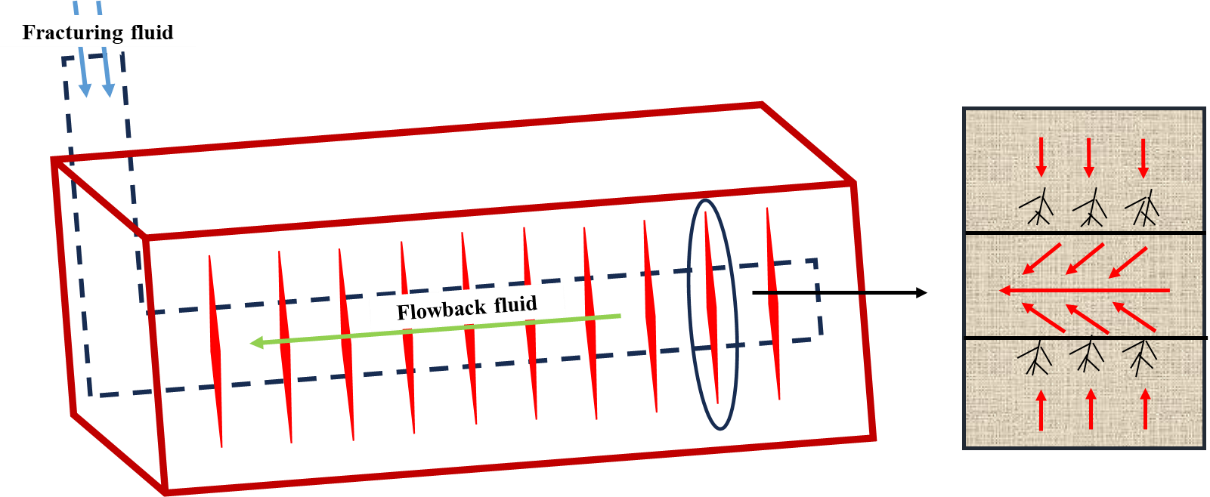
This study addresses fracturing performance evaluation during shale oil well flowback by developing a seepage flowback mathematical model and a water-phase evaluation framework. A method calculating effective fracture pore volume via flowback water production data is proposed. Using Well H flowback records, variable-production log-log well test plots and RNP-tm diagnostic charts were constructed for time-dependent fracturing effectiveness quantification. Key findings include: (1) Initial maximum cumulative water production derived from Arps harmonic decline model shows a semilogarithmic relationship between daily/cumulative water output; (2) Unit slope in fracturing fluid flowback indicates pseudosteady single-phase fracture depletion, while early positive slope deviation represents radial flow regime; (3) Complex fracture networks from stimulation reduce fluid seepage distances, transforming imbibition displacement into dominant mechanism and establishing fracture-dominated early flow imbibition-controlled sustained production progression. Field applications demonstrate the significance of flowback water production data in flow regime characterization and fracturing performance evaluation.
Graphical Abstract
Keywords
Data Availability Statement
Funding
Conflicts of Interest
AI Use Statement
Ethical Approval and Consent to Participate
References
- Abbasi, M. A., Dehghanpour, H., & Hawkes, R. V. (2012, October). Flowback analysis for fracture characterization. In SPE Canada Unconventional Resources Conference (pp. SPE-162661). SPE.
[CrossRef] [Google Scholar] - Clarkson, C. R., & Williams-Kovacs, J. D. (2013). Modeling two-phase flowback of multifractured horizontal wells completed in shale. SPE Journal, 18(4), 795-812.
[CrossRef] [Google Scholar] - Clarkson, C. R., & Williams-Kovacs, J. D. (2013, September). A new method for modeling multi-phase flowback of multi-fractured horizontal tight oil wells to determine hydraulic fracture properties. In SPE Annual Technical Conference and Exhibition? (p. D031S041R007). SPE.
[CrossRef] [Google Scholar] - Williams-Kovacs, J. D., Clarkson, C. R., & Zanganeh, B. (2015, October). Case studies in quantitative flowback analysis. In SPE Canada Unconventional Resources Conference (p. D011S003R004). SPE.
[CrossRef] [Google Scholar] - Fu, Y., Dehghanpour, H., Motealleh, S., Lopez, C. M., & Hawkes, R. (2019). Evaluating fracture volume loss during flowback and its relationship to choke size: fastback vs. slowback. SPE Production & Operations, 34(03), 615-624.
[CrossRef] [Google Scholar] - Lin, Y., Liu, S., Gao, S., Yuan, Y., Wang, J., & Xia, S. (2021). Study on the optimal design of volume fracturing for shale gas based on evaluating the fracturing effect—A case study on the Zhao Tong shale gas demonstration zone in Sichuan, China. Journal of Petroleum Exploration and Production, 11(4), 1705-1714.
[CrossRef] [Google Scholar] - Wu, J., Ren, L., Chang, C., Sheng, S., Zhu, J., Liu, S., ... & Wang, F. (2024). Diagnostics of Secondary Fracture Properties Using Pressure Decline Data during the Post-Fracturing Soaking Process for Shale Gas Wells. Processes, 12(2), 239.
[CrossRef] [Google Scholar] - Tang, D., Wu, J., Zhao, J., Zeng, B., Song, Y., Shen, C., ... & Wang, Z. (2024). The Inversion Method of Shale Gas Effective Fracture Network Volume Based on Flow Back Data—A Case Study of Southern Sichuan Basin Shale. Processes, 12(5), 1027.
[CrossRef] [Google Scholar] - Xing, C., Yin, H., Liu, K., Li, X., & Fu, J. (2018). Well test analysis for fractured and vuggy carbonate reservoirs of well drilling in large scale cave. Energies, 11(1), 80.
[CrossRef] [Google Scholar] - Chu, H., Liao, X., Dong, P., Chen, Z., Zhao, X., & Zou, J. (2019). An automatic classification method of well testing plot based on convolutional neural network (CNN). Energies, 12(15), 2846.
[CrossRef] [Google Scholar] - Chen, D., Wang, X., Yang, F., Chang, B., Liu, L., Wang, J., & Zhou, W. (2024). Pressure transient test analysis for deep fractured gas reservoirs in Tarim Basin. Energies, 17(7), 1717.
[CrossRef] [Google Scholar] - Zhang, Q., Wang, X., Wang, D., Zeng, J., Zeng, F., & Zhang, L. (2018). Pressure transient analysis for vertical fractured wells with fishbone fracture patterns. Journal of Natural Gas Science and Engineering, 52, 187-201.
[CrossRef] [Google Scholar] - Wang, S., Zhou, J., Zhang, L., Wang, Y., & Chen, T. (2024). Numerical insight into hydraulic fracture propagation in hot dry rock with complex natural fracture networks via fluid-solid coupling grain-based modeling. Energy, 295, 131060.
[CrossRef] [Google Scholar] - Wan, Y., Liu, Y., Chen, F., Wang, J., & Li, Z. (2018). Numerical well test model for caved carbonate reservoirs and its application in Tarim Basin, China. Journal of Petroleum Science and Engineering, 161, 611-624.
[CrossRef] [Google Scholar] - Zhang, Q., Wang, D., Zeng, F., Guo, Z., & Wei, N. (2020). Pressure transient behaviors of vertical fractured wells with asymmetric fracture patterns. Journal of Energy Resources Technology, 142(4), 043001.
[CrossRef] [Google Scholar] - Wang, B., Zhang, Q., Yao, S., Zeng, F., & Wang, D. (2022). A semi-analytical mathematical model for the pressure transient analysis of multiple fractured horizontal well with secondary fractures. Journal of Petroleum Science and Engineering, 208, 109444.
[CrossRef] [Google Scholar] - Li, N., Yang, K., & Kao, J. (2023). A new extended finite element model for gas flow in shale gas reservoirs with complex fracture networks. Arabian Journal of Geosciences, 16(9), 519.
[CrossRef] [Google Scholar] - Qin, J., Xu, Y., Tang, Y., Liang, R., Zhong, Q., Yu, W., & Sepehrnoori, K. (2022). Impact of complex fracture networks on rate transient behavior of wells in unconventional reservoirs based on embedded discrete fracture model. Journal of Energy Resources Technology, 144(8), 083007.
[CrossRef] [Google Scholar] - Chen, Y., Zhang, Q., Zhao, Z., Wang, L., & Liu, H. (2022). Semi-analytical model for the transient analysis of the pressure in vertically fractured wells in reservoirs considering the influence of natural fractures. Journal of Energy Resources Technology, 144(8), 083005.
[CrossRef] [Google Scholar] - Jiaming, Z., Zongxiao, R., Guiyi, Z., Zhenhua, P., Minjing, C., Liang, W., ... & Xinggang, M. (2022). Study on flow model of multi-stage fracturing horizontal well in stress-denpendent dual medium reservoir. Frontiers in Earth Science, 10, 990684.
[CrossRef] [Google Scholar] - Abbasi, M. A., Ezulike, D. O., Dehghanpour, H., & Hawkes, R. V. (2014). A comparative study of flowback rate and pressure transient behavior in multifractured horizontal wells completed in tight gas and oil reservoirs. Journal of Natural Gas Science and Engineering, 17, 82-93.
[CrossRef] [Google Scholar] - Wang, Y., Lei, Z., Xu, Z., Liu, J., Zhang, X., Luo, E., ... & Liu, P. (2021). A Novel Mathematical Model for Fracturing Effect Evaluation Based on Early Flowback Data in Shale Oil Reservoirs. Geofluids, 2021(1), 1780937.
[CrossRef] [Google Scholar] - Chen, Q., Wang, S., Zhu, D., Ren, G., Zhang, Y., & Hu, J. (2020). A comprehensive model for estimating stimulated reservoir volume based on flowback data in shale gas reservoirs. Geofluids, 2020(1), 8886988.
[CrossRef] [Google Scholar] - Williams-Kovacs, J. D., & Clarkson, C. R. (2013, November). Stochastic modeling of multi-phase flowback from multi-fractured horizontal tight oil wells. In SPE Canada Unconventional Resources Conference (pp. SPE-167232). SPE.
[CrossRef] [Google Scholar] - Xiao, J., Ke, X., & Wu, H. (2021). Production decline analysis and hydraulic fracture network interpretation method for shale gas with consideration of fracturing fluid flowback data. Geofluids, 2021(1), 6076566.
[CrossRef] [Google Scholar] - Liao, K., Zhu, J., Sun, X., Zhang, S., & Ren, G. (2022). Numerical investigation on injected-fluid recovery and production performance following hydraulic fracturing in shale oil wells. Processes, 10(9), 1749.
[CrossRef] [Google Scholar] - Zhang, F., & Emami-Meybodi, H. (2020). Flowback fracture closure of multi-fractured horizontal wells in shale gas reservoirs. Journal of Petroleum Science and Engineering, 186, 106711.
[CrossRef] [Google Scholar] - Liu, S., Cao, N., Lou, Y., & Yuan, Y. (2023). A new approach for post-fracturing evaluation and productivity prediction based on a reservoir fracability index model in shale gas reservoirs. Journal of Petroleum Exploration and Production Technology, 13(8), 1807-1818.
[CrossRef] [Google Scholar] - Huang, Y., Li, X., Guo, W., Liu, X., Lin, W., Qian, C., ... & Shi, X. (2023). Research on productivity evaluation method based on shale gas well early flow stage data. Geofluids, 2023(1), 2529837.
[CrossRef] [Google Scholar] - Zhang, Q., Wang, B., Chen, W., Wang, W., & Zeng, F. (2021). Pressure transient analysis of vertically fractured wells with multi-wing complex fractures. Petroleum Science and Technology, 39(9-10), 323-350.
[CrossRef] [Google Scholar] - Ren, L., Dou, M., Dong, X., Chen, B., Zhang, L., Sun, J., ... & Li, H. (2024). Quantitative characterization of stimulated reservoir volume (SRV) fracturing effects in naturally fractured unconventional hydrocarbon reservoirs. Frontiers in Earth Science, 12, 1419631.
[Google Scholar] - Kang, L., Wang, G., Zhang, X., Guo, W., Liang, B., Jiang, P., ... & Sun, Y. (2024). Dynamic pressure analysis of shale gas wells considering three-dimensional distribution and properties of the hydraulic fracture network. Processes, 12(2), 286.
[CrossRef] [Google Scholar] - Li, L., YaWan, T., Aiwei, Z., Qian, Z., Yimin, W., & Jin, C. (2024). New approach of evaluating fracturing interference based on wellhead pressure monitoring data: a case study from the well group-A of Fuling shale gas field. Journal of Petroleum Exploration and Production Technology, 14(1), 139-148.
[CrossRef] [Google Scholar]
Cite This Article
TY  - JOUR
AU  - Tian, Luo
AU  - Zhang, Qiushi
AU  - Li, Xingcai
AU  - Li, Cunlei
PY  - 2026
DA  - 2026/03/15
TI  - Fracturing Effectiveness Evaluation Based on Flowback Data Using Pressure Transient Testing
JO  - Reservoir Science
T2  - Reservoir Science
JF  - Reservoir Science
VL  - 2
IS  - 2
SP  - 97
EP  - 110
DO  - 10.62762/RS.2026.228817
UR  - https://www.icck.org/article/abs/RS.2026.228817
KW  - fracturing flowback data
KW  - flowback seepage
KW  - fracturing effectiveness evaluation
KW  - variable production conditions
KW  - unsteady well testing
AB  - This study addresses fracturing performance evaluation during shale oil well flowback by developing a seepage flowback mathematical model and a water-phase evaluation framework. A method calculating effective fracture pore volume via flowback water production data is proposed. Using Well H flowback records, variable-production log-log well test plots and RNP-tm diagnostic charts were constructed for time-dependent fracturing effectiveness quantification. Key findings include: (1) Initial maximum cumulative water production derived from Arps harmonic decline model shows a semilogarithmic relationship between daily/cumulative water output; (2) Unit slope in fracturing fluid flowback indicates pseudosteady single-phase fracture depletion, while early positive slope deviation represents radial flow regime; (3) Complex fracture networks from stimulation reduce fluid seepage distances, transforming imbibition displacement into dominant mechanism and establishing fracture-dominated early flow imbibition-controlled sustained production progression. Field applications demonstrate the significance of flowback water production data in flow regime characterization and fracturing performance evaluation.
SN  - 3070-2356
PB  - Institute of Central Computation and Knowledge
LA  - English
ER  -
@article{Tian2026Fracturing,
  author = {Luo Tian and Qiushi Zhang and Xingcai Li and Cunlei Li},
  title = {Fracturing Effectiveness Evaluation Based on Flowback Data Using Pressure Transient Testing},
  journal = {Reservoir Science},
  year = {2026},
  volume = {2},
  number = {2},
  pages = {97-110},
  doi = {10.62762/RS.2026.228817},
  url = {https://www.icck.org/article/abs/RS.2026.228817},
  abstract = {This study addresses fracturing performance evaluation during shale oil well flowback by developing a seepage flowback mathematical model and a water-phase evaluation framework. A method calculating effective fracture pore volume via flowback water production data is proposed. Using Well H flowback records, variable-production log-log well test plots and RNP-tm diagnostic charts were constructed for time-dependent fracturing effectiveness quantification. Key findings include: (1) Initial maximum cumulative water production derived from Arps harmonic decline model shows a semilogarithmic relationship between daily/cumulative water output; (2) Unit slope in fracturing fluid flowback indicates pseudosteady single-phase fracture depletion, while early positive slope deviation represents radial flow regime; (3) Complex fracture networks from stimulation reduce fluid seepage distances, transforming imbibition displacement into dominant mechanism and establishing fracture-dominated early flow imbibition-controlled sustained production progression. Field applications demonstrate the significance of flowback water production data in flow regime characterization and fracturing performance evaluation.},
  keywords = {fracturing flowback data, flowback seepage, fracturing effectiveness evaluation, variable production conditions, unsteady well testing},
  issn = {3070-2356},
  publisher = {Institute of Central Computation and Knowledge}
}
Article Metrics
Publisher's Note
ICCK stays neutral with regard to jurisdictional claims in published maps and institutional affiliations.
Rights and Permissions
 Copyright © 2026 by the Author(s). Published by Institute of Central Computation and Knowledge. This article is an open access article distributed under the terms and conditions of the Creative Commons Attribution (CC BY) license (https://creativecommons.org/licenses/by/4.0/), which permits use, sharing, adaptation, distribution and reproduction in any medium or format, as long as you give appropriate credit to the original author(s) and the source, provide a link to the Creative Commons licence, and indicate if changes were made.

