
Volume 2, Issue 1, ICCK Transactions on Advanced Computing and Systems
Volume 2, Issue 1, 2026
Submit Manuscript Edit a Special Issue
Article QR Code
Article QR Code
Scan the QR code for reading
Popular articles
ICCK Transactions on Advanced Computing and Systems, Volume 2, Issue 1, 2026: 42-52

Open Access | Research Article | 12 January 2026
Hybrid XGBoost-CNN Model for Anomaly Detection: A New Approach for IoT Wireless Sensor Networks
1 Department of Computer Engineering, Chungbuk National University, Cheongju, Republic of Korea
2 Department of Computer Engineering, University of Isfahan, Isfahan, Iran
3 Department of Artificial Intelligence, Tashkent State University of Economics, Tashkent 100066, Uzbekistan
4 Department of Computer Systems, Tashkent University of Information Technologies Named after Muhammad Al-Khwarizmi, Tashkent 100200, Uzbekistan
5 School of Computer Science and Technology, Chongqing University of Posts and Telecommunications, Chongqing 400065, China
6 Health Services Academy, Government of Pakistan, Chak Shahzad, Islamabad, Pakistan
7 School of Computer Science and Technology, University of Science and Technology of China, Hefei 230027, China
* Corresponding Author: Habib Ullah, [email protected]
ARK: ark:/57805/tacs.2025.354651
Received: 11 June 2025, Accepted: 11 December 2025, Published: 12 January 2026  
Abstract
The Internet of Things (IoT) continues to expand rapidly, resulting in increasingly heterogeneous and complex wireless sensor networks (WSNs). Traditional anomaly detection approaches cannot cope with dynamic traffic patterns, high data volumes, and strict resource constraints. This study presents a hybrid XGBoost–CNN model that integrates XGBoost-based feature selection with a lightweight Convolutional Neural Network optimized for IoT environments. The proposed model was evaluated using real-world IoT traffic data and benchmarked against XGBoost, KNN, and SVM. Experimental results show that the hybrid approach improves detection accuracy by over 1%, increases throughput by 22–40%, and reduces computational cost by 4–8% compared with the baseline models. The model also demonstrated 1% higher energy efficiency under varying attack scenarios. These results indicate that combining the feature selection capabilities of XGBoost with CNN’s pattern extraction of CNN yields a scalable, accurate, and resource-efficient anomaly detection solution suitable for IoT-WSN devices.

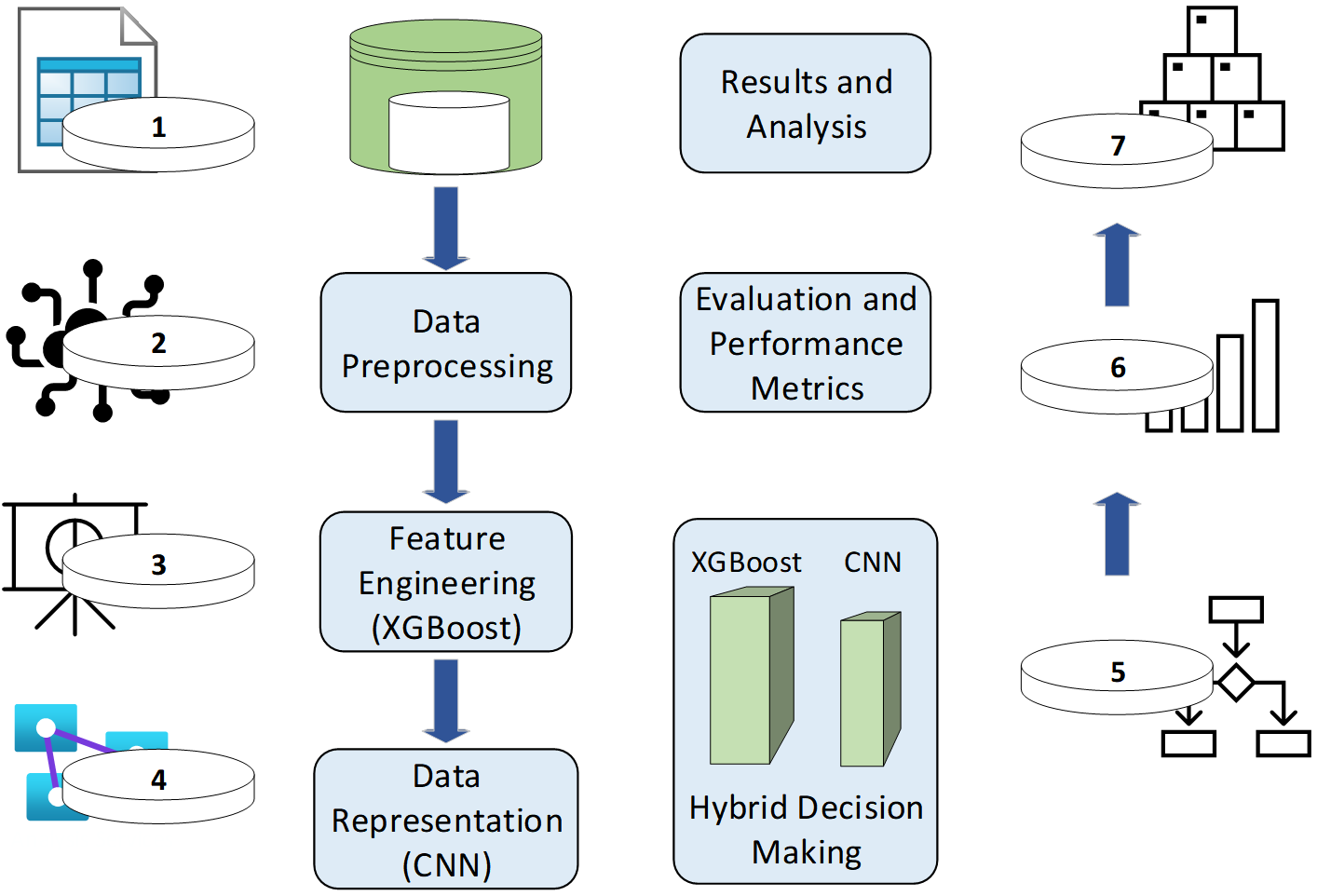
Graphical Abstract
Hybrid XGBoost-CNN Model for Anomaly Detection: A New Approach for IoT Wireless Sensor Networks

Keywords
IoT wireless sensor networks
anomaly detection
XGBoost
convolutional neural networks
feature selection
hybrid model
real-time detection

Data Availability Statement
Data will be made available on request.

Funding
This work was supported without any funding.

Conflicts of Interest
The authors declare no conflicts of interest.

Ethical Approval and Consent to Participate
Not applicable.

References
  1. Irshad, A., Mallah, G. A., Bilal, M., Chaudhry, S. A., Shafiq, M., & Song, H. (2023). SUSIC: A secure user access control mechanism for SDN-enabled IIoT and cyber–physical systems. IEEE Internet of Things Journal, 10(18), 16504-16515.
    [CrossRef]   [Google Scholar]
  2. Sajid, M., Malik, K. R., Almogren, A., Malik, T. S., Khan, A. H., Tanveer, J., & Rehman, A. U. (2024). Enhancing intrusion detection: a hybrid machine and deep learning approach. Journal of Cloud Computing, 13(1), 123.
    [CrossRef]   [Google Scholar]
  3. Pramila, R. S., & VA, T. P. S. (2024). Defense Mechanisms for Vehicular Networks: Deep Learning Approaches for Detecting DDoS Attacks. International Journal of Advanced Computer Science & Applications, 15(7).
    [CrossRef]   [Google Scholar]
  4. Abdullahi, M., Baashar, Y., Alhussian, H., Alwadain, A., Aziz, N., Capretz, L. F., & Abdulkadir, S. J. (2022). Detecting cybersecurity attacks in internet of things using artificial intelligence methods: A systematic literature review. Electronics, 11(2), 198.
    [CrossRef]   [Google Scholar]
  5. Akif, M. A., Butun, I., & Mahgoub, I. (2024, October). Harnessing machine learning for enhanced internet of things (iot) security and attack detection. In 2024 International Symposium on Networks, Computers and Communications (ISNCC) (pp. 1-6). IEEE.
    [CrossRef]   [Google Scholar]
  6. Sivaprasad Yerneni, K., Ravi Teja, A., Sri Harsha, K., & Naresh Kiran Kumar Reddy, Y. (2025). Towards Proactive Cloud Security: A Survey on ML and Deep Learning-Based Intrusion Detection Systems. J Contemp Edu Theo Artific Intel: JCETAI-116.
    [CrossRef]   [Google Scholar]
  7. Manivannan, D. (2024). Recent endeavors in machine learning-powered intrusion detection systems for the internet of things. Journal of Network and Computer Applications, 229, 103925.
    [CrossRef]   [Google Scholar]
  8. Adamova, A., Zhukabayeva, T., & Adamov, N. (2024). Machine Learning Algorithms for Intrusion Detection in IoT-enabled Smart Homes. Procedia Computer Science, 241, 427-432.
    [CrossRef]   [Google Scholar]
  9. Singh, A., Rani, P., Ramesh, J. V. N., Athawale, S. V., Alkhayyat, A. H., Aledaily, A. N., ... & Sharma, R. (2024). Blockchain-based lightweight authentication protocol for next-generation trustworthy internet of vehicles communication. IEEE Transactions on Consumer Electronics, 70(2), 4898-4907.
    [CrossRef]   [Google Scholar]
  10. Dashdondov, K., Kim, M. H., & Jo, K. (2023). NDAMA: A novel deep autoencoder and multivariate analysis approach for IOT-based methane gas leakage detection. IEEE Access, 11, 140740-140751.
    [CrossRef]   [Google Scholar]
  11. Shafiq, M., Tian, Z., Sun, Y., Du, X., & Guizani, M. (2020). Selection of effective machine learning algorithm and Bot-IoT attacks traffic identification for internet of things in smart city. Future Generation Computer Systems, 107, 433-442.
    [CrossRef]   [Google Scholar]
  12. Al-Garadi, M. A., Mohamed, A., Al-Ali, A. K., Du, X., Ali, I., & Guizani, M. (2020). A survey of machine and deep learning methods for internet of things (IoT) security. IEEE communications surveys & tutorials, 22(3), 1646-1685.
    [CrossRef]   [Google Scholar]
  13. Hasan, M., Islam, M. M., Zarif, M. I. I., & Hashem, M. M. A. (2019). Attack and anomaly detection in IoT sensors in IoT sites using machine learning approaches. Internet of Things, 7, 100059.
    [CrossRef]   [Google Scholar]
  14. Moustafa, N., & Slay, J. (2015, November). UNSW-NB15: a comprehensive data set for network intrusion detection systems (UNSW-NB15 network data set). In 2015 military communications and information systems conference (MilCIS) (pp. 1-6). IEEE.
    [CrossRef]   [Google Scholar]
  15. Huiqin, L., Liyang, X., Wenhua, Z., & Jianxun, M. (2023, December). Active Defense Detection Technology for Power System Network Attacks Based on Artificial Intelligence. In 2023 3rd International Conference on Mobile Networks and Wireless Communications (ICMNWC) (pp. 1-7). IEEE.
    [CrossRef]   [Google Scholar]
  16. Nguyen, X. H., & Le, K. H. (2023). Robust detection of unknown DoS/DDoS attacks in IoT networks using a hybrid learning model. Internet of Things, 23, 100851.
    [CrossRef]   [Google Scholar]
  17. Obidiagha, C. C., Rahouti, M., & Hayajneh, T. (2024). DeepImageDroid: A Hybrid Framework Leveraging Visual Transformers and Convolutional Neural Networks for Robust Android Malware Detection. IEEE Access.
    [CrossRef]   [Google Scholar]
  18. Thanigaivelu, P. S., Ranganathan, C. S., Priya, S., Asha, R. M., Murugan, S., & GaneshBabu, T. R. (2024, April). Securing Chemical Processing Plants using Isolation Forest Algorithm and IoT Sensors for Leakage Prevention. In 2024 International Conference on Inventive Computation Technologies (ICICT) (pp. 1848-1853). IEEE.
    [CrossRef]   [Google Scholar]
  19. Bilal, H., Obaidat, M. S., Aslam, M. S., Zhang, J., Yin, B., & Mahmood, K. (2024). Online fault diagnosis of industrial robot using IoRT and hybrid deep learning techniques: An experimental approach. IEEE Internet of Things Journal, 11(19), 31422-31437.
    [CrossRef]   [Google Scholar]
  20. Rosero-Montalvo, P. D., István, Z., Tözün, P., & Hernandez, W. (2023). Hybrid anomaly detection model on trusted IoT devices. IEEE Internet of Things Journal, 10(12), 10959–10969.
    [CrossRef]   [Google Scholar]
  21. Haider, Z. A., Khan, F. M., Zafar, A., & Khan, I. U. (2024). Optimizing Machine Learning Classifiers for Credit Card Fraud Detection on Highly Imbalanced Datasets Using PCA and SMOTE Techniques. VAWKUM Transactions on Computer Sciences, 12(2), 28-49.
    [CrossRef]   [Google Scholar]
  22. Behiry, M. H., & Aly, M. (2024). Cyberattack detection in wireless sensor networks using a hybrid feature reduction technique with AI and machine learning methods. Journal of Big Data, 11(1), 16.
    [CrossRef]   [Google Scholar]
  23. Otoum, Y., Liu, D., & Nayak, A. (2022). DL‐IDS: a deep learning–based intrusion detection framework for securing IoT. Transactions on Emerging Telecommunications Technologies, 33(3), e3803.
    [CrossRef]   [Google Scholar]
  24. Nayak, J., Naik, B., Dash, P. B., Vimal, S., & Kadry, S. (2022). Hybrid Bayesian optimization hypertuned catboost approach for malicious access and anomaly detection in IoT nomalyframework. Sustainable Computing: Informatics and Systems, 36, 100805.
    [CrossRef]   [Google Scholar]
  25. Khraisat, A., Gondal, I., Vamplew, P., & Kamruzzaman, J. (2019). Survey of intrusion detection systems: techniques, datasets and challenges. Cybersecurity, 2(1), 1-22.
    [CrossRef]   [Google Scholar]
  26. Haque, A., Chowdhury, N. U. R., Soliman, H., Hossen, M. S., Fatima, T., & Ahmed, I. (2023, September). Wireless sensor networks anomaly detection using machine learning: a survey. In Intelligent Systems Conference (pp. 491-506). Cham: Springer Nature Switzerland.
    [CrossRef]   [Google Scholar]
  27. Kasongo, S. M., & Sun, Y. (2020). A deep learning method with wrapper based feature extraction for wireless intrusion detection system. Computers & Security, 92, 101752.
    [CrossRef]   [Google Scholar]

Cite This Article
APA Style
Dashdondov, K., Chamazkoti, M. N., Abdusalomov, A., Ullah, H., Khan, M. Z., & Ali, B. S. (2026). Hybrid XGBoost-CNN Model for Anomaly Detection: A New Approach for IoT Wireless Sensor Networks. ICCK Transactions on Advanced Computing and Systems, 2(1), 42–52. https://doi.org/10.62762/TACS.2025.354651
Export Citation
RIS Format
Compatible with EndNote, Zotero, Mendeley, and other reference managers
RIS format data for reference managers
TY  - JOUR
AU  - Dashdondov, Khongorzul
AU  - Chamazkoti, Mahjoobe Nazari
AU  - Abdusalomov, Akmalbek
AU  - Ullah, Habib
AU  - Khan, Muhammad Zubair
AU  - Ali, Bakht Sher
PY  - 2026
DA  - 2026/01/12
TI  - Hybrid XGBoost-CNN Model for Anomaly Detection: A New Approach for IoT Wireless Sensor Networks
JO  - ICCK Transactions on Advanced Computing and Systems
T2  - ICCK Transactions on Advanced Computing and Systems
JF  - ICCK Transactions on Advanced Computing and Systems
VL  - 2
IS  - 1
SP  - 42
EP  - 52
DO  - 10.62762/TACS.2025.354651
UR  - https://www.icck.org/article/abs/TACS.2025.354651
KW  - IoT wireless sensor networks
KW  - anomaly detection
KW  - XGBoost
KW  - convolutional neural networks
KW  - feature selection
KW  - hybrid model
KW  - real-time detection
AB  - The Internet of Things (IoT) continues to expand rapidly, resulting in increasingly heterogeneous and complex wireless sensor networks (WSNs). Traditional anomaly detection approaches cannot cope with dynamic traffic patterns, high data volumes, and strict resource constraints. This study presents a hybrid XGBoost–CNN model that integrates XGBoost-based feature selection with a lightweight Convolutional Neural Network optimized for IoT environments. The proposed model was evaluated using real-world IoT traffic data and benchmarked against XGBoost, KNN, and SVM. Experimental results show that the hybrid approach improves detection accuracy by over 1%, increases throughput by 22–40%, and reduces computational cost by 4–8% compared with the baseline models. The model also demonstrated 1% higher energy efficiency under varying attack scenarios. These results indicate that combining the feature selection capabilities of XGBoost with CNN’s pattern extraction of CNN yields a scalable, accurate, and resource-efficient anomaly detection solution suitable for IoT-WSN devices.
SN  - 3068-7969
PB  - Institute of Central Computation and Knowledge
LA  - English
ER  - 
BibTeX Format
Compatible with LaTeX, BibTeX, and other reference managers
BibTeX format data for LaTeX and reference managers
@article{Dashdondov2026Hybrid,
  author = {Khongorzul Dashdondov and Mahjoobe Nazari Chamazkoti and Akmalbek Abdusalomov and Habib Ullah and Muhammad Zubair Khan and Bakht Sher Ali},
  title = {Hybrid XGBoost-CNN Model for Anomaly Detection: A New Approach for IoT Wireless Sensor Networks},
  journal = {ICCK Transactions on Advanced Computing and Systems},
  year = {2026},
  volume = {2},
  number = {1},
  pages = {42-52},
  doi = {10.62762/TACS.2025.354651},
  url = {https://www.icck.org/article/abs/TACS.2025.354651},
  abstract = {The Internet of Things (IoT) continues to expand rapidly, resulting in increasingly heterogeneous and complex wireless sensor networks (WSNs). Traditional anomaly detection approaches cannot cope with dynamic traffic patterns, high data volumes, and strict resource constraints. This study presents a hybrid XGBoost–CNN model that integrates XGBoost-based feature selection with a lightweight Convolutional Neural Network optimized for IoT environments. The proposed model was evaluated using real-world IoT traffic data and benchmarked against XGBoost, KNN, and SVM. Experimental results show that the hybrid approach improves detection accuracy by over 1\%, increases throughput by 22–40\%, and reduces computational cost by 4–8\% compared with the baseline models. The model also demonstrated 1\% higher energy efficiency under varying attack scenarios. These results indicate that combining the feature selection capabilities of XGBoost with CNN’s pattern extraction of CNN yields a scalable, accurate, and resource-efficient anomaly detection solution suitable for IoT-WSN devices.},
  keywords = {IoT wireless sensor networks, anomaly detection, XGBoost, convolutional neural networks, feature selection, hybrid model, real-time detection},
  issn = {3068-7969},
  publisher = {Institute of Central Computation and Knowledge}
}

Article Metrics
Citations:

Crossref

0

Scopus

0

Web of Science

0
Article Access Statistics:
Views: 120
PDF Downloads: 21

Publisher's Note
ICCK stays neutral with regard to jurisdictional claims in published maps and institutional affiliations.

Rights and Permissions
CC BY Copyright © 2026 by the Author(s). Published by Institute of Central Computation and Knowledge. This article is an open access article distributed under the terms and conditions of the Creative Commons Attribution (CC BY) license (https://creativecommons.org/licenses/by/4.0/), which permits use, sharing, adaptation, distribution and reproduction in any medium or format, as long as you give appropriate credit to the original author(s) and the source, provide a link to the Creative Commons licence, and indicate if changes were made.
ICCK Transactions on Advanced Computing and Systems

ICCK Transactions on Advanced Computing and Systems

ISSN: 3068-7969 (Online)

Email: [email protected]

Portico

Portico

All published articles are preserved here permanently:
https://www.portico.org/publishers/icck/