
RETRACTED: Graph-Driven Multimodal Feature Learning Framework for Apparent Personality Assessment








Article Information
Abstract
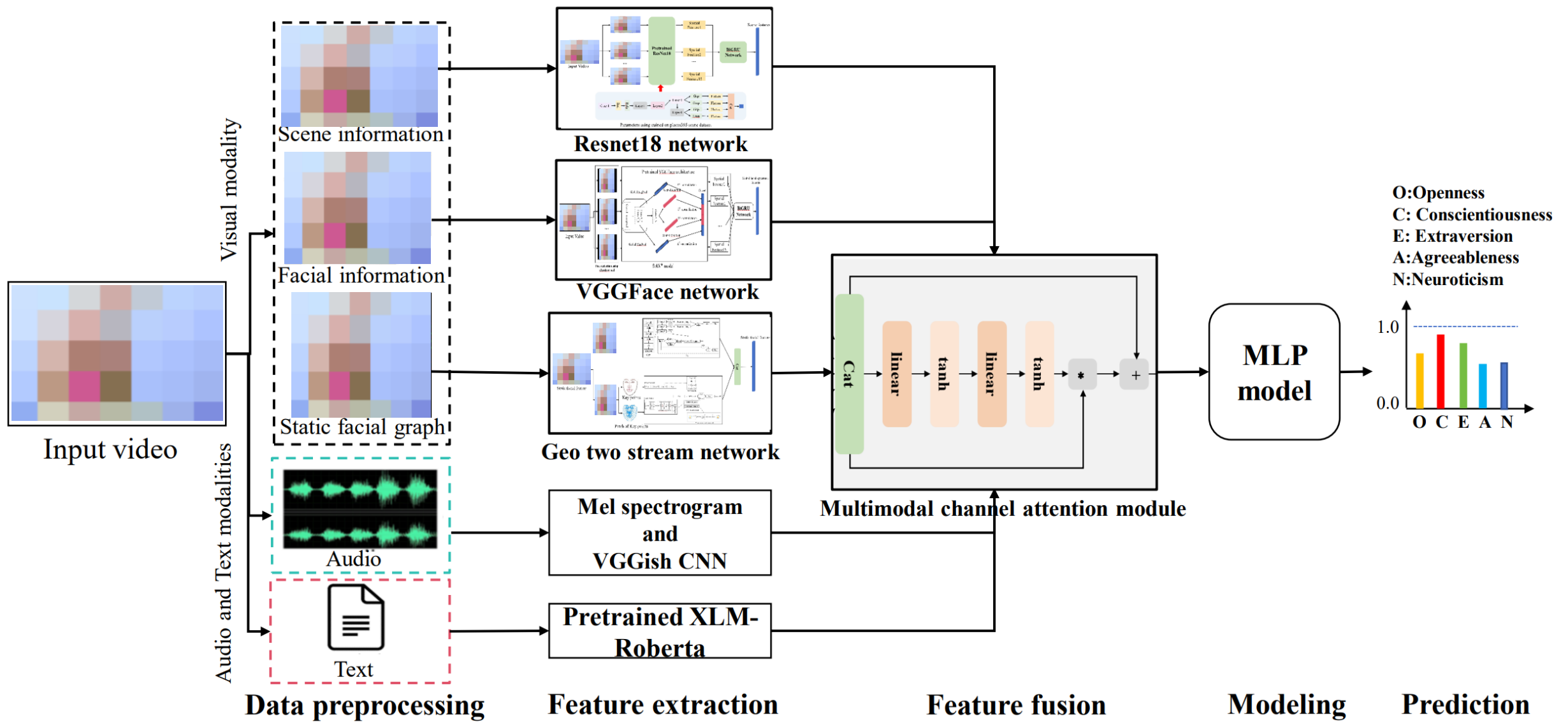
Predicting personality traits automatically has emerged as a challenging problem in computer vision. This paper introduces an innovative multimodal feature learning framework for personality analysis in short video clips. For visual processing, we construct a facial graph and design a Geo-based two-stream network incorporating an attention mechanism, leveraging both Graph Convolutional Networks (GCN) and Convolutional Neural Networks (CNN) to capture static facial expressions. Additionally, ResNet18 and VGGFace networks are employed to extract global scene and facial appearance features at the frame level. To capture dynamic temporal information, we integrate a BiGRU with a temporal attention module for extracting salient frame representations. To further enhance the model’s robustness, we incorporate the VGGish CNN for audio-based features and XLM-Roberta for text-based features. Finally, a multimodal channel attention mechanism is introduced to integrate different modalities, and a Multi-Layer Perceptron (MLP) regression model is utilized to predict personality traits. Experimental results confirm that our proposed framework surpasses existing state-of-the-art approaches in performance.
Graphical Abstract
Keywords
Data Availability Statement
Funding
Conflicts of Interest
Ethical Approval and Consent to Participate
References
- Wei, X. S., Zhang, C. L., Zhang, H., & Wu, J. (2017). Deep bimodal regression of apparent personality traits from short video sequences. IEEE Transactions on Affective Computing, 9(3), 303-315.
[CrossRef] [Google Scholar] - Kaya, H., Gurpinar, F., & Ali Salah, A. (2017). Multi-modal score fusion and decision trees for explainable automatic job candidate screening from video cvs. In Proceedings of the IEEE conference on computer vision and pattern recognition workshops (pp. 1-9).
[CrossRef] [Google Scholar] - Güçlütürk, Y., Güçlü, U., Baro, X., Escalante, H. J., Guyon, I., Escalera, S., ... & Van Lier, R. (2017). Multimodal first impression analysis with deep residual networks. IEEE Transactions on Affective Computing, 9(3), 316-329.
[CrossRef] [Google Scholar] - Ventura, C., Masip, D., & Lapedriza, A. (2017). Interpreting cnn models for apparent personality trait regression. In Proceedings of the IEEE conference on computer vision and pattern recognition workshops (pp. 55-63).
[CrossRef] [Google Scholar] - Subramaniam, A., Patel, V., Mishra, A., Balasubramanian, P., & Mittal, A. (2016). Bi-modal first impressions recognition using temporally ordered deep audio and stochastic visual features. In Computer Vision–ECCV 2016 Workshops: Amsterdam, The Netherlands, October 8-10 and 15-16, 2016, Proceedings, Part III 14 (pp. 337-348). Springer International Publishing.
[CrossRef] [Google Scholar] - Suman, C., Saha, S., Gupta, A., Pandey, S. K., & Bhattacharyya, P. (2022). A multi-modal personality prediction system. Knowledge-Based Systems, 236, 107715.
[CrossRef] [Google Scholar] - Escalante, H. J., Kaya, H., Salah, A. A., Escalera, S., Güçlütürk, Y., Güçlü, U., ... & Van Lier, R. (2020). Modeling, recognizing, and explaining apparent personality from videos. IEEE Transactions on Affective Computing, 13(2), 894-911.
[CrossRef] [Google Scholar] - Mujtaba, D. F., & Mahapatra, N. R. (2021, December). Multi-task deep neural networks for multimodal personality trait prediction. In 2021 international conference on computational science and computational intelligence (CSCI) (pp. 85-91). IEEE.
[CrossRef] [Google Scholar] - Agrawal, T., Agarwal, D., Balazia, M., Sinha, N., & Bremond, F. (2021). Multimodal personality recognition using cross-attention transformer and behaviour encoding. arXiv preprint arXiv:2112.12180.
[Google Scholar] - Hershey, S., Chaudhuri, S., Ellis, D. P., Gemmeke, J. F., Jansen, A., Moore, R. C., ... & Wilson, K. (2017, March). CNN architectures for large-scale audio classification. In 2017 ieee international conference on acoustics, speech and signal processing (icassp) (pp. 131-135). IEEE.
[CrossRef] [Google Scholar] - Conneau, A., Khandelwal, K., Goyal, N., Chaudhary, V., Wenzek, G., Guzmán, F., ... & Stoyanov, V. (2020, July). Unsupervised cross-lingual representation learning at scale. In Proceedings of the 58th annual meeting of the association for computational linguistics (pp. 8440-8451).
[CrossRef] [Google Scholar] - Parkhi, O., Vedaldi, A., & Zisserman, A. (2015). Deep face recognition. In BMVC 2015-Proceedings of the British Machine Vision Conference 2015. British Machine Vision Association.
[Google Scholar] - Eddine Bekhouche, S., Dornaika, F., Ouafi, A., & Taleb-Ahmed, A. (2017). Personality traits and job candidate screening via analyzing facial videos. In Proceedings of the IEEE conference on computer vision and pattern recognition workshops (pp. 10-13).
[CrossRef] [Google Scholar] - Gürpinar, F., Kaya, H., & Salah, A. A. (2016, December). Multimodal fusion of audio, scene, and face features for first impression estimation. In 2016 23rd International conference on pattern recognition (ICPR) (pp. 43-48). IEEE.
[CrossRef] [Google Scholar] - Güçlütürk, Y., Güçlü, U., van Gerven, M. A., & van Lier, R. (2016). Deep impression: Audiovisual deep residual networks for multimodal apparent personality trait recognition. In Computer Vision–ECCV 2016 Workshops: Amsterdam, The Netherlands, October 8-10 and 15-16, 2016, Proceedings, Part III 14 (pp. 349-358). Springer International Publishing.
[CrossRef] [Google Scholar] - Zhang, C. L., Zhang, H., Wei, X. S., & Wu, J. (2016, October). Deep bimodal regression for apparent personality analysis. In European conference on computer vision (pp. 311-324). Cham: Springer International Publishing.
[CrossRef] [Google Scholar] - Vo, N. N., Liu, S., He, X., & Xu, G. (2018). Multimodal mixture density boosting network for personality mining. In Advances in Knowledge Discovery and Data Mining: 22nd Pacific-Asia Conference, PAKDD 2018, Melbourne, VIC, Australia, June 3-6, 2018, Proceedings, Part I 22 (pp. 644-655). Springer International Publishing.
[CrossRef] [Google Scholar] - Principi, R. D. P., Palmero, C., Junior, J. C. J., & Escalera, S. (2019). On the effect of observed subject biases in apparent personality analysis from audio-visual signals. IEEE Transactions on Affective Computing, 12(3), 607-621.
[CrossRef] [Google Scholar] - Zhao, X., Liao, Y., Tang, Z., Xu, Y., Tao, X., Wang, D., ... & Lu, H. (2023). Integrating audio and visual modalities for multimodal personality trait recognition via hybrid deep learning. Frontiers in Neuroscience, 16, 1107284.
[CrossRef] [Google Scholar] - Ponce-López, V., Chen, B., Oliu, M., Corneanu, C., Clapés, A., Guyon, I., ... & Escalera, S. (2016). Chalearn lap 2016: First round challenge on first impressions-dataset and results. In Computer Vision–ECCV 2016 Workshops: Amsterdam, The Netherlands, October 8-10 and 15-16, 2016, Proceedings, Part III 14 (pp. 400-418). Springer International Publishing.
[CrossRef] [Google Scholar]
Cited By (2)
-
Devraj Patel, Sunita V. Dhavale, Bhushan B. Mhetre. Personality in 3D: multimodal deep learning framework for big five trait prediction.
Neural Computing and Applications, 2026 , 38 (7).
[CrossRef] -
Kangsheng Wang, Chengwei Ye, Huanzhen Zhang, Linuo Xu, Shuyan Liu. Retraction Notice to "Graph-Driven Multimodal Feature Learning Framework for Apparent Personality Assessment".
ICCK Transactions on Emerging Topics in Artificial Intelligence, 2025 , 2 (2).
[CrossRef]
Cite This Article
TY  - JOUR
AU  - Wang, Kangsheng
AU  - Ye, Chengwei
AU  - Zhang, Huanzhen
AU  - Xu, Linuo
AU  - Liu, Shuyan
PY  - 2025
DA  - 2025/04/15
TI  - RETRACTED: Graph-Driven Multimodal Feature Learning Framework for Apparent Personality Assessment
JO  - ICCK Transactions on Emerging Topics in Artificial Intelligence
T2  - ICCK Transactions on Emerging Topics in Artificial Intelligence
JF  - ICCK Transactions on Emerging Topics in Artificial Intelligence
VL  - 2
IS  - 2
SP  - 57
EP  - 67
DO  - 10.62762/TETAI.2025.279350
UR  - https://www.icck.org/article/abs/tetai.2025.279350
KW  - personality prediction
KW  - facial graph
KW  - graph convolutional network(GCN)
KW  - convolutional neural network(CNN)
KW  - attention mechanism
KW  - geometric and appearance features
AB  - Predicting personality traits automatically has emerged as a challenging problem in computer vision. This paper introduces an innovative multimodal feature learning framework for personality analysis in short video clips. For visual processing, we construct a facial graph and design a Geo-based two-stream network incorporating an attention mechanism, leveraging both Graph Convolutional Networks (GCN) and Convolutional Neural Networks (CNN) to capture static facial expressions. Additionally, ResNet18 and VGGFace networks are employed to extract global scene and facial appearance features at the frame level. To capture dynamic temporal information, we integrate a BiGRU with a temporal attention module for extracting salient frame representations. To further enhance the model’s robustness, we incorporate the VGGish CNN for audio-based features and XLM-Roberta for text-based features. Finally, a multimodal channel attention mechanism is introduced to integrate different modalities, and a Multi-Layer Perceptron (MLP) regression model is utilized to predict personality traits. Experimental results confirm that our proposed framework surpasses existing state-of-the-art approaches in performance.
SN  - 3068-6652
PB  - Institute of Central Computation and Knowledge
LA  - English
ER  -
@article{Wang2025RETRACTED,
  author = {Kangsheng Wang and Chengwei Ye and Huanzhen Zhang and Linuo Xu and Shuyan Liu},
  title = {RETRACTED: Graph-Driven Multimodal Feature Learning Framework for Apparent Personality Assessment},
  journal = {ICCK Transactions on Emerging Topics in Artificial Intelligence},
  year = {2025},
  volume = {2},
  number = {2},
  pages = {57-67},
  doi = {10.62762/TETAI.2025.279350},
  url = {https://www.icck.org/article/abs/tetai.2025.279350},
  abstract = {Predicting personality traits automatically has emerged as a challenging problem in computer vision. This paper introduces an innovative multimodal feature learning framework for personality analysis in short video clips. For visual processing, we construct a facial graph and design a Geo-based two-stream network incorporating an attention mechanism, leveraging both Graph Convolutional Networks (GCN) and Convolutional Neural Networks (CNN) to capture static facial expressions. Additionally, ResNet18 and VGGFace networks are employed to extract global scene and facial appearance features at the frame level. To capture dynamic temporal information, we integrate a BiGRU with a temporal attention module for extracting salient frame representations. To further enhance the model’s robustness, we incorporate the VGGish CNN for audio-based features and XLM-Roberta for text-based features. Finally, a multimodal channel attention mechanism is introduced to integrate different modalities, and a Multi-Layer Perceptron (MLP) regression model is utilized to predict personality traits. Experimental results confirm that our proposed framework surpasses existing state-of-the-art approaches in performance.},
  keywords = {personality prediction, facial graph, graph convolutional network(GCN), convolutional neural network(CNN), attention mechanism, geometric and appearance features},
  issn = {3068-6652},
  publisher = {Institute of Central Computation and Knowledge}
}
Publisher's Note
ICCK stays neutral with regard to jurisdictional claims in published maps and institutional affiliations.
Rights and Permissions
 Copyright © 2025 by the Author(s). Published by Institute of Central Computation and Knowledge. This article is an open access article distributed under the terms and conditions of the Creative Commons Attribution (CC BY) license (https://creativecommons.org/licenses/by/4.0/), which permits use, sharing, adaptation, distribution and reproduction in any medium or format, as long as you give appropriate credit to the original author(s) and the source, provide a link to the Creative Commons licence, and indicate if changes were made.


Portico
