
Dynamic Spectrum Handoff in Cognitive Radio Networks via Improved TSP Modeling




Article Information
Abstract
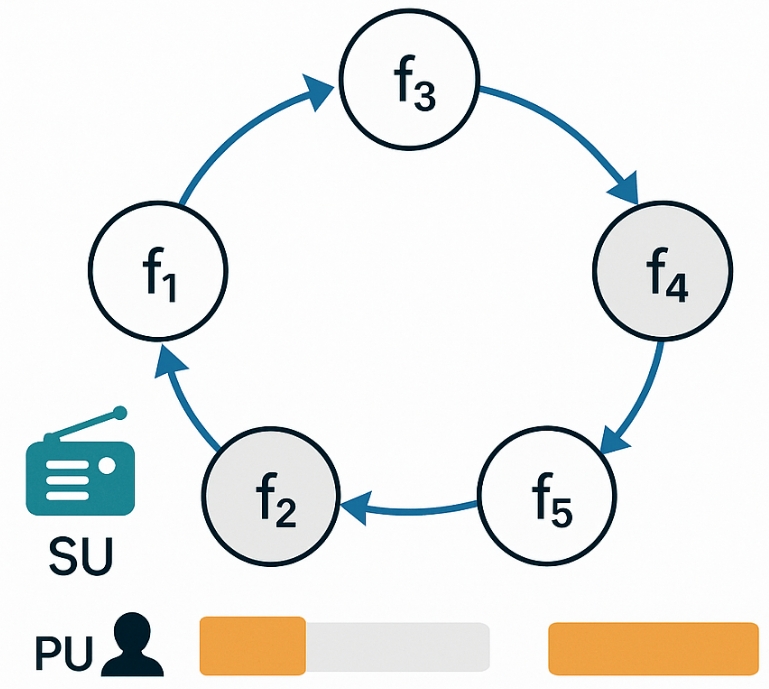
In cognitive radio networks (CRNs), dynamic spectrum handoff requires efficient path planning to minimize the overhead of frequent channel switching. This paper proposes a polynomial-time approximation algorithm for spectrum handoff scheduling, based on an improved Traveling Salesman Problem (TSP) modeling of the channel switching sequence. A two-phase cooperative mechanism is designed to minimize frequency-hopping overhead. We rapidly generate diverse candidate channel-switching sequences using a probabilistic method guided by real-time spectrum availability distributions. We dynamically merge locally optimal sub-paths by leveraging historical channel quality data and predicted primary user (PU) behavior in a fuzzy-logic framework. Theoretical analysis shows that the algorithm runs in worst-case O(N^4) time under a dynamic TSP variant, significantly outperforming traditional heuristic methods in scalability. Simulations demonstrate an average deviation of only 0.35% from the optimal solution. In dynamic interference scenarios, the proposed approach reduces spectrum switching delay by 41.2% compared to baseline strategies.Our algorithm effectively resolves distributed spectrum handoff conflicts in multi-user CRN scenarios.
Graphical Abstract
Keywords
Data Availability Statement
Funding
Conflicts of Interest
Ethical Approval and Consent to Participate
References
- Liu, L., Wang, N., Chen, Z., & Guo, L. (2018). A Novel Spectrum Scheduling Scheme with Ant Colony Optimization Algorithm. Algorithms, 11(2), 16.
[CrossRef] [Google Scholar] - Bai, W., Zheng, G., Xia, W., Mu, Y., & Xue, Y. (2025). Multi-User Opportunistic Spectrum Access for Cognitive Radio Networks Based on Multi-Head Self-Attention and Multi-Agent Deep Reinforcement Learning. Sensors, 25(7), 2025.
[CrossRef] [Google Scholar] - Maskery, M., Krishnamurthy, V., & Zhao, Q. (2009). Decentralized dynamic spectrum access for cognitive radios: Cooperative design of a non-cooperative game. IEEE Transactions on Communications, 57(2), 459-469.
[CrossRef] [Google Scholar] - Ji, Z., & Liu, K. R. (2007). Cognitive radios for dynamic spectrum access-dynamic spectrum sharing: A game theoretical overview. IEEE Communications Magazine, 45(5), 88-94.
[CrossRef] [Google Scholar] - Zhang, N., Liang, H., Cheng, N., Tang, Y., Mark, J. W., & Shen, X. S. (2014). Dynamic spectrum access in multi-channel cognitive radio networks. IEEE Journal on Selected Areas in Communications, 32(11), 2053-2064.
[CrossRef] [Google Scholar] - Daoudi, L., Baslam, M., & Safi, S. (2024). Dynamic Spectrum Allocation in Cognitive Radio Networks: A Fair Game With Asymmetric Information. In Spectrum and Power Allocation in Cognitive Radio Systems (pp. 78-96). IGI Global.
[CrossRef] [Google Scholar] - Wang, S., Huang, X. L., Hu, F., & Yu, S. (2025). A Fast-Convergence, Induced Dynamic Spectrum Access Based on Accelerated Q-Learning for Cognitive Radio Networks. IEEE Transactions on Vehicular Technology.
[CrossRef] [Google Scholar] - Rao, A. L. N., Ramesh, B., Jain, A., Alzubaidi, L. H., & Barolia, P. A. (2024, April). The Role of Cognitive Radio in Optimizing Spectrum Utilization. In 2024 IEEE 13th International Conference on Communication Systems and Network Technologies (CSNT) (pp. 176-182). IEEE.
[CrossRef] [Google Scholar] - Panda, S. B., Swain, P. K., Imoize, A. L., Tripathy, S. S., & Lee, C. C. (2025). A Robust Spectrum Allocation Framework Towards Inference Management in Multichannel Cognitive Radio Networks. International Journal of Communication Systems, 38(5), e6057.
[CrossRef] [Google Scholar] - Shrote, S. B., & Poshattiwar, S. D. (2024, October). Efficient Spectrum Sensing Parameter Adjustment in Cognitive Radio Systems. In 2024 IEEE International Conference on Blockchain and Distributed Systems Security (ICBDS) (pp. 1-7). IEEE.
[CrossRef] [Google Scholar]
Cite This Article
TY  - JOUR
AU  - Wu, Liangshun
AU  - Tao, Tao
PY  - 2025
DA  - 2025/07/13
TI  - Dynamic Spectrum Handoff in Cognitive Radio Networks via Improved TSP Modeling
JO  - ICCK Transactions on Green Communications and Networking
T2  - ICCK Transactions on Green Communications and Networking
JF  - ICCK Transactions on Green Communications and Networking
VL  - 1
IS  - 1
SP  - 1
EP  - 12
DO  - 10.62762/TGCN.2025.232754
UR  - https://www.icck.org/article/abs/tgcn.2025.232754
KW  - cognitive radio network (CRN)
KW  - dynamic spectrum handoff
KW  - traveling salesman problem (TSP)
KW  - spectrum scheduling
KW  - heuristic optimization
KW  - polynomial-time approximation
AB  - In cognitive radio networks (CRNs), dynamic spectrum handoff requires efficient path planning to minimize the overhead of frequent channel switching. This paper proposes a polynomial-time approximation algorithm for spectrum handoff scheduling, based on an improved Traveling Salesman Problem (TSP) modeling of the channel switching sequence. A two-phase cooperative mechanism is designed to minimize frequency-hopping overhead. We rapidly generate diverse candidate channel-switching sequences using a probabilistic method guided by real-time spectrum availability distributions. We dynamically merge locally optimal sub-paths by leveraging historical channel quality data and predicted primary user (PU) behavior in a fuzzy-logic framework. Theoretical analysis shows that the algorithm runs in worst-case O(N^4) time under a dynamic TSP variant, significantly outperforming traditional heuristic methods in scalability. Simulations demonstrate an average deviation of only 0.35% from the optimal solution. In dynamic interference scenarios, the proposed approach reduces spectrum switching delay by 41.2% compared to baseline strategies.Our algorithm effectively resolves distributed spectrum handoff conflicts in multi-user CRN scenarios.
SN  - pending
PB  - Institute of Central Computation and Knowledge
LA  - English
ER  -
@article{Wu2025Dynamic,
  author = {Liangshun Wu and Tao Tao},
  title = {Dynamic Spectrum Handoff in Cognitive Radio Networks via Improved TSP Modeling},
  journal = {ICCK Transactions on Green Communications and Networking},
  year = {2025},
  volume = {1},
  number = {1},
  pages = {1-12},
  doi = {10.62762/TGCN.2025.232754},
  url = {https://www.icck.org/article/abs/tgcn.2025.232754},
  abstract = {In cognitive radio networks (CRNs), dynamic spectrum handoff requires efficient path planning to minimize the overhead of frequent channel switching. This paper proposes a polynomial-time approximation algorithm for spectrum handoff scheduling, based on an improved Traveling Salesman Problem (TSP) modeling of the channel switching sequence. A two-phase cooperative mechanism is designed to minimize frequency-hopping overhead. We rapidly generate diverse candidate channel-switching sequences using a probabilistic method guided by real-time spectrum availability distributions. We dynamically merge locally optimal sub-paths by leveraging historical channel quality data and predicted primary user (PU) behavior in a fuzzy-logic framework. Theoretical analysis shows that the algorithm runs in worst-case O(N^4) time under a dynamic TSP variant, significantly outperforming traditional heuristic methods in scalability. Simulations demonstrate an average deviation of only 0.35\% from the optimal solution. In dynamic interference scenarios, the proposed approach reduces spectrum switching delay by 41.2\% compared to baseline strategies.Our algorithm effectively resolves distributed spectrum handoff conflicts in multi-user CRN scenarios.},
  keywords = {cognitive radio network (CRN), dynamic spectrum handoff, traveling salesman problem (TSP), spectrum scheduling, heuristic optimization, polynomial-time approximation},
  issn = {pending},
  publisher = {Institute of Central Computation and Knowledge}
}
Article Metrics
Publisher's Note
ICCK stays neutral with regard to jurisdictional claims in published maps and institutional affiliations.
Rights and Permissions


Portico
