MFE-YOLO: A Multi-feature Fusion Algorithm for Airport Bird Detection





Article Information
Abstract
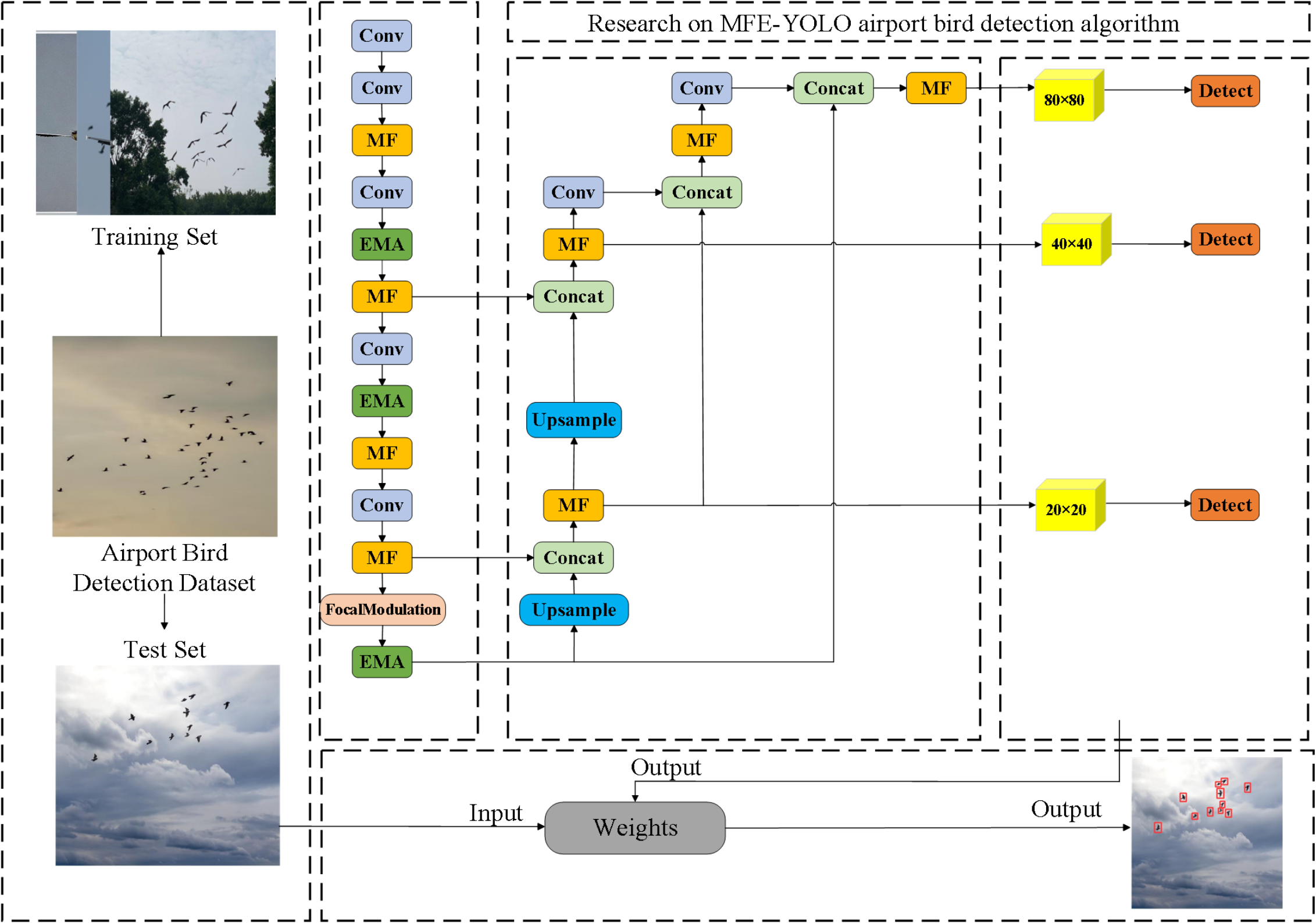
To address the issues of low accuracy in manual observation and slow detection by radar in airport bird detection, this paper designs a lightweight bird detection network named MFE-YOLO. This network is based on the YOLOv8 framework, with the main body part featuring an MF module replacing the original C2f module to enhance the network's feature extraction capability. An EMA mechanism is added to increase the focus on bird targets, and the Focal-Modulation module is introduced to reduce background interference. Additionally, a DCSlideLoss is designed during the supervised network training process to alleviate the imbalance of samples. Finally, the real-time detection performance is verified by combining the Byte Track algorithm, and generalization experiments are conducted on the public MS COCO dataset. The experimental results show that the MFE-YOLO algorithm has certain improvements in evaluation metrics such as Precision, Recall, and mean Average Precision, indicating that this algorithm has good detection performance and can achieve precise detection of birds in the low-altitude area of airports.
Graphical Abstract
Keywords
Data Availability Statement
Funding
Conflicts of Interest
Ethical Approval and Consent to Participate
References
- Liu, Z., Wang, Z., Cao, Y., Cai, S., Chen, W., & Lu, K. (2025). Risk assessment of bird strike at airport based on improved CRITIC-cloud model. Ecology and Environment, 34(1), 135.
[CrossRef] [Google Scholar] - Hu, Y., Xing, P., Yang, F., Feng, G., Yang, G., & Zhang, Z. (2020). A birdstrike risk assessment model and its application at Ordos Airport, China. Scientific Reports, 10(1), 19627.
[CrossRef] [Google Scholar] - Yu, C., Zhao, F., Yin, Y., & Wu, Y. (2025). Entropy-weighted TOPSIS-based bird strike risk assessment for an airport. International Journal of Computational Intelligence Systems, 18(1), 28.
[CrossRef] [Google Scholar] - Gong, J., Yan, J., Kong, D., & Li, D. (2024, September). Enhancing airport airspace safety: A small radar system for mitigating bird, drone, and wake vortex hazards. In 2024 AIAA DATC/IEEE 43rd Digital Avionics Systems Conference (DASC) (pp. 1-10). IEEE.
[CrossRef] [Google Scholar] - Wu, H., Cheng, Z., Wei, K., Ma, J., & Li, X. (2022, October). Performance Evaluation of Bird Detection Radar in the Application of Airports. In Proceedings of the 2022 6th International Conference on Electronic Information Technology and Computer Engineering (pp. 756-760).
[CrossRef] [Google Scholar] - Shakeri, M., & Zhang, H. (2012, July). Real-time bird detection based on background subtraction. In Proceedings of the 10th World Congress on Intelligent Control and Automation (pp. 4507-4510). IEEE.
[CrossRef] [Google Scholar] - Boudaoud, L. B., Maussang, F., Garello, R., & Chevallier, A. (2019, June). Marine bird detection based on deep learning using high-resolution aerial images. In OCEANS 2019-Marseille (pp. 1-7). IEEE.
[CrossRef] [Google Scholar] - Wang, R., Li, J., Shi, Y., & Sun, H. (2022). Vision-based path planning algorithm of unmanned bird-repelling vehicles in airports. Journal of Beijing University of Aeronautics and Astronautics, 50(5), 1446-1453.
[CrossRef] [Google Scholar] - Yang, F., Fan, H., Chu, P., Blasch, E., & Ling, H. (2019). Clustered object detection in aerial images. In Proceedings of the IEEE/CVF International Conference on Computer Vision (pp. 8311-8320).
[Google Scholar] - Ma, Q., Cai, J., & Chen, Q. (2025, July). Design of Airport Bird Detection Algorithm. In 2025 4th International Conference on Electronics, Integrated Circuits and Communication Technology (EICCT) (pp. 392-395). IEEE.
[CrossRef] [Google Scholar] - Yang, C., Huang, Z., & Wang, N. (2022). QueryDet: Cascaded sparse query for accelerating high-resolution small object detection. In Proceedings of the IEEE/CVF Conference on Computer Vision and Pattern Recognition (pp. 13668-13677).
[CrossRef] [Google Scholar] - Wu, T., Tang, S., Zhang, R., Cao, J., & Zhang, Y. (2020). CGNet: A light-weight context guided network for semantic segmentation. IEEE Transactions on Image Processing, 30, 1169-1179.
[CrossRef] [Google Scholar] - Ouyang, D., He, S., Zhang, G., Luo, M., Guo, H., Zhan, J., & Huang, Z. (2023, June). Efficient multi-scale attention module with cross-spatial learning. In ICASSP 2023-2023 IEEE International Conference on Acoustics, Speech and Signal Processing (ICASSP) (pp. 1-5). IEEE.
[CrossRef] [Google Scholar] - Yang, J., Li, C., Dai, X., & Gao, J. (2022). Focal modulation networks. Advances in Neural Information Processing Systems, 35, 4203-4217.
[Google Scholar] - Amirgaliyev, B., Mussabek, M., Rakhimzhanova, T., & Zhumadillayeva, A. (2025). A review of machine learning and deep learning methods for person detection, tracking and identification, and face recognition with applications. Sensors, 25(5), 1410.
[CrossRef] [Google Scholar] - Zou, Z., Chen, K., Shi, Z., Guo, Y., & Ye, J. (2023). Object detection in 20 years: A survey. Proceedings of the IEEE, 111(3), 257-276.
[CrossRef] [Google Scholar] - Cheng, G., Yuan, X., Yao, X., Yan, K., Zeng, Q., Xie, X., & Han, J. (2023). Towards large-scale small object detection: Survey and benchmarks. IEEE Transactions on Pattern Analysis and Machine Intelligence, 45(11), 13467-13488.
[CrossRef] [Google Scholar] - Liang, H., Zhang, X., Kong, J., Zhao, Z., & Ma, K. (2024). Smb-yolov5: A lightweight airport flying bird detection algorithm based on deep neural networks. IEEE Access, 12, 84878-84892.
[CrossRef] [Google Scholar] - Wang, C. Y., Bochkovskiy, A., & Liao, H. Y. M. (2023). YOLOv7: Trainable bag-of-freebies sets new state-of-the-art for real-time object detectors. In Proceedings of the IEEE/CVF Conference on Computer Vision and Pattern Recognition (pp. 7464-7475).
[CrossRef] [Google Scholar]
Cited By (4)
-
Lijun Mao, Tianxiang Zhou, Chenghui Nan. Rapid extraction of forest burned areas using Sentinel-2 satellite imagery on the PIE-engine platform.
Journal of Measurements in Engineering, 2026 , 14 (3).
[CrossRef] -
Lucija Žužić, Franko Hržić, Jonatan Lerga. Collision course detection for personal watercrafts using models based on recurrent neural networks.
Knowledge-Based Systems, 2026 , 333 .
[CrossRef] -
Peng Shi, Jingjing Guo, Lu Deng, Yingkai Liu, Lizhi Long, Shaopeng Xu. Enhanced recognition of low-discernibility Railway Sleeper Serial Numbers via dual-stage adaptive image enhancement and position prior-guided detection.
Engineering Applications of Artificial Intelligence, 2026 , 169 .
[CrossRef] -
Anoop Dev, Sachin Singh, Ashmeet Kaur, Neha, Satish Upadhyay, J. Refonaa. AI-ASSISTED RESTORATION OF FOLK MURALS.
ShodhKosh: Journal of Visual and Performing Arts, 2025 , 6 (1s).
[CrossRef]
Cite This Article
TY  - JOUR
AU  - Sun, Hui
AU  - Wang, Yukun
AU  - Du, Jingjin
AU  - Wang, Rui
PY  - 2025
DA  - 2025/05/21
TI  - MFE-YOLO: A Multi-feature Fusion Algorithm for Airport Bird Detection
JO  - ICCK Transactions on Intelligent Systematics
T2  - ICCK Transactions on Intelligent Systematics
JF  - ICCK Transactions on Intelligent Systematics
VL  - 2
IS  - 2
SP  - 85
EP  - 94
DO  - 10.62762/TIS.2025.323887
UR  - https://www.icck.org/article/abs/tis.2025.323887
KW  - airport bird detection
KW  - MFE-YOLO
KW  - multi-feature
KW  - attention mechanism
KW  - byte track algorithm
AB  - To address the issues of low accuracy in manual observation and slow detection by radar in airport bird detection, this paper designs a lightweight bird detection network named MFE-YOLO. This network is based on the YOLOv8 framework, with the main body part featuring an MF module replacing the original C2f module to enhance the network's feature extraction capability. An EMA mechanism is added to increase the focus on bird targets, and the Focal-Modulation module is introduced to reduce background interference. Additionally, a DCSlideLoss is designed during the supervised network training process to alleviate the imbalance of samples. Finally, the real-time detection performance is verified by combining the Byte Track algorithm, and generalization experiments are conducted on the public MS COCO dataset. The experimental results show that the MFE-YOLO algorithm has certain improvements in evaluation metrics such as Precision, Recall, and mean Average Precision, indicating that this algorithm has good detection performance and can achieve precise detection of birds in the low-altitude area of airports.
SN  - 3068-5079
PB  - Institute of Central Computation and Knowledge
LA  - English
ER  -
@article{Sun2025MFEYOLO,
  author = {Hui Sun and Yukun Wang and Jingjin Du and Rui Wang},
  title = {MFE-YOLO: A Multi-feature Fusion Algorithm for Airport Bird Detection},
  journal = {ICCK Transactions on Intelligent Systematics},
  year = {2025},
  volume = {2},
  number = {2},
  pages = {85-94},
  doi = {10.62762/TIS.2025.323887},
  url = {https://www.icck.org/article/abs/tis.2025.323887},
  abstract = {To address the issues of low accuracy in manual observation and slow detection by radar in airport bird detection, this paper designs a lightweight bird detection network named MFE-YOLO. This network is based on the YOLOv8 framework, with the main body part featuring an MF module replacing the original C2f module to enhance the network's feature extraction capability. An EMA mechanism is added to increase the focus on bird targets, and the Focal-Modulation module is introduced to reduce background interference. Additionally, a DCSlideLoss is designed during the supervised network training process to alleviate the imbalance of samples. Finally, the real-time detection performance is verified by combining the Byte Track algorithm, and generalization experiments are conducted on the public MS COCO dataset. The experimental results show that the MFE-YOLO algorithm has certain improvements in evaluation metrics such as Precision, Recall, and mean Average Precision, indicating that this algorithm has good detection performance and can achieve precise detection of birds in the low-altitude area of airports.},
  keywords = {airport bird detection, MFE-YOLO, multi-feature, attention mechanism, byte track algorithm},
  issn = {3068-5079},
  publisher = {Institute of Central Computation and Knowledge}
}
Publisher's Note
ICCK stays neutral with regard to jurisdictional claims in published maps and institutional affiliations.
Rights and Permissions


Portico