

Privacy-Preserving Machine Learning Using Homomorphic Encryption


Article Information
Abstract
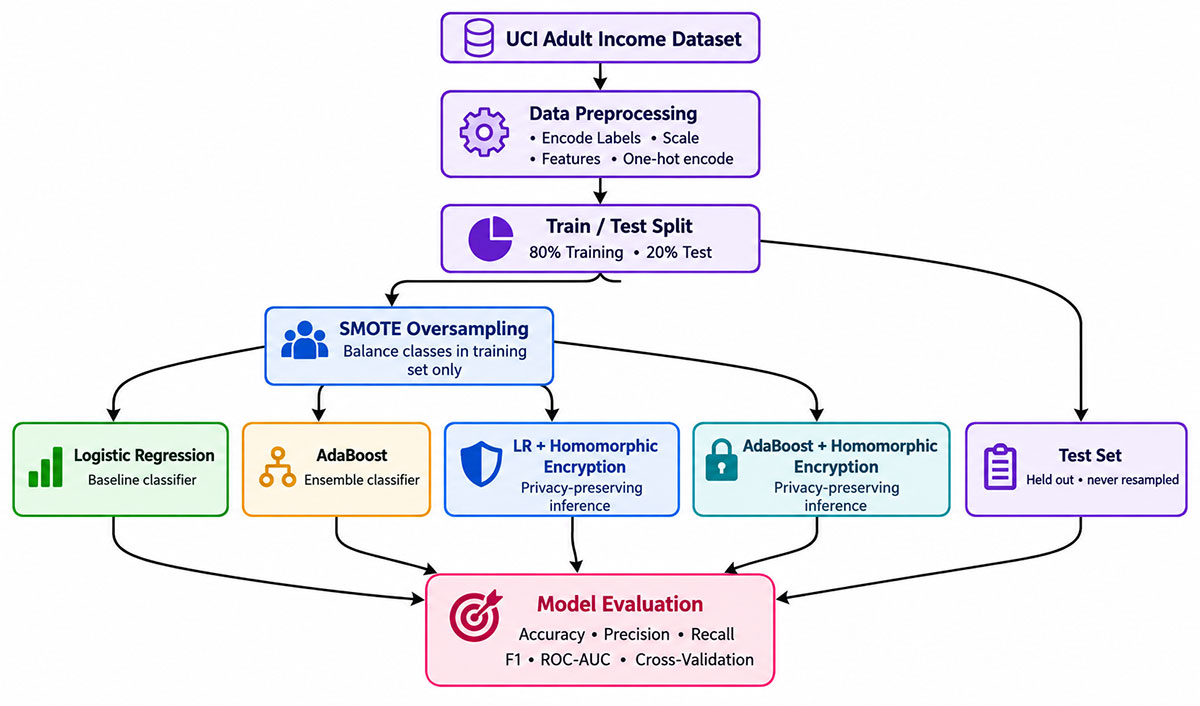
The exponential growth of machine learning applications in healthcare, finance, and cloud computing has raised significant data privacy concerns, as traditional encryption methods require access to decrypted data for processing, creating security vulnerabilities. Regulatory frameworks including the European Union's General Data Protection Regulation and the Health Insurance Portability and Accountability Act mandate privacy protection throughout the entire data management lifecycle. This research develops a privacy-preserving machine learning framework combining CKKS-based homomorphic encryption with Logistic Regression and AdaBoost classifiers using the UCI Adult Income dataset containing 48,842 records. Arithmetic verification demonstrates CKKS errors of \(2.17 \times 10^{-9}\) for addition, \(4.71 \times 10^{-9}\) for subtraction, and \(7.00 \times 10^{-9}\) for scalar multiplication. Plaintext evaluation shows AdaBoost outperforming Logistic Regression with accuracy of 0.8221, precision of 0.6072, F1 score of 0.6937, and ROC-AUC of 0.9108. Encrypted variants LR+HE and AdaBoost+HE produce results numerically identical to plaintext counterparts across all five evaluation metrics on 6,033 test instances, proving that encryption does not affect predictive performance. The study establishes CKKS-based homomorphic encryption as a secure and effective solution enabling organisations to perform machine learning inference while complying with regulatory requirements.
Graphical Abstract
Keywords
Data Availability Statement
Funding
Conflicts of Interest
AI Use Statement
Ethical Approval and Consent to Participate
References
- Mireshghallah, F., Taram, M., Vepakomma, P., Singh, A., Raskar, R., & Esmaeilzadeh, H. (2020). Privacy in deep learning: A survey. arXiv preprint arXiv:2004.12254.
[CrossRef] [Google Scholar] - El Mestari, S. Z., Lenzini, G., & Demirci, H. (2024). Preserving data privacy in machine learning systems. Computers & Security, 137, 103605.
[CrossRef] [Google Scholar] - Meier, D., & Troncoso Pastoriza, J. R. (2023). Privacy preserving machine learning. SSRN Electronic Journal.
[CrossRef] [Google Scholar] - Khalid, N., Qayyum, A., Bilal, M., Al-Fuqaha, A., & Qadir, J. (2023). Privacy-preserving artificial intelligence in healthcare: Techniques and applications. Computers in biology and medicine, 158, 106848.
[CrossRef] [Google Scholar] - Munjal, K., & Bhatia, R. (2023). A systematic review of homomorphic encryption and its contributions in healthcare industry: K. Munjal, R. Bhatia. Complex & Intelligent Systems, 9(4), 3759-3786.
[CrossRef] [Google Scholar] - Xu, R., Baracaldo, N., & Joshi, J. (2021). Privacy-preserving machine learning: Methods, challenges and directions. arXiv preprint arXiv:2108.04417.
[CrossRef] [Google Scholar] - Lou, Q., & Jiang, L. (2019). She: A fast and accurate deep neural network for encrypted data. Advances in neural information processing systems, 32.
[Google Scholar] - Truong, N., Sun, K., Wang, S., Guitton, F., & Guo, Y. (2021). Privacy preservation in federated learning: An insightful survey from the GDPR perspective. Computers & Security, 110, 102402.
[CrossRef] [Google Scholar] - Wu, L., Wang, X. A., Liu, J., Su, Y., Tu, Z., Liu, W., ... & Zhang, J. (2025). Homomorphic encryption for machine learning applications with ckks algorithms: A survey of developments and applications. Computers, Materials & Continua, 85(1), 89-119.
[CrossRef] [Google Scholar] - Al Badawi, A., Bates, J., Bergamaschi, F., Cousins, D. B., Erabelli, S., Genise, N., ... & Zucca, V. (2022, November). Openfhe: Open-source fully homomorphic encryption library. In proceedings of the 10th workshop on encrypted computing & applied homomorphic cryptography (pp. 53-63).
[CrossRef] [Google Scholar] - Benaissa, A., Retiat, B., Cebere, B., & Belfedhal, A. E. (2021). Tenseal: A library for encrypted tensor operations using homomorphic encryption. arXiv preprint arXiv:2104.03152.
[CrossRef] [Google Scholar] - Cheon, J. H., Kim, A., Kim, M., & Song, Y. (2017, November). Homomorphic encryption for arithmetic of approximate numbers. In International conference on the theory and application of cryptology and information security (pp. 409-437). Cham: Springer International Publishing.
[CrossRef] [Google Scholar] - Haq, F., Chen, C., & Chen, Z. (2025). Privacy-Preserving Classification of Medical Tabular Data with Homomorphic Encryption. Algorithms, 18(12), 731.
[CrossRef] [Google Scholar] - Sonkar, S. (2025). Recent Innovations in AI Privacy: Protecting Data in the Age of Machine Learning. International Journal of Scientific Research in Computer Science, Engineering and Information Technology, 11(2), 611-619.
[CrossRef] [Google Scholar] - Yuan, J., Liu, W., Shi, J., & Li, Q. (2025). Approximate homomorphic encryption based privacy-preserving machine learning: a survey. Artificial Intelligence Review, 58(3), 82.
[CrossRef] [Google Scholar] - Marcolla, C., Sucasas, V., Manzano, M., Bassoli, R., Fitzek, F. H. P., & Aaraj, N. (2022). Survey on fully homomorphic encryption, theory, and applications. Proceedings of the IEEE, 110(10), 1572-1609.
[CrossRef] [Google Scholar] - Vizitiu, A., Nita, C. I., Puiu, A., Suciu, C., & Itu, L. M. (2020). Applying deep neural networks over homomorphic encrypted medical data. Computational and mathematical methods in medicine, 2020(1), 3910250.
[CrossRef] [Google Scholar] - Salman, R. H., & Alomari, E. S. (2023). Survey: Homomorphic encryption-based deep learning that preserves privacy. International Academic Journal of Science and Engineering, 10(2), 153-163.
[CrossRef] [Google Scholar] - Fang, H., & Qian, Q. (2021). Privacy preserving machine learning with homomorphic encryption and federated learning. Future Internet, 13(4), 94.
[CrossRef] [Google Scholar] - Brand, M., & Pradel, G. (2023). Practical privacy-preserving machine learning using fully homomorphic encryption. Cryptology ePrint Archive. https://eprint.iacr.org/2023/1320
[Google Scholar] - Al Badawi, A., & Faizal Bin Yusof, M. (2024). Private pathological assessment via machine learning and homomorphic encryption. BioData Mining, 17(1), 33.
[CrossRef] [Google Scholar] - Walsh, L. (2021). Homomorphic encryption for privacy-preserving machine learning in cloud environments. International Journal of AI, Blockchain, and Digital Currency Management Systems, 2, 10-19.
[CrossRef] [Google Scholar] - Naresh, V. S., & Reddi, S. (2025). Exploring the future of privacy-preserving heart disease prediction: a fully homomorphic encryption-driven logistic regression approach. Journal of Big Data, 12(1), 52.
[CrossRef] [Google Scholar] - Hong, C. (2024). Recent advances of privacy-preserving machine learning based on (Fully) Homomorphic Encryption. Security and Safety, 4, 2024012.
[CrossRef] [Google Scholar] - Davoudi, M. (2020). Efficient and privacy-preserving AdaBoost classification framework for mining healthcare data over outsourced cloud [Master's thesis]. University of New Brunswick. https://unbscholar.dspace.lib.unb.ca/server/api/core/bitstreams/b80867ef-5bce-436a-963e-f87358a0dff8/content
[Google Scholar] - Naresh, V. S., & Thamarai, M. (2023). Privacy‐preserving data mining and machine learning in healthcare: Applications, challenges, and solutions. Wiley Interdisciplinary Reviews: Data Mining and Knowledge Discovery, 13(2), e1490.
[CrossRef] [Google Scholar]
Cite This Article
TY  - JOUR
AU  - Mohd, Abdul Kashif
AU  - Saleem, Nasir
AU  - Gogate, Mandar
AU  - Hussain, Adeel
AU  - Dashtipour, Kia
PY  - 2026
DA  - 2026/09/22
TI  - Privacy-Preserving Machine Learning Using Homomorphic Encryption
JO  - ICCK Transactions on Information Security and Cryptography
T2  - ICCK Transactions on Information Security and Cryptography
JF  - ICCK Transactions on Information Security and Cryptography
VL  - 2
IS  - 3
SP  - 159
EP  - 171
DO  - 10.62762/TISC.2026.247194
UR  - https://www.icck.org/article/abs/TISC.2026.247194
KW  - homomorphic encryption
KW  - privacy-preserving machine learning
KW  - CKKS
KW  - logistic regression
KW  - AdaBoost
KW  - encrypted inference
AB  - The exponential growth of machine learning applications in healthcare, finance, and cloud computing has raised significant data privacy concerns, as traditional encryption methods require access to decrypted data for processing, creating security vulnerabilities. Regulatory frameworks including the European Union's General Data Protection Regulation and the Health Insurance Portability and Accountability Act mandate privacy protection throughout the entire data management lifecycle. This research develops a privacy-preserving machine learning framework combining CKKS-based homomorphic encryption with Logistic Regression and AdaBoost classifiers using the UCI Adult Income dataset containing 48,842 records. Arithmetic verification demonstrates CKKS errors of \(2.17 \times 10^{-9}\) for addition, \(4.71 \times 10^{-9}\) for subtraction, and \(7.00 \times 10^{-9}\) for scalar multiplication. Plaintext evaluation shows AdaBoost outperforming Logistic Regression with accuracy of 0.8221, precision of 0.6072, F1 score of 0.6937, and ROC-AUC of 0.9108. Encrypted variants LR+HE and AdaBoost+HE produce results numerically identical to plaintext counterparts across all five evaluation metrics on 6,033 test instances, proving that encryption does not affect predictive performance. The study establishes CKKS-based homomorphic encryption as a secure and effective solution enabling organisations to perform machine learning inference while complying with regulatory requirements.
SN  - 3070-2429
PB  - Institute of Central Computation and Knowledge
LA  - English
ER  -
@article{Mohd2026PrivacyPre,
  author = {Abdul Kashif Mohd and Nasir Saleem and Mandar Gogate and Adeel Hussain and Kia Dashtipour},
  title = {Privacy-Preserving Machine Learning Using Homomorphic Encryption},
  journal = {ICCK Transactions on Information Security and Cryptography},
  year = {2026},
  volume = {2},
  number = {3},
  pages = {159-171},
  doi = {10.62762/TISC.2026.247194},
  url = {https://www.icck.org/article/abs/TISC.2026.247194},
  abstract = {The exponential growth of machine learning applications in healthcare, finance, and cloud computing has raised significant data privacy concerns, as traditional encryption methods require access to decrypted data for processing, creating security vulnerabilities. Regulatory frameworks including the European Union's General Data Protection Regulation and the Health Insurance Portability and Accountability Act mandate privacy protection throughout the entire data management lifecycle. This research develops a privacy-preserving machine learning framework combining CKKS-based homomorphic encryption with Logistic Regression and AdaBoost classifiers using the UCI Adult Income dataset containing 48,842 records. Arithmetic verification demonstrates CKKS errors of \(2.17 \times 10^{-9}\) for addition, \(4.71 \times 10^{-9}\) for subtraction, and \(7.00 \times 10^{-9}\) for scalar multiplication. Plaintext evaluation shows AdaBoost outperforming Logistic Regression with accuracy of 0.8221, precision of 0.6072, F1 score of 0.6937, and ROC-AUC of 0.9108. Encrypted variants LR+HE and AdaBoost+HE produce results numerically identical to plaintext counterparts across all five evaluation metrics on 6,033 test instances, proving that encryption does not affect predictive performance. The study establishes CKKS-based homomorphic encryption as a secure and effective solution enabling organisations to perform machine learning inference while complying with regulatory requirements.},
  keywords = {homomorphic encryption, privacy-preserving machine learning, CKKS, logistic regression, AdaBoost, encrypted inference},
  issn = {3070-2429},
  publisher = {Institute of Central Computation and Knowledge}
}
Article Metrics
Publisher's Note
ICCK stays neutral with regard to jurisdictional claims in published maps and institutional affiliations.
Rights and Permissions


Portico
