
Towards Economical Long-Form Summarization: A Chunk-Based Approach Using LLMs



Article Information
Abstract
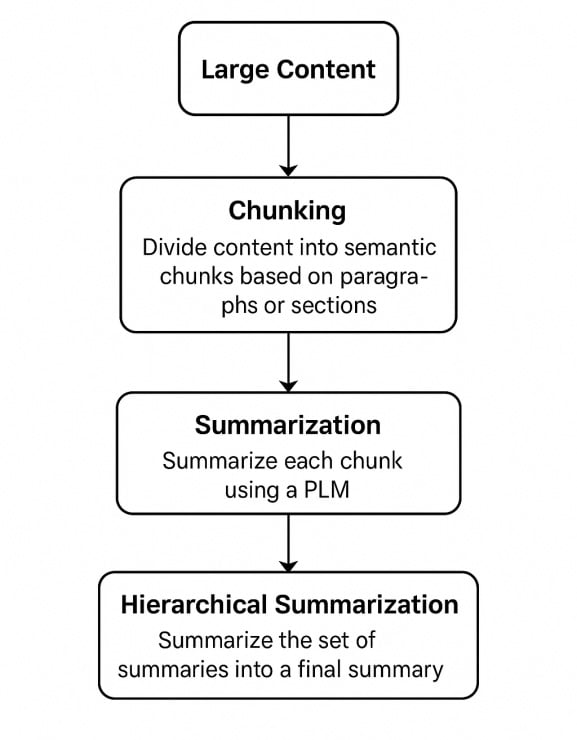
In today's world anything almost everything related to literature can be achieved by LLMs. Be it summarization, abstraction, translation, transformation, etc. But not always is it possible to do those operations on extremely large content. Even with the large token output limits of newly launched advanced LLMs it is not always economically and technically feasible to perform such operations. To cater to such a problem this paper explores the idea of summarization of extensive contents by a chunk-based approach which is both efficient and economical. This approach also understands the drawback of loss of information while chunking and efficiently solves that issue. The usage of such a framework is highly demandable across various enterprise software industries as well as healthcare and financial industries to store, summarize as well as query various large contents which are sometimes challenging to maintain and query. To create a generic framework the approach used for the summarization is mainly zero-shot summarization.
Graphical Abstract
Keywords
Data Availability Statement
Funding
Conflicts of Interest
Ethical Approval and Consent to Participate
References
- Soares, E. R., & Barrére, E. (2018, October). Automatic topic segmentation for video lectures using low and high-level audio features. In Proceedings of the 24th Brazilian Symposium on Multimedia and the Web (pp. 189-196).
[CrossRef] [Google Scholar] - Alesh, Y., Aoudia, M., Abdulghani, O., Al Ali, O., & Abu Talib, M. (2024, July). Abstractive Summarization of Lectures and Lecture Segments Transcripts with BART. In International Conference on Artificial Intelligence in Education Technology (pp. 43-55). Singapore: Springer Nature Singapore.
[CrossRef] [Google Scholar] - Parmar, M., Deilamsalehy, H., Dernoncourt, F., Yoon, S., Rossi, R. A., & Bui, T. (2024). Towards enhancing coherence in extractive summarization: Dataset and experiments with LLMs. arXiv preprint arXiv:2407.04855.
[Google Scholar] - Kotkar, A. D., Mahadik, R. S., More, P. G., & Thorat, S. A. (2024, August). Comparative analysis of transformer-based large language models (llms) for text summarization. In 2024 1st International Conference on Advanced Computing and Emerging Technologies (ACET) (pp. 1-7). IEEE.
[CrossRef] [Google Scholar] - Wilson, E., Saxena, A., Mahajan, J., Panikulangara, L., Kulkarni, S., & Jain, P. (2024, March). FIN2SUM: advancing AI-driven financial text summarization with LLMs. In 2024 International Conference on Trends in Quantum Computing and Emerging Business Technologies (pp. 1-5). IEEE.
[CrossRef] [Google Scholar] - Sojitra, D., Jain, R., Saha, S., Jatowt, A., & Gupta, M. (2024, July). Timeline summarization in the era of llms. In Proceedings of the 47th International ACM SIGIR Conference on Research and Development in Information Retrieval (pp. 2657-2661).
[CrossRef] [Google Scholar] - Provakar, M. M. (2024, October). Evaluating the Text Summarization Efficiency of Large Language Models. In 2024 2nd International Conference on Information and Communication Technology (ICICT) (pp. 6-10). IEEE.
[CrossRef] [Google Scholar] - Jiang, Z., Yang, J., & Rao, D. (2024, November). An Empirical Study of Leveraging PLMs and LLMs for Long-Text Summarization. In Pacific Rim International Conference on Artificial Intelligence (pp. 424-435). Singapore: Springer Nature Singapore.
[CrossRef] [Google Scholar] - Sultana, F., Fuad, M. T. H., Fahim, M., Rahman, R. R., Hossain, M., Amin, M. A., ... & Ali, A. A. (2024, December). How Good are LM and LLMs in Bangla Newspaper Article Summarization?. In International Conference on Pattern Recognition (pp. 72-86). Cham: Springer Nature Switzerland.
[CrossRef] [Google Scholar] - VarastehNezhad, A., Tavasoli, R., Masumi, M., Majd, S. S., & Shamsfard, M. (2024, December). Evaluating LLMs in Persian News Summarization. In 2024 15th International Conference on Information and Knowledge Technology (IKT) (pp. 195-201). IEEE.
[CrossRef] [Google Scholar] - Aljohani, A., Alharbi, R., Alkhaldi, A., & Aljedaani, W. (2025, February). Evaluating LLMs for Arabic Code Summarization: Challenges and Insights from GPT-4. In 2025 8th International Conference on Data Science and Machine Learning Applications (CDMA) (pp. 67-72). IEEE.
[CrossRef] [Google Scholar] - Xiao, W., Liu, Y., Li, X., Gao, F., & Gu, J. (2024, December). TKG-RAG: A Retrieval-Augmented Generation Framework with Text-chunk Knowledge Graph. In 2024 25th International Arab Conference on Information Technology (ACIT) (pp. 1-9). IEEE.
[CrossRef] [Google Scholar] - Thulke, D., Gao, Y., Jalota, R., Dugast, C., & Ney, H. (2024, November). Prompting and Fine-Tuning of Small LLMs for Length-Controllable Telephone Call Summarization. In 2024 2nd International Conference on Foundation and Large Language Models (FLLM) (pp. 305-312). IEEE.
[CrossRef] [Google Scholar]
Cite This Article
TY  - JOUR
AU  - Banerjee, Avishto
PY  - 2025
DA  - 2025/11/17
TI  - Towards Economical Long-Form Summarization: A Chunk-Based Approach Using LLMs
JO  - ICCK Transactions on Large Language Models
T2  - ICCK Transactions on Large Language Models
JF  - ICCK Transactions on Large Language Models
VL  - 1
IS  - 1
SP  - 4
EP  - 8
DO  - 10.62762/TLLM.2025.674475
UR  - https://www.icck.org/article/abs/tllm.2025.674475
KW  - LLMs
KW  - summarization
KW  - chunking
KW  - generative AI
KW  - NLP
AB  - In today's world anything almost everything related to literature can be achieved by LLMs. Be it summarization, abstraction, translation, transformation, etc. But not always is it possible to do those operations on extremely large content. Even with the large token output limits of newly launched advanced LLMs it is not always economically and technically feasible to perform such operations. To cater to such a problem this paper explores the idea of summarization of extensive contents by a chunk-based approach which is both efficient and economical. This approach also understands the drawback of loss of information while chunking and efficiently solves that issue. The usage of such a framework is highly demandable across various enterprise software industries as well as healthcare and financial industries to store, summarize as well as query various large contents which are sometimes challenging to maintain and query. To create a generic framework the approach used for the summarization is mainly zero-shot summarization.
SN  - request pending
PB  - Institute of Central Computation and Knowledge
LA  - English
ER  -
@article{Banerjee2025Towards,
  author = {Avishto Banerjee},
  title = {Towards Economical Long-Form Summarization: A Chunk-Based Approach Using LLMs},
  journal = {ICCK Transactions on Large Language Models},
  year = {2025},
  volume = {1},
  number = {1},
  pages = {4-8},
  doi = {10.62762/TLLM.2025.674475},
  url = {https://www.icck.org/article/abs/tllm.2025.674475},
  abstract = {In today's world anything almost everything related to literature can be achieved by LLMs. Be it summarization, abstraction, translation, transformation, etc. But not always is it possible to do those operations on extremely large content. Even with the large token output limits of newly launched advanced LLMs it is not always economically and technically feasible to perform such operations. To cater to such a problem this paper explores the idea of summarization of extensive contents by a chunk-based approach which is both efficient and economical. This approach also understands the drawback of loss of information while chunking and efficiently solves that issue. The usage of such a framework is highly demandable across various enterprise software industries as well as healthcare and financial industries to store, summarize as well as query various large contents which are sometimes challenging to maintain and query. To create a generic framework the approach used for the summarization is mainly zero-shot summarization.},
  keywords = {LLMs, summarization, chunking, generative AI, NLP},
  issn = {request pending},
  publisher = {Institute of Central Computation and Knowledge}
}
Article Metrics
Publisher's Note
ICCK stays neutral with regard to jurisdictional claims in published maps and institutional affiliations.
Rights and Permissions


Portico
