

Performance Analysis of DC Motor in SISO Circuit Using LQR Control Method: A Comparative Evaluation of Stability and Optimization


Article Information
Abstract
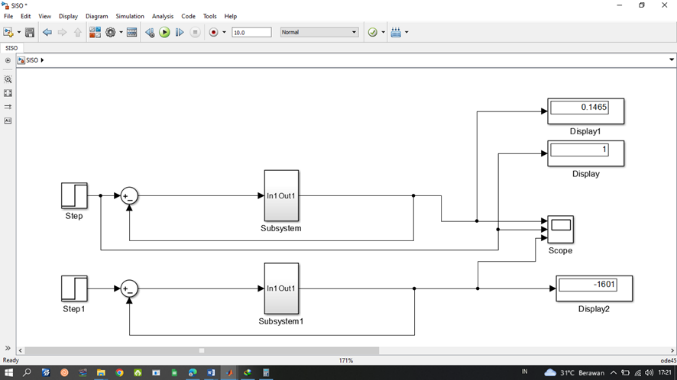
The rapid advancement of telecommunications has significantly influenced various engineering applications, including control systems for electrical and mechanical systems. One crucial aspect of control system design is ensuring signal integrity and stability, particularly in Single-Input Single-Output (SISO) circuits. In this study, we analyze the performance of a DC motor within a SISO circuit using Linear Quadratic Regulator (LQR) and Linear Quadratic Tracking (LQT) control methods. The research employs a simulation-based approach, evaluating first-order and second-order system responses under different conditions, including scenarios with and without external noise interference. Experimental results indicate that each control approach exhibits distinct dynamic characteristics, influencing system stability, response time, and noise suppression capability. The presence of noise significantly affects system behavior, leading to deviations from the desired set point. An optimal control circuit is defined by minimal ripple, rapid convergence to the set point, and robustness against disturbances. Comparative analysis highlights that LQR and LQT methods offer significant improvements in trajectory tracking and system optimization, with LQT providing enhanced adaptability in the presence of external perturbations. This study contributes to the field of control engineering and automation by offering insights into the optimization of DC motor control in SISO circuits, with potential applications in robotics, industrial automation, and power electronics.
Graphical Abstract
Keywords
Data Availability Statement
Funding
Conflicts of Interest
Ethical Approval and Consent to Participate
References
- Dharmawan, A., Ashari, A., & Putra, A. E. (2018). Translation movement stability control of quad tiltrotor using LQR and LQG. Int. J. Intell. Syst. Appl, 10(3), 10-21.
[CrossRef] [Google Scholar] - ARROFIQ, M., NUGROHO, L. S., FAHMIZAL, F., & APRIASKAR, E. (2021). Sistem Kendali Eddy Current Brakes Dinamometer menggunakan Linear Quadratic Regulator (LQR). ELKOMIKA: Jurnal Teknik Energi Elektrik, Teknik Telekomunikasi, & Teknik Elektronika, 9(4), 923.
[CrossRef] [Google Scholar] - Nuriev, M., Kalyashina, A., Smirnov, Y., Gumerova, G., & Gadzhieva, G. (2024). The 5G revolution transforming connectivity and powering innovations. In E3S Web of Conferences (Vol. 515, p. 04008). EDP Sciences.
[CrossRef] [Google Scholar] - Syahdana, O. P. (2022). RANCANG BANGUN AUTOFEEDER DENGAN SISTEM NAVIGASI WAYPOINT DAN KENDALI KESTABILAN POSISI MENGGUNAKAN METODE FUZZY LOGIC (Doctoral dissertation, Politeknik Perkapalan Negeri Surabaya).
[Google Scholar] - Agna, D. I. Y., Yuniza, S. I., & Nugraha, A. T. (2022). The Single-Phase Controlled Half Wave Rectifier with Single-Phase Generator Circuit Model to Establish Stable DC Voltage Converter Result. International Journal of Advanced Electrical and Computer Engineering, 3(3).
[Google Scholar] - Yuniza, S. I., Agna, D. I. Y., & Nugraha, A. T. (2022). The Design of Effective Single-Phase Bridge Full Control Resistive Load Rectifying Circuit Based on MATLAB and PSIM. International Journal of Advanced Electrical and Computer Engineering, 3(3).
[Google Scholar] - Aziz, M. B. (2024). High-speed Optical Interconnects in harsh environments (Master's thesis, Chalmers Tekniska Hogskola (Sweden)).
[Google Scholar] - Aicardi, M., Bozzi, A., Graffione, S., Sacile, R., & Zero, E. (2024). Alternating direction method of multipliers in distributed control of a system of systems: Application to a quadruple tank plant. Control Engineering Practice, 149, 105972.
[CrossRef] [Google Scholar] - Shoukat, H., Khurshid, A. A., Daha, M. Y., Shahid, K., & Hadi, M. U. (2024, June). A Comparative Analysis of DNN and Conventional Signal Detection Techniques in SISO and MIMO Communication Systems. In Telecom (Vol. 5, No. 2, pp. 487-507). MDPI.
[CrossRef] [Google Scholar] - Kaur, R., Bansal, B., Majhi, S., Jain, S., Huang, C., & Yuen, C. (2024). A survey on reconfigurable intelligent surface for physical layer security of next-generation wireless communications. IEEE open journal of vehicular technology, 5, 172-199.
[CrossRef] [Google Scholar] - Ma, T., Li, M. J., Fan, C. H., & Dong, H. S. (2024). A novel real-time dynamic performance evaluation and capacity configuration optimization method of generation-storage-load for integrated energy system. Applied Energy, 374, 123896.
[CrossRef] [Google Scholar] - Tarkhani, R., Krim, S., Mansouri, M., & Mimouni, M. F. (2025). Robust Current Sensor Fault-Tolerant Controller Using Third Order Super-Twisting Sliding Mode Observer and Controller for Induction Motors. IEEE Access.
[CrossRef] [Google Scholar] - Saeed Kandezy, R., Jiang, J., & Wu, D. (2024). On SINDy Approach to Measure-Based Detection of Nonlinear Energy Flows in Power Grids with High Penetration Inverter-Based Renewables. Energies, 17(3), 711.
[CrossRef] [Google Scholar] - Nugraha, A. T., & Eviningsih, R. P. (2022). Konsep Dasar Elektronika Daya. Deepublish.
[Google Scholar] - Saleem, O., Rizwan, M., & Iqbal, J. (2023). Adaptive optimal control of under-actuated robotic systems using a self-regulating nonlinear weight-adjustment scheme: Formulation and experimental verification. Plos one, 18(12), e0295153.
[CrossRef] [Google Scholar] - Sengupta, I., Gupta, S., Deb, D., & Ozana, S. (2021). Dynamic stability of an electric monowheel system using LQG-based adaptive control. Applied Sciences, 11(20), 9766.
[CrossRef] [Google Scholar] - Kaushik, G., & Veerachary, M. (2024, December). Pole-placement Based Controller Design for High Gain Quadratic Boost Converter. In 2024 IEEE 11th Power India International Conference (PIICON) (pp. 1-6). IEEE.
[CrossRef] [Google Scholar] - Muhssin, M. T., Ajaweed, M. N., & Khalaf, S. K. (2023). Optimal control of underwater vehicle using LQR controller driven by new matrix decision control algorithm. International Journal of Dynamics and Control, 11(6), 2911-2923.
[CrossRef] [Google Scholar] - Zamfirache, I. A., Precup, R. E., Roman, R. C., & Petriu, E. M. (2022). Policy iteration reinforcement learning-based control using a grey wolf optimizer algorithm. Information Sciences, 585, 162-175.
[CrossRef] [Google Scholar] - Schwenzer, M., Ay, M., Bergs, T., & Abel, D. (2021). Review on model predictive control: An engineering perspective. The International Journal of Advanced Manufacturing Technology, 117(5), 1327-1349.
[CrossRef] [Google Scholar]
Cite This Article
TY  - JOUR
AU  - Haj, Muhammad Izzul
AU  - Sobhita, Rama Arya
AU  - Nugraha, Anggara Trisna
PY  - 2025
DA  - 2025/07/29
TI  - Performance Analysis of DC Motor in SISO Circuit Using LQR Control Method: A Comparative Evaluation of Stability and Optimization
JO  - ICCK Transactions on Power Electronics and Industrial Systems
T2  - ICCK Transactions on Power Electronics and Industrial Systems
JF  - ICCK Transactions on Power Electronics and Industrial Systems
VL  - 1
IS  - 1
SP  - 23
EP  - 30
DO  - 10.62762/TPEIS.2025.107838
UR  - https://www.icck.org/article/abs/TPEIS.2025.107838
KW  - control circuit
KW  - DC Motor
KW  - matlab
KW  - SISO
AB  - The rapid advancement of telecommunications has significantly influenced various engineering applications, including control systems for electrical and mechanical systems. One crucial aspect of control system design is ensuring signal integrity and stability, particularly in Single-Input Single-Output (SISO) circuits. In this study, we analyze the performance of a DC motor within a SISO circuit using Linear Quadratic Regulator (LQR) and Linear Quadratic Tracking (LQT) control methods. The research employs a simulation-based approach, evaluating first-order and second-order system responses under different conditions, including scenarios with and without external noise interference. Experimental results indicate that each control approach exhibits distinct dynamic characteristics, influencing system stability, response time, and noise suppression capability. The presence of noise significantly affects system behavior, leading to deviations from the desired set point. An optimal control circuit is defined by minimal ripple, rapid convergence to the set point, and robustness against disturbances. Comparative analysis highlights that LQR and LQT methods offer significant improvements in trajectory tracking and system optimization, with LQT providing enhanced adaptability in the presence of external perturbations. This study contributes to the field of control engineering and automation by offering insights into the optimization of DC motor control in SISO circuits, with potential applications in robotics, industrial automation, and power electronics.
SN  - request pending
PB  - Institute of Central Computation and Knowledge
LA  - English
ER  -
@article{Haj2025Performanc,
  author = {Muhammad Izzul Haj and Rama Arya Sobhita and Anggara Trisna Nugraha},
  title = {Performance Analysis of DC Motor in SISO Circuit Using LQR Control Method: A Comparative Evaluation of Stability and Optimization},
  journal = {ICCK Transactions on Power Electronics and Industrial Systems},
  year = {2025},
  volume = {1},
  number = {1},
  pages = {23-30},
  doi = {10.62762/TPEIS.2025.107838},
  url = {https://www.icck.org/article/abs/TPEIS.2025.107838},
  abstract = {The rapid advancement of telecommunications has significantly influenced various engineering applications, including control systems for electrical and mechanical systems. One crucial aspect of control system design is ensuring signal integrity and stability, particularly in Single-Input Single-Output (SISO) circuits. In this study, we analyze the performance of a DC motor within a SISO circuit using Linear Quadratic Regulator (LQR) and Linear Quadratic Tracking (LQT) control methods. The research employs a simulation-based approach, evaluating first-order and second-order system responses under different conditions, including scenarios with and without external noise interference. Experimental results indicate that each control approach exhibits distinct dynamic characteristics, influencing system stability, response time, and noise suppression capability. The presence of noise significantly affects system behavior, leading to deviations from the desired set point. An optimal control circuit is defined by minimal ripple, rapid convergence to the set point, and robustness against disturbances. Comparative analysis highlights that LQR and LQT methods offer significant improvements in trajectory tracking and system optimization, with LQT providing enhanced adaptability in the presence of external perturbations. This study contributes to the field of control engineering and automation by offering insights into the optimization of DC motor control in SISO circuits, with potential applications in robotics, industrial automation, and power electronics.},
  keywords = {control circuit, DC Motor, matlab, SISO},
  issn = {request pending},
  publisher = {Institute of Central Computation and Knowledge}
}
Article Metrics
Publisher's Note
ICCK stays neutral with regard to jurisdictional claims in published maps and institutional affiliations.
Rights and Permissions


Portico
