

Reliability and Maintenance Optimization for $k$-out-of-$n$ Systems: A Systematic Review and Recent Advances in Theory and Practice



Article Information
Abstract
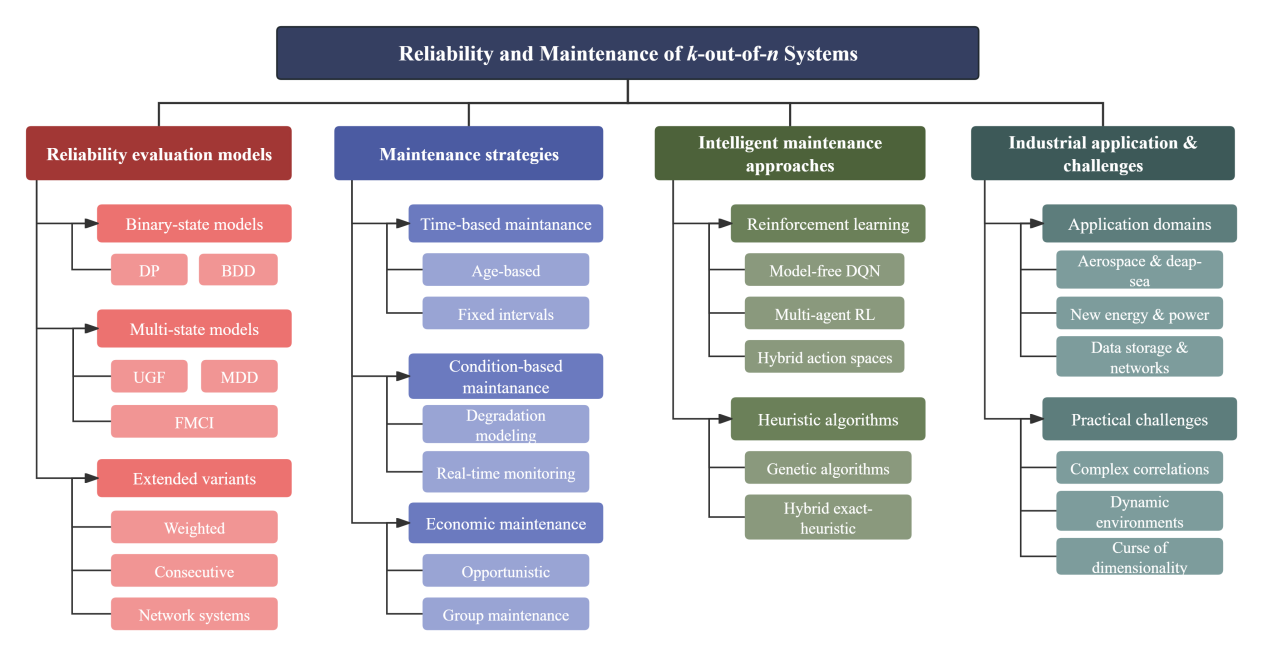
The $k$-out-of-$n$ system is a fundamental redundancy model in reliability engineering, playing a critical role in safety-critical domains, such as power transmission, transportation network, communication networks and industrial production lines. This paper provides a systematic review of recent research advances in reliability modeling and maintenance strategy optimization for $k$-out-of-$n$ systems. We first introduce the standard $k$-out-of-$n$ model and its extensions, including multi-state, weighted, consecutive, and network configurations, along with their reliability evaluation methods. We then review maintenance models encompassing time-based, condition-based, and economically oriented maintenance strategies. Furthermore, we discuss intelligent maintenance approaches based on reinforcement learning and heuristic algorithms. Finally, we highlight industrial applications and practical challenges. This review aims to serve as a reference for both academic research and engineering practice in the field.
Graphical Abstract
Keywords
Data Availability Statement
Funding
Conflicts of Interest
AI Use Statement
Ethical Approval and Consent to Participate
References
- Tong, Y. L. (1985). A rearrangement inequality for the longest run, with an application to network reliability. Journal of Applied Probability, 22(2), 386-393.
[CrossRef] [Google Scholar] - Sfakianakis, M. E., & Papastavridis, S. G. (2002). Reliability of a general consecutive-k-out-of-n: F system. IEEE transactions on reliability, 42(3), 491-496.
[CrossRef] [Google Scholar] - Chiang, D. T., & Niu, S. C. (1981). Reliability of consecutive-k-out-of-n: F system. IEEE transactions on Reliability, 30(1), 87-89.
[CrossRef] [Google Scholar] - Birnbaum, Z. W., Esary, J. D., & Saunders, S. C. (1961). Multi-component systems and structures and their reliability. Technometrics, 3(1), 55-77.
[CrossRef] [Google Scholar] - Barlow, R. E., & Wu, A. S. (1978). Coherent systems with multi-state components. Mathematics of operations research, 3(4), 275-281.
[CrossRef] [Google Scholar] - Levitin, G., Xing, L., & Dai, Y. (2022). Minimizing mission cost for production system with unreliable storage. Reliability Engineering & System Safety, 227, 108724.
[CrossRef] [Google Scholar] - Lin, Y. K., & Huang, C. F. (2015). Assessment of spare reliability for multi-state computer networks within tolerable packet unreliability. International Journal of Systems Science, 46(6), 1020-1035.
[CrossRef] [Google Scholar] - Hu, Y., Ding, Y., & Bao, M. (2024). An efficient reliability evaluation method for large-scale multi-performance multi-state series-parallel systems considering multi-dimensional approximation. Reliability Engineering & System Safety, 252, 110457.
[CrossRef] [Google Scholar] - Mellal, M. A., Zio, E., Al-Dahidi, S., Masuyama, N., & Nojima, Y. (2023). System design optimization with mixed subsystems failure dependencies. Reliability Engineering & System Safety, 231, 109005.
[CrossRef] [Google Scholar] - Yin, M., Liu, Y., Liu, S., Chen, Y., & Yan, Y. (2023). Scheduling heterogeneous repair channels in selective maintenance of multi-state systems with maintenance duration uncertainty. Reliability Engineering & System Safety, 231, 108977.
[CrossRef] [Google Scholar] - Huang, J., Zuo, M. J., & Fang, Z. (2003). Multi-state consecutive-k-out-of-n systems. IIE Transactions, 35(6), 527-534.
[CrossRef] [Google Scholar] - Su, H., Cao, Q., & Li, Y. (2024). Condition-based opportunistic maintenance strategy for multi-component wind turbines by using stochastic differential equations. Scientific reports, 14(1), 2390.
[CrossRef] [Google Scholar] - Ahmad, R., & Kamaruddin, S. (2012). An overview of time-based and condition-based maintenance in industrial application. Computers & industrial engineering, 63(1), 135-149.
[CrossRef] [Google Scholar] - Jardine, A. K., Lin, D., & Banjevic, D. (2006). A review on machinery diagnostics and prognostics implementing condition-based maintenance. Mechanical systems and signal processing, 20(7), 1483-1510.
[CrossRef] [Google Scholar] - Vu, H. C., Do, P., & Barros, A. (2018). A study on the impacts of maintenance duration on dynamic grouping modeling and optimization of multicomponent systems. IEEE Transactions on Reliability, 67(3), 1377-1392.
[CrossRef] [Google Scholar] - Duffuaa, S. O., Ben‐Daya, M., Al‐Sultan, K. S., & Andijani, A. A. (2001). A generic conceptual simulation model for maintenance systems. Journal of Quality in Maintenance Engineering, 7(3), 207-219.
[CrossRef] [Google Scholar] - Pham, H., & Wang, H. (2000). Optimal (τ, T) opportunistic maintenance of ak‐out‐of‐n: G system with imperfect PM and partial failure. Naval Research Logistics (NRL), 47(3), 223-239.
[CrossRef] [Google Scholar] - Dinh, D. H., Do, P., & Iung, B. (2022). Multi-level opportunistic predictive maintenance for multi-component systems with economic dependence and assembly/disassembly impacts. Reliability Engineering & System Safety, 217, 108055.
[CrossRef] [Google Scholar] - Laggoune, R., Chateauneuf, A., & Aissani, D. (2010). Preventive maintenance scheduling for a multi-component system with non-negligible replacement time. International Journal of Systems Science, 41(7), 747-761.
[CrossRef] [Google Scholar] - Thomas, L. C. (1986). A survey of maintenance and replacement models for maintainability and reliability of multi-item systems. Reliability Engineering, 16(4), 297-309.
[CrossRef] [Google Scholar] - Song, S., Chatwattanasiri, N., Coit, D. W., Feng, Q., & Wattanapongsakorn, N. (2012, June). Reliability analysis for k-out-of-n systems subject to multiple dependent competing failure processes. In 2012 International Conference on Quality, Reliability, Risk, Maintenance, and Safety Engineering (pp. 36-42). IEEE.
[CrossRef] [Google Scholar] - Eryilmaz, S., & Devrim, Y. (2019). Reliability and optimal replacement policy for a k-out-of-n system subject to shocks. Reliability Engineering & System Safety, 188, 393-397.
[CrossRef] [Google Scholar] - Kelkinnama, M., & Lorvand, H. (2025). Reliability analysis and optimal replacement for a k-out-of-n system with various components subject to shocks. Proceedings of the Institution of Mechanical Engineers, Part O: Journal of Risk and Reliability, 239(4), 693-702.
[CrossRef] [Google Scholar] - Zhang, Y., & Kang, Z. (2025). Situational Awareness and Fault Warning for Smart Grids Combined with Deep Learning Technology: Application of Digital Twin Technology and Long Short Term Memory Networks. Informatica, 49(22).
[CrossRef] [Google Scholar] - Kuo, W., & Zuo, M. J. (2003). Optimal reliability modeling: principles and applications. John Wiley & Sons.
[Google Scholar] - Arulmozhi, G. (2002). Exact equation and an algorithm for reliability evaluation of k-out-of-n: G system. Reliability Engineering & System Safety, 78(2), 87-91.
[CrossRef] [Google Scholar] - Zaigraev, A., & Kaniovski, S. (2013). A note on the probability of at least k successes in n correlated binary trials. Operations Research Letters, 41(1), 116-120.
[CrossRef] [Google Scholar] - Myers, A., & Rauzy, A. (2008). Efficient reliability assessment of redundant systems subject to imperfect fault coverage using binary decision diagrams. IEEE Transactions on Reliability, 57(2), 336-348.
[CrossRef] [Google Scholar] - Zhu, X., Fu, Y., & Yuan, T. (2020). Optimum reassignment of degrading components for non-repairable systems. IISE Transactions, 52(3), 349-361.
[CrossRef] [Google Scholar] - Huang, J., Zuo, M. J., & Wu, Y. (2000). Generalized multi-state k-out-of-n: G systems. IEEE Transactions on reliability, 49(1), 105-111.
[CrossRef] [Google Scholar] - Zuo, M. J., & Tian, Z. (2006). Performance evaluation of generalized multi-state k-out-of-n systems. IEEE Transactions on Reliability, 55(2), 319-327.
[CrossRef] [Google Scholar] - Li, Y. F., Ding, Y., & Zio, E. (2014). Random fuzzy extension of the universal generating function approach for the reliability assessment of multi-state systems under aleatory and epistemic uncertainties. IEEE Transactions on Reliability, 63(1), 13-25.
[CrossRef] [Google Scholar] - Li, Y. F., & Zio, E. (2012). A multi-state model for the reliability assessment of a distributed generation system via universal generating function. Reliability Engineering & System Safety, 106, 28-36.
[CrossRef] [Google Scholar] - Mo, Y., Xing, L., Amari, S. V., & Dugan, J. B. (2015). Efficient analysis of multi-state k-out-of-n systems. Reliability Engineering & System Safety, 133, 95-105.
[CrossRef] [Google Scholar] - Wang, C., Wang, S., Xing, L., & Guan, Q. (2023). Efficient performability analysis of dynamic multi-state k-out-of-n: G systems. Reliability Engineering & System Safety, 237, 109384.
[CrossRef] [Google Scholar] - Ruiz-Castro, J. E. (2020). A complex multi-state k-out-of-n: G system with preventive maintenance and loss of units. Reliability Engineering & System Safety, 197, 106797.
[CrossRef] [Google Scholar] - Wu, B., & Cui, L. (2022). On reliability analysis of a load-sharing k-out-of-n: G system with interacting Markov subsystems. International Journal of Production Research, 60(7), 2331-2345.
[CrossRef] [Google Scholar] - Cui, L., Gao, H., & Mo, Y. (2018). Reliability for k-out-of-n: F balanced systems with m sectors. IISE Transactions, 50(5), 381-393.
[CrossRef] [Google Scholar] - Wang, S., Zhao, X., & Zuo, M. J. (2022). A multi‐state k‐out‐of‐n: F balanced system with a rebalancing mechanism. Quality and Reliability Engineering International, 38(6), 2908-2920.
[CrossRef] [Google Scholar] - Dong, Q., Bai, M., Yan, Z., & Wu, B. (2025). Optimal load adjustment policy for multi-state k-out-of-n balanced systems with self-healing mechanisms. Reliability Engineering & System Safety, 261, 111091.
[CrossRef] [Google Scholar] - Gao, H., Tu, T., Fang, C., & Zhou, X. (2025). Multi-state k-out-of-n: F network system performance evaluation by considering a balance dependence mechanism. Reliability Engineering & System Safety, 264, 111291.
[CrossRef] [Google Scholar] - Chen, Y., & Yang, Q. (2005). Reliability of two-stage weighted-k-out-of-n systems with components in common. IEEE Transactions on Reliability, 54(3), 431-440.
[CrossRef] [Google Scholar] - Eryilmaz, S. (2013). On reliability analysis of a k-out-of-n system with components having random weights. Reliability Engineering & System Safety, 109, 41-44.
[CrossRef] [Google Scholar] - Li, W., & Zuo, M. J. (2008). Reliability evaluation of multi-state weighted k-out-of-n systems. Reliability engineering & system safety, 93(1), 160-167.
[CrossRef] [Google Scholar] - Larsen, E. M., Ding, Y., Li, Y. F., & Zio, E. (2020). Definitions of generalized multi-performance weighted multi-state K-out-of-n system and its reliability evaluations. Reliability Engineering & System Safety, 199, 105876.
[CrossRef] [Google Scholar] - Bisht, V., & Singh, S. B. (2023). Lz‐transform approach to evaluate reliability indices of multi‐state repairable weighted K‐out‐of‐n systems. Quality and Reliability Engineering International, 39(3), 1043-1057.
[CrossRef] [Google Scholar] - Wang, X., Zhao, X., Wu, C., & Wang, S. (2022). Mixed shock model for multi-state weighted k-out-of-n: F systems with degraded resistance against shocks. Reliability Engineering & System Safety, 217, 108098.
[CrossRef] [Google Scholar] - Zhao, X., Cui, L., & Kuo, W. (2007). Reliability for sparsely connected consecutive-$ k $ systems. IEEE Transactions on Reliability, 56(3), 516-524.
[CrossRef] [Google Scholar] - Gao, H., Cui, L., & Chen, J. (2021). Reliability modeling for sparsely connected homogeneous multistate consecutive-k-out-of-n: GSystems. IEEE Transactions on Systems, Man, and Cybernetics: Systems, 51(3), 1844-1854.
[CrossRef] [Google Scholar] - Tian-yuan, Y., Lin-lin, L., He-wei, P., & Yuan-zi, Z. (2023). Bayesian Networks based approach to enhance GO methodology for reliability modeling of multi-state consecutive-k-out-of-n: F system. Reliability Engineering & System Safety, 229, 108828.
[CrossRef] [Google Scholar] - Lin, C., Cui, L., Coit, D. W., & Lv, M. (2016). Reliability modeling on consecutive-$ k_r $-out-of-$ n_r $: F linear zigzag structure and circular polygon structure. IEEE Transactions on Reliability, 65(3), 1509-1521.
[CrossRef] [Google Scholar] - Gao, H., Tu, T., & Qiu, Q. (2024). Reliability analysis for a generalized sparse connection multi-state consecutive-k-out-of-n linear system. Reliability Engineering & System Safety, 246, 110056.
[CrossRef] [Google Scholar] - Kozyra, P. M. (2024). A parallel algorithm for reliability assessment of multi-state flow networks based on simultaneous finding of all multi-state minimal paths and performing state space decomposition. Reliability Engineering & System Safety, 251, 110376.
[CrossRef] [Google Scholar] - Yeh, W. C. (2024). A new hybrid inequality BAT for comprehensive all-level d-MP identification using minimal paths in Multistate Flow Network reliability analysis. Reliability Engineering & System Safety, 244, 109876.
[CrossRef] [Google Scholar] - Yeh, W. C. (2025). Enhancing reliability calculation for one-output k-out-of-n binary-state networks using a new BAT. Reliability Engineering & System Safety, 257, 110835.
[CrossRef] [Google Scholar] - Wu, J. S., & Chen, R. J. (1994). An algorithm for computing the reliability of weighted-k-out-of-n systems. IEEE Transactions on Reliability, 43(2), 327-328.
[CrossRef] [Google Scholar] - Zhang, Y., Wu, W., & Tang, Y. (2017). Analysis of an k-out-of-n: G system with repairman's single vacation and shut off rule. Operations Research Perspectives, 4, 29-38.
[CrossRef] [Google Scholar] - Zhang, N., Fouladirad, M., Barros, A., & Zhang, J. (2020). Condition-based maintenance for a K-out-of-N deteriorating system under periodic inspection with failure dependence. European Journal of Operational Research, 287(1), 159-167.
[CrossRef] [Google Scholar] - Zheng, M., Lin, J., Xia, T., Liu, Y., & Pan, E. (2023). Joint condition-based maintenance and spare provisioning policy for a K-out-of-N system with failures during inspection intervals. European Journal of Operational Research, 308(3), 1220-1232.
[CrossRef] [Google Scholar] - Park, M., & Pham, H. (2016). Cost models for age replacement policies and block replacement policies under warranty. Applied Mathematical Modelling, 40(9-10), 5689-5702.
[CrossRef] [Google Scholar] - Eryılmaz, S. (2009). Reliability properties of consecutive k-out-of-n systems of arbitrarily dependent components. Reliability Engineering & System Safety, 94(2), 350-356.
[CrossRef] [Google Scholar] - Chang, C. C. (2023). Optimal maintenance policy for a k-out-of-n system with replacement first and last. Annals of Operations Research, 323(1), 31-43.
[CrossRef] [Google Scholar] - Hamdan, K., Tavangar, M., & Asadi, M. (2021). Optimal preventive maintenance for repairable weighted k-out-of-n systems. Reliability Engineering & System Safety, 205, 107267.
[CrossRef] [Google Scholar] - Zhang, Q., & Fang, Z. (2025). Optimal age replacement policies for k-out-of-n systems considering mission durations. Reliability Engineering & System Safety, 254, 110625.
[CrossRef] [Google Scholar] - Wu, J., Qian, C., & Dohi, T. (2024). Optimal opportunity-based age replacement policies in discrete time. Reliability Engineering & System Safety, 241, 109587.
[CrossRef] [Google Scholar] - Lei, Y., Li, N., Guo, L., Li, N., Yan, T., & Lin, J. (2018). Machinery health prognostics: A systematic review from data acquisition to RUL prediction. Mechanical systems and signal processing, 104, 799-834.
[CrossRef] [Google Scholar] - Gan, S., Song, Z., & Zhang, L. (2022). A maintenance strategy based on system reliability considering imperfect corrective maintenance and shocks. Computers & Industrial Engineering, 164, 107886.
[CrossRef] [Google Scholar] - Hong, L., Zhai, Q., Wang, X., & Ye, Z. S. (2018). System reliability evaluation under dynamic operating conditions. IEEE Transactions on Reliability, 68(3), 800-809.
[CrossRef] [Google Scholar] - Xu, A., Zhou, S., & Tang, Y. (2019). A unified model for system reliability evaluation under dynamic operating conditions. IEEE Transactions on Reliability, 70(1), 65-72.
[CrossRef] [Google Scholar] - Liu, Q., Ma, L., Wang, N., Chen, A., & Jiang, Q. (2022). A condition-based maintenance model considering multiple maintenance effects on the dependent failure processes. Reliability Engineering & System Safety, 220, 108267.
[CrossRef] [Google Scholar] - Bloch, H. P., & Geitner, F. K. (2012). Machinery failure analysis and troubleshooting: practical machinery management for process plants. Butterworth-Heinemann.
[Google Scholar] - Peng, Y., Dong, M., & Zuo, M. J. (2010). Current status of machine prognostics in condition-based maintenance: a review. The International Journal of Advanced Manufacturing Technology, 50(1), 297-313.
[CrossRef] [Google Scholar] - Alaswad, S., & Xiang, Y. (2017). A review on condition-based maintenance optimization models for stochastically deteriorating system. Reliability engineering & system safety, 157, 54-63.
[CrossRef] [Google Scholar] - Si, X. S., Wang, W., Hu, C. H., & Zhou, D. H. (2011). Remaining useful life estimation–a review on the statistical data driven approaches. European journal of operational research, 213(1), 1-14.
[CrossRef] [Google Scholar] - Van Noortwijk, J. M. (2009). A survey of the application of gamma processes in maintenance. Reliability Engineering & System Safety, 94(1), 2-21.
[CrossRef] [Google Scholar] - Bérenguer, C., Grall, A., Dieulle, L., & Roussignol, M. (2003). Maintenance policy for a continuously monitored deteriorating system. Probability in the Engineering and Informational Sciences, 17(2), 235-250.
[CrossRef] [Google Scholar] - Huynh, K. T., Castro, I. T., Barros, A., & Bérenguer, C. (2012). Modeling age-based maintenance strategies with minimal repairs for systems subject to competing failure modes due to degradation and shocks. European journal of operational research, 218(1), 140-151.
[CrossRef] [Google Scholar] - Safaei, F., Ahmadi, J., & Taghipour, S. (2022). A maintenance policy for a k-out-of-n system under enhancing the system's operating time and safety constraints, and selling the second-hand components. Reliability Engineering & System Safety, 218, 108103.
[CrossRef] [Google Scholar] - Arabzadeh Jamali, M., & Pham, H. (2022). Opportunistic maintenance model for load sharing k-out-of-n systems with perfect PM and minimal repairs. Quality Engineering, 34(2), 205-214.
[CrossRef] [Google Scholar] - Eryilmaz, S. (2020). Age-based preventive maintenance for coherent systems with applications to consecutive-k-out-of-n and related systems. Reliability Engineering & System Safety, 204, 107143.
[CrossRef] [Google Scholar] - Castanier, B., Grall, A., & Bérenguer, C. (2005). A condition-based maintenance policy with non-periodic inspections for a two-unit series system. Reliability Engineering & System Safety, 87(1), 109-120.
[CrossRef] [Google Scholar] - De Jonge, B., & Scarf, P. A. (2020). A review on maintenance optimization. European journal of operational research, 285(3), 805-824.
[CrossRef] [Google Scholar] - Wang, H., & Pham, H. (2006). Reliability and optimal maintenance. London: Springer London.
[CrossRef] [Google Scholar] - Cui, L., & Li, H. (2006). Opportunistic maintenance for multi-component shock models. Mathematical Methods of Operations Research, 63(3), 493-511.
[CrossRef] [Google Scholar] - Bouvard, K., Artus, S., Bérenguer, C., & Cocquempot, V. (2011). Condition-based dynamic maintenance operations planning & grouping. Application to commercial heavy vehicles. Reliability Engineering & System Safety, 96(6), 601-610.
[CrossRef] [Google Scholar] - Rehage, D., Carl, U. B., & Vahl, A. (2005). Redundancy management of fault tolerant aircraft system architectures–reliability synthesis and analysis of degraded system states. Aerospace science and technology, 9(4), 337-347.
[CrossRef] [Google Scholar] - Puterman, M. L. (2014). Markov decision processes: discrete stochastic dynamic programming. John Wiley & Sons.
[Google Scholar] - Hu, H., Bansal, V., & Zhou, S. (2026). Condition-based maintenance planning for K-out-of-N systems under partial observability. Reliability Engineering & System Safety, 111943.
[CrossRef] [Google Scholar] - Wang, C., Ning, G., Deng, Q., Liu, R., & Luo, Q. (2025). Joint optimization of cooperative maintenance and inventory control for multiple k-out-of-n: F systems considering component interchange and shared spare parts. Reliability Engineering & System Safety, 262, 111181.
[CrossRef] [Google Scholar] - Wang, J., Zhou, S., Peng, R., Qiu, Q., & Yang, L. (2023). An inspection-based replacement planning in consideration of state-driven imperfect inspections. Reliability Engineering & System Safety, 232, 109064.
[CrossRef] [Google Scholar] - Jia, X., & Cui, L. (2011). Optimization of joint maintenance strategy for safety‐critical systems with different reliability degrees. Expert Systems, 28(3), 199-208.
[CrossRef] [Google Scholar] - Qiu, Q., Cui, L., & Kong, D. (2019). Availability analysis and optimal inspection policy for systems with neglected down time. Communications in Statistics-Theory and Methods, 48(11), 2787-2809.
[CrossRef] [Google Scholar] - Wang, J., & Zhu, X. (2021). Joint optimization of condition-based maintenance and inventory control for a k-out-of-n: F system of multi-state degrading components. European Journal of Operational Research, 290(2), 514-529.
[CrossRef] [Google Scholar] - Zhao, S., Wei, Y., Cheng, Y., & Li, Y. (2025). A state-specific joint size, maintenance, and inventory policy for a k-out-of-n load-sharing system subject to self-announcing failures. Reliability Engineering & System Safety, 257, 110855.
[CrossRef] [Google Scholar] - Xu, J., Liang, Z., Li, Y. F., & Wang, K. (2021). Generalized condition-based maintenance optimization for multi-component systems considering stochastic dependency and imperfect maintenance. Reliability Engineering & System Safety, 211, 107592.
[CrossRef] [Google Scholar] - Zhang, C., Li, Y. F., & Coit, D. W. (2022). Deep reinforcement learning for dynamic opportunistic maintenance of multi-component systems with load sharing. IEEE Transactions on Reliability, 72(3), 863-877.
[CrossRef] [Google Scholar] - Hao, Y., Zhu, X., & Kuo, W. (2024). Optimization of condition-based maintenance with multiple times of component reallocation using Markov decision process. IEEE Transactions on Reliability, 73(1), 131-141.
[CrossRef] [Google Scholar] - Zhao, S., Wei, Y., Li, Y., & Cheng, Y. (2025). A multi-agent reinforcement learning (MARL) framework for designing an optimal state-specific hybrid maintenance policy for a series k-out-of-n load-sharing system. Reliability Engineering & System Safety, 111587.
[CrossRef] [Google Scholar] - Zhao, X., Li, Z., Wang, X., & Qi, X. (2025). Reliability and mission abort strategy for a multi-state k-out-of-n: F system in a dynamically changing shock environment. Reliability Engineering & System Safety, 264, 111433.
[CrossRef] [Google Scholar] - Zheng, M., Su, Z., Wang, D., & Pan, E. (2024). Joint maintenance and spare part ordering from multiple suppliers for multicomponent systems using a deep reinforcement learning algorithm. Reliability Engineering & System Safety, 241, 109628.
[CrossRef] [Google Scholar] - Liu, Y., Wang, G., & Liu, P. (2024). A condition-based maintenance policy with non-periodic inspection for k-out-of-n: G systems. Reliability Engineering & System Safety, 241, 109640.
[CrossRef] [Google Scholar] - Yang, A., Qiu, Q., Zhu, M., Cui, L., Chen, W., & Chen, J. (2022). Condition-based maintenance strategy for redundant systems with arbitrary structures using improved reinforcement learning. Reliability Engineering & System Safety, 225, 108643.
[CrossRef] [Google Scholar] - Zhang, P., Zhu, X., & Xie, M. (2021). A model-based reinforcement learning approach for maintenance optimization of degrading systems in a large state space. Computers & Industrial Engineering, 161, 107622.
[CrossRef] [Google Scholar] - Xu, D., Tian, Y., Shi, J., Wang, D., Zhang, M., & Li, H. (2023). Reliability analysis and optimal redundancy for a satellite power supply system based on a new dynamic k-out-of-n: G model. Reliability Engineering & System Safety, 236, 109317.
[CrossRef] [Google Scholar] - Cai, B., Liu, Y., Liu, Z., Tian, X., Dong, X., & Yu, S. (2012). Using Bayesian networks in reliability evaluation for subsea blowout preventer control system. Reliability Engineering & System Safety, 108, 32-41.
[CrossRef] [Google Scholar] - Rykov, V., Kochueva, O., & Farkhadov, M. (2021). Preventive Maintenance of a k-out-of-n System with Applications in Subsea Pipeline Monitoring. Journal of Marine Science and Engineering, 9(1), 85.
[CrossRef] [Google Scholar] - Zhou, P., & Yin, P. T. (2019). An opportunistic condition-based maintenance strategy for offshore wind farm based on predictive analytics. Renewable and Sustainable Energy Reviews, 109, 1-9.
[CrossRef] [Google Scholar] - Plank, J. S. (2005, December). T1: erasure codes for storage applications. In Proc. of the 4th USENIX Conference on File and Storage Technologies (pp. 1-74). https://www.usenix.org/legacy/events/fast05/tutorials/tutonefile1.html
[Google Scholar] - Lu, J., Yi, H., Li, X., & Balakrishnan, N. (2023). Joint reliability of two consecutive-(1, l) or (2, k)-out-of-(2, n): F type systems and its application in smart street light deployment. Methodology and Computing in Applied Probability, 25(1), 33.
[CrossRef] [Google Scholar] - Ogunfowora, O., & Najjaran, H. (2023). Reinforcement and deep reinforcement learning-based solutions for machine maintenance planning, scheduling policies, and optimization. Journal of Manufacturing Systems, 70, 244-263.
[CrossRef] [Google Scholar]
Cite This Article
TY  - JOUR
AU  - Wei, Shiqi
AU  - Liu, Yuxin
AU  - Wang, Hongping
AU  - Rong, Xiaorui
AU  - Zheng, Nianzhi
AU  - Gao, Hongda
PY  - 2026
DA  - 2026/06/13
TI  - Reliability and Maintenance Optimization for $k$-out-of-$n$ Systems: A Systematic Review and Recent Advances in Theory and Practice
JO  - ICCK Transactions on Systems Safety and Reliability
T2  - ICCK Transactions on Systems Safety and Reliability
JF  - ICCK Transactions on Systems Safety and Reliability
VL  - 2
IS  - 3
SP  - 140
EP  - 161
DO  - 10.62762/TSSR.2026.749244
UR  - https://www.icck.org/article/abs/TSSR.2026.749244
KW  - $k$-out-of-$n$ system
KW  - reliability
KW  - system modeling
KW  - maintenance strategy
AB  - The $k$-out-of-$n$ system is a fundamental redundancy model in reliability engineering, playing a critical role in safety-critical domains, such as power transmission, transportation network, communication networks and industrial production lines. This paper provides a systematic review of recent research advances in reliability modeling and maintenance strategy optimization for $k$-out-of-$n$ systems. We first introduce the standard $k$-out-of-$n$ model and its extensions, including multi-state, weighted, consecutive, and network configurations, along with their reliability evaluation methods. We then review maintenance models encompassing time-based, condition-based, and economically oriented maintenance strategies. Furthermore, we discuss intelligent maintenance approaches based on reinforcement learning and heuristic algorithms. Finally, we highlight industrial applications and practical challenges. This review aims to serve as a reference for both academic research and engineering practice in the field.
SN  - 3069-1087
PB  - Institute of Central Computation and Knowledge
LA  - English
ER  -
@article{Wei2026Reliabilit,
  author = {Shiqi Wei and Yuxin Liu and Hongping Wang and Xiaorui Rong and Nianzhi Zheng and Hongda Gao},
  title = {Reliability and Maintenance Optimization for \$k\$-out-of-\$n\$ Systems: A Systematic Review and Recent Advances in Theory and Practice},
  journal = {ICCK Transactions on Systems Safety and Reliability},
  year = {2026},
  volume = {2},
  number = {3},
  pages = {140-161},
  doi = {10.62762/TSSR.2026.749244},
  url = {https://www.icck.org/article/abs/TSSR.2026.749244},
  abstract = {The \$k\$-out-of-\$n\$ system is a fundamental redundancy model in reliability engineering, playing a critical role in safety-critical domains, such as power transmission, transportation network, communication networks and industrial production lines. This paper provides a systematic review of recent research advances in reliability modeling and maintenance strategy optimization for \$k\$-out-of-\$n\$ systems. We first introduce the standard \$k\$-out-of-\$n\$ model and its extensions, including multi-state, weighted, consecutive, and network configurations, along with their reliability evaluation methods. We then review maintenance models encompassing time-based, condition-based, and economically oriented maintenance strategies. Furthermore, we discuss intelligent maintenance approaches based on reinforcement learning and heuristic algorithms. Finally, we highlight industrial applications and practical challenges. This review aims to serve as a reference for both academic research and engineering practice in the field.},
  keywords = {\$k\$-out-of-\$n\$ system, reliability, system modeling, maintenance strategy},
  issn = {3069-1087},
  publisher = {Institute of Central Computation and Knowledge}
}
Article Metrics
Publisher's Note
ICCK stays neutral with regard to jurisdictional claims in published maps and institutional affiliations.
Rights and Permissions


Portico
