

Metaverse Journey Exploring Requirements, Architectural Frameworks, Standards, Challenges and Vision




Article Information
Abstract
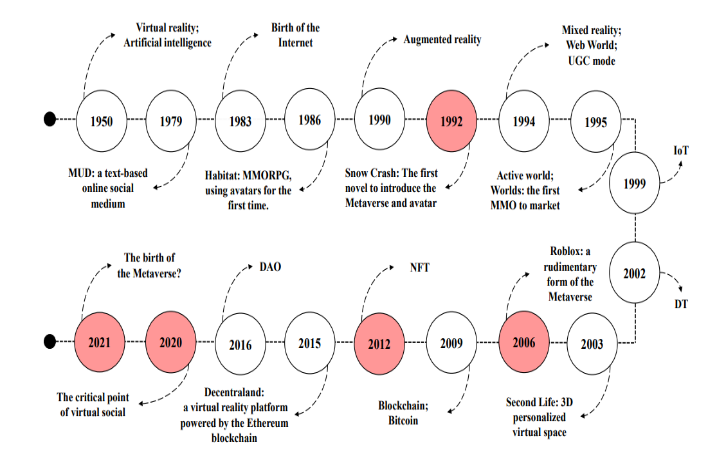
The Metaverse is an emerging paradigm that integrates immersive digital technologies to create a unified, persistent, and interconnected 3D virtual space with transformative potential across work, education, healthcare, and daily life. This paper presents a comprehensive review of the Metaverse, covering its historical evolution, core characteristics, architectural frameworks, key enabling technologies, standardization efforts, and open challenges. We propose a tripartite architecture comprising infrastructure, interactivity, and ecosystem layers, and provide a structured overview of relevant standards including IEEE 2888, IEEE P2048, IEEE P7016, and ISO/IEC 23005. Seven essential technological requirements are examined, spanning networking and communication, ubiquitous computing, digital twins, extended reality, artificial intelligence, big data management, and jurisdictional challenges. Critical research gaps are identified, including the absence of a consensus architectural standard, unresolved security and privacy concerns, and underdeveloped cross-border legal frameworks. This work provides researchers and practitioners with a structured foundation for understanding the current state of the Metaverse and its future development trajectory.
Graphical Abstract
Keywords
Data Availability Statement
Funding
Conflicts of Interest
Ethical Approval and Consent to Participate
References
- Dwivedi, Y. K., Hughes, L., Baabdullah, A. M., Ribeiro-Navarrete, S., Giannakis, M., Al-Debei, M. M., ... & Wamba, S. F. (2022). Metaverse beyond the hype: Multidisciplinary perspectives on emerging challenges, opportunities, and agenda for research, practice and policy. International journal of information management, 66, 102542.
[CrossRef] [Google Scholar] - Yang, Q., Zhao, Y., Huang, H., Xiong, Z., Kang, J., & Zheng, Z. (2022). Fusing blockchain and AI with metaverse: A survey. IEEE open journal of the computer society, 3, 122-136.
[CrossRef] [Google Scholar] - Rawat, D. B., & El Alami, H. (2023). Metaverse: Requirements, architecture, standards, status, challenges, and perspectives. IEEE Internet of Things Magazine, 6(1), 14-18.
[CrossRef] [Google Scholar] - Fu, Y., Li, C., Yu, F. R., Luan, T. H., Zhao, P., & Liu, S. (2023). A survey of blockchain and intelligent networking for the Metaverse. IEEE Internet of Things Journal, 10(4), 3587-3610.
[CrossRef] [Google Scholar] - IEEE Standards Association. (2022). IEEE 2888 standards. Retrieved from https://sagroups.ieee.org/2888/
[Google Scholar] - IEEE Standards Association. (2022). IEEE 1589 standards. Retrieved from https://standards.ieee.org/ieee/1589/6073/
[Google Scholar] - IEEE Standards Association. (2022). IEEE P2048 standards. Retrieved from https://standards.ieee.org/ieee/2048/11072/
[Google Scholar] - IEEE Standards Association. (2022). IEEE P7016 standards. Retrieved from https://standards.ieee.org/ieee/7016/11078/
[Google Scholar] - Chu, N. H., Hoang, D. T., Nguyen, D. N., Phan, K. T., Dutkiewicz, E., Niyato, D., & Shu, T. (2023). Metaslicing: A novel resource allocation framework for metaverse. IEEE Transactions on Mobile Computing, 23(5), 4145-4162.
[CrossRef] [Google Scholar] - Wang, H., Ning, H., Lin, Y., Wang, W., Dhelim, S., Farha, F., ... & Daneshmand, M. (2023). A survey on the metaverse: The state-of-the-art, technologies, applications, and challenges. IEEE Internet of Things Journal, 10(16), 14671-14688.
[CrossRef] [Google Scholar] - Wu, Y., Zhang, K., & Zhang, Y. (2021). Digital twin networks: A survey. IEEE Internet of Things Journal, 8(18), 13789-13804.
[CrossRef] [Google Scholar] - Park, S. M., & Kim, Y. G. (2022). A Metaverse: Taxonomy, components, applications, and open challenges. IEEE Access, 10, 4209–4251.
[CrossRef] [Google Scholar] - Chengoden, R., Victor, N., Huynh-The, T., Yenduri, G., Jhaveri, R. H., Alazab, M., ... & Gadekallu, T. R. (2023). Metaverse for healthcare: a survey on potential applications, challenges and future directions. IEEE Access, 11, 12765-12795.
[CrossRef] [Google Scholar] - Kalyvaki, M. (2023). Navigating the metaverse business and legal challenges: Intellectual property, privacy, and jurisdiction. Journal of Metaverse, 3(1), 87-92.
[CrossRef] [Google Scholar] - Huynh-The, T., Pham, Q. V., Pham, X. Q., Nguyen, T. T., Han, Z., & Kim, D. S. (2023). Artificial intelligence for the metaverse: A survey. Engineering Applications of Artificial Intelligence, 117, 105581.
[CrossRef] [Google Scholar] - Truong, V. T., Le, L., & Niyato, D. (2023). Blockchain meets metaverse and digital asset management: A comprehensive survey. IEEE Access, 11, 26258-26288.
[CrossRef] [Google Scholar]
Cited By (2)
-
Yifeng Shen, Yaochu Ye, Shulai Wang. CAFF-Net for coupled eco-health prediction of urban green space and water body with multi-source remote sensing.
Ain Shams Engineering Journal, 2026 , 17 (11).
[CrossRef] -
Jiazhou Sun, Peng Zhang. MSCA-Deeplabv3+: A fine-grained optical image segmentation model based on multi-scale channel attention.
Alexandria Engineering Journal, 2026 , 145 .
[CrossRef]
Cite This Article
TY  - JOUR
AU  - Khalid, Mahtab
AU  - Sajid, Ahthasham
AU  - Mehmood, Arshad
AU  - Dashdondov, Khongorzul
PY  - 2025
DA  - 2025/05/27
TI  - Metaverse Journey Exploring Requirements, Architectural Frameworks, Standards, Challenges and Vision
JO  - ICCK Transactions on Advanced Computing and Systems
T2  - ICCK Transactions on Advanced Computing and Systems
JF  - ICCK Transactions on Advanced Computing and Systems
VL  - 1
IS  - 2
SP  - 97
EP  - 105
DO  - 10.62762/TACS.2024.309607
UR  - https://www.icck.org/article/abs/TACS.2024.309607
KW  - metaverse
KW  - artificial intelligence
KW  - virtual reality (VR)
KW  - big data
KW  - blockchain
KW  - augmented reality (AR)
KW  - 5G/6G connectivity
KW  - mixed reality (MR)
AB  - The Metaverse is an emerging paradigm that integrates immersive digital technologies to create a unified, persistent, and interconnected 3D virtual space with transformative potential across work, education, healthcare, and daily life. This paper presents a comprehensive review of the Metaverse, covering its historical evolution, core characteristics, architectural frameworks, key enabling technologies, standardization efforts, and open challenges. We propose a tripartite architecture comprising infrastructure, interactivity, and ecosystem layers, and provide a structured overview of relevant standards including IEEE 2888, IEEE P2048, IEEE P7016, and ISO/IEC 23005. Seven essential technological requirements are examined, spanning networking and communication, ubiquitous computing, digital twins, extended reality, artificial intelligence, big data management, and jurisdictional challenges. Critical research gaps are identified, including the absence of a consensus architectural standard, unresolved security and privacy concerns, and underdeveloped cross-border legal frameworks. This work provides researchers and practitioners with a structured foundation for understanding the current state of the Metaverse and its future development trajectory.
SN  - 3068-7969
PB  - Institute of Central Computation and Knowledge
LA  - English
ER  -
@article{Khalid2025Metaverse,
  author = {Mahtab Khalid and Ahthasham Sajid and Arshad Mehmood and Khongorzul Dashdondov},
  title = {Metaverse Journey Exploring Requirements, Architectural Frameworks, Standards, Challenges and Vision},
  journal = {ICCK Transactions on Advanced Computing and Systems},
  year = {2025},
  volume = {1},
  number = {2},
  pages = {97-105},
  doi = {10.62762/TACS.2024.309607},
  url = {https://www.icck.org/article/abs/TACS.2024.309607},
  abstract = {The Metaverse is an emerging paradigm that integrates immersive digital technologies to create a unified, persistent, and interconnected 3D virtual space with transformative potential across work, education, healthcare, and daily life. This paper presents a comprehensive review of the Metaverse, covering its historical evolution, core characteristics, architectural frameworks, key enabling technologies, standardization efforts, and open challenges. We propose a tripartite architecture comprising infrastructure, interactivity, and ecosystem layers, and provide a structured overview of relevant standards including IEEE 2888, IEEE P2048, IEEE P7016, and ISO/IEC 23005. Seven essential technological requirements are examined, spanning networking and communication, ubiquitous computing, digital twins, extended reality, artificial intelligence, big data management, and jurisdictional challenges. Critical research gaps are identified, including the absence of a consensus architectural standard, unresolved security and privacy concerns, and underdeveloped cross-border legal frameworks. This work provides researchers and practitioners with a structured foundation for understanding the current state of the Metaverse and its future development trajectory.},
  keywords = {metaverse, artificial intelligence, virtual reality (VR), big data, blockchain, augmented reality (AR), 5G/6G connectivity, mixed reality (MR)},
  issn = {3068-7969},
  publisher = {Institute of Central Computation and Knowledge}
}
Article Metrics
Publisher's Note
ICCK stays neutral with regard to jurisdictional claims in published maps and institutional affiliations.
Rights and Permissions
 Copyright © 2025 by the Author(s). Published by Institute of Central Computation and Knowledge. This article is an open access article distributed under the terms and conditions of the Creative Commons Attribution (CC BY) license (https://creativecommons.org/licenses/by/4.0/), which permits use, sharing, adaptation, distribution and reproduction in any medium or format, as long as you give appropriate credit to the original author(s) and the source, provide a link to the Creative Commons licence, and indicate if changes were made.


Portico
