

A Novel Deep Learning Framework for Brain Tumor Classification Using Improved Swin Transformer V2




Article Information
Abstract
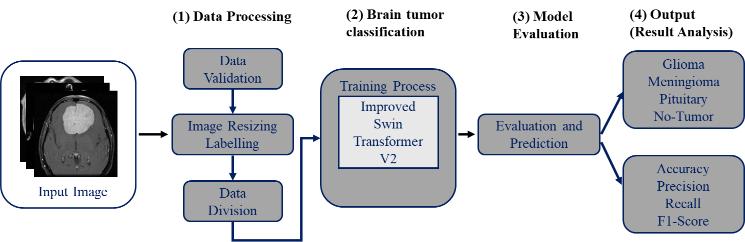
Brain tumors pose a serious threat to global health, making accurate and early detection essential for effective treatment planning. While Magnetic Resonance Imaging (MRI) is widely used for diagnosis, manual interpretation is time-consuming and subject to error. This has prompted increasing use of deep learning for automated tumor classification. We propose a novel framework based on the Swin Transformer V2 architecture for classifying brain tumors in MRI scans into glioma, meningioma, pituitary tumor, and non-tumor categories. The design introduces two core innovations: a Dual-Branch Down-sampling module and an Enhanced Attention Mechanism, which improve multi-scale feature representation and computational efficiency. Using a dataset of 7,023 grayscale MRI images, the proposed model achieved an accuracy of 98.97%, outperforming ResNet50 (90.39%) and DenseNet121 (93.20%). It maintained precision, recall, and F1-scores above 98% across all classes and showed improved training efficiency. These results demonstrate the model’s potential as a robust and efficient diagnostic support system for brain tumor classification.
Graphical Abstract
Keywords
Data Availability Statement
Funding
Conflicts of Interest
Ethical Approval and Consent to Participate
References
- Khazaei, Z., Goodarzi, E., Borhaninejad, V., Iranmanesh, F., Mirshekarpour, H., Mirzaei, B., ... & Naghibzadeh-Tahami, A. (2020). The association between incidence and mortality of brain cancer and human development index (HDI): an ecological study. BMC Public Health, 20, 1-7.
[CrossRef] [Google Scholar] - Ferlay, J., Ervik, M., Lam, F., Colombet, M., Mery, L., Piñeros, M., Znaor, A., Soerjomataram, I., & Bray, F. (2020). Global Cancer Observatory: Cancer Today. Lyon, France: International Agency for Research on Cancer. Retrieved from https://gco.iarc.fr/today
[Google Scholar] - Weller, M., Van Den Bent, M., Hopkins, K., Tonn, J. C., Stupp, R., Falini, A., ... & Wick, W. (2014). EANO guideline for the diagnosis and treatment of anaplastic gliomas and glioblastoma. The lancet oncology, 15(9), e395-e403.
[CrossRef] [Google Scholar] - Ostrom, Q. T., Price, M., Neff, C., Cioffi, G., Waite, K. A., Kruchko, C., & Barnholtz-Sloan, J. S. (2022). CBTRUS statistical report: primary brain and other central nervous system tumors diagnosed in the United States in 2015–2019. Neuro-oncology, 24(Supplement\_5), v1-v95.
[CrossRef] [Google Scholar] - Tiwari, A., Srivastava, S., & Pant, M. (2020). Brain tumor segmentation and classification from magnetic resonance images: Review of selected methods from 2014 to 2019. Pattern recognition letters, 131, 244-260.
[CrossRef] [Google Scholar] - Tummala, S., Kadry, S., Bukhari, S. A. C., & Rauf, H. T. (2022). Classification of brain tumor from magnetic resonance imaging using vision transformers ensembling. Current Oncology, 29(10), 7498-7511.
[CrossRef] [Google Scholar] - Hossain, S., Chakrabarty, A., Gadekallu, T. R., Alazab, M., & Piran, M. J. (2024). Vision transformers, ensemble model, and transfer learning leveraging explainable AI for brain tumor detection and classification. IEEE Journal of Biomedical and Health Informatics, 28(3), 1261-1272.
[CrossRef] [Google Scholar] - Al-Masni, M. A., Lee, S., Yi, J., Kim, S., Gho, S. M., Choi, Y. H., & Kim, D. H. (2022). Stacked U-Nets with self-assisted priors towards robust correction of rigid motion artifact in brain MRI. NeuroImage, 259, 119411.
[CrossRef] [Google Scholar] - Kaplan, K., Kaya, Y., Kuncan, M., & Ertunç, H. M. (2020). Brain tumor classification using modified local binary patterns (LBP) feature extraction methods. Medical hypotheses, 139, 109696.
[CrossRef] [Google Scholar] - Solanki, S., Singh, U. P., Chouhan, S. S., & Jain, S. (2023). Brain tumor detection and classification using intelligence techniques: an overview. IEEE Access, 11, 12870-12886.
[CrossRef] [Google Scholar] - Nayak, D. R., Padhy, N., Mallick, P. K., Zymbler, M., & Kumar, S. (2022). Brain tumor classification using dense efficient-net. Axioms, 11(1), 34.
[CrossRef] [Google Scholar] - Ferdous, G. J., Sathi, K. A., Hossain, M. A., Hoque, M. M., & Dewan, M. A. A. (2023). LCDEiT: A linear complexity data-efficient image transformer for MRI brain tumor classification. IEEE Access, 11, 20337-20350.
[CrossRef] [Google Scholar] - Suganyadevi, S., Seethalakshmi, V., & Balasamy, K. (2022). A review on deep learning in medical image analysis. International Journal of Multimedia Information Retrieval, 11(1), 19-38.
[CrossRef] [Google Scholar] - Tabatabaei, S., Rezaee, K., & Zhu, M. (2023). Attention transformer mechanism and fusion-based deep learning architecture for MRI brain tumor classification system. Biomedical Signal Processing and Control, 86, 105119.
[CrossRef] [Google Scholar] - Badža, M. M., & Barjaktarović, M. Č. (2020). Classification of brain tumors from MRI images using a convolutional neural network. Applied Sciences, 10(6), 1999.
[CrossRef] [Google Scholar] - Gumaei, A., Hassan, M. M., Hassan, M. R., Alelaiwi, A., & Fortino, G. (2019). A hybrid feature extraction method with regularized extreme learning machine for brain tumor classification. IEEE Access, 7, 36266-36273.
[CrossRef] [Google Scholar] - Srujan, K., Shivakumar, S., Sitnur, K., Garde, O., & Poornima, P. (2020). Brain tumor segmentation and classification using CNN model. Brain, 7(4). Available from https://www.academia.edu/download/64371826/IRJET-V7I4782.pdf
[Google Scholar] - Ahmad, B., Sun, J., You, Q., Palade, V., & Mao, Z. (2022). Brain tumor classification using a combination of variational autoencoders and generative adversarial networks. Biomedicines, 10(2), 223.
[CrossRef] [Google Scholar] - Ghassemi, N., Shoeibi, A., & Rouhani, M. (2020). Deep neural network with generative adversarial networks pre-training for brain tumor classification based on MR images. Biomedical Signal Processing and Control, 57, 101678.
[CrossRef] [Google Scholar] - Ayadi, W., Charfi, I., Elhamzi, W., & Atri, M. (2022). Brain tumor classification based on hybrid approach. The Visual Computer, 38(1), 107-117.
[CrossRef] [Google Scholar] - Rezaei, K., Agahi, H., & Mahmoodzadeh, A. (2022). A weighted voting classifiers ensemble for the brain tumors classification in MR images. IETE Journal of Research, 68(5), 3829-3842.
[CrossRef] [Google Scholar] - Swati, Z. N. K., Zhao, Q., Kabir, M., Ali, F., Ali, Z., Ahmed, S., & Lu, J. (2019). Brain tumor classification for MR images using transfer learning and fine-tuning. Computerized Medical Imaging and Graphics, 75, 34-46.
[CrossRef] [Google Scholar] - Noreen, N., Palaniappan, S., Qayyum, A., Ahmad, I., & Alassafi, M. O. (2021). Brain Tumor Classification Based on Fine-Tuned Models and the Ensemble Method. CMES-Computer Modeling in Engineering and Sciences, 67(3), 3967-3982.
[CrossRef] [Google Scholar] - Szegedy, C., Vanhoucke, V., Ioffe, S., Shlens, J., & Wojna, Z. (2016). Rethinking the inception architecture for computer vision. In Proceedings of the IEEE conference on computer vision and pattern recognition (pp. 2818-2826).
[Google Scholar] - Satyanarayana, G., Naidu, P. A., Desanamukula, V. S., & Rao, B. C. (2023). A mass correlation based deep learning approach using deep convolutional neural network to classify the brain tumor. Biomedical signal processing and control, 81, 104395.
[CrossRef] [Google Scholar] - Deepak, S., & Ameer, P. (2023). Brain tumor categorization from imbalanced MRI dataset using weighted loss and deep feature fusion. Neurocomputing, 520, 94-102.
[CrossRef] [Google Scholar] - Liu, Z., Hu, H., Lin, Y., Yao, Z., Xie, Z., Wei, Y., ... & Guo, B. (2022). Swin transformer v2: Scaling up capacity and resolution. In Proceedings of the IEEE/CVF conference on computer vision and pattern recognition (pp. 12009-12019).
[CrossRef] [Google Scholar] - Bhuvaji, S., Kadam, A., Bhumkar, P., Dedge, S., & Kanchan, S. (2020). Brain tumor classification (MRI) [Data set]. Kaggle.
[CrossRef] [Google Scholar] - Cheng, J. (2017). Brain tumor dataset [Data set]. Figshare.
[CrossRef] [Google Scholar] - Hamada, A. (2020). Br35H: Brain tumor detection 2020 [Data set]. Kaggle. Retrieved from https://www.kaggle.com/datasets/ahmedhamada0/brain-tumor-detection
[Google Scholar] - He, K., Zhang, X., Ren, S., & Sun, J. (2016). Deep residual learning for image recognition. In Proceedings of the IEEE Conference on Computer Vision and Pattern Recognition (pp. 770-778).
[CrossRef] [Google Scholar] - Huang, G., Liu, Z., Van Der Maaten, L., & Weinberger, K. Q. (2017, July). Densely Connected Convolutional Networks. In 2017 IEEE Conference on Computer Vision and Pattern Recognition (CVPR) (pp. 2261-2269). IEEE.
[CrossRef] [Google Scholar] - Howard, A., Sandler, M., Chu, G., Chen, L. C., Chen, B., Tan, M., ... & Adam, H. (2019). Searching for mobilenetv3. In Proceedings of the IEEE/CVF International Conference on Computer Vision (pp. 1314-1324).
[CrossRef] [Google Scholar] - Dosovitskiy, A., Beyer, L., Kolesnikov, A., Weissenborn, D., Zhai, X., Unterthiner, T., ... & Houlsby, N. (2020). An image is worth 16x16 words: Transformers for image recognition at scale. arXiv preprint arXiv:2010.11929.
[CrossRef] [Google Scholar] - Mehta, S., & Rastegari, M. (2022). Separable self-attention for mobile vision transformers. arXiv preprint arXiv:2206.02680.
[CrossRef] [Google Scholar]
Cited By (7)
-
Hongjuan Wang, Chenxi Wang, Xinjun An. DKTransformer: An Accurate and Efficient Model for Fine-Grained Food Image Classification.
Sensors, 2026 , 26 (4).
[CrossRef] -
Tingrui Feng, Yali Wang, Chuan Fu, Bo Du, Fulin Luo. MMFormer: Macro–Micro Transformer for Small-Sample Classification of Mars Hyperspectral Image.
IEEE Transactions on Geoscience and Remote Sensing, 2026 , 64 .
[CrossRef] -
S. Gayathri, Santhi Baskaran. .
2026 Fourth International Conference on Augmented Intelligence and Sustainable Systems (ICAISS), 2026 .
[CrossRef] -
Xuebing Xu, Gaofeng Chang, Liping Xie, Shihong Liu, Meng Tang, Xinmin Ding, Dongrui Gao. Dynamic Topology Networks for Driving Vigilance Recognition to Enhance Human–Machine Interaction.
IEEE Transactions on Consumer Electronics, 2026 , 72 (2).
[CrossRef] -
Kirti Pant, Pijush Kanti Dutta Pramanik, Zhongming Zhao. A Robust ConvNeXt-Based Framework for Efficient, Generalizable, and Explainable Brain Tumor Classification on MRI.
Bioengineering, 2026 , 13 (2).
[CrossRef] -
Kirti Pant, Pijush Kanti Dutta Pramanik, Shahid Mohammad Ganie, Anindita Saha, Zhongming Zhao. Global–local feature fusion: a robust hybrid deep learning model for multiclass brain tumor classification with Grad-CAM++ interpretation.
Frontiers in Genetics, 2026 , 17 .
[CrossRef] -
S M Masfequier Rahman Swapno, Md Basitur Rahman Bappi, A B M Shawkat Ali. .
2025 28th International Conference on Computer and Information Technology (ICCIT), 2025 .
[CrossRef]
Cite This Article
TY  - JOUR
AU  - Alam, Nur
AU  - Zhu, Yutong
AU  - Shao, Jiaqi
AU  - Usman, Muhammad
AU  - Fayaz, Muhammad
PY  - 2025
DA  - 2025/07/09
TI  - A Novel Deep Learning Framework for Brain Tumor Classification Using Improved Swin Transformer V2
JO  - ICCK Transactions on Advanced Computing and Systems
T2  - ICCK Transactions on Advanced Computing and Systems
JF  - ICCK Transactions on Advanced Computing and Systems
VL  - 1
IS  - 3
SP  - 154
EP  - 163
DO  - 10.62762/TACS.2025.807755
UR  - https://www.icck.org/article/abs/TACS.2025.807755
KW  - brain tumor classification
KW  - deep learning
KW  - MRI scans
KW  - computational efficiency
KW  - medical image analysis
AB  - Brain tumors pose a serious threat to global health, making accurate and early detection essential for effective treatment planning. While Magnetic Resonance Imaging (MRI) is widely used for diagnosis, manual interpretation is time-consuming and subject to error. This has prompted increasing use of deep learning for automated tumor classification. We propose a novel framework based on the Swin Transformer V2 architecture for classifying brain tumors in MRI scans into glioma, meningioma, pituitary tumor, and non-tumor categories. The design introduces two core innovations: a Dual-Branch Down-sampling module and an Enhanced Attention Mechanism, which improve multi-scale feature representation and computational efficiency. Using a dataset of 7,023 grayscale MRI images, the proposed model achieved an accuracy of 98.97%, outperforming ResNet50 (90.39%) and DenseNet121 (93.20%). It maintained precision, recall, and F1-scores above 98% across all classes and showed improved training efficiency. These results demonstrate the model’s potential as a robust and efficient diagnostic support system for brain tumor classification.
SN  - 3068-7969
PB  - Institute of Central Computation and Knowledge
LA  - English
ER  -
@article{Alam2025A,
  author = {Nur Alam and Yutong Zhu and Jiaqi Shao and Muhammad Usman and Muhammad Fayaz},
  title = {A Novel Deep Learning Framework for Brain Tumor Classification Using Improved Swin Transformer V2},
  journal = {ICCK Transactions on Advanced Computing and Systems},
  year = {2025},
  volume = {1},
  number = {3},
  pages = {154-163},
  doi = {10.62762/TACS.2025.807755},
  url = {https://www.icck.org/article/abs/TACS.2025.807755},
  abstract = {Brain tumors pose a serious threat to global health, making accurate and early detection essential for effective treatment planning. While Magnetic Resonance Imaging (MRI) is widely used for diagnosis, manual interpretation is time-consuming and subject to error. This has prompted increasing use of deep learning for automated tumor classification. We propose a novel framework based on the Swin Transformer V2 architecture for classifying brain tumors in MRI scans into glioma, meningioma, pituitary tumor, and non-tumor categories. The design introduces two core innovations: a Dual-Branch Down-sampling module and an Enhanced Attention Mechanism, which improve multi-scale feature representation and computational efficiency. Using a dataset of 7,023 grayscale MRI images, the proposed model achieved an accuracy of 98.97\%, outperforming ResNet50 (90.39\%) and DenseNet121 (93.20\%). It maintained precision, recall, and F1-scores above 98\% across all classes and showed improved training efficiency. These results demonstrate the model’s potential as a robust and efficient diagnostic support system for brain tumor classification.},
  keywords = {brain tumor classification, deep learning, MRI scans, computational efficiency, medical image analysis},
  issn = {3068-7969},
  publisher = {Institute of Central Computation and Knowledge}
}
Publisher's Note
ICCK stays neutral with regard to jurisdictional claims in published maps and institutional affiliations.
Rights and Permissions
 Copyright © 2025 by the Author(s). Published by Institute of Central Computation and Knowledge. This article is an open access article distributed under the terms and conditions of the Creative Commons Attribution (CC BY) license (https://creativecommons.org/licenses/by/4.0/), which permits use, sharing, adaptation, distribution and reproduction in any medium or format, as long as you give appropriate credit to the original author(s) and the source, provide a link to the Creative Commons licence, and indicate if changes were made.


Portico
