

Enhancing Authentication Security in Internet of Vehicles: A Blockchain-Driven Approach for Trustworthy Communication







Article Information
Abstract
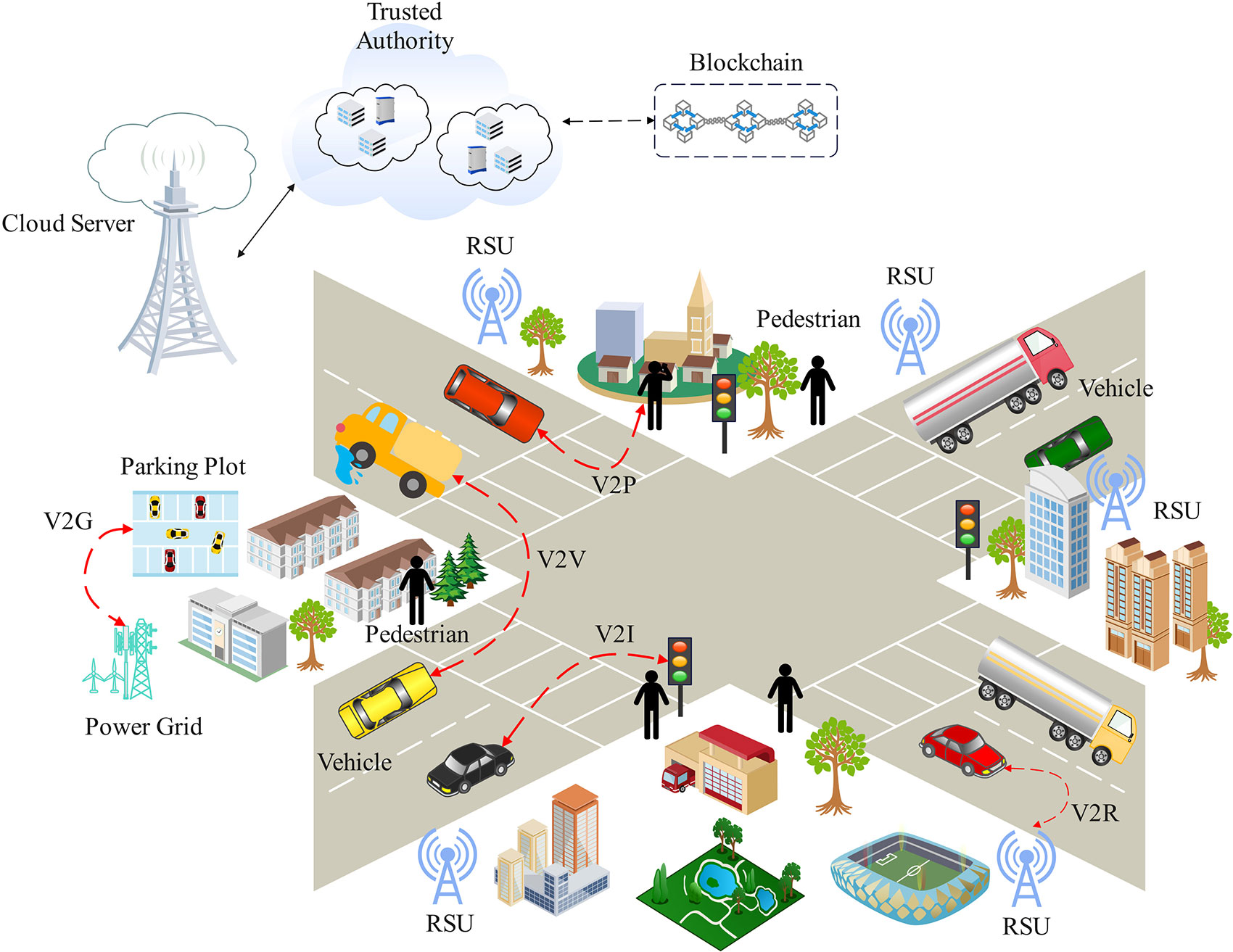
The Internet of Vehicles (IoVs) is an emerging technology that enhances transportation systems by enabling interactions between vehicles, infrastructure, and other entities. Securing IoV networks from cyber threats like eavesdropping, data tampering, and intrusions is a major challenge. This research presents a Blockchain-Enabled Secure Authentication Protocol for IoVs (BESA-IOV), which leverages blockchain’s decentralized and tamper-resistant nature for secure communication in vehicular networks. By utilizing ECC-based lightweight cryptography and blockchain-based public key management, it ensures strong authentication, confidentiality, and integrity. The results show that BESA-IOV significantly reduces authentication delay and computational cost compared to protocols such as NOTSA, RVAC, VANET-Auth, and SecureIoV. Extensive simulations indicate that BESA-IOV reduces authentication delay by 35% and computational overhead by 40%, enhancing real-time communication in the IoV environment. BESA-IOV is secure, efficient, and scalable for next-generation IoV systems.
Graphical Abstract
Keywords
Data Availability Statement
Funding
Conflicts of Interest
Ethical Approval and Consent to Participate
References
- Kebande, V. R., Awaysheh, F. M., Ikuesan, R. A., Alawadi, S. A., & Alshehri, M. D. (2021). A blockchain-based multi-factor authentication model for a cloud-enabled internet of vehicles. Sensors, 21(18), 6018.
[Google Scholar] - Kumar, S., Velliangiri, S., Karthikeyan, P., Kumari, S., Kumar, S., & Khan, M. K. (2021). A survey on the blockchain techniques for the Internet of Vehicles security. Transactions on Emerging Telecommunications Technologies, 35(4), e4317.
[CrossRef] [Google Scholar] - Wang, C., Cheng, X., Li, J., He, Y., & Xiao, K. (2021). A survey: applications of blockchain in the internet of vehicles. EURASIP Journal on wireless communications and networking, 2021, 1-16.
[CrossRef] [Google Scholar] - Rammohan, A. (2023). Revolutionizing Intelligent Transportation Systems with Cellular Vehicle-to-Everything (C-V2X) technology: Current trends, use cases, emerging technologies, standardization bodies, industry analytics and future directions. Vehicular Communications, 43, 100638.
[CrossRef] [Google Scholar] - Siddiqui, S. A., Mahmood, A., Sheng, Q. Z., Suzuki, H., & Ni, W. (2021). A survey of trust management in the internet of vehicles. Electronics, 10(18), 2223.
[CrossRef] [Google Scholar] - Chen, W., Wu, H., Chen, X., & Chen, J. (2022). A review of research on privacy protection of Internet of Vehicles based on blockchain. Journal of Sensor and Actuator Networks, 11(4), 86.
[CrossRef] [Google Scholar] - Jabbar, R., Fetais, N., Kharbeche, M., Krichen, M., Barkaoui, K., & Shinoy, M. (2021). Blockchain for the Internet of Vehicles: How to use blockchain to secure vehicle-to-everything (V2X) communication and payment?. IEEE Sensors Journal, 21(14), 15807-15823.
[CrossRef] [Google Scholar] - Fadhil, J. A., & Sarhan, Q. I. (2020, November). Internet of Vehicles (IoV): A survey of challenges and solutions. In 2020 21st International Arab Conference on Information Technology (ACIT) (pp. 1-10). IEEE.
[CrossRef] [Google Scholar] - Liu, Y., Wang, J., Yan, Z., Wan, Z., & Jäntti, R. (2023). A survey on blockchain-based trust management for Internet of Things. IEEE Internet of Things Journal, 10(7), 5898-5922.
[CrossRef] [Google Scholar] - Zhang, J., & Letaief, K. B. (2019). Mobile edge intelligence and computing for the internet of vehicles. Proceedings of the IEEE, 108(2), 246-261.
[CrossRef] [Google Scholar] - Alshudukhi, J. S., Al-Mekhlafi, Z. G., & Mohammed, B. A. (2021). A lightweight authentication with privacy-preserving scheme for vehicular ad hoc networks based on elliptic curve cryptography. IEEE Access, 9, 15633-15642.
[CrossRef] [Google Scholar] - Karim, S. M., Habbal, A., Chaudhry, S. A., & Irshad, A. (2022). Architecture, protocols, and security in IoV: Taxonomy, analysis, challenges, and solutions. Security and Communication Networks, 2022(1), 1131479.
[CrossRef] [Google Scholar] - Banerjee, S., Das, D., Chatterjee, P., Blakely, B., & Ghosh, U. (2023). A blockchain-enabled sustainable safety management framework for connected vehicles. IEEE Transactions on Intelligent Transportation Systems, 25(6), 5271-5281.
[CrossRef] [Google Scholar] - Dua, A., Kumar, N., Das, A. K., & Susilo, W. (2017). Secure message communication protocol among vehicles in smart city. IEEE Transactions on Vehicular Technology, 67(5), 4359-4373.
[CrossRef] [Google Scholar] - Liu, J., Zhang, L., Li, C., Bai, J., Lv, H., & Lv, Z. (2022). Blockchain-based secure communication of intelligent transportation digital twins system. IEEE transactions on intelligent transportation systems, 23(11), 22630-22640.
[CrossRef] [Google Scholar] - Qiao, Z., Ma, K., Zhou, Y., Yang, Q., Xia, Z., Yang, B., & Zhang, M. (2023). An anonymous and efficient certificate-based identity authentication protocol for VANET. IEEE Internet of Things Journal, 11(7), 11232-11245.
[CrossRef] [Google Scholar] - Gupta, M., Patel, R. B., Jain, S., Garg, H., & Sharma, B. (2023). Lightweight branched blockchain security framework for Internet of Vehicles. Transactions on Emerging Telecommunications Technologies, 34(11), e4520.
[CrossRef] [Google Scholar] - Feng, Q., He, D., Zeadally, S., & Liang, K. (2019). BPAS: Blockchain-assisted privacy-preserving authentication system for vehicular ad hoc networks. IEEE Transactions on Industrial Informatics, 16(6), 4146-4155.
[CrossRef] [Google Scholar] - Lu, Z., Wang, Q., Qu, G., Zhang, H., & Liu, Z. (2019). A blockchain-based privacy-preserving authentication scheme for VANETs. IEEE Transactions on Very Large Scale Integration (VLSI) Systems, 27(12), 2792-2801.
[CrossRef] [Google Scholar] - Cheng, G., Huang, J., Wang, Y., Zhao, J., Kong, L., Deng, S., & Yan, X. (2023). Conditional privacy-preserving multi-domain authentication and pseudonym management for 6G-enabled IoV. IEEE Transactions on Information Forensics and Security, 19, 10206-10220.
[CrossRef] [Google Scholar] - Vangala, A., Bera, B., Saha, S., Das, A. K., Kumar, N., & Park, Y. (2020). Blockchain-enabled certificate-based authentication for vehicle accident detection and notification in intelligent transportation systems. IEEE sensors journal, 21(14), 15824-15838.
[CrossRef] [Google Scholar] - Farooq, S. M., Hussain, S. S., Kiran, S., & Ustun, T. S. (2019). Certificate based security mechanisms in vehicular ad-hoc networks based on IEC 61850 and IEEE WAVE standards. Electronics, 8(1), 96.
[CrossRef] [Google Scholar] - Lux, Z. A., Thatmann, D., Zickau, S., & Beierle, F. (2020, September). Distributed-ledger-based authentication with decentralized identifiers and verifiable credentials. In 2020 2nd Conference on Blockchain Research & Applications for Innovative Networks and Services (BRAINS) (pp. 71-78). IEEE.
[CrossRef] [Google Scholar] - Vasudev, H., Deshpande, V., Das, D., & Das, S. K. (2020). A lightweight mutual authentication protocol for V2V communication in internet of vehicles. IEEE Transactions on Vehicular Technology, 69(6), 6709-6717.
[CrossRef] [Google Scholar] - Wang, C., Huang, R., Shen, J., Liu, J., Vijayakumar, P., & Kumar, N. (2021). A novel lightweight authentication protocol for emergency vehicle avoidance in VANETs. IEEE Internet of Things Journal, 8(18), 14248-14257.
[CrossRef] [Google Scholar] - Bagga, P., Sutrala, A. K., Das, A. K., & Vijayakumar, P. (2021). Blockchain-based batch authentication protocol for Internet of Vehicles. Journal of Systems Architecture, 113, 101877.
[CrossRef] [Google Scholar] - Javaid, U., Aman, M. N., & Sikdar, B. (2020). A scalable protocol for driving trust management in internet of vehicles with blockchain. IEEE Internet of Things Journal, 7(12), 11815-11829.
[CrossRef] [Google Scholar] - Ying, B., & Nayak, A. (2017). Anonymous and lightweight authentication for secure vehicular networks. IEEE Transactions on Vehicular Technology, 66(12), 10626-10636.
[CrossRef] [Google Scholar] - Aljumaili, A., Trabelsi, H., & Jerbi, W. (2023, October). A review on secure authentication protocols in iov: Algorithms, protocols, and comparisons. In 2023 7th International Symposium on Multidisciplinary Studies and Innovative Technologies (ISMSIT) (pp. 1-11). IEEE.
[CrossRef] [Google Scholar] - Wang, L., & Liu, X. (2018). NOTSA: Novel OBU with three-level security architecture for internet of vehicles. IEEE Internet of Things Journal, 5(5), 3548-3558.
[CrossRef] [Google Scholar] - Singh, S., Hosen, A. S., & Yoon, B. (2021). Blockchain security attacks, challenges, and solutions for the future distributed iot network. Ieee Access, 9, 13938-13959.
[CrossRef] [Google Scholar] - Hussain, A., Ullah, W., Khan, N., Khan, Z. A., Kim, M. J., & Baik, S. W. (2024). TDS-Net: Transformer enhanced dual-stream network for video Anomaly Detection. Expert Systems with Applications, 256, 124846.
[CrossRef] [Google Scholar] - Yang, Z., Yang, K., Lei, L., Zheng, K., & Leung, V. C. (2018). Blockchain-based decentralized trust management in vehicular networks. IEEE internet of things journal, 6(2), 1495-1505.
[CrossRef] [Google Scholar] - Ferrag, M. A., & Shu, L. (2021). The performance evaluation of blockchain-based security and privacy systems for the Internet of Things: A tutorial. IEEE Internet of Things Journal, 8(24), 17236-17260.
[CrossRef] [Google Scholar] - Liu, Y., Xiong, Z., Hu, Q., Niyato, D., Zhang, J., Miao, C., ... & Tian, Z. (2022). VRepChain: A decentralized and privacy-preserving reputation system for social Internet of Vehicles based on blockchain. IEEE Transactions on Vehicular Technology, 71(12), 13242-13253.
[CrossRef] [Google Scholar] - Raikwar, M., Gligoroski, D., & Kralevska, K. (2019). SoK of used cryptography in blockchain. Ieee Access, 7, 148550-148575.
[CrossRef] [Google Scholar] - Wang, X., Zeng, P., Patterson, N., Jiang, F., & Doss, R. (2019). An improved authentication scheme for internet of vehicles based on blockchain technology. IEEE Access, 7, 45061-45072.
[CrossRef] [Google Scholar] - Alladi, T., Chamola, V., Sahu, N., Venkatesh, V., Goyal, A., & Guizani, M. (2022). A comprehensive survey on the applications of blockchain for securing vehicular networks. IEEE Communications Surveys & Tutorials, 24(2), 1212-1239.
[CrossRef] [Google Scholar] - Arshad, U., Shah, M. A., & Javaid, N. (2021). Futuristic blockchain based scalable and cost-effective 5g vehicular network architecture. Vehicular Communications, 31, 100386.
[CrossRef] [Google Scholar] - Kudva, S., Badsha, S., Sengupta, S., Khalil, I., & Zomaya, A. (2021). Towards secure and practical consensus for blockchain based VANET. Information Sciences, 545, 170-187.
[CrossRef] [Google Scholar]
Cited By (10)
-
Syed Zain Ul Abideen, Inam Ullah, Xiaoshan Bai, Weidong Zhang, Jianqiang Li, Shuzhi Sam Ge. Multi-robot task assignment: A survey of algorithmic approaches, challenges, and future directions.
Computer Science Review, 2026 , 61 .
[CrossRef] -
Jiawei Shi, Yebo Feng, Konglin Zhu, Tingda Shen, Lin Zhang. Decentralized and Adaptive Internet of Vehicles: A Blockchain-Based Approach.
ACM Transactions on Internet Technology, 2026 , 26 (3).
[CrossRef] -
Sarveshwaran Velliangiri, P. Karthikeyan, J. Premalatha. A blockchain-based scalable authentication framework for secure data sharing in internet of vehicles.
Discover Computing, 2026 , 29 (1).
[CrossRef] -
Alaa M. Momani, Deema Mohammed Alsekait, Mahmoud Ahmad Al-Khasawneh, Siti Hajar Othman, Kholoud Alkayid, Samia Kouki, K. M. Baalamurugan. Federated deep reinforcement learning for privacy-preserving offloading in vehicular edge computing.
Scientific Reports, 2026 , 16 (1).
[CrossRef] -
Inam Ullah, Zeeshan Ali Haider, Xin Su, Chang Choi, Ali Arishi, Hazrat Bilal. Vehicular communications for autonomous and intelligent transportation systems: a comprehensive survey.
Digital Communications and Networks, 2026 , 12 (8).
[CrossRef] -
Zeeshan Ali Haider, Asim Zeb, Taoufik Saidani, Inam Ullah, Sahil Garg, Tamer Mohamed. AI-assisted wireless edge authentication with Hyperelliptic Curve Cryptography and optimized blockchain for intelligent vehicular networks.
Computers and Electrical Engineering, 2026 , 139 .
[CrossRef] -
Zeeshan Ali Haider, Inam Ullah, Akmalbek Abdusalomov, Mohsin Shah, Muhammad Zubair Khan, Basem Abu Zneid. Edge-intelligent semantic aggregation in blockchain-secured 6G UAV-assisted Internet of vehicles.
Journal of Electronic Science and Technology, 2026 , 24 (1).
[CrossRef] -
Fida Muhammad Khan, Asim Zeb, Taj Rahman, Mahmoud Ahmad Al-Khasawneh, Yousef Ibrahim Daradkeh, Isma Farah Siddiqui, Ali Kashif Bashir, Inam Ullah. XAI-driven Data Mining for Self-defending IoT Systems: Enhancing Cybersecurity Transparency in the Age of Smart Cities.
Cognitive Computation, 2026 , 18 (1).
[CrossRef] -
Fida Muhammad Khan, Asim Zeb, Taj Rahman, Inam Ullah, Nazik Alturki, Ali Kashif Bashir, Yamen El Touati, Nidhal Ben Khedher, Khalid Mahmood Awan. Federated Deep Learning for Collision Avoidance in IoV With Digital Twin Integration.
Expert Systems, 2026 , 43 (1).
[CrossRef] -
Abdullah Alwabli. Optimized multi-tier task offloading strategy for sustainable IoV systems in 6G networks.
Scientific Reports, 2026 , 16 (1).
[CrossRef]
Cite This Article
TY  - JOUR
AU  - Haider, Muhammad Hassnain Ali
AU  - Fayaz, Muhammad
AU  - Zhang, Yue
AU  - Noureen, Haseena
AU  - Haider, Zeeshan Ali
AU  - Khan, Fida Muhammad
AU  - Khan, Inam Ullah
AU  - Rahman, Md Moklesur
PY  - 2025
DA  - 2025/03/31
TI  - Enhancing Authentication Security in Internet of Vehicles: A Blockchain-Driven Approach for Trustworthy Communication
JO  - ICCK Transactions on Advanced Computing and Systems
T2  - ICCK Transactions on Advanced Computing and Systems
JF  - ICCK Transactions on Advanced Computing and Systems
VL  - 1
IS  - 1
SP  - 48
EP  - 62
DO  - 10.62762/TACS.2025.835144
UR  - https://www.icck.org/article/abs/TACS.2025.835144
KW  - internet of vehicles (IoV)
KW  - blockchain-enabled secure authentication protocol for IoVs (BESA-IOV)
KW  - blockchain
KW  - secure authentication
AB  - The Internet of Vehicles (IoVs) is an emerging technology that enhances transportation systems by enabling interactions between vehicles, infrastructure, and other entities. Securing IoV networks from cyber threats like eavesdropping, data tampering, and intrusions is a major challenge. This research presents a Blockchain-Enabled Secure Authentication Protocol for IoVs (BESA-IOV), which leverages blockchain’s decentralized and tamper-resistant nature for secure communication in vehicular networks. By utilizing ECC-based lightweight cryptography and blockchain-based public key management, it ensures strong authentication, confidentiality, and integrity. The results show that BESA-IOV significantly reduces authentication delay and computational cost compared to protocols such as NOTSA, RVAC, VANET-Auth, and SecureIoV. Extensive simulations indicate that BESA-IOV reduces authentication delay by 35% and computational overhead by 40%, enhancing real-time communication in the IoV environment. BESA-IOV is secure, efficient, and scalable for next-generation IoV systems.
SN  - 3068-7969
PB  - Institute of Central Computation and Knowledge
LA  - English
ER  -
@article{Haider2025Enhancing,
  author = {Muhammad Hassnain Ali Haider and Muhammad Fayaz and Yue Zhang and Haseena Noureen and Zeeshan Ali Haider and Fida Muhammad Khan and Inam Ullah Khan and Md Moklesur Rahman},
  title = {Enhancing Authentication Security in Internet of Vehicles: A Blockchain-Driven Approach for Trustworthy Communication},
  journal = {ICCK Transactions on Advanced Computing and Systems},
  year = {2025},
  volume = {1},
  number = {1},
  pages = {48-62},
  doi = {10.62762/TACS.2025.835144},
  url = {https://www.icck.org/article/abs/TACS.2025.835144},
  abstract = {The Internet of Vehicles (IoVs) is an emerging technology that enhances transportation systems by enabling interactions between vehicles, infrastructure, and other entities. Securing IoV networks from cyber threats like eavesdropping, data tampering, and intrusions is a major challenge. This research presents a Blockchain-Enabled Secure Authentication Protocol for IoVs (BESA-IOV), which leverages blockchain’s decentralized and tamper-resistant nature for secure communication in vehicular networks. By utilizing ECC-based lightweight cryptography and blockchain-based public key management, it ensures strong authentication, confidentiality, and integrity. The results show that BESA-IOV significantly reduces authentication delay and computational cost compared to protocols such as NOTSA, RVAC, VANET-Auth, and SecureIoV. Extensive simulations indicate that BESA-IOV reduces authentication delay by 35\% and computational overhead by 40\%, enhancing real-time communication in the IoV environment. BESA-IOV is secure, efficient, and scalable for next-generation IoV systems.},
  keywords = {internet of vehicles (IoV), blockchain-enabled secure authentication protocol for IoVs (BESA-IOV), blockchain, secure authentication},
  issn = {3068-7969},
  publisher = {Institute of Central Computation and Knowledge}
}
Publisher's Note
ICCK stays neutral with regard to jurisdictional claims in published maps and institutional affiliations.
Rights and Permissions
 Copyright © 2025 by the Author(s). Published by Institute of Central Computation and Knowledge. This article is an open access article distributed under the terms and conditions of the Creative Commons Attribution (CC BY) license (https://creativecommons.org/licenses/by/4.0/), which permits use, sharing, adaptation, distribution and reproduction in any medium or format, as long as you give appropriate credit to the original author(s) and the source, provide a link to the Creative Commons licence, and indicate if changes were made.


Portico
