

Prediction of Coronavirus Inhibitors in Drug Discovery through Deep Learning





Article Information
Abstract
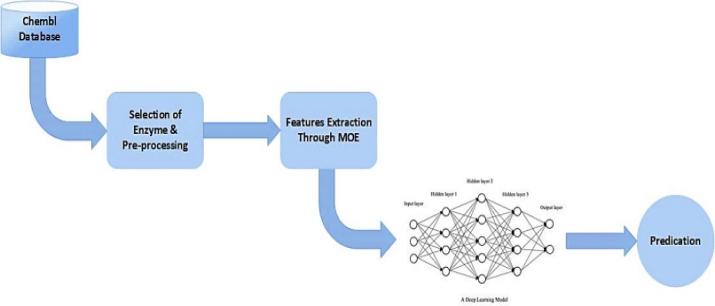
In the therapy of Coronavirus, the drug target is a demanding task to find novel medicine. A bunch of pharmaceutics procedures are employed to recognize these mutual actions. But they are exhausting and high-priced. Keeping this in view, computational procedures are widely approached to determine the mutual action of the medicine and their respective proteins. Many scientists have applied ML approaches to deduce attributes from simplified molecular-input line systems (for medicine) and protein sequences. Such approaches dropped the proteins' chemical, physical, and structural characteristics and the respective medicine. Our job is to undertake deep learning approaches to detect coronavirus enzyme correspondence with the validated Chembl database medicine. The representation of the molecular structure of proteins, medically known as fingerprints, will be done scientifically. Then, a deep learning model will be given training on the pulled-out fingerprints and the properties of molecules to determine the interplay of the medicine with the respective catalyst. The suggested approach will be proficient in recognizing the catalyst's interactivity with the approved database medicine.
Graphical Abstract
Keywords
Data Availability Statement
Funding
Conflicts of Interest
Ethical Approval and Consent to Participate
References
- Beck, B. R., Shin, B., Choi, Y., Park, S., & Kang, K. (2020). Predicting commercially available antiviral drugs that may act on the novel coronavirus (SARS-CoV-2) through a drug-target interaction deep learning model. Computational and structural biotechnology journal, 18, 784-790.
[CrossRef] [Google Scholar] - Woo, P. C., Huang, Y., Lau, S. K., & Yuen, K. Y. (2010). Coronavirus genomics and bioinformatics analysis. Viruses, 2(8).
[CrossRef] [Google Scholar] - Kuiken, T., Fouchier, R. A., Schutten, M., Rimmelzwaan, G. F., Van Amerongen, G., Van Riel, D., ... & Osterhaus, A. D. (2003). Newly discovered coronavirus as the primary cause of severe acute respiratory syndrome. The Lancet, 362(9380), 263-270.
[CrossRef] [Google Scholar] - Zaki, A. M., Van Boheemen, S., Bestebroer, T. M., Osterhaus, A. D., & Fouchier, R. A. (2012). Isolation of a novel coronavirus from a man with pneumonia in Saudi Arabia. New England journal of medicine, 367(19), 1814-1820.
[CrossRef] [Google Scholar] - Li, Q., Guan, X., Wu, P., Wang, X., Zhou, L., Tong, Y., ... & Feng, Z. (2020). Early transmission dynamics in Wuhan, China, of novel coronavirus–infected pneumonia. New England journal of medicine, 382(13), 1199-1207.
[CrossRef] [Google Scholar] - Sanders, J. M., Monogue, M. L., Jodlowski, T. Z., & Cutrell, J. B. (2020). Pharmacologic treatments for coronavirus disease 2019 (COVID-19): a review. Jama, 323(18), 1824-1836.
[CrossRef] [Google Scholar] - Majumdar, S., Nandi, S. K., Ghosal, S., Ghosh, B., Mallik, W., Roy, N. D., ... & Bhattacharyya, N. (2024). Deep learning-based potential ligand prediction framework for COVID-19 with drug–target interaction model. Cognitive computation, 16(4), 1682-1694.
[CrossRef] [Google Scholar] - Ton, A. T., Gentile, F., Hsing, M., Ban, F., & Cherkasov, A. (2020). Rapid identification of potential inhibitors of SARS‐CoV‐2 main protease by deep docking of 1.3 billion compounds. Molecular informatics, 39(8), 2000028.
[CrossRef] [Google Scholar] - Zhou, Y., Hou, Y., Shen, J., Huang, Y., Martin, W., & Cheng, F. (2020). Network-based drug repurposing for novel coronavirus 2019-nCoV/SARS-CoV-2. Cell discovery, 6(1), 14.
[CrossRef] [Google Scholar] - Jing, Y., Bian, Y., Hu, Z., Wang, L., & Xie, X. Q. S. (2018). Deep learning for drug design: an artificial intelligence paradigm for drug discovery in the big data era. The AAPS journal, 20(3), 58.
[CrossRef] [Google Scholar] - Choi, Y., Shin, B., Kang, K., Park, S., & Beck, B. R. (2020). Target-centered drug repurposing predictions of human angiotensin-converting enzyme 2 (ACE2) and transmembrane protease serine subtype 2 (TMPRSS2) interacting approved drugs for coronavirus disease 2019 (COVID-19) treatment through a drug-target interaction deep learning model. Viruses, 12(11), 1325.
[CrossRef] [Google Scholar] - Korotcov, A., Tkachenko, V., Russo, D. P., & Ekins, S. (2017). Comparison of deep learning with multiple machine learning methods and metrics using diverse drug discovery datasets. Molecular pharmaceutics, 14(12), 4462.
[CrossRef] [Google Scholar] - Abdel-Basset, M., Hawash, H., Elhoseny, M., Chakrabortty, R. K., & Ryan, M. (2020). DeepH-DTA: deep learning for predicting drug-target interactions: a case study of COVID-19 drugs repurposing. IEEE Access, 8, 170433-170451.
[CrossRef] [Google Scholar] - Jin, W., Stokes, J. M., Eastman, R. T., Itkin, Z., Zakharov, A. V., Collins, J. J., ... & Barzilay, R. (2021). Deep learning identifies synergistic drug combinations for treating COVID-19. Proceedings of the National Academy of Sciences, 118(39), e2105070118.
[CrossRef] [Google Scholar] - Huang, K., Fu, T., Glass, L. M., Zitnik, M., Xiao, C., & Sun, J. (2020). DeepPurpose: a deep learning library for drug–target interaction prediction. Bioinformatics, 36(22-23), 5545-5547.
[CrossRef] [Google Scholar] - You, J., McLeod, R. D., & Hu, P. (2019). Predicting drug-target interaction network using deep learning model. Computational biology and chemistry, 80, 90-101.
[CrossRef] [Google Scholar] - He, T., Heidemeyer, M., Ban, F., Cherkasov, A., & Ester, M. (2017). SimBoost: a read-across approach for predicting drug–target binding affinities using gradient boosting machines. Journal of cheminformatics, 9(1), 24.
[CrossRef] [Google Scholar] - Wang, Y. B., You, Z. H., Yang, S., Yi, H. C., Chen, Z. H., & Zheng, K. (2020). A deep learning-based method for drug-target interaction prediction based on long short-term memory neural network. BMC medical informatics and decision making, 20(Suppl 2), 49.
[CrossRef] [Google Scholar] - Cai, C., Wang, S., Xu, Y., Zhang, W., Tang, K., Ouyang, Q., ... & Pei, J. (2020). Transfer learning for drug discovery. Journal of Medicinal Chemistry, 63(16), 8683-8694.
[CrossRef] [Google Scholar] - Öztürk, H., Özgür, A., & Ozkirimli, E. (2018). DeepDTA: deep drug–target binding affinity prediction. Bioinformatics, 34(17), i821-i829.
[CrossRef] [Google Scholar] - Wen, M., Zhang, Z., Niu, S., Sha, H., Yang, R., Yun, Y., & Lu, H. (2017). Deep-learning-based drug–target interaction prediction. Journal of proteome research, 16(4), 1401-1409.
[CrossRef] [Google Scholar] - Nguyen, T., Le, H., Quinn, T. P., Nguyen, T., Le, T. D., & Venkatesh, S. (2021). GraphDTA: predicting drug–target binding affinity with graph neural networks. Bioinformatics, 37(8), 1140-1147.
[CrossRef] [Google Scholar] - Kim, J., Park, S., Min, D., & Kim, W. (2021). Comprehensive survey of recent drug discovery using deep learning. International Journal of Molecular Sciences, 22(18), 9983.
[CrossRef] [Google Scholar] - Chemical Computing Group. (2024). Molecular Operating Environment (MOE). Chemical Computing Group ULC, Montreal, QC. Retrieved from https://www.chemcomp.com/
[Google Scholar] - Amir-Aslani, A., & Mangematin, V. (2010). The future of drug discovery and development: shifting emphasis towards personalized medicine. Technological Forecasting and Social Change, 77(2), 203-217.
[CrossRef] [Google Scholar] - Lipinski, C. A., Lombardo, F., Dominy, B. W., & Feeney, P. J. (1997). Experimental and computational approaches to estimate solubility and permeability in drug discovery and development settings. Advanced drug delivery reviews, 23(1-3), 3-25.
[CrossRef] [Google Scholar] - Zeng, X., Song, X., Ma, T., Pan, X., Zhou, Y., Hou, Y., ... & Cheng, F. (2020). Repurpose open data to discover therapeutics for COVID-19 using deep learning. Journal of proteome research, 19(11), 4624-4636.
[CrossRef] [Google Scholar] - Zhang, Y., Ye, T., Xi, H., Juhas, M., & Li, J. (2021). Deep learning driven drug discovery: tackling severe acute respiratory syndrome coronavirus 2. Frontiers in Microbiology, 12, 739684.
[CrossRef] [Google Scholar] - Vamathevan, J., Clark, D., Czodrowski, P., Dunham, I., Ferran, E., Lee, G., ... & Zhao, S. (2019). Applications of machine learning in drug discovery and development. Nature Reviews Drug Discovery, 18(6), 463-477.
[CrossRef] [Google Scholar] - Jia, J., Zhu, F., Ma, X., Cao, Z. W., Li, Y. X., & Chen, Y. Z. (2009). Mechanisms of drug combinations: interaction and network perspectives. Nature Reviews Drug Discovery, 8(2), 111-128.
[CrossRef] [Google Scholar] - Chen, X., Yan, C. C., Zhang, X., Zhang, X., Dai, F., Yin, J., & Zhang, Y. (2016). Drug–target interaction prediction: databases, web servers and computational models. Briefings in Bioinformatics, 17(4), 696-712.
[CrossRef] [Google Scholar] - Bobrowski, T., Chen, L., Eastman, R. T., Itkin, Z., Shinn, P., Chen, C. Z., ... & Muratov, E. N. (2021). Synergistic and antagonistic drug combinations against SARS-CoV-2. Molecular Therapy, 29(2), 873-885.
[CrossRef] [Google Scholar] - Pushpakom, S., Iorio, F., Eyers, P. A., Escott, K. J., Hopper, S., Wells, A., ... & Pirmohamed, M. (2019). Drug repurposing: progress, challenges and recommendations. Nature reviews Drug discovery, 18(1), 41-58.
[CrossRef] [Google Scholar] - Wang, S., Sun, Q., Xu, Y., Pei, J., & Lai, L. (2021). A transferable deep learning approach to fast screen potential antiviral drugs against SARS-CoV-2. Briefings in Bioinformatics, 22(6), bbab211.
[CrossRef] [Google Scholar] - Zhavoronkov, A., Ivanenkov, Y. A., Aliper, A., Veselov, M. S., Aladinskiy, V. A., Aladinskaya, A. V., ... & Aspuru-Guzik, A. (2019). Deep learning enables rapid identification of potent DDR1 kinase inhibitors. Nature biotechnology, 37(9), 1038-1040.
[CrossRef] [Google Scholar] - Ekins, S., Puhl, A. C., Zorn, K. M., Lane, T. R., Russo, D. P., Klein, J. J., ... & Clark, A. M. (2019). Exploiting machine learning for end-to-end drug discovery and development. Nature materials, 18(5), 435-441.
[CrossRef] [Google Scholar] - Dara, S., Dhamercherla, S., Jadav, S. S., Babu, C. M., & Ahsan, M. J. (2022). Machine learning in drug discovery: a review. Artificial intelligence review, 55(3), 1947-1999.
[CrossRef] [Google Scholar] - Allan, M., Lièvre, M., Laurenson-Schafer, H., de Barros, S., Jinnai, Y., Andrews, S., ... & Fitzner, J. (2022). The world health organization COVID-19 surveillance database. International Journal for Equity in Health, 21(Suppl 3), 167.
[CrossRef] [Google Scholar] - Wishart, D. S., Feunang, Y. D., Guo, A. C., Lo, E. J., Marcu, A., Grant, J. R., ... & Wilson, M. (2018). DrugBank 5.0: a major update to the DrugBank database for 2018. Nucleic acids research, 46(D1), D1074-D1082.
[CrossRef] [Google Scholar] - Irwin, J. J., & Shoichet, B. K. (2005). ZINC- a free database of commercially available compounds for virtual screening. Journal of chemical information and modeling, 45(1), 177-182.
[CrossRef] [Google Scholar] - Koh, H. K., Geller, A. C., & VanderWeele, T. J. (2021). Deaths from COVID-19. JAMA, 325(2), 133-134.
[CrossRef] [Google Scholar] - Hasan, M. N., Haider, N., Stigler, F. L., Khan, R. A., McCoy, D., Zumla, A., ... & Uddin, M. J. (2021). The global case-fatality rate of COVID-19 has been declining since May 2020. The American Journal of Tropical Medicine and Hygiene, 104(6), 2176–2184.
[CrossRef] [Google Scholar]
Cite This Article
TY  - JOUR
AU  - Khan, Tauseef
AU  - Hussain, Altaf
AU  - Hussain, Tariq
AU  - Lin, Xianxuan
AU  - Sharafian, Amin
AU  - Monirul, Islam Md
AU  - Laila, Umme
PY  - 2025
DA  - 2025/02/19
TI  - Prediction of Coronavirus Inhibitors in Drug Discovery through Deep Learning
JO  - ICCK Transactions on Advanced Computing and Systems
T2  - ICCK Transactions on Advanced Computing and Systems
JF  - ICCK Transactions on Advanced Computing and Systems
VL  - 1
IS  - 1
SP  - 19
EP  - 31
DO  - 10.62762/TACS.2024.974479
UR  - https://www.icck.org/article/abs/TACS.2024.974479
KW  - drug discovery
KW  - Covid-19
KW  - deep learning
KW  - machine learning
KW  - bio-informatics
AB  - In the therapy of Coronavirus, the drug target is a demanding task to find novel medicine. A bunch of pharmaceutics procedures are employed to recognize these mutual actions. But they are exhausting and high-priced. Keeping this in view, computational procedures are widely approached to determine the mutual action of the medicine and their respective proteins. Many scientists have applied ML approaches to deduce attributes from simplified molecular-input line systems (for medicine) and protein sequences. Such approaches dropped the proteins' chemical, physical, and structural characteristics and the respective medicine. Our job is to undertake deep learning approaches to detect coronavirus enzyme correspondence with the validated Chembl database medicine. The representation of the molecular structure of proteins, medically known as fingerprints, will be done scientifically. Then, a deep learning model will be given training on the pulled-out fingerprints and the properties of molecules to determine the interplay of the medicine with the respective catalyst. The suggested approach will be proficient in recognizing the catalyst's interactivity with the approved database medicine.
SN  - 3068-7969
PB  - Institute of Central Computation and Knowledge
LA  - English
ER  -
@article{Khan2025Prediction,
  author = {Tauseef Khan and Altaf Hussain and Tariq Hussain and Xianxuan Lin and Amin Sharafian and Islam Md Monirul and Umme Laila},
  title = {Prediction of Coronavirus Inhibitors in Drug Discovery through Deep Learning},
  journal = {ICCK Transactions on Advanced Computing and Systems},
  year = {2025},
  volume = {1},
  number = {1},
  pages = {19-31},
  doi = {10.62762/TACS.2024.974479},
  url = {https://www.icck.org/article/abs/TACS.2024.974479},
  abstract = {In the therapy of Coronavirus, the drug target is a demanding task to find novel medicine. A bunch of pharmaceutics procedures are employed to recognize these mutual actions. But they are exhausting and high-priced. Keeping this in view, computational procedures are widely approached to determine the mutual action of the medicine and their respective proteins. Many scientists have applied ML approaches to deduce attributes from simplified molecular-input line systems (for medicine) and protein sequences. Such approaches dropped the proteins' chemical, physical, and structural characteristics and the respective medicine. Our job is to undertake deep learning approaches to detect coronavirus enzyme correspondence with the validated Chembl database medicine. The representation of the molecular structure of proteins, medically known as fingerprints, will be done scientifically. Then, a deep learning model will be given training on the pulled-out fingerprints and the properties of molecules to determine the interplay of the medicine with the respective catalyst. The suggested approach will be proficient in recognizing the catalyst's interactivity with the approved database medicine.},
  keywords = {drug discovery, Covid-19, deep learning, machine learning, bio-informatics},
  issn = {3068-7969},
  publisher = {Institute of Central Computation and Knowledge}
}
Article Metrics
Publisher's Note
ICCK stays neutral with regard to jurisdictional claims in published maps and institutional affiliations.
Rights and Permissions
 Copyright © 2025 by the Author(s). Published by Institute of Central Computation and Knowledge. This article is an open access article distributed under the terms and conditions of the Creative Commons Attribution (CC BY) license (https://creativecommons.org/licenses/by/4.0/), which permits use, sharing, adaptation, distribution and reproduction in any medium or format, as long as you give appropriate credit to the original author(s) and the source, provide a link to the Creative Commons licence, and indicate if changes were made.


Portico
