

An Efficient Algorithm for Weather Forecasting Using Causal Graph Neural Network




Article Information
Abstract
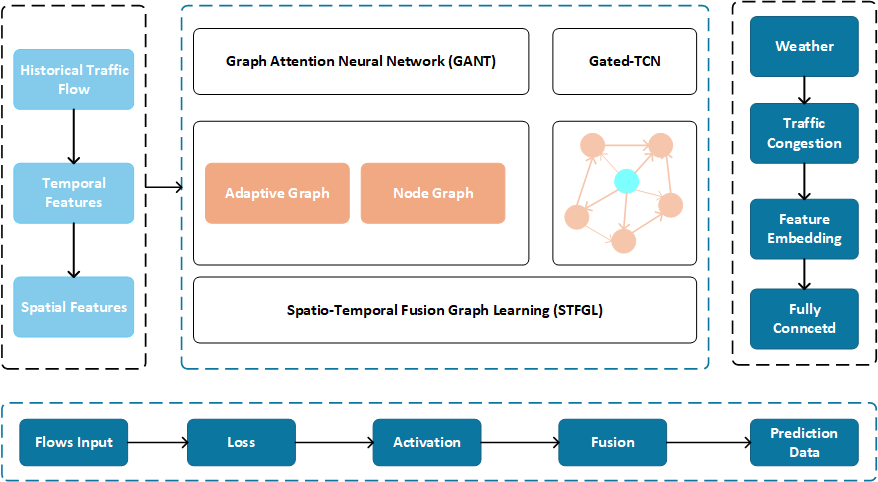
The rapid accumulation of large-scale, long-term meteorological data presents unprecedented opportunities for data-driven weather modeling and high-resolution atmospheric prediction. While various deep learning techniques-such as Long Short-Term Memory (LSTM), Recurrent Neural Networks (RNNs), and Graph Neural Networks (GNNs)-have been explored for weather forecasting, the complex spatial dependencies within historical meteorological data, particularly dynamic spatial correlations among distributed observation stations, remain insufficiently addressed. To tackle this challenge, we propose a Dynamic Spatio-Temporal Fusion Graph Network (DSTFGN), a novel framework that integrates multivariate time-series analysis with graph-based causal inference to capture intricate and time-varying interdependencies among weather variables across meteorological observation networks. The DSTFGN module fuses real-time inputs (e.g., sensor data, live weather feeds, satellite observations) with historical records to model the propagation of atmospheric disturbances-such as storm systems, pressure fronts, or humidity anomalies-through the meteorological observation network. By effectively capturing dynamic spatial-temporal interactions among weather stations, our approach significantly enhances forecasting accuracy and supports adaptive meteorological monitoring strategies. Experimental evaluations on two real-world meteorological datasets demonstrate that DSTFGN consistently outperforms existing baseline models across short-term, medium-term, and long-term forecasting horizons, achieving improvements of up to 10.58\% in temperature forecasting and 8.88\% in humidity forecasting over the best competing baseline.
Graphical Abstract
Keywords
Data Availability Statement
Funding
Conflicts of Interest
Ethical Approval and Consent to Participate
References
- Ren, X., Li, X., Ren, K., Song, J., Xu, Z., Deng, K., & Wang, X. (2021). Deep learning-based weather prediction: a survey. Big Data Research, 23, 100178.
[CrossRef] [Google Scholar] - Hewage, P., Behera, A., Trovati, M., Pereira, E., Ghahremani, M., Palmieri, F., & Liu, Y. (2020). Temporal convolutional neural (TCN) network for an effective weather forecasting using time-series data from the local weather station. Soft Computing, 24(21), 16453-16482.
[CrossRef] [Google Scholar] - Khan, M. M. H., Mustafa, M. R. U., Hossain, M. S., Shams, S., & Julius, A. D. (2023). Short-term and long-term rainfall forecasting using arima model. International Journal of Environmental Science and Development, 14(5), 292-298.
[CrossRef] [Google Scholar] - Jin, M., Koh, H. Y., Wen, Q., Zambon, D., Alippi, C., Webb, G. I., ... & Pan, S. (2024). A survey on graph neural networks for time series: Forecasting, classification, imputation, and anomaly detection. IEEE Transactions on Pattern Analysis and Machine Intelligence.
[CrossRef] [Google Scholar] - Weyn, J. A., Durran, D. R., & Caruana, R. (2020). Improving data‐driven global weather prediction using deep convolutional neural networks on a cubed sphere. Journal of Advances in Modeling Earth Systems, 12(9), e2020MS002109.
[CrossRef] [Google Scholar] - Lira, H., Martí, L., & Sanchez-Pi, N. (2022). A graph neural network with spatio-temporal attention for multi-sources time series data: An application to frost forecast. Sensors, 22(4), 1486.
[CrossRef] [Google Scholar] - Lam, R., Sanchez-Gonzalez, A., Willson, M., Wirnsberger, P., Fortunato, M., Alet, F., ... & Battaglia, P. (2023). Learning skillful medium-range global weather forecasting. Science, 382(6677), 1416-1421.
[CrossRef] [Google Scholar] - Ma, M., Xie, P., Teng, F., Wang, B., Ji, S., Zhang, J., & Li, T. (2023). HiSTGNN: Hierarchical spatio-temporal graph neural network for weather forecasting. Information Sciences, 648, 119580.
[CrossRef] [Google Scholar] - Zhang, F. H., & Shao, Z. G. (2023). ST-GRF: Spatiotemporal graph neural networks for rainfall forecasting. Digital Signal Processing, 136, 103989.
[CrossRef] [Google Scholar] - Gao, Z., Li, Z., Zhang, H., Yu, J., & Xu, L. (2023). Dynamic spatiotemporal interactive graph neural network for multivariate time series forecasting. Knowledge-Based Systems, 280, 110995.
[CrossRef] [Google Scholar] - Silva, F. N., Vega‐Oliveros, D. A., Yan, X., Flammini, A., Menczer, F., Radicchi, F., ... & Fortunato, S. (2021). Detecting climate teleconnections with Granger causality. Geophysical Research Letters, 48(18), e2021GL094707.
[CrossRef] [Google Scholar] - Sun, G., Zhao, Y., & Qi, X. (2025). Sequence to sequence architecture based on hybrid LSTM global and local encoders approach for meteorological factors forecasting. Scientific reports, 15(1), 22753.
[CrossRef] [Google Scholar] - Nketiah, E. A., Chenlong, L., Yingchuan, J., & Aram, S. A. (2023). Recurrent neural network modeling of multivariate time series and its application in temperature forecasting. Plos one, 18(5), e0285713.
[CrossRef] [Google Scholar] - Vaswani, A., Shazeer, N., Parmar, N., Uszkoreit, J., Jones, L., Gomez, A. N., ... & Polosukhin, I. (2017). Attention is all you need. Advances in neural information processing systems, 30.
[Google Scholar] - Khodayar, M., & Wang, J. (2018). Spatio-temporal graph deep neural network for short-term wind speed forecasting. IEEE Transactions on Sustainable Energy, 10(2), 670-681.
[CrossRef] [Google Scholar] - Hewage, P., Trovati, M., Pereira, E., & Behera, A. (2021). Deep learning-based effective fine-grained weather forecasting model. Pattern Analysis and Applications, 24(1), 343-366.
[CrossRef] [Google Scholar] - Xiang, L., Xiang, J., Guan, J., Zhang, L., Cao, Z., & Xia, J. (2022). Spatiotemporal forecasting model based on hybrid convolution for local weather prediction post-processing. Frontiers in Earth Science, 10, 978942.
[CrossRef] [Google Scholar] - Abdulla, N., Demirci, M., & Ozdemir, S. (2022). Design and evaluation of adaptive deep learning models for weather forecasting. Engineering Applications of Artificial Intelligence, 116, 105440.
[CrossRef] [Google Scholar] - Guo, A., Liu, Y., Shao, S., Jia, S., Shi, X., & Feng, Z. (2024, November). Spatial-Temporal Graph Attention Networks Based on Novel Adjacency Matrix for Weather Forecasting. In EAI International Conference on Collaborative Computing: Networking, Applications and Worksharing (pp. 24-41). Cham: Springer Nature Switzerland.
[CrossRef] [Google Scholar] - Shi, X., Chen, Z., Wang, H., Yeung, D. Y., Wong, W. K., & Woo, W. C. (2015). Convolutional LSTM network: A machine learning approach for precipitation nowcasting. Advances in neural information processing systems, 28.
[Google Scholar] - Espeholt, L., Agrawal, S., Sønderby, C., Kumar, M., Heek, J., Bromberg, C., ... & Kalchbrenner, N. (2022). Deep learning for twelve hour precipitation forecasts. Nature communications, 13(1), 5145.
[CrossRef] [Google Scholar] - Sønderby, C. K., Espeholt, L., Heek, J., Dehghani, M., Oliver, A., Salimans, T., ... & Kalchbrenner, N. (2020). Metnet: A neural weather model for precipitation forecasting. arXiv preprint arXiv:2003.12140.
[CrossRef] [Google Scholar] - Salman, A. G., Kanigoro, B., & Heryadi, Y. (2015, October). Weather forecasting using deep learning techniques. In 2015 international conference on advanced computer science and information systems (ICACSIS) (pp. 281-285). IEEE.
[CrossRef] [Google Scholar] - Keisler, R. (2022). Forecasting global weather with graph neural networks. arXiv preprint arXiv:2202.07575.
[CrossRef] [Google Scholar] - Pathak, J., Subramanian, S., Harrington, P., Raja, S., Chattopadhyay, A., Mardani, M., ... & Anandkumar, A. (2022). Fourcastnet: A global data-driven high-resolution weather model using adaptive fourier neural operators. arXiv preprint arXiv:2202.11214.
[CrossRef] [Google Scholar] - Bi, K., Xie, L., Zhang, H., Chen, X., Gu, X., & Tian, Q. (2023). Accurate medium-range global weather forecasting with 3D neural networks. Nature, 619(7970), 533-538.
[CrossRef] [Google Scholar] - Aykas, D., & Mehrkanoon, S. (2021, December). Multistream graph attention networks for wind speed forecasting. In 2021 IEEE Symposium Series on Computational Intelligence (SSCI) (pp. 1-8). IEEE.
[CrossRef] [Google Scholar] - Papagiannopoulou, C., Miralles, D. G., Decubber, S., Demuzere, M., Verhoest, N. E., Dorigo, W. A., & Waegeman, W. (2017). A non-linear Granger-causality framework to investigate climate–vegetation dynamics. Geoscientific Model Development, 10(5), 1945-1960.
[CrossRef] [Google Scholar] - Runge, J., Gerhardus, A., Varando, G., Eyring, V., & Camps-Valls, G. (2023). Causal inference for time series. Nature Reviews Earth & Environment, 4(7), 487-505.
[CrossRef] [Google Scholar] - Pamfil, R., Sriwattanaworachai, N., Desai, S., Pilgerstorfer, P., Georgatzis, K., Beaumont, P., & Aragam, B. (2020, June). Dynotears: Structure learning from time-series data. In International Conference on Artificial Intelligence and Statistics (pp. 1595-1605). Pmlr.
[Google Scholar] - Runge, J., Nowack, P., Kretschmer, M., Flaxman, S., & Sejdinovic, D. (2019). Detecting and quantifying causal associations in large nonlinear time series datasets. Science advances, 5(11), eaau4996.
[CrossRef] [Google Scholar] - Nauta, M., Bucur, D., & Seifert, C. (2019). Causal discovery with attention-based convolutional neural networks. Machine Learning and Knowledge Extraction, 1(1), 19.
[CrossRef] [Google Scholar] - Guo, R., Cheng, L., Li, J., Hahn, P. R., & Liu, H. (2020). A survey of learning causality with data: Problems and methods. ACM Computing Surveys (CSUR), 53(4), 1-37.
[CrossRef] [Google Scholar] - Fathi, M., Haghi Kashani, M., Jameii, S. M., & Mahdipour, E. (2022). Big data analytics in weather forecasting: A systematic review. Archives of Computational Methods in Engineering, 29(2), 1247-1275.
[CrossRef] [Google Scholar] - Al Sukhni, H., Sakr, F., Alsmadi, M. K., Abd-Elghany, M., Gomaa, I. A., & Abdallah, S. (2025). Data-Driven Weather Prediction: Integrating Deep Learning and Ensemble Models for Robust Weather Forecasting. Journal of Cybersecurity & Information Management, 15(2).
[CrossRef] [Google Scholar] - Brotzge, J. A., Berchoff, D., Carlis, D. L., Carr, F. H., Carr, R. H., Gerth, J. J., ... & Wang, X. (2023). Challenges and opportunities in numerical weather prediction. Bulletin of the American Meteorological Society, 104(3), E698-E705.
[CrossRef] [Google Scholar] - García-Duarte, L., Cifuentes, J., & Marulanda, G. (2023). Short-term spatio-temporal forecasting of air temperatures using deep graph convolutional neural networks. Stochastic Environmental Research and Risk Assessment, 37(5), 1649-1667.
[CrossRef] [Google Scholar] - Haupt, S. E., Cowie, J., Linden, S., McCandless, T., Kosovic, B., & Alessandrini, S. (2018, October). Machine learning for applied weather prediction. In 2018 IEEE 14th international conference on e-science (e-Science) (pp. 276-277). IEEE.
[CrossRef] [Google Scholar] - Schultz, M. G., Betancourt, C., Gong, B., Kleinert, F., Langguth, M., Leufen, L. H., ... & Stadtler, S. (2021). Can deep learning beat numerical weather prediction?. Philosophical Transactions of the Royal Society A, 379(2194), 20200097.
[CrossRef] [Google Scholar] - Mehrkanoon, S. (2019). Deep shared representation learning for weather elements forecasting. Knowledge-Based Systems, 179, 120-128.
[CrossRef] [Google Scholar]
Cited By (8)
-
Hanqi Zhang, Ke Xu, Xinghao Jiang, Tanfeng Sun, Zeyu Zhao. .
Advanced Intelligent Computing Technology and Applications, 2027 , 16656 .
[CrossRef] -
Chunlong Fan, Ruihao Fu, Li Xu, Yu Bai. .
Advanced Intelligent Computing Technology and Applications, 2027 , 16645 .
[CrossRef] -
Juzheng Zhang, Kehao Zhang, Binnan Yan, Hongliang Liu, Yong Pei. .
Advanced Intelligent Computing Technology and Applications, 2027 , 16672 .
[CrossRef] -
Xinwei Yao, Liang Xu, Qiang Li, Kunhua Yang, Chao Ren, Xinyu Gu. .
Advanced Intelligent Computing Technology and Applications, 2027 , 16650 .
[CrossRef] -
Rui Xiang, Yuhao Zhou, Jianhui Jiang. .
Advanced Intelligent Computing Technology and Applications, 2027 , 16644 .
[CrossRef] -
Yuchuan Pu, Yutong Zhang, Yaoran Yang, Yifan Zhu, Ziyi Shen, Wentao Zhang. .
Advanced Intelligent Computing Technology and Applications, 2027 , 16656 .
[CrossRef] -
Ziyi Yu, Guofang Zhang. .
Advanced Intelligent Computing Technology and Applications, 2027 , 16645 .
[CrossRef] -
Mohamed Naeem. Resource-efficient and fair spatial graph attention networks for edge-based multi-label cardiac abnormality detection.
Applied Soft Computing, 2026 , 202 .
[CrossRef]
Cite This Article
TY  - JOUR
AU  - Ali, Ahmad
AU  - Naeem, H. M. Yasir
AU  - Ali, Riaz
AU  - Asad, Mujtaba
AU  - Heyat, Md Belal Bin
AU  - Alsarhan, Tamam
PY  - 2025
DA  - 2025/10/28
TI  - An Efficient Algorithm for Weather Forecasting Using Causal Graph Neural Network
JO  - ICCK Transactions on Advanced Computing and Systems
T2  - ICCK Transactions on Advanced Computing and Systems
JF  - ICCK Transactions on Advanced Computing and Systems
VL  - 1
IS  - 4
SP  - 258
EP  - 274
DO  - 10.62762/TACS.2025.619794
UR  - https://www.icck.org/article/abs/TACS.2025.619794
KW  - weather forecasting
KW  - causal graph learning
KW  - spatio-temporal graph neural network
KW  - attention mechanism
KW  - meteorological prediction
AB  - The rapid accumulation of large-scale, long-term meteorological data presents unprecedented opportunities for data-driven weather modeling and high-resolution atmospheric prediction. While various deep learning techniques-such as Long Short-Term Memory (LSTM), Recurrent Neural Networks (RNNs), and Graph Neural Networks (GNNs)-have been explored for weather forecasting, the complex spatial dependencies within historical meteorological data, particularly dynamic spatial correlations among distributed observation stations, remain insufficiently addressed. To tackle this challenge, we propose a Dynamic Spatio-Temporal Fusion Graph Network (DSTFGN), a novel framework that integrates multivariate time-series analysis with graph-based causal inference to capture intricate and time-varying interdependencies among weather variables across meteorological observation networks. The DSTFGN module fuses real-time inputs (e.g., sensor data, live weather feeds, satellite observations) with historical records to model the propagation of atmospheric disturbances-such as storm systems, pressure fronts, or humidity anomalies-through the meteorological observation network. By effectively capturing dynamic spatial-temporal interactions among weather stations, our approach significantly enhances forecasting accuracy and supports adaptive meteorological monitoring strategies. Experimental evaluations on two real-world meteorological datasets demonstrate that DSTFGN consistently outperforms existing baseline models across short-term, medium-term, and long-term forecasting horizons, achieving improvements of up to 10.58\% in temperature forecasting and 8.88\% in humidity forecasting over the best competing baseline.
SN  - 3068-7969
PB  - Institute of Central Computation and Knowledge
LA  - English
ER  -
@article{Ali2025An,
  author = {Ahmad Ali and H. M. Yasir Naeem and Riaz Ali and Mujtaba Asad and Md Belal Bin Heyat and Tamam Alsarhan},
  title = {An Efficient Algorithm for Weather Forecasting Using Causal Graph Neural Network},
  journal = {ICCK Transactions on Advanced Computing and Systems},
  year = {2025},
  volume = {1},
  number = {4},
  pages = {258-274},
  doi = {10.62762/TACS.2025.619794},
  url = {https://www.icck.org/article/abs/TACS.2025.619794},
  abstract = {The rapid accumulation of large-scale, long-term meteorological data presents unprecedented opportunities for data-driven weather modeling and high-resolution atmospheric prediction. While various deep learning techniques-such as Long Short-Term Memory (LSTM), Recurrent Neural Networks (RNNs), and Graph Neural Networks (GNNs)-have been explored for weather forecasting, the complex spatial dependencies within historical meteorological data, particularly dynamic spatial correlations among distributed observation stations, remain insufficiently addressed. To tackle this challenge, we propose a Dynamic Spatio-Temporal Fusion Graph Network (DSTFGN), a novel framework that integrates multivariate time-series analysis with graph-based causal inference to capture intricate and time-varying interdependencies among weather variables across meteorological observation networks. The DSTFGN module fuses real-time inputs (e.g., sensor data, live weather feeds, satellite observations) with historical records to model the propagation of atmospheric disturbances-such as storm systems, pressure fronts, or humidity anomalies-through the meteorological observation network. By effectively capturing dynamic spatial-temporal interactions among weather stations, our approach significantly enhances forecasting accuracy and supports adaptive meteorological monitoring strategies. Experimental evaluations on two real-world meteorological datasets demonstrate that DSTFGN consistently outperforms existing baseline models across short-term, medium-term, and long-term forecasting horizons, achieving improvements of up to 10.58\\% in temperature forecasting and 8.88\\% in humidity forecasting over the best competing baseline.},
  keywords = {weather forecasting, causal graph learning, spatio-temporal graph neural network, attention mechanism, meteorological prediction},
  issn = {3068-7969},
  publisher = {Institute of Central Computation and Knowledge}
}
Publisher's Note
ICCK stays neutral with regard to jurisdictional claims in published maps and institutional affiliations.
Rights and Permissions
 Copyright © 2025 by the Author(s). Published by Institute of Central Computation and Knowledge. This article is an open access article distributed under the terms and conditions of the Creative Commons Attribution (CC BY) license (https://creativecommons.org/licenses/by/4.0/), which permits use, sharing, adaptation, distribution and reproduction in any medium or format, as long as you give appropriate credit to the original author(s) and the source, provide a link to the Creative Commons licence, and indicate if changes were made.


Portico
