

A Comprehensive Survey of Deep Learning-Based Traffic Flow Prediction Models for Intelligent Transportation Systems




Article Information
Abstract
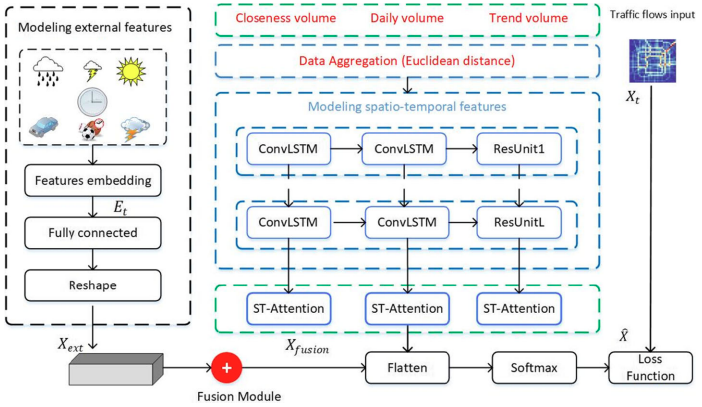
Traffic flow prediction is a critical component of Intelligent Transportation Systems (ITS) and smart city infrastructures. This survey paper provides a comprehensive analysis of recent advancements in deep learning-based approaches for traffic flow prediction, focusing on spatiotemporal correlations and attention mechanisms. We systematically review key representative works that propose innovative neural network architectures including DHSTNet, Att-DHSTNet, and ASTMGCNet for citywide traffic prediction. Our survey examines their methodologies, key contributions, experimental results, and comparative performance. We organize the discussion around three main themes: (1) modeling dynamic spatiotemporal dependencies, (2) attention mechanisms for traffic prediction, and (3) hybrid neural network architectures. The paper includes detailed comparison tables and conceptual figures synthesized from the reviewed works. Our analysis shows that attention-based hybrid models outperform traditional techniques, with ASTMGCNet having the lowest RMSE (4.06) and MAPE (12.56%) on benchmark datasets. We end by outlining current issues and potential research directions in this rapidly changing subject.
Graphical Abstract
Keywords
Data Availability Statement
Funding
Conflicts of Interest
Ethical Approval and Consent to Participate
References
- Ali, A., Zhu, Y., & Zakarya, M. (2021). Exploiting dynamic spatiotemporal correlations for citywide traffic flow prediction using attention based neural networks. Information Sciences, 577, 852-870.
[CrossRef] [Google Scholar] - Chen, C., Li, K., Teo, S. G., Zou, X., Li, K., & Zeng, Z. (2020). Citywide traffic flow prediction based on multiple gated spatiotemporal convolutional neural networks. ACM Transactions on Knowledge Discovery from Data (TKDD), 14(4), 1-23.
[CrossRef] [Google Scholar] - Zheng, C., Fan, X., Wen, C., Chen, L., Wang, C., & Li, J. (2019). DeepSTD: Mining spatiotemporal disturbances of multiple context factors for citywide traffic flow prediction. IEEE Transactions on Intelligent Transportation Systems, 21(9), 3744-3755.
[CrossRef] [Google Scholar] - Jia, T., & Yan, P. (2020). Predicting citywide road traffic flow using deep spatiotemporal neural networks. IEEE Transactions on Intelligent Transportation Systems, 22(5), 3101-3111.
[CrossRef] [Google Scholar] - Luo, Y., Zheng, J., Wang, X., Tao, Y., & Jiang, X. (2024). GT-LSTM: A spatiotemporal ensemble network for traffic flow prediction. Neural Networks, 171, 251-262.
[CrossRef] [Google Scholar] - Williams, B. M., & Hoel, L. A. (2003). Modeling and forecasting vehicular traffic flow as a seasonal ARIMA process: Theoretical basis and empirical results. Journal of transportation engineering, 129(6), 664-672.
[CrossRef] [Google Scholar] - Zivot, E., & Wang, J. (2006). Vector autoregressive models for multivariate time series. Modeling financial time series with S-PLUS, 385-429.
[CrossRef] [Google Scholar] - Zhang, J., Zheng, Y., & Qi, D. (2017, February). Deep spatiotemporal residual networks for citywide crowd flows prediction. In Proceedings of the AAAI conference on artificial intelligence (Vol. 31, No. 1).
[CrossRef] [Google Scholar] - Ali, A., Zhu, Y., Chen, Q., Yu, J., & Cai, H. (2019, December). Leveraging spatio-temporal patterns for predicting citywide traffic crowd flows using deep hybrid neural networks. In 2019 IEEE 25th international conference on parallel and distributed systems (ICPADS) (pp. 125-132). IEEE.
[CrossRef] [Google Scholar] - Hu, N., Zhang, D., Xie, K., Liang, W., Li, K. C., & Zomaya, A. Y. (2024). Dynamic multi-scale spatial--temporal graph convolutional network for traffic flow prediction. Future Generation Computer Systems, 158, 323-332.
[CrossRef] [Google Scholar] - Zhang, X., Xu, Y., & Shao, Y. (2022). Forecasting traffic flow with spatial--temporal convolutional graph attention networks. Neural Computing and Applications, 34(18), 15457-15479.
[CrossRef] [Google Scholar] - Wang, X., Ma, Y., Wang, Y., Jin, W., Wang, X., Tang, J., ... & Yu, J. (2020, April). Traffic flow prediction via spatial temporal graph neural network. In Proceedings of the web conference 2020 (pp. 1082-1092).
[CrossRef] [Google Scholar] - Wang, Y. (2023). Advances in spatiotemporal graph neural network prediction research. International Journal of Digital Earth, 16(1), 2034-2066.
[CrossRef] [Google Scholar] - Schrank, D., Eisele, B., & Lomax, T. (2019). Urban Mobility Report 2019. Texas Transportation Institute. Retrieved from https://rosap.ntl.bts.gov/view/dot/61408
[Google Scholar] - Zhang, J., Wang, F. Y., Wang, K., Lin, W. H., Xu, X., & Chen, C. (2011). Data-driven intelligent transportation systems: A survey. IEEE Transactions on Intelligent Transportation Systems, 12(4), 1624-1639.
[CrossRef] [Google Scholar] - Yin, X., Wu, G., Wei, J., Shen, Y., Qi, H., & Yin, B. (2021). Deep learning on traffic prediction: Methods, analysis, and future directions. IEEE Transactions on Intelligent Transportation Systems, 23(6), 4927-4943.
[CrossRef] [Google Scholar] - Abduljabbar, R., Dia, H., Liyanage, S., & Bagloee, S. A. (2019). Applications of artificial intelligence in transport: An overview. Sustainability, 11(1), 189.
[CrossRef] [Google Scholar] - Nguyen, H., Liu, W., & Chen, F. (2016). Discovering congestion propagation patterns in spatio-temporal traffic data. IEEE Transactions on Big Data, 3(2), 169-180.
[CrossRef] [Google Scholar] - Vlahogianski, E. I., Karlaftis, M. G., & Golias, J. C. (2014). Short-term traffic forecasting: Where we are and where we're going. Transportation Research Part C: Emerging Technologies, 43, 3-19.
[CrossRef] [Google Scholar] - Jiang, W., & Luo, J. (2022). Graph neural network for traffic forecasting: A survey. Expert systems with applications, 207, 117921.
[CrossRef] [Google Scholar] - Yu, B., Yin, H., & Zhu, Z. (2018). Spatio-temporal graph convolutional networks: A deep learning framework for traffic forecasting. In Proceedings of the Twenty-Seventh International Joint Conference on Artificial Intelligence (IJCAI-18) (pp. 3634--3640).
[CrossRef] [Google Scholar] - Li, Y., Yu, R., Shahabi, C., & Liu, Y. (2017). Diffusion convolutional recurrent neural network: Data-driven traffic forecasting. arXiv preprint arXiv:1707.01926.
[CrossRef] [Google Scholar] - Selvi, K. T., Thamilselvan, R., & Saranya, S. M. (2021, February). Diffusion convolution recurrent neural network--a comprehensive survey. In IOP Conference Series: Materials Science and Engineering (Vol. 1055, No. 1, p. 012119). IOP Publishing.
[CrossRef] [Google Scholar] - Tedjopurnomo, D. A., Bao, Z., Zheng, B., Choudhury, F. M., & Qin, A. K. (2020). A survey on modern deep neural network for traffic prediction: Trends, methods and challenges. IEEE Transactions on Knowledge and Data Engineering, 34(4), 1544-1561.
[CrossRef] [Google Scholar] - Huang, W., Song, G., Hong, H., & Xie, K. (2014). Deep architecture for traffic flow prediction: Deep belief networks with multitask learning. IEEE Transactions on Intelligent Transportation Systems, 15(5), 2191-2201.
[CrossRef] [Google Scholar] - Liu, Q., Chen, C., Zhang, Y., & Hu, Z. (2011). Feature selection for support vector machines with RBF kernel. Artificial Intelligence Review, 36(2), 99-115.
[CrossRef] [Google Scholar] - Sun, S., Zhang, C., & Yu, G. (2006). A Bayesian network approach to traffic flow forecasting. IEEE Transactions on intelligent transportation systems, 7(1), 124-132.
[CrossRef] [Google Scholar] - Ou, J., Xia, J., Wu, Y. J., & Rao, W. (2017). Short-term traffic flow forecasting for urban roads using data-driven feature selection strategy and bias-corrected random forests. Transportation Research Record, 2645(1), 157-167.
[CrossRef] [Google Scholar] - Ma, X., Dai, Z., He, Z., Ma, J., Wang, Y., & Wang, Y. (2017). Learning traffic as images: A deep convolutional neural network for large-scale transportation network speed prediction. Sensors, 17(4), 818.
[CrossRef] [Google Scholar] - Miglani, A., & Kumar, N. (2019). Deep learning models for traffic flow prediction in autonomous vehicles: A review, solutions, and challenges. Vehicular Communications, 20, 100184.
[CrossRef] [Google Scholar] - Ma, X., Tao, Z., Wang, Y., Yu, H., & Wang, Y. (2015). Long short-term memory neural network for traffic speed prediction using remote microwave sensor data. Transportation research part C: emerging technologies, 54, 187-197.
[CrossRef] [Google Scholar] - Chen, Z., Wu, B., Li, B., & Ruan, H. (2021). Expressway exit traffic flow prediction for ETC and MTC charging system based on entry traffic flows and LSTM model. IEEE Access, 9, 54613-54624.
[CrossRef] [Google Scholar] - Boukerche, A., & Wang, J. (2020). Machine learning-based traffic prediction models for intelligent transportation systems. Computer Networks, 181, 107530.
[CrossRef] [Google Scholar] - Bahdanau, D., Cho, K., & Bengio, Y. (2014). Neural machine translation by jointly learning to align and translate. arXiv preprint arXiv:1409.0473.
[CrossRef] [Google Scholar] - Brauwers, G., & Frasincar, F. (2021). A general survey on attention mechanisms in deep learning. IEEE Transactions on Knowledge and Data Engineering, 35(4), 3279-3298.
[CrossRef] [Google Scholar] - Duan, P., Mao, G., Liang, W., & Zhang, D. (2018). A unified spatiotemporal model for short-term traffic flow prediction. IEEE Transactions on Intelligent Transportation Systems, 20(9), 3212-3223.
[CrossRef] [Google Scholar] - Cao, S., Wu, L., Wu, J., Wu, D., & Li, Q. (2022). A spatiotemporal sequence-to-sequence network for traffic flow prediction. Information Sciences, 610, 185-203.
[CrossRef] [Google Scholar] - Hussain, B., Afzal, M. K., Anjum, S., Rao, I., & Kim, B. S. (2023). A novel graph convolutional gated recurrent unit framework for network-based traffic prediction. IEEE Access, 11, 130102-130118.
[CrossRef] [Google Scholar] - Zhang, W., Yu, Y., Qi, Y., Shu, F., & Wang, Y. (2019). Short-term traffic flow prediction based on spatio-temporal analysis and CNN deep learning. Transportmetrica A: Transport Science, 15(2), 1688-1711.
[CrossRef] [Google Scholar] - Liu, M., Zhu, T., Ye, J., Meng, Q., Sun, L., & Du, B. (2023). Spatio-temporal autoencoder for traffic flow prediction. IEEE Transactions on Intelligent Transportation Systems, 24(5), 5516-5526.
[CrossRef] [Google Scholar] - Zhang, J., Zheng, Y., Sun, J., & Qi, D. (2019). Flow prediction in spatiotemporal networks based on multitask deep learning. IEEE Transactions on Knowledge and Data Engineering, 32(3), 468-478.
[CrossRef] [Google Scholar] - Lippi, M., Bertini, M., & Frasconi, P. (2013). Short-term traffic flow forecasting: An experimental comparison of time-series analysis and supervised learning. IEEE Transactions on Intelligent Transportation Systems, 14(2), 871-882.
[CrossRef] [Google Scholar] - Wu, Y., Tan, H., Qin, L., Ran, B., & Jiang, Z. (2018). A hybrid deep learning based traffic flow prediction method and its understanding. Transportation Research Part C: Emerging Technologies, 90, 166-180.
[CrossRef] [Google Scholar] - Du, B., Peng, H., Wang, S., Bhuiyan, M. Z. A., Wang, L., Gong, Q., ... & Li, J. (2019). Deep irregular convolutional residual LSTM for urban traffic passenger flows prediction. IEEE Transactions on Intelligent Transportation Systems, 21(3), 972-985.
[CrossRef] [Google Scholar] - Jiang, W., Luo, J., He, M., & Gu, W. (2023). Graph neural network for traffic forecasting: The research progress. ISPRS International Journal of Geo-Information, 12(3), 100.
[CrossRef] [Google Scholar] - Wang, C., & Ye, Z. (2016). Traffic flow forecasting based on a hybrid model. Journal of Intelligent Transportation Systems, 20(5), 428-437.
[CrossRef] [Google Scholar] - Yao, B., Wang, Z., Zhang, M., Hu, P., & Yan, X. (2016, April). Hybrid model for prediction of real-time traffic flow. In Proceedings of the Institution of Civil Engineers-Transport (Vol. 169, No. 2, pp. 88-96). Thomas Telford Ltd.
[CrossRef] [Google Scholar] - Zheng, H., Lin, F., Feng, X., & Chen, Y. (2020). A hybrid deep learning model with attention-based conv-LSTM networks for short-term traffic flow prediction. IEEE Transactions on Intelligent Transportation Systems, 22(11), 6910-6920.
[CrossRef] [Google Scholar] - Zhang, Y., Zhang, Y., & Haghani, A. (2014). A hybrid short-term traffic flow forecasting method based on spectral analysis and statistical volatility model. Transportation Research Part C: Emerging Technologies, 43, 65-78.
[CrossRef] [Google Scholar] - Liu, L., Zhen, J., Li, G., Zhan, G., He, Z., Du, B., & Lin, L. (2020). Dynamic spatial-temporal representation learning for traffic flow prediction. IEEE Transactions on Intelligent Transportation Systems, 22(11), 7169-7183.
[CrossRef] [Google Scholar] - Ma, T., Antoniou, C., & Toledo, T. (2020). Hybrid machine learning algorithm and statistical time series model for network-wide traffic forecast. Transportation Research Part C: Emerging Technologies, 111, 352-372.
[CrossRef] [Google Scholar] - Awan, N., Ali, A., Khan, F., Zakarya, M., Alturki, R., Kundi, M., Alshehri, M. D., & Haleem, M. (2021). Modeling dynamic spatiotemporal correlations for urban traffic flows prediction. IEEE Access, 9, 26502--26511.
[CrossRef] [Google Scholar] - Lv, M., Hong, Z., Chen, L., Chen, T., Zhu, T., & Ji, S. (2020). Temporal multi-graph convolutional network for traffic flow prediction. IEEE Transactions on Intelligent Transportation Systems, 22(6), 3337-3348.
[CrossRef] [Google Scholar] - Moretti, F., Pizzuti, S., Panzieri, S., & Annunziato, M. (2015). Urban traffic flow forecasting through statistical and neural network bagging ensemble hybrid modeling. Neurocomputing, 167, 3-7.
[CrossRef] [Google Scholar] - Dimitriou, L., Tsekeris, T., & Stathopoulos, A. (2008). Adaptive hybrid fuzzy rule-based system approach for modeling and predicting urban traffic flow. Transportation Research Part C: Emerging Technologies, 16(5), 554-573.
[CrossRef] [Google Scholar] - Chan, K. Y., Dillon, T. S., Singh, J., & Chang, E. (2011). Neural-network-based models for short-term traffic flow forecasting using a hybrid exponential smoothing and Levenberg--Marquardt algorithm. IEEE Transactions on Intelligent Transportation Systems, 13(2), 644-654.
[CrossRef] [Google Scholar] - Chen, Y., Qin, Y., Li, K., Yeo, C. K., & Li, K. (2023). Adaptive spatial-temporal graph convolution networks for collaborative local-global learning in traffic prediction. IEEE Transactions on Vehicular Technology, 72(10), 12653-12663.
[CrossRef] [Google Scholar] - Ali, A., Zhu, Y., & Zakarya, M. (2022). Exploiting dynamic spatio-temporal graph convolutional neural networks for citywide traffic flows prediction. Neural networks, 145, 233-247.
[CrossRef] [Google Scholar] - Hochreiter, S., & Schmidhuber, J. (1997). Long short-term memory. Neural computation, 9(8), 1735-1780.
[CrossRef] [Google Scholar] - Lv, Y., Duan, Y., Kang, W., Li, Z., & Wang, F. Y. (2014). Traffic flow prediction with big data: A deep learning approach. IEEE Transactions on Intelligent Transportation Systems, 16(2), 865-873.
[CrossRef] [Google Scholar] - Qiu, S., Zhu, W., & Cai, W. (2024, July). Multi-Source Data Based LSTM for Urban Vehicle Speed Prediction. In Proceedings of the 2024 4th International Conference on Artificial Intelligence, Automation and High Performance Computing (pp. 398-402).
[CrossRef] [Google Scholar] - Altché, F., & de La Fortelle, A. (2017). An LSTM network for highway trajectory prediction. In 2017 IEEE 20th international conference on intelligent transportation systems (ITSC) (pp. 353-359). IEEE.
[CrossRef] [Google Scholar] - Fu, R., Zhang, Z., & Li, L. (2016, November). Using LSTM and GRU neural network methods for traffic flow prediction. In 2016 31st Youth academic annual conference of Chinese association of automation (YAC) (pp. 324-328). IEEE.
[CrossRef] [Google Scholar] - Zhao, Z., Chen, W., Wu, X., Chen, P. C., & Liu, J. (2017). LSTM network: a deep learning approach for short-term traffic forecast. IET intelligent transport systems, 11(2), 68-75.
[CrossRef] [Google Scholar] - Niepert, M., Ahmed, M., & Kutzkov, K. (2016, June). Learning convolutional neural networks for graphs. In Proceedings of the 33rd International Conference on International Conference on Machine Learning-Volume 48 (pp. 2014-2023).
[CrossRef] [Google Scholar] - Cui, Z., Henrickson, K., Ke, R., & Wang, Y. (2019). Traffic graph convolutional recurrent neural network: A deep learning framework for network-scale traffic learning and forecasting. IEEE Transactions on Intelligent Transportation Systems, 21(11), 4883-4894.
[CrossRef] [Google Scholar] - Bruna, J., Zaremba, W., Szlam, A., & LeCun, Y. (2013). Spectral networks and locally connected networks on graphs. arXiv preprint arXiv:1312.6203.
[CrossRef] [Google Scholar] - Defferrard, M., Bresson, X., & Vandergheynst, P. (2016). Convolutional neural networks on graphs with fast localized spectral filtering. Advances in neural information processing systems, 29.
[Google Scholar] - Yao, H., Tang, X., Wei, H., Zheng, G., & Li, Z. (2019, July). Revisiting spatial-temporal similarity: A deep learning framework for traffic prediction. In Proceedings of the AAAI conference on artificial intelligence (Vol. 33, No. 01, pp. 5668-5675).
[CrossRef] [Google Scholar] - Zahedian, S. (2021). Introducing a Graph-Based Neural Network for Networkwide Traffic Volume Estimation (Doctoral dissertation, University of Maryland, College Park).
[CrossRef] [Google Scholar] - Osei, K. K., Adams, C. A., Sivanandan, R., & Ackaah, W. (2022). Modelling of segment level travel time on urban roadway arterials using floating vehicle and GPS probe data. Scientific African, 15, e01105.
[CrossRef] [Google Scholar] - Bai, L., Yao, L., Wang, X., Li, C., & Zhang, X. (2021). Deep spatial--temporal sequence modeling for multi-step passenger demand prediction. Future Generation Computer Systems, 121, 25-34.
[CrossRef] [Google Scholar] - James, J. Q. (2021). Citywide traffic speed prediction: A geometric deep learning approach. Knowledge-Based Systems, 212, 106592.
[CrossRef] [Google Scholar] - Zhang, X., Wen, S., Yan, L., Feng, J., & Xia, Y. (2024). A hybrid-convolution spatial--temporal recurrent network for traffic flow prediction. The Computer Journal, 67(1), 236-252.
[CrossRef] [Google Scholar] - Chen, K., Chen, F., Lai, B., Jin, Z., Liu, Y., Li, K., Wei, L., Wang, P., Tang, Y., Huang, J., & others. (2020). Dynamic spatiotemporal graph-based CNNs for traffic flow prediction. IEEE Access, 8, 185136--185145.
[CrossRef] [Google Scholar] - Zhang, S., Guo, Y., Zhao, P., Zheng, C., & Chen, X. (2021). A graph-based temporal attention framework for multi-sensor traffic flow forecasting. IEEE Transactions on Intelligent Transportation Systems, 23(7), 7743-7758.
[CrossRef] [Google Scholar] - Qiu, H., Zheng, Q., Msahli, M., Memmi, G., Qiu, M., & Lu, J. (2020). Topological graph convolutional network-based urban traffic flow and density prediction. IEEE Transactions on Intelligent Transportation Systems, 22(7), 4560-4569.
[CrossRef] [Google Scholar] - Wang, H., Zhang, R., Cheng, X., & Yang, L. (2022). Hierarchical traffic flow prediction based on spatial-temporal graph convolutional network. IEEE Transactions on Intelligent Transportation Systems, 23(9), 16137-16147.
[CrossRef] [Google Scholar] - Wang, L., Guo, D., Wu, H., Li, K., & Yu, W. (2024). TC-GCN: Triple cross-attention and graph convolutional network for traffic forecasting. Information Fusion, 105, 102229.
[CrossRef] [Google Scholar] - Ling, J., Lan, Y., Huang, X., & Yang, X. (2024). A Multi-Scale Residual Graph Convolution Network with hierarchical attention for predicting traffic flow in urban mobility. Complex & Intelligent Systems, 10(3), 3305-3317.
[CrossRef] [Google Scholar] - Reddy, S. M. V., Dammur, A., & Narasimhamurthy, A. (2023). Traffic Flow Prediction and Identifying Critical Node Networks Using Attention-based Spectral Temporal Graph Neural Network. International Journal of Intelligent Engineering & Systems, 16(6).
[CrossRef] [Google Scholar] - Wang, Y., Jing, C., Xu, S., & Guo, T. (2022). Attention based spatiotemporal graph attention networks for traffic flow forecasting. Information Sciences, 607, 869-883.
[CrossRef] [Google Scholar] - Sun, H., Xue, R., Hu, T., Pan, T., He, L., Rao, Y., ... & He, H. (2024). Predicting citywide crowd flows in critical areas based on dynamic spatio-temporal network. IEEE Transactions on Emerging Topics in Computational Intelligence, 8(5), 3703-3715.
[CrossRef] [Google Scholar] - Guo, S., Lin, Y., Feng, N., Song, C., & Wan, H. (2019, July). Attention based spatial-temporal graph convolutional networks for traffic flow forecasting. In Proceedings of the AAAI conference on artificial intelligence (Vol. 33, No. 01, pp. 922-929).
[CrossRef] [Google Scholar] - Reza, S., Ferreira, M. C., Machado, J. J., & Tavares, J. M. R. (2022). A multi-head attention-based transformer model for traffic flow forecasting with a comparative analysis to recurrent neural networks. Expert Systems with Applications, 202, 117275.
[CrossRef] [Google Scholar] - Geng, Z., Xu, J., Wu, R., Zhao, C., Wang, J., Li, Y., & Zhang, C. (2024). STGAFormer: Spatial-temporal gated attention transformer based graph neural network for traffic flow forecasting. Information Fusion, 105, 102228.
[CrossRef] [Google Scholar] - Sun, B., Sun, T., Zhang, Y., & Jiao, P. (2020). Urban traffic flow online prediction based on multi-component attention mechanism. IET intelligent transport systems, 14(10), 1249-1258.
[CrossRef] [Google Scholar] - Wei, S., Shen, S., Liu, D., Song, Y., Gao, R., & Wang, C. (2024). Coordinate attention enhanced adaptive spatiotemporal convolutional networks for traffic flow forecasting. IEEE Access, 12, 140611-140627.
[CrossRef] [Google Scholar] - Zheng, C., Fan, X., Wang, C., & Qi, J. (2020, April). Gman: A graph multi-attention network for traffic prediction. In Proceedings of the AAAI conference on artificial intelligence (Vol. 34, No. 01, pp. 1234-1241).
[CrossRef] [Google Scholar] - Wu, Z., Pan, S., Long, G., Jiang, J., & Zhang, C. (2019). Graph wavenet for deep spatial-temporal graph modeling. arXiv preprint arXiv:1906.00121.
[CrossRef] [Google Scholar] - Zhao, L., Song, Y., Zhang, C., Liu, Y., Wang, P., Lin, T., ... & Li, H. (2019). T-GCN: A temporal graph convolutional network for traffic prediction. IEEE transactions on intelligent transportation systems, 21(9), 3848-3858.
[CrossRef] [Google Scholar] - Bai, L., Yao, L., Li, C., Wang, X., & Wang, C. (2020). Adaptive graph convolutional recurrent network for traffic forecasting. Advances in neural information processing systems, 33, 17804-17815.
[Google Scholar] - Vaswani, A., Shazeer, N., Parmar, N., Uszkoreit, J., Jones, L., Gomez, A. N., ... & Polosukhin, I. (2017). Attention is all you need. Advances in neural information processing systems, 30.
[Google Scholar] - Ma, C., Dai, G., & Zhou, J. (2021). Short-term traffic flow prediction for urban road sections based on time series analysis and LSTM\_BILSTM method. IEEE Transactions on Intelligent Transportation Systems, 23(6), 5615-5624.
[CrossRef] [Google Scholar] - Yan, H., Ma, X., & Pu, Z. (2021). Learning dynamic and hierarchical traffic spatiotemporal features with transformer. IEEE Transactions on Intelligent Transportation Systems, 23(11), 22386-22399.
[CrossRef] [Google Scholar] - Kumar, R., Panwar, R., & Chaurasiya, V. K. (2024). Urban traffic forecasting using attention based model with GCN and GRU. Multimedia Tools and Applications, 83(16), 47751-47774.
[CrossRef] [Google Scholar] - Janarthanan, M. (2025). Enhanced traffic congestion prediction using attention-based multi-layer GRU model with feature embedding. International Journal of Advanced Computer Science & Applications, 16(1).
[CrossRef] [Google Scholar] - Chauhan, N. S., & Kumar, N. (2024). Novel confined attention-enabled hierarchical bi-LSTM and bi-GRU fusion: A multiscale traffic flow prediction application. IEEE Transactions on Computational Social Systems, 11(6), 7541-7554.
[CrossRef] [Google Scholar] - Hu, Y., Li, S., Xia, D., Zhang, W., Yuan, P., Wu, F., & Li, H. (2024). A multiview spatial-temporal adaptive transformer-GRU framework for traffic flow prediction. IEEE Internet of Things Journal, 12(6), 7114-7132.
[CrossRef] [Google Scholar] - Song, C., Lin, Y., Guo, S., & Wan, H. (2020, April). Spatial-temporal synchronous graph convolutional networks: A new framework for spatial-temporal network data forecasting. In Proceedings of the AAAI conference on artificial intelligence (Vol. 34, No. 01, pp. 914-921).
[CrossRef] [Google Scholar] - Li, M., & Zhu, Z. (2021, May). Spatial-temporal fusion graph neural networks for traffic flow forecasting. In Proceedings of the AAAI conference on artificial intelligence (Vol. 35, No. 5, pp. 4189-4196).
[CrossRef] [Google Scholar] - Xu, M., Dai, W., Liu, C., Gao, X., Lin, W., Qi, G. J., & Xiong, H. (2020). Spatial-temporal transformer networks for traffic flow forecasting. arXiv preprint arXiv:2001.02908.
[CrossRef] [Google Scholar] - An, J., Guo, L., Liu, W., Fu, Z., Ren, P., Liu, X., & Li, T. (2021). IGAGCN: Information geometry and attention-based spatiotemporal graph convolutional networks for traffic flow prediction. Neural Networks, 143, 355-367.
[CrossRef] [Google Scholar] - Tang, C., Sun, J., Sun, Y., Peng, M., & Gan, N. (2020). A general traffic flow prediction approach based on spatial-temporal graph attention. IEEE Access, 8, 153731-153741.
[CrossRef] [Google Scholar] - Gao, M., Du, Z., Qin, H., Wang, W., Jin, G., & Xie, G. (2024). Dynamic multi-scale spatial-temporal graph convolutional network for traffic flow prediction. Knowledge-Based Systems, 305, 112586.
[CrossRef] [Google Scholar] - Ni, Q., & Zhang, M. (2022). STGMN: A gated multi-graph convolutional network framework for traffic flow prediction. Applied Intelligence, 52(13), 15026-15039.
[CrossRef] [Google Scholar] - Zheng, Y., Wang, S., Dong, C., Li, W., Zheng, W., & Yu, J. (2022). Urban road traffic flow prediction: A graph convolutional network embedded with wavelet decomposition and attention mechanism. Physica A: Statistical Mechanics and its Applications, 608, 128274.
[CrossRef] [Google Scholar] - Yang, H., Jiang, J., Zhao, Z., Pan, R., & Tao, S. (2024). STVANet: A spatiotemporal visual attention framework with large kernel attention mechanism for citywide traffic dynamics prediction. Expert Systems with Applications, 254, 124466.
[CrossRef] [Google Scholar] - Ye, B. L., Zhang, M., Li, L., Liu, C., & Wu, W. (2024). A Survey of Traffic Flow Prediction Methods Based on Long Short-Term Memory Networks. IEEE Intelligent Transportation Systems Magazine, 16(5), 87-112.
[CrossRef] [Google Scholar]
Cited By (18)
-
Yuchuan Pu, Yutong Zhang, Yaoran Yang, Yifan Zhu, Ziyi Shen, Wentao Zhang. .
Advanced Intelligent Computing Technology and Applications, 2027 , 16656 .
[CrossRef] -
Ziyi Yu, Guofang Zhang. .
Advanced Intelligent Computing Technology and Applications, 2027 , 16645 .
[CrossRef] -
Jaime A. Cuchia, Roberto Ferro, Dario Liberona. .
Multidisciplinary Social Networks Research, 2027 , 3092 .
[CrossRef] -
Bo Wang, Zhanbo Cui, Congmin Miao, Haiyu Guo, Shijiang Li, Liang Hou, XiangJian Bu. Physics-constrained machine learning for impedance-based measurement and sound absorption prediction of composite acoustic materials.
Neural Networks, 2027 , 205 .
[CrossRef] -
Chunlong Fan, Ruihao Fu, Li Xu, Yu Bai. .
Advanced Intelligent Computing Technology and Applications, 2027 , 16645 .
[CrossRef] -
Juzheng Zhang, Kehao Zhang, Binnan Yan, Hongliang Liu, Yong Pei. .
Advanced Intelligent Computing Technology and Applications, 2027 , 16672 .
[CrossRef] -
Sasan Soltani, Farshid Khojasteh, Majid Alavi, Majid Haghverdi. Fixed point prediction using a hybrid neural network with chaotic oscillators.
Neurocomputing, 2026 , 705 .
[CrossRef] -
Md Atiqur Rahman Mallick, Kamrul Hasan, Pulock Das, Liang Hong, S M Shazzad Rassel. .
SoutheastCon 2026, 2026 .
[CrossRef] -
Yueqiao Zhang, Jian Zhang. Congestion-Aware Traffic Forecasting with Physics-Guided Spatio-Temporal Graph Convolutional Networks.
Applied Sciences, 2026 , 16 (7).
[CrossRef] -
Nan Zhao, Xiangqi Kong, Chun Feng, Pengtao Wen, Jiaxue Du, Jiayu Qin, Huilong Fan. Modeling spatio-temporal coupling and emergency-induced perturbations in urban traffic networks: A multi-scale dynamical approach.
Physica A: Statistical Mechanics and its Applications, 2026 , 693 .
[CrossRef] -
Messaouda Boutassetta, Amina Makhlouf, Newfel Messaoudi, Abdelmadjid Benmachiche, Ines Boutabia. .
2026 8th International Conference on Pattern Analysis and Intelligent Systems (PAIS), 2026 .
[CrossRef] -
Mengqiang Zhou, Zhixue Liang, Wenyong Dong. WRD-Seg:Water Reflection-suppressed depth-guided semantic segmentation for surface scenes.
Intelligent Systems with Applications, 2026 .
[CrossRef] -
Abuzar Khan, Ahmad Junaid, Ghassan Husnain, Abdulmohsen Algarni, Amal Al‐Rasheed, Hala AbdelHameed Mostafa. Risk‐Aware Federated Hierarchical Reinforcement Learning for cooperative CAV Safety in Intelligent Transportation System.
IET Intelligent Transport Systems, 2026 , 20 (1).
[CrossRef] -
Jie He. DGGAT: Dual-branch gated graph attention transformer for high-accuracy semantic segmentation.
Alexandria Engineering Journal, 2026 , 137 .
[CrossRef] -
Jiyan Wang, Xiaojun Ban, Shengkun Xie. ASTAC: An adaptive spatio-temporal autocorrelation clustering for complex traffic flow pattern discovery.
Expert Systems with Applications, 2026 , 328 .
[CrossRef] -
Wenxin Li, Yunhui Zhang, Changxi Ma, Yuhonghao Wang. Short-term traffic flow prediction with bio-inspired optimization: a case study from China.
Transportation Letters, 2026 .
[CrossRef] -
Masoud Khanmohamadi, Marco Guerrieri. Towards Transportation Metaverse: A Conceptual Perspective on Future Road, Railway, Maritime, and Aviation Systems.
Infrastructures, 2026 , 11 (6).
[CrossRef] -
Shiqi Zhang, Zhen Liu, Chenliang Wo, Jialong Qian, Yonghong Liu, H. Oliver Gao. Spatiotemporal graph neural network for traffic flow prediction based on a two-stage pre-training and fine-tuning framework.
Advanced Engineering Informatics, 2026 , 73 .
[CrossRef]
Cite This Article
TY  - JOUR
AU  - Ali, Riaz
AU  - Ali, Ahmad
AU  - Naeem, Hafiz Muhammad Yasir
AU  - Asad, Mujtaba
AU  - Alsarhan, Tamam
AU  - Heyat, Md Belal Bin
PY  - 2025
DA  - 2025/07/08
TI  - A Comprehensive Survey of Deep Learning-Based Traffic Flow Prediction Models for Intelligent Transportation Systems
JO  - ICCK Transactions on Advanced Computing and Systems
T2  - ICCK Transactions on Advanced Computing and Systems
JF  - ICCK Transactions on Advanced Computing and Systems
VL  - 1
IS  - 3
SP  - 117
EP  - 137
DO  - 10.62762/TACS.2025.795448
UR  - https://www.icck.org/article/abs/TACS.2025.795448
KW  - intelligent transportation systems
KW  - traffic prediction
KW  - deep learning
KW  - machine learning
KW  - graph neural network
KW  - neural network
AB  - Traffic flow prediction is a critical component of Intelligent Transportation Systems (ITS) and smart city infrastructures. This survey paper provides a comprehensive analysis of recent advancements in deep learning-based approaches for traffic flow prediction, focusing on spatiotemporal correlations and attention mechanisms. We systematically review key representative works that propose innovative neural network architectures including DHSTNet, Att-DHSTNet, and ASTMGCNet for citywide traffic prediction. Our survey examines their methodologies, key contributions, experimental results, and comparative performance. We organize the discussion around three main themes: (1) modeling dynamic spatiotemporal dependencies, (2) attention mechanisms for traffic prediction, and (3) hybrid neural network architectures. The paper includes detailed comparison tables and conceptual figures synthesized from the reviewed works. Our analysis shows that attention-based hybrid models outperform traditional techniques, with ASTMGCNet having the lowest RMSE (4.06) and MAPE (12.56%) on benchmark datasets. We end by outlining current issues and potential research directions in this rapidly changing subject.
SN  - 3068-7969
PB  - Institute of Central Computation and Knowledge
LA  - English
ER  -
@article{Ali2025A,
  author = {Riaz Ali and Ahmad Ali and Hafiz Muhammad Yasir Naeem and Mujtaba Asad and Tamam Alsarhan and Md Belal Bin Heyat},
  title = {A Comprehensive Survey of Deep Learning-Based Traffic Flow Prediction Models for Intelligent Transportation Systems},
  journal = {ICCK Transactions on Advanced Computing and Systems},
  year = {2025},
  volume = {1},
  number = {3},
  pages = {117-137},
  doi = {10.62762/TACS.2025.795448},
  url = {https://www.icck.org/article/abs/TACS.2025.795448},
  abstract = {Traffic flow prediction is a critical component of Intelligent Transportation Systems (ITS) and smart city infrastructures. This survey paper provides a comprehensive analysis of recent advancements in deep learning-based approaches for traffic flow prediction, focusing on spatiotemporal correlations and attention mechanisms. We systematically review key representative works that propose innovative neural network architectures including DHSTNet, Att-DHSTNet, and ASTMGCNet for citywide traffic prediction. Our survey examines their methodologies, key contributions, experimental results, and comparative performance. We organize the discussion around three main themes: (1) modeling dynamic spatiotemporal dependencies, (2) attention mechanisms for traffic prediction, and (3) hybrid neural network architectures. The paper includes detailed comparison tables and conceptual figures synthesized from the reviewed works. Our analysis shows that attention-based hybrid models outperform traditional techniques, with ASTMGCNet having the lowest RMSE (4.06) and MAPE (12.56\%) on benchmark datasets. We end by outlining current issues and potential research directions in this rapidly changing subject.},
  keywords = {intelligent transportation systems, traffic prediction, deep learning, machine learning, graph neural network, neural network},
  issn = {3068-7969},
  publisher = {Institute of Central Computation and Knowledge}
}
Publisher's Note
ICCK stays neutral with regard to jurisdictional claims in published maps and institutional affiliations.
Rights and Permissions
 Copyright © 2025 by the Author(s). Published by Institute of Central Computation and Knowledge. This article is an open access article distributed under the terms and conditions of the Creative Commons Attribution (CC BY) license (https://creativecommons.org/licenses/by/4.0/), which permits use, sharing, adaptation, distribution and reproduction in any medium or format, as long as you give appropriate credit to the original author(s) and the source, provide a link to the Creative Commons licence, and indicate if changes were made.


Portico
