


Journal of Nonlinear Dynamics and Applications

Publishing Model:
ISSN:
ISSN: 3069-6313
Journal of Nonlinear Dynamics and Applications (JNDA) is a peer-reviewed, interdisciplinary journal dedicated to advancing research in nonlinear dynamics and its broad applications across science and engineering. The journal provides a platform for original theoretical, computational, and experimental studies that explore the behavior of nonlinear systems, their stability, bifurcations, chaos, and control.
DOI Prefix: 10.62762/JNDA

Journal Metrics

-
Impact Factor
-
CiteScore

Recent Articles

Free Access | Research Article | 20 September 2026
Formalism of a Treatment-Modulated Logistic Map for Breast Tumor Growth: Mathematical Formulation, Nonlinear Dynamics, and Clinically Inspired Simulation
Journal of Nonlinear Dynamics and Applications | Volume 2, Issue 3: 177-191, 2026 | DOI: 10.62762/JNDA.2026.825872
Abstract
This study develops a treatment-modulated discrete framework for breast-tumor dynamics, emphasizing dimensional consistency, treatment dependence, and the distinction between scalar tumor burden and spatial tumor-density fields. Starting from the dimensional logistic growth law, treatment is introduced through a cycle-dependent survival factor. Normalization by the continuous carrying capacity $K_c$ yields the exact Euler update $y_{n+1}=S_n[y_n+g\Delta t_n y_n(1-y_n)]$, whereas the canonical non-autonomous map $x_{n+1}=r_nx_n(1-x_n)$, with $r_n=(1+g\Delta t_n)S_n$, is retained as a reduced nonlinear benchmark. This distinction prevents discretization-induced period-doubling and chaos from b... More >

Graphical Abstract
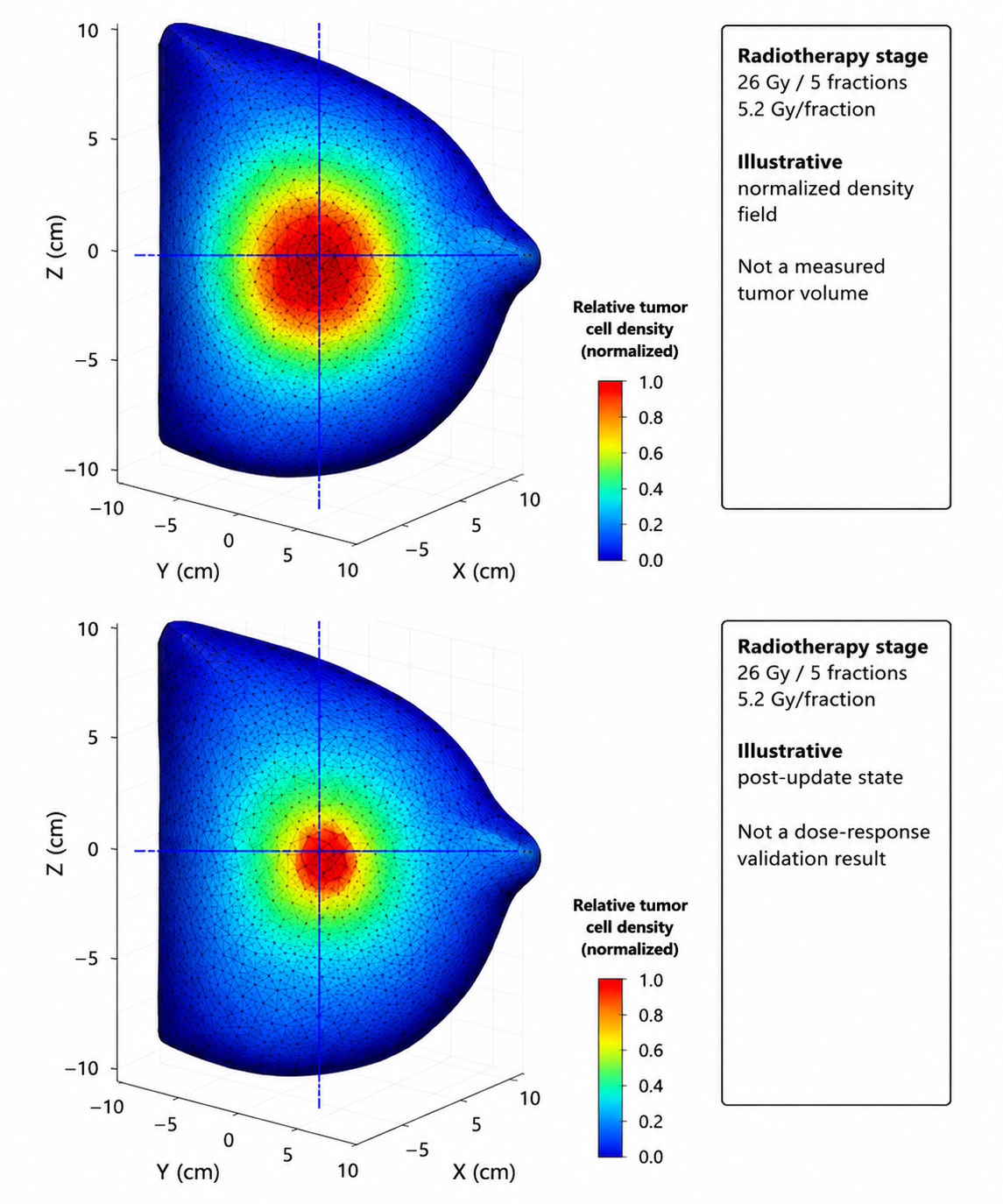
Formalism of a Treatment-Modulated Logistic Map for Breast Tumor Growth: Mathematical Formulation, Nonlinear Dynamics, and Clinically Inspired Simulation
Open Access | Research Article | 10 September 2026
Organizational Responsiveness in a Three-Dimensional Discrete Model of AI, ESG Disclosure, and Green Supply Chain Collaboration
Journal of Nonlinear Dynamics and Applications | Volume 2, Issue 3: 159-176, 2026 | DOI: 10.62762/JNDA.2026.451847
Abstract
Artificial intelligence (AI) investment, environmental, social, and governance (ESG) disclosure, and green supply chain collaboration increasingly operate as an interconnected corporate sustainability system, yet their relationships are commonly examined through static or approximately linear models. This study develops a bounded three-dimensional discrete nonlinear framework in which firms periodically adjust AI-investment maturity, ESG disclosure quality, and green supply chain collaboration in response to cross-domain benefits and self-limiting organizational costs. The model contributes by separating structural complementarity from organizational responsiveness, allowing the same long-ru... More >

Graphical Abstract
Organizational Responsiveness in a Three-Dimensional Discrete Model of AI, ESG Disclosure, and Green Supply Chain Collaboration
Free Access | Research Article | 10 August 2026
A Third-Order Variable Step Size Superclass of Block Backward Differentiation Formula for Efficient Solution of Highly Stiff Differential Systems
Journal of Nonlinear Dynamics and Applications | Volume 2, Issue 3: 143-158, 2026 | DOI: 10.62762/JNDA.2026.749084
Abstract
This paper develops a third-order fully implicit adaptive variable step-size superclass block backward differentiation formula (VSBBDF3) for the efficient numerical simulation of nonlinear stiff dynamical systems, including oscillatory, chaotic, and reaction-kinetics systems governed by ordinary differential equations. The method extends the classical block BDF framework through a structured superclass coefficient formulation while preserving full implicitness. By computing multiple solution approximations simultaneously within each block, the scheme enhances both stability and computational efficiency. An adaptive step-size strategy controls local truncation errors, enabling dynamic respons... More >

Graphical Abstract
A Third-Order Variable Step Size Superclass of Block Backward Differentiation Formula for Efficient Solution of Highly Stiff Differential Systems
Free Access | Research Article | 28 June 2026
Bifurcation and Stability Analysis in a Spatially Fractional-Order Diffusive Mussel-Algae Model
Journal of Nonlinear Dynamics and Applications | Volume 2, Issue 2: 127-142, 2026 | DOI: 10.62762/JNDA.2026.807630
Abstract
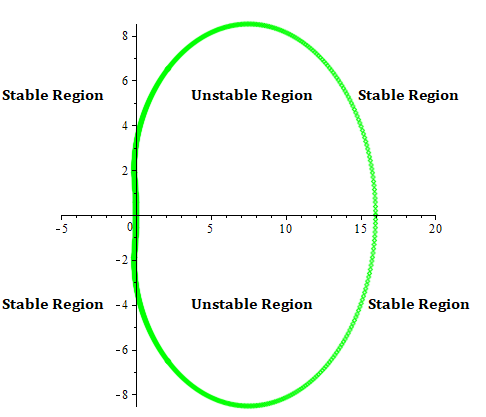
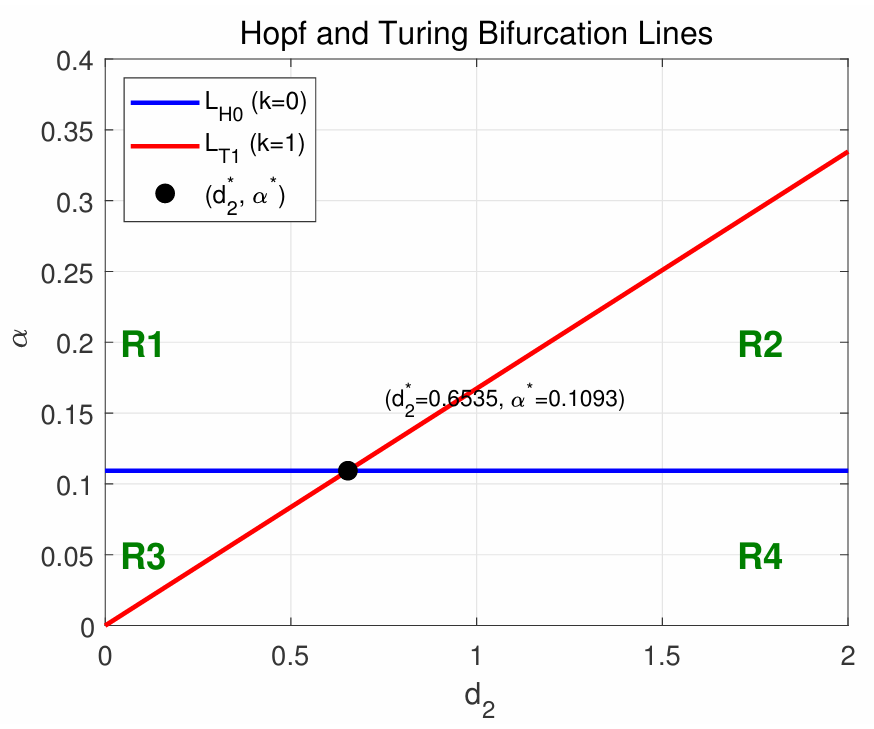
This study elucidates the ramifications of integrating a spatial fractional-order derivative into a diffusive mussel-algae model. While the formation in such models of patterns such as Turing instability, Hopf bifurcation, and Turing-Hopf bifurcation has been extensively scrutinized in prior investigations, the impact of spatial fractional-order derivatives remains largely unknown. Beyond its ecological significance, the fractional diffusion operator is of interest because it elicits novel and nontrivial pattern formations, particularly those emerging from Turing-Hopf bifurcations. Our core objective is to dissect how spatial fractional-order derivatives modulate the spatiotemporal dynamics... More >

Graphical Abstract
Bifurcation and Stability Analysis in a Spatially Fractional-Order Diffusive Mussel-Algae Model
Free Access | Research Article | 10 June 2026
The Economic Singularity: Dimensional Reduction, Invariants, and Stability Analysis of the Financialization Threshold
Journal of Nonlinear Dynamics and Applications | Volume 2, Issue 2: 119-126, 2026 | DOI: 10.62762/JNDA.2026.489975
Abstract
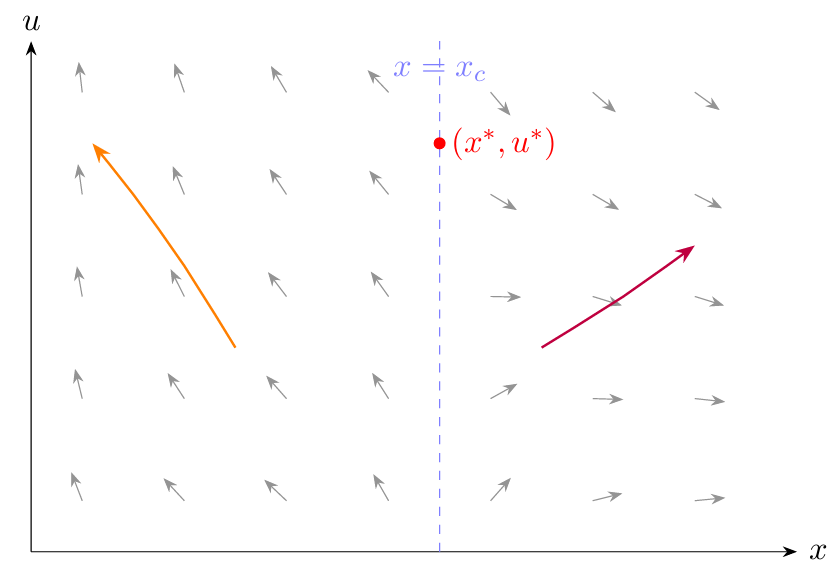
Background: The possibility of an economic singularity---a finite‑time explosion of AI capability, financial capital, and inequality---has been discussed in futurist and economic literature, but endogenous feedback loops between AI, finance, and labour markets remain underexplored. Methods: This paper presents a dimensional reduction of a dynamical systems model of an economy with recursively self‑improving artificial intelligence and financial autocatalysis. By transforming to three economically meaningful ratios---financial depth per AI capability ($x = K_f/A$), AI capital per financial capital ($u = K_{ai}/K_f$), and employment odds ($z = L_p/(1-L_p)$)---the original four‑variable e... More >

Graphical Abstract
The Economic Singularity: Dimensional Reduction, Invariants, and Stability Analysis of the Financialization Threshold
Free Access | Research Article | 02 June 2026
Observer-Based Event-Triggered Scheme for Finite-Time Control of Discrete-Time Linear Time-Varying Networked Control Systems
Journal of Nonlinear Dynamics and Applications | Volume 2, Issue 2: 108-118, 2026 | DOI: 10.62762/JNDA.2026.314876
Abstract
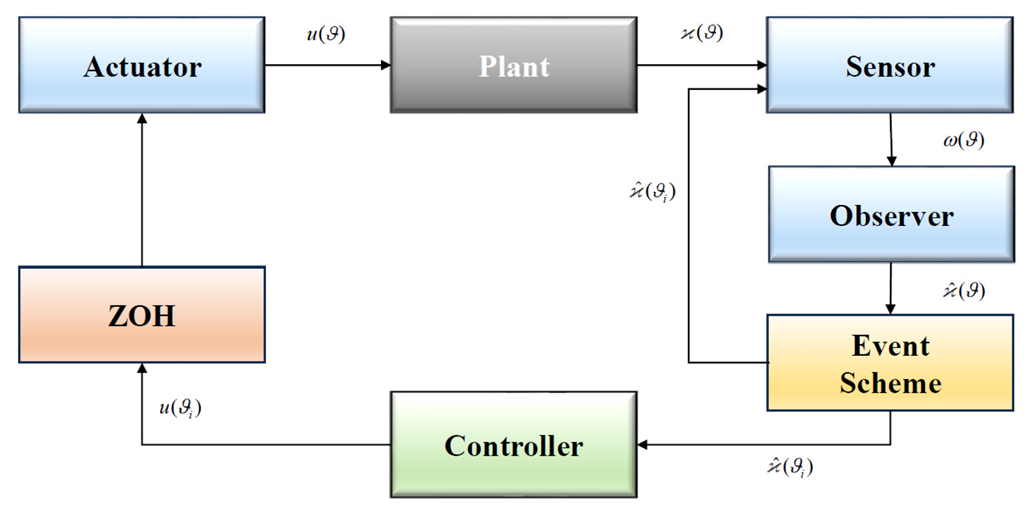
This article investigates the finite-time boundedness (FTB) problem for a class of observer-based discrete linear time-varying networked control systems (DLTNCSs). The interval matrix method (IMM) is adopted to handle the bounded time-varying coefficient via an uncertain convex-hull representation, and a maximum absolute value method (MAM) is also established to solve the time-varying coefficient for comparison. An observer-based event-triggered controller (ETC) is then developed, and sufficient linear matrix inequality (LMI) conditions are derived to obtain the admissible controller gain. Moreover, an implementable algorithm is provided for minimizing the energy consumption. Two numerical e... More >

Graphical Abstract
Observer-Based Event-Triggered Scheme for Finite-Time Control of Discrete-Time Linear Time-Varying Networked Control Systems
Free Access | Research Article | 27 May 2026 | Cited: Crossref logo  1
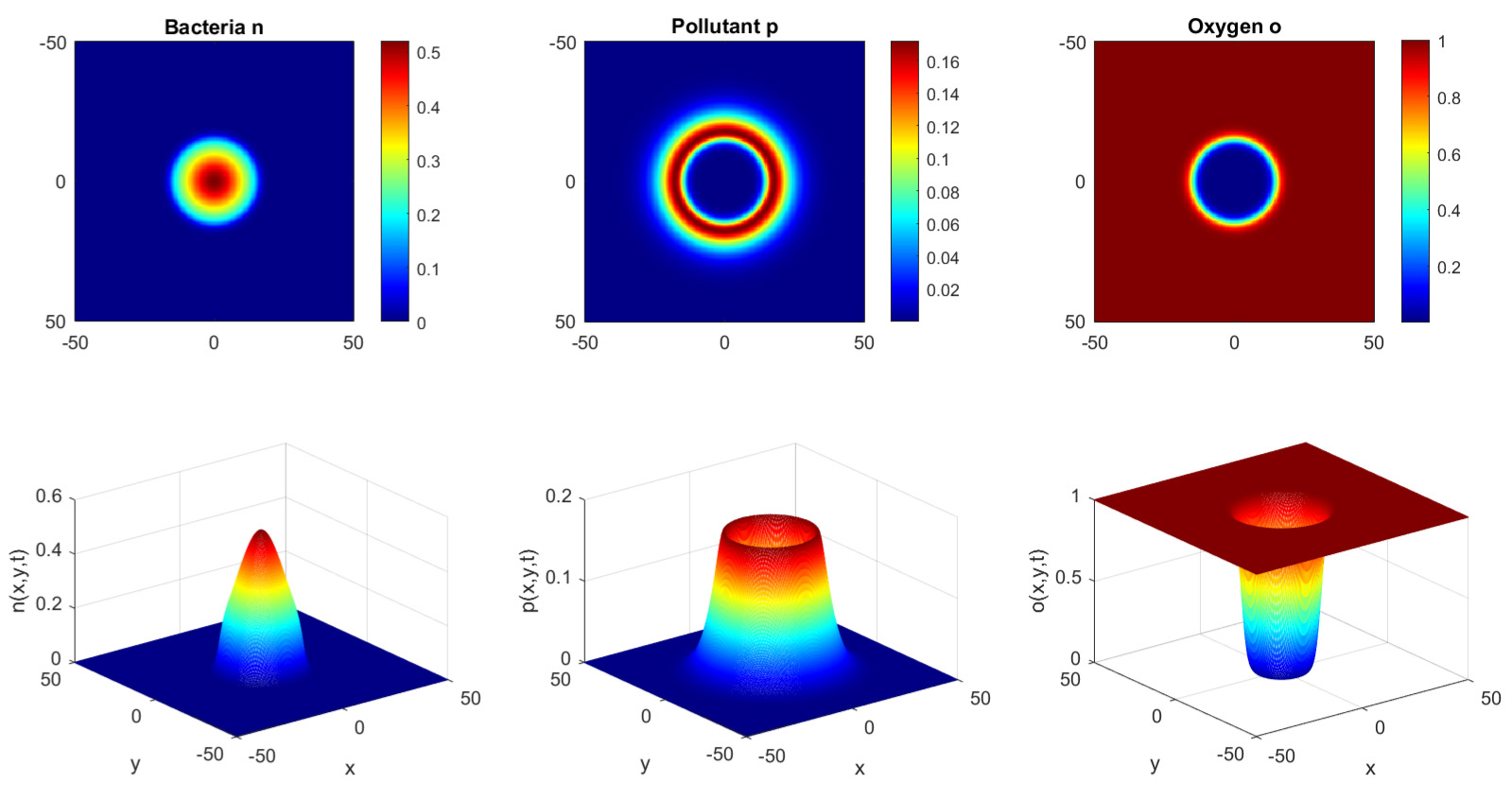
Chemotaxis–Reaction Models in Microbial Ecology: Theory, Analysis, and Applications
Journal of Nonlinear Dynamics and Applications | Volume 2, Issue 2: 76-107, 2026 | DOI: 10.62762/JNDA.2026.783618
Abstract
Chemotaxis, the directed movement of microorganisms in response to chemical gradients, plays a pivotal role in microbial ecology. This article provides a comprehensive review of mathematical models that couple chemotaxis with reaction dynamics to describe microbial population behavior. We discuss how such chemotaxis–reaction models capture essential ecological phenomena, from nutrient foraging and biofilm formation to inter-species competition and environmental processes. Key model formulations, starting from the classical Keller--Segel system, are presented alongside extensions incorporating multiple species, complex reaction terms, and fluid flow coupling. We survey rigorous mathematical... More >

Graphical Abstract
Chemotaxis–Reaction Models in Microbial Ecology: Theory, Analysis, and Applications
Free Access | Research Article | 30 April 2026 | Cited: Crossref logo  1 , Scopus 1
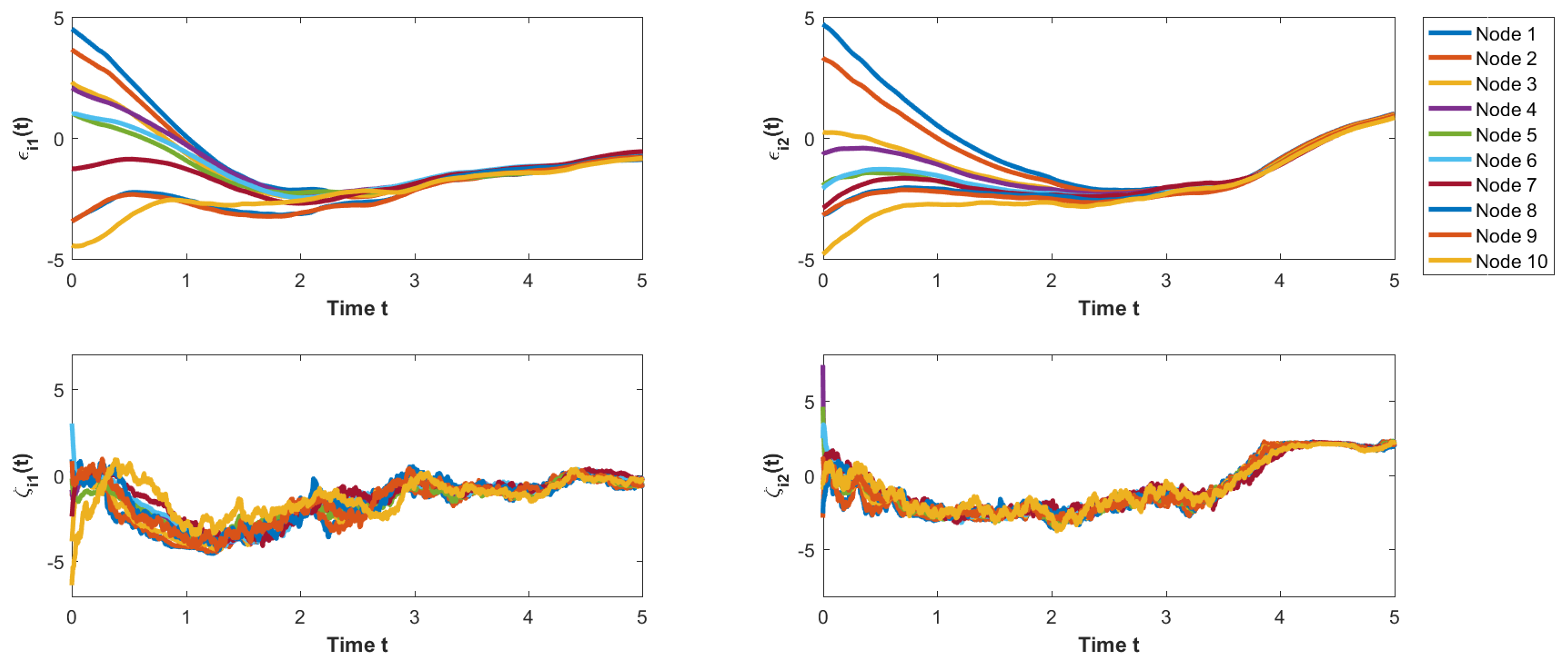
Prescribed-Time Mean-Square Synchronization of Stochastic Coupled Inertial Neural Networks with Time Delays via Pinning Control
Journal of Nonlinear Dynamics and Applications | Volume 2, Issue 2: 61-75, 2026 | DOI: 10.62762/JNDA.2026.284613
Abstract
This paper investigates the issue of prescribed-time mean-square synchronization (PTMSS) for stochastic coupled inertial neural networks (SCINNs), encompassing both scenarios without time delays (TDs) and with TDs. By constructing appropriate Lyapunov functionals and utilizing the prescribed-time stability (PTS) approach, combined with the theory of directed spanning trees, several sufficient conditions are rigorously derived to realize the prescribed-time mean-square synchronization within a given time $t_p$ for SCINNs with and without TDs. Different from most existing results that primarily address deterministic systems or neglect stochastic disturbances and time delays, this work explicit... More >

Graphical Abstract
Prescribed-Time Mean-Square Synchronization of Stochastic Coupled Inertial Neural Networks with Time Delays via Pinning Control

Journal Statistics

52
Authors
14
Countries / Regions
23
Articles
48
Scopus Citations
56.5% Cited
2025
Published Since
35,520
Article Views
8,582
Article Downloads
Journal of Nonlinear Dynamics and Applications
eISSN: 3069-6313
Crossref
Crossref
Member of Crossref
Visit Crossref →