


ISSN: 3070-2429
ICCK Transactions on Information Security and Cryptography is a peer-reviewed academic journal dedicated to advancing research and development in the fields of information security, cryptographic technologies, and their applications in protecting data and communications in the digital era.
DOI Prefix: 10.62762/TISC

Journal Metrics

-
Impact Factor
-
CiteScore

Recent Articles

Free Access | Research Article | 25 September 2026
A Layered Security Framework Against Prompt Injection in RAG-Based Chatbots
ICCK Transactions on Information Security and Cryptography | Volume 2, Issue 3: 192-215, 2026 | DOI: 10.62762/TISC.2026.712476
Abstract
Prompt injection is ranked as the most critical vulnerability in large language model (LLM) deployments by the OWASP Top 10 for LLM Applications, yet existing defenses operate at isolated pipeline stages and remain incomplete. Input filters cannot inspect retrieved documents, while output monitors cannot prevent malicious payloads from reaching the model. Consequently, retrieval-augmented generation (RAG) chatbots remain vulnerable to indirect injection, where a poisoned knowledge-base document compromises every user whose query retrieves it. We present a three-layer framework that intercepts both direct and indirect prompt injection throughout the inference pipeline. Layer 1 screens user in... More >

Graphical Abstract
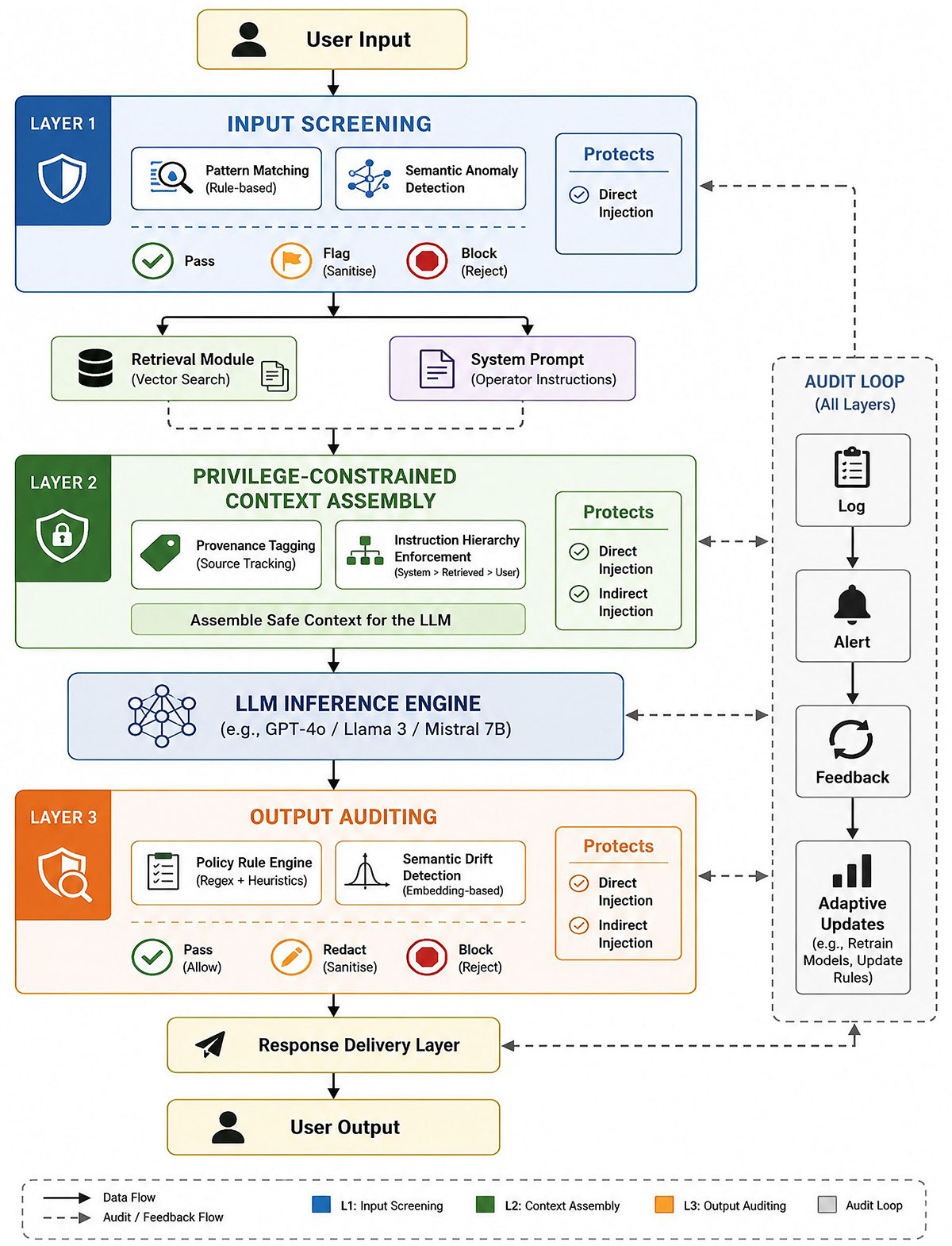
A Layered Security Framework Against Prompt Injection in RAG-Based Chatbots
Free Access | Research Article | 23 September 2026
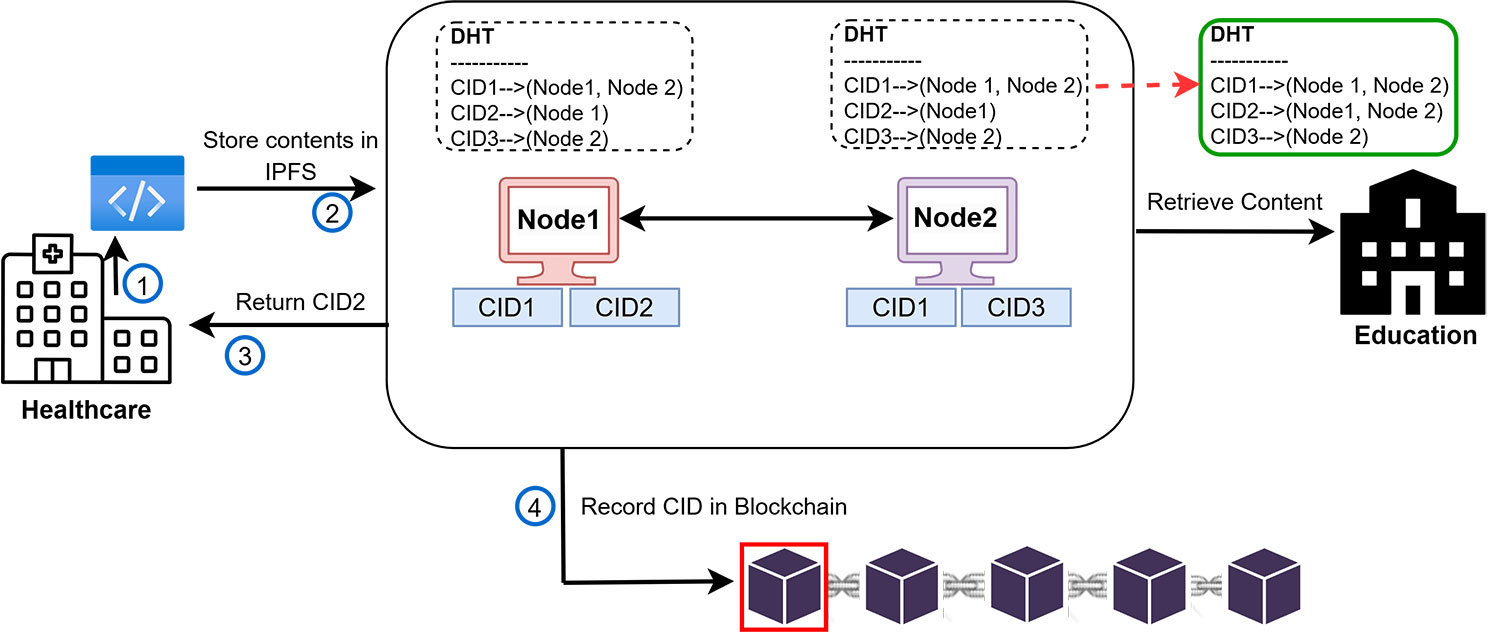
A Secure and Auditable Distributed Data-Sharing Framework for Multi-Domain Systems
ICCK Transactions on Information Security and Cryptography | Volume 2, Issue 3: 172-191, 2026 | DOI: 10.62762/TISC.2026.917693
Abstract
Data is one of the essential assets of every organisation, and its security has frequently been highlighted as a concern due to unauthorised access, breaches, and tampering. Conventional data repositories are often based on centralised setups, which are prone to problems such as single points of failure, privacy breaches, and unpredictable system behaviour. While an auditing mechanism can strengthen transparency by tracking how data is accessed, such tools are often managed by external third parties or rely on manual methods. Additionally, due to complexities such as duplicate user credentials across multiple services and systems, it becomes even more difficult for users to control their con... More >

Graphical Abstract
A Secure and Auditable Distributed Data-Sharing Framework for Multi-Domain Systems
Free Access | Research Article | 22 September 2026
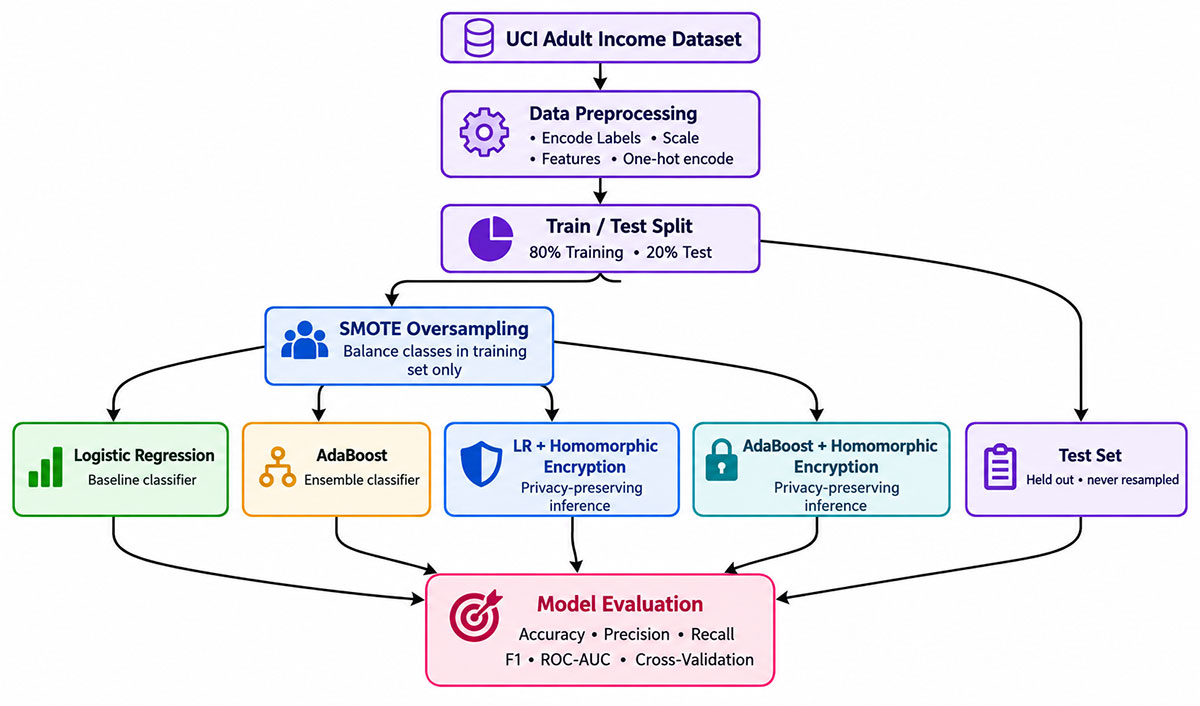
Privacy-Preserving Machine Learning Using Homomorphic Encryption
ICCK Transactions on Information Security and Cryptography | Volume 2, Issue 3: 159-171, 2026 | DOI: 10.62762/TISC.2026.247194
Abstract
The exponential growth of machine learning applications in healthcare, finance, and cloud computing has raised significant data privacy concerns, as traditional encryption methods require access to decrypted data for processing, creating security vulnerabilities. Regulatory frameworks including the European Union's General Data Protection Regulation and the Health Insurance Portability and Accountability Act mandate privacy protection throughout the entire data management lifecycle. This research develops a privacy-preserving machine learning framework combining CKKS-based homomorphic encryption with Logistic Regression and AdaBoost classifiers using the UCI Adult Income dataset containing 4... More >

Graphical Abstract
Privacy-Preserving Machine Learning Using Homomorphic Encryption
Free Access | Review Article | 20 September 2026
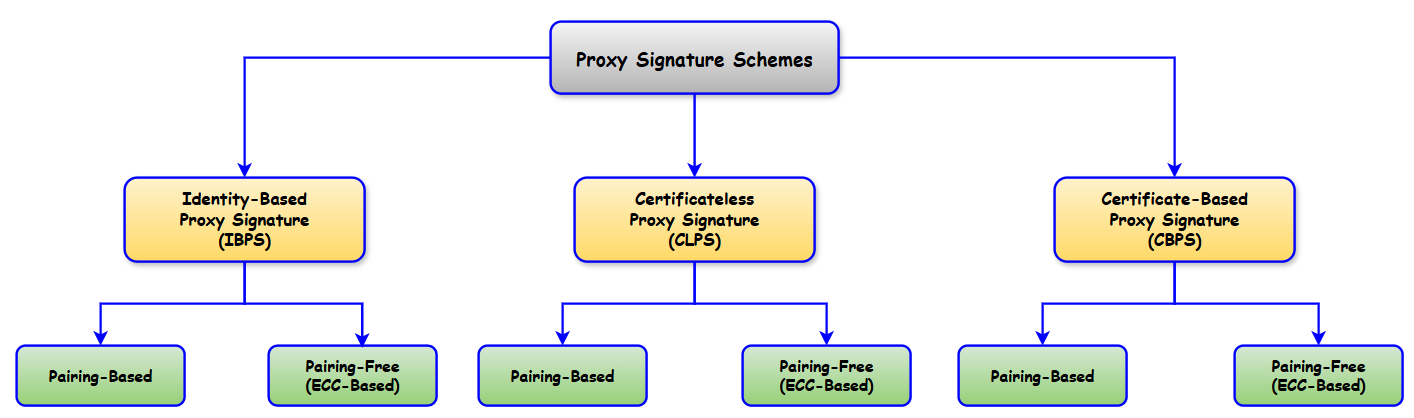
Security Vulnerabilities in Proxy Signature Schemes: Cryptanalysis, Design Weaknesses, and Open Challenges
ICCK Transactions on Information Security and Cryptography | Volume 2, Issue 3: 136-158, 2026 | DOI: 10.62762/TISC.2026.211619
Abstract
Proxy signature schemes allow an original signer to delegate signing authority to a proxy signer, supporting flexible authentication in distributed and resource-constrained environments such as cloud computing, blockchain, and Internet of Things (IoT) networks. Although many constructions have been proposed, a large number have later been broken due to flawed design assumptions, weak delegation binding, or the absence of rigorous provable security. This paper surveys proxy signature schemes with a focus on their security weaknesses. {It presents} a taxonomy of existing constructions by cryptographic primitive, delegation mechanism, and proof framework, {and then consolidates} known cryptanal... More >

Graphical Abstract
Security Vulnerabilities in Proxy Signature Schemes: Cryptanalysis, Design Weaknesses, and Open Challenges
Free Access | Research Article | 18 August 2026
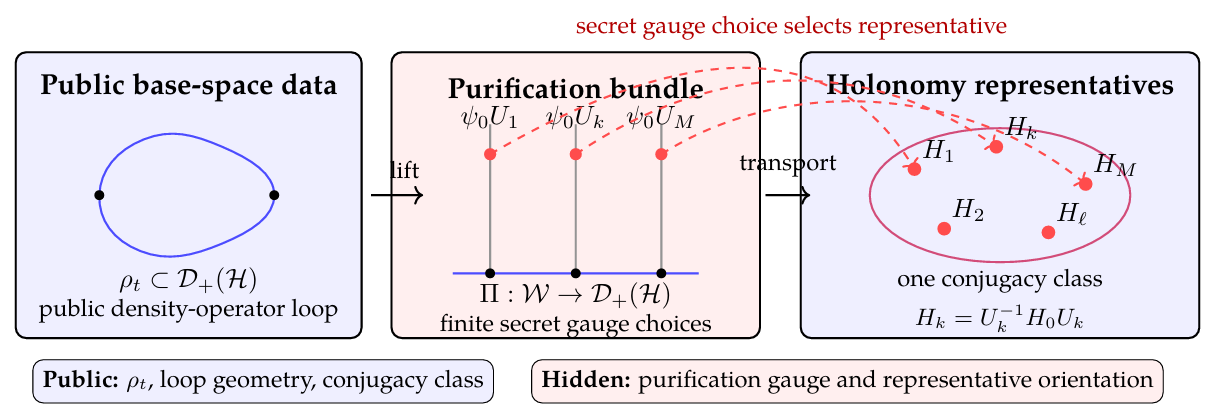
Discretized Holonomy as an Encoding Primitive for Quantum Cryptography
ICCK Transactions on Information Security and Cryptography | Volume 2, Issue 3: 119-135, 2026 | DOI: 10.62762/TISC.2026.243476
Abstract
Geometric phases in quantum systems give rise to holonomies associated with cyclic evolution. In mixed-state settings, these holonomies arise from Uhlmann parallel transport on the purification bundle of density operators and depend on the global geometry of density-operator trajectories. In this work we introduce discretized mixed-state holonomy as a geometric encoding primitive. The public object is a density-operator trajectory, while the encoded information resides in a finite family of purification gauges associated with the same holonomy conjugacy class. By discretizing the gauge freedom of the purification bundle, continuous mixed-state holonomy is converted into finite alphabets suit... More >

Graphical Abstract
Discretized Holonomy as an Encoding Primitive for Quantum Cryptography
Free Access | Research Article | 29 May 2026
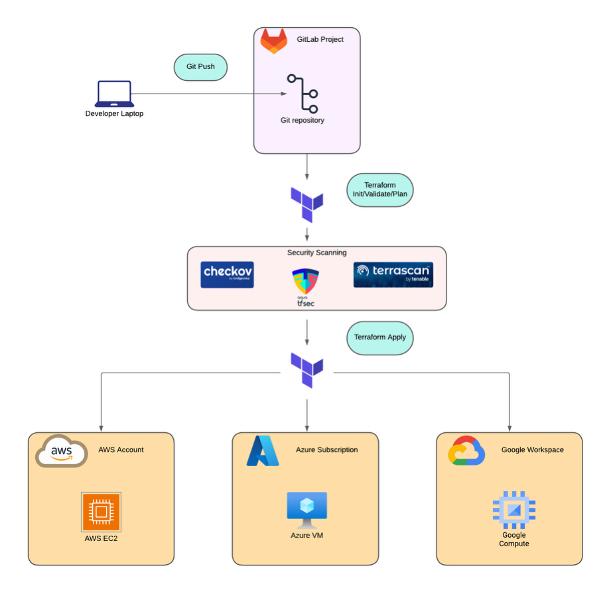
Multicloud Security Assessment: A Benchmark Study of Infrastructure as Code Scanners
ICCK Transactions on Information Security and Cryptography | Volume 2, Issue 2: 109-118, 2026 | DOI: 10.62762/TISC.2026.777114
Abstract
Multicloud environments are becoming more common, often businesses will have workloads across one or more of AWS, Azure and GCP, with each provider slightly differing in security features and capabilities. Furthermore, Infrastructure as Code is increasing in popularity meaning cloud resources are being provisioned as code through automation pipelines as opposed to GUI/Portal deployments. This shift means that security scanning of the resource code is a crucial first step in securing a cloud environment, and the tool(s) being used for this need to be able to perform at a consistent level across all the different cloud providers. Failure to do this could mean the introduction of security vulne... More >

Graphical Abstract
Multicloud Security Assessment: A Benchmark Study of Infrastructure as Code Scanners
Free Access | Research Article | 28 April 2026 | Cited: Scopus 1
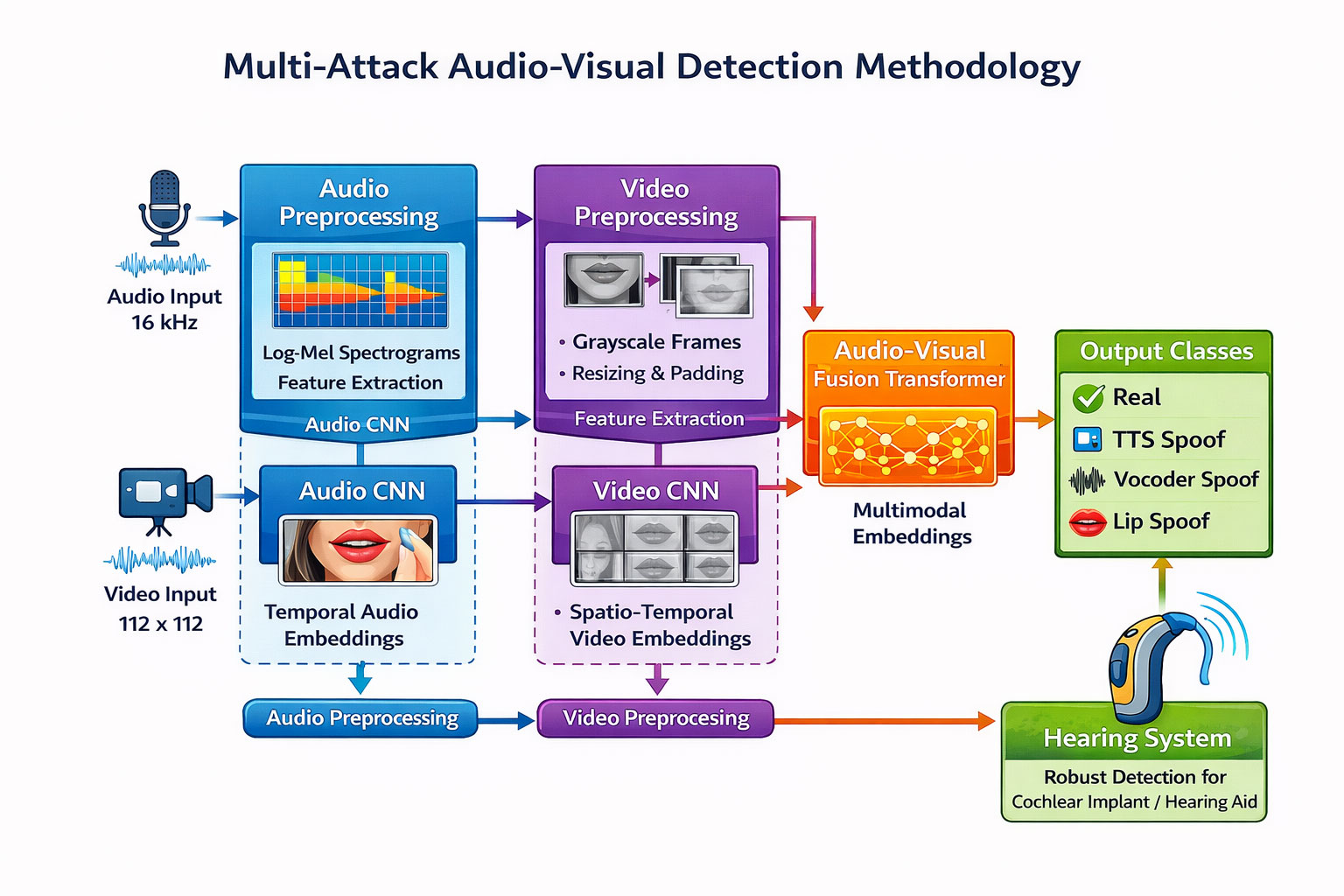
Multi-Attack Audio-Visual Spoof Detection for Secure Hearing-Assistive Systems Using Transformer Fusion
ICCK Transactions on Information Security and Cryptography | Volume 2, Issue 2: 101-108, 2026 | DOI: 10.62762/TISC.2026.221187
Abstract
Audio-visual spoofing attacks have emerged as a serious threat to modern hearing-assistive systems due to rapid advances in text-to-speech synthesis, neural vocoders, and lip-sync deepfake generation. Advanced hearing aids and cochlear implants increasingly incorporate AI-based speech enhancement and multimodal perception modules, which makes them vulnerable to manipulated or synthetic inputs. Traditional spoof detection approaches are often limited to binary classification between bonafide and spoofed speech, failing to capture the diversity of emerging multi-modal attack types.In this paper, we propose a multi-attack audio-visual spoof detection framework designed that explicitly models fo... More >

Graphical Abstract
Multi-Attack Audio-Visual Spoof Detection for Secure Hearing-Assistive Systems Using Transformer Fusion
Free Access | Research Article | 17 April 2026 | Cited: Crossref logo  1
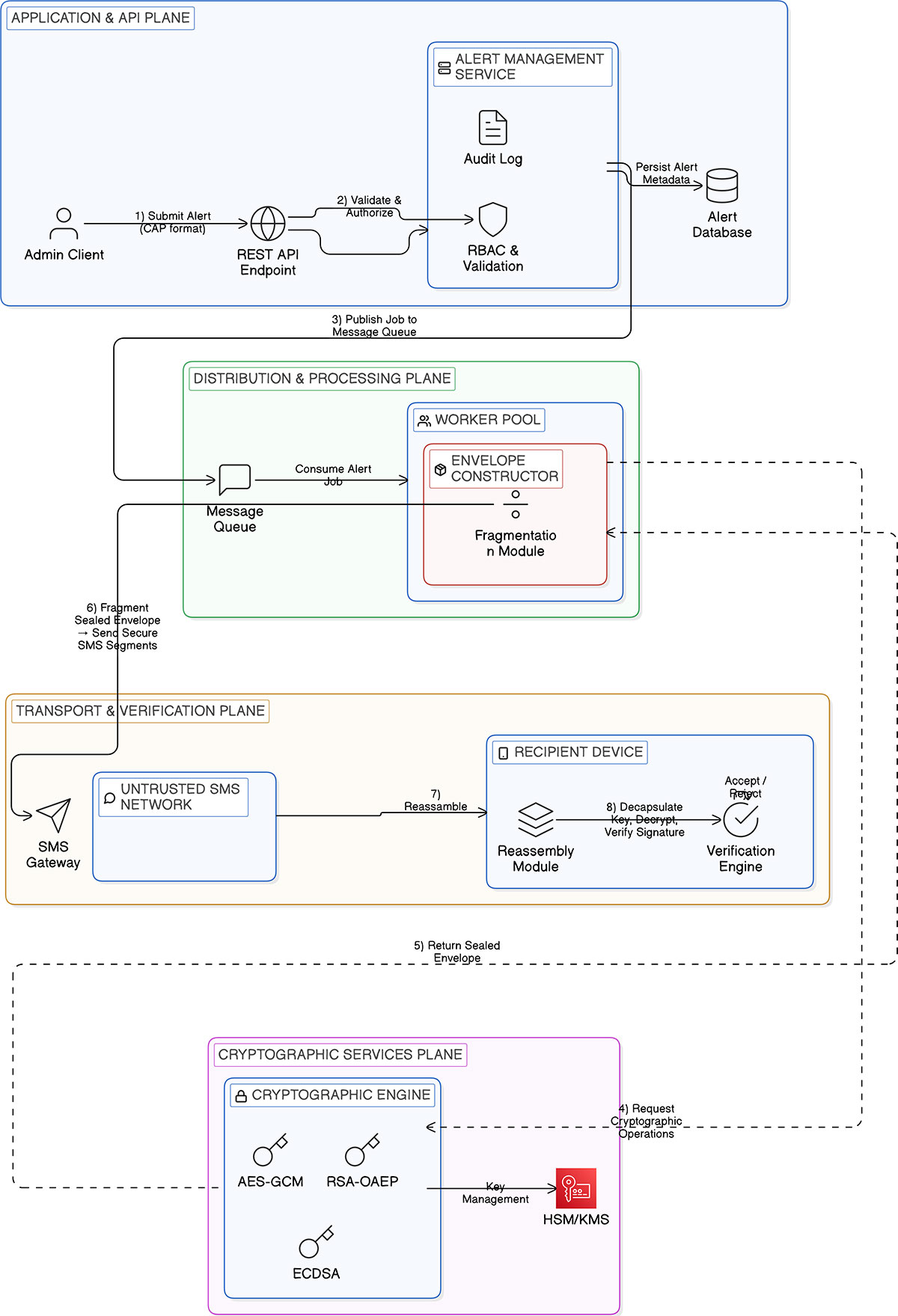
SMS-Based Disaster Alert System with Integrated Cryptographic Security
ICCK Transactions on Information Security and Cryptography | Volume 2, Issue 2: 82-100, 2026 | DOI: 10.62762/TISC.2026.121086
Abstract
Natural disasters are on a rise all over the world, and these have pointed out vulnerabilities in existing Public Warning Systems, which fail during crises when they become choked with information, and it is not very efficient for people using basic mobile technology. The standard Short Message Service is widely accepted and in practice but lacks basic authentication, which makes this service a highly vulnerable target for Denial of Service (DoS) attacks and message spoofing attacks. This research proposes a Disaster Alert System with an advanced Cryptographic Security system over SMS notifications for authenticated and safe transfer of information. The major highlight is a security system c... More >

Graphical Abstract
SMS-Based Disaster Alert System with Integrated Cryptographic Security

Journal Statistics

59
Authors
15
Countries / Regions
20
Articles
12
Scopus Citations
30% Cited
2025
Published Since
29,519
Article Views
6,888
Article Downloads
ICCK Transactions on Information Security and Cryptography
eISSN: 3070-2429
Crossref
Crossref
Member of Crossref
Visit Crossref →