

Aerospace Engineering Communications
ISSN: pending (Online)
Email: [email protected]

 Submit Manuscript
Edit a Special Issue
Submit Manuscript
Edit a Special Issue


TY  - JOUR
AU  - Li, Wei
AU  - Zhu, Jinbiao
AU  - Liu, Tiejun
AU  - Ni, Fan
AU  - Liu, Yiheng
AU  - Liu, Guoliang
PY  - 2026
DA  - 2026/01/24
TI  - A Review of Fixed-Wing Unmanned Aerial Vehicle Formation Research
JO  - Aerospace Engineering Communications
T2  - Aerospace Engineering Communications
JF  - Aerospace Engineering Communications
VL  - 1
IS  - 1
SP  - 3
EP  - 27
DO  - 10.62762/AEC.2025.339037
UR  - https://www.icck.org/article/abs/AEC.2025.339037
KW  - fixed-wing UAV
KW  - formation control
KW  - obstacle avoidance strategy
KW  - autonomous decision-making
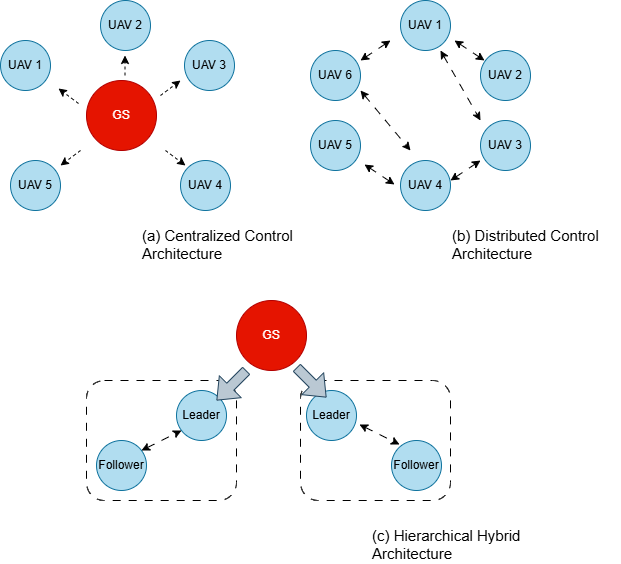
AB  - Fixed-wing unmanned aerial vehicle (UAV) formation technology, as a crucial research direction in multi-agent system cooperative control, while facing constraints in multiple areas, has demonstrated broad application prospects in military reconnaissance, disaster monitoring, agricultural plant protection and other fields in recent years. This paper systematically reviews the key technological systems of fixed-wing UAV formation control, including formation configuration design, communication topology, cooperative control algorithms, navigation positioning and obstacle avoidance strategies. By analyzing the latest research progress, the performance differences between centralized and distributed control architectures were summarized, and the applicable scenarios of mainstream formation control strategies such as behavior method, virtual structure method, and navigation-follow method were compared. The research results show that hybrid control architectures combining model predictive control and reinforcement learning algorithms exhibit superior performance in complex environments. Meanwhile, this paper discusses the technical challenges faced by formation systems in terms of communication reliability, dynamic obstacle avoidance, and energy optimization. This paper highlights the critical transition from traditional control to AI-enabled autonomous cooperation. By identifying the limitations of current communication protocols and energy management strategies, it provides a roadmap for the theoretical research and engineering application of large-scale fixed-wing UAV formations.
SN  - pending
PB  - Institute of Central Computation and Knowledge
LA  - English
ER  -
@article{Li2026A,
  author = {Wei Li and Jinbiao Zhu and Tiejun Liu and Fan Ni and Yiheng Liu and Guoliang Liu},
  title = {A Review of Fixed-Wing Unmanned Aerial Vehicle Formation Research},
  journal = {Aerospace Engineering Communications},
  year = {2026},
  volume = {1},
  number = {1},
  pages = {3-27},
  doi = {10.62762/AEC.2025.339037},
  url = {https://www.icck.org/article/abs/AEC.2025.339037},
  abstract = {Fixed-wing unmanned aerial vehicle (UAV) formation technology, as a crucial research direction in multi-agent system cooperative control, while facing constraints in multiple areas, has demonstrated broad application prospects in military reconnaissance, disaster monitoring, agricultural plant protection and other fields in recent years. This paper systematically reviews the key technological systems of fixed-wing UAV formation control, including formation configuration design, communication topology, cooperative control algorithms, navigation positioning and obstacle avoidance strategies. By analyzing the latest research progress, the performance differences between centralized and distributed control architectures were summarized, and the applicable scenarios of mainstream formation control strategies such as behavior method, virtual structure method, and navigation-follow method were compared. The research results show that hybrid control architectures combining model predictive control and reinforcement learning algorithms exhibit superior performance in complex environments. Meanwhile, this paper discusses the technical challenges faced by formation systems in terms of communication reliability, dynamic obstacle avoidance, and energy optimization. This paper highlights the critical transition from traditional control to AI-enabled autonomous cooperation. By identifying the limitations of current communication protocols and energy management strategies, it provides a roadmap for the theoretical research and engineering application of large-scale fixed-wing UAV formations.},
  keywords = {fixed-wing UAV, formation control, obstacle avoidance strategy, autonomous decision-making},
  issn = {pending},
  publisher = {Institute of Central Computation and Knowledge}
}
 Copyright © 2026 by the Author(s). Published by Institute of Central Computation and Knowledge. This article is an open access article distributed under the terms and conditions of the Creative Commons Attribution (CC BY) license (https://creativecommons.org/licenses/by/4.0/), which permits use, sharing, adaptation, distribution and reproduction in any medium or format, as long as you give appropriate credit to the original author(s) and the source, provide a link to the Creative Commons licence, and indicate if changes were made.

Portico
All published articles are preserved here permanently:
https://www.portico.org/publishers/icck/