Volume 1, Issue 1, Aerospace Engineering Communications
Volume 1, Issue 1, 2026
Submit Manuscript Edit a Special Issue
Article QR Code
Article QR Code
Scan the QR code for reading
Popular articles
Aerospace Engineering Communications, Volume 1, Issue 1, 2026: 47-56

Open Access | Research Article | 19 February 2026
Robust Imbalanced Learning for Aero-Engine Bearing Anomaly Detection via a Hybrid SMOTE-BLS Framework
1 Beijing Satellite Navigation Center, Beijing 100094, China
* Corresponding Author: Jingjing Dong, [email protected]
ARK: ark:/57805/aec.2026.599020
Received: 04 January 2026, Accepted: 12 February 2026, Published: 19 February 2026  
Abstract
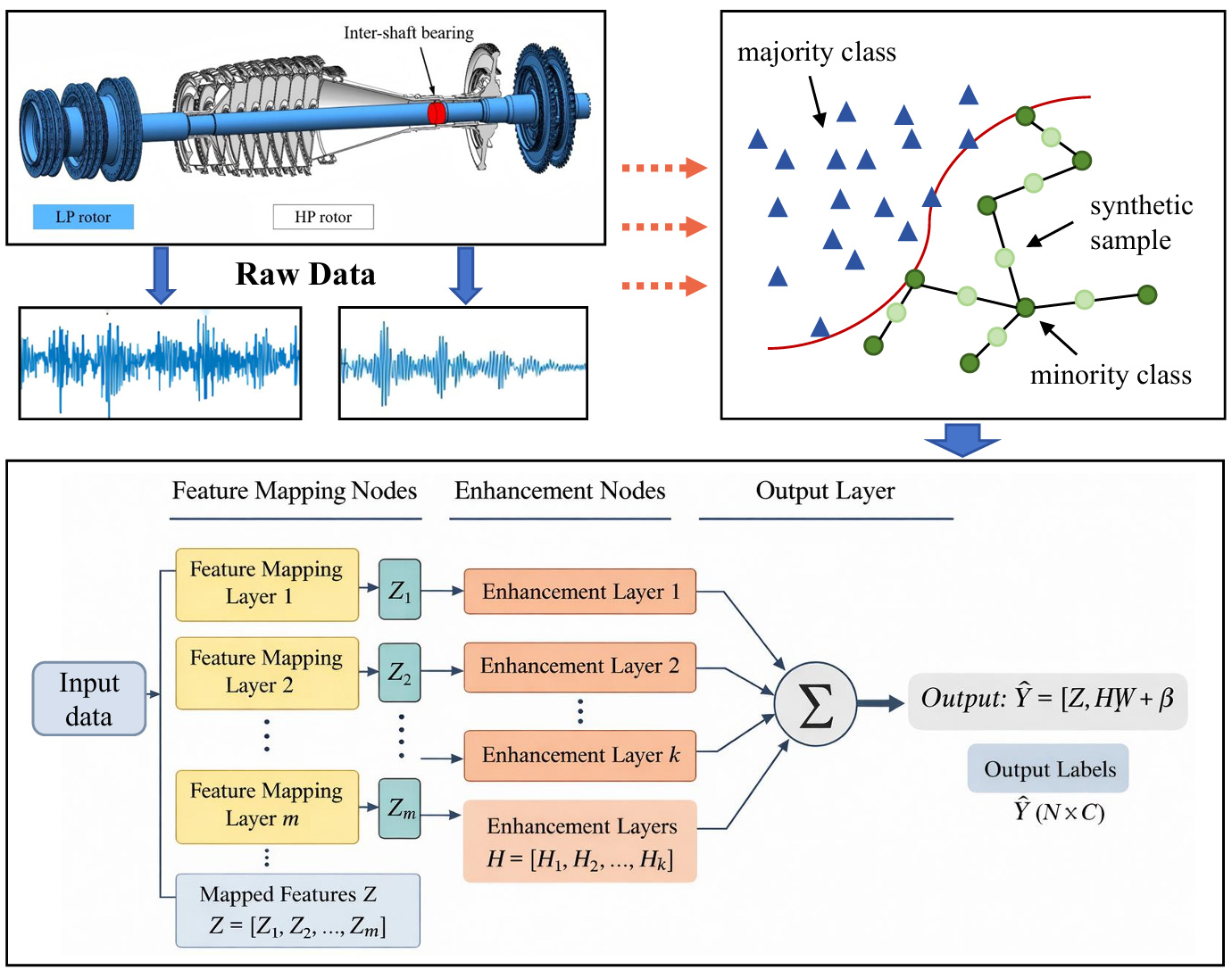
The operational reliability of aeroengines is vital to civil aviation safety; however, bearings and other key components are prone to failure under harsh operating conditions. In real-world monitoring data, severe class imbalance often leads conventional fault diagnosis methods to be biased toward majority classes, limiting their ability to identify critical faults. To address this issue, this paper proposes a robust anomaly detection framework that integrates the Synthetic Minority Oversampling Technique (SMOTE) with a Broad Learning System (BLS). SMOTE is first applied to generate synthetic fault samples in the feature space, thereby balancing the data distribution and reducing bias. The balanced data are then fed into a BLS classifier, which exploits its flat architecture to achieve high-dimensional feature representation and fast non-iterative training. Experimental results on multiple aeroengine bearing datasets demonstrate that the proposed method outperforms comparative approaches in terms of fault detection accuracy and robustness.

Graphical Abstract
Robust Imbalanced Learning for Aero-Engine Bearing Anomaly Detection via a Hybrid SMOTE-BLS Framework

Keywords
aircraft engine
fault diagnosis
imbalance learning
broad learning system

Data Availability Statement
Data will be made available on request.

Funding
This work was supported without any funding.

Conflicts of Interest
The authors declare no conflicts of interest.

AI Use Statement
The authors declare that no generative AI was used in the preparation of this manuscript.

Ethical Approval and Consent to Participate
Not applicable.

References
  1. Yang, K., Chen, W., Shi, Y., Yu, Z., & Chen, C. L. P. (2024). Simplified Kernel-Based Cost-Sensitive Broad Learning System for Imbalanced Fault Diagnosis. IEEE Transactions on Artificial Intelligence, 5(12), 6629–6644.
    [CrossRef]   [Google Scholar]
  2. Lei, Y., Li, N., Guo, L., Li, N., Yan, T., & Lin, J. (2018). Machinery health prognostics: A systematic review from data acquisition to RUL prediction. Mechanical systems and signal processing, 104, 799-834.
    [CrossRef]   [Google Scholar]
  3. Chen, W., Yang, K., Yu, Z., & Zhang, W. (2022). Double-kernel based class-specific broad learning system for multiclass imbalance learning. Knowledge-Based Systems, 253, 109535.
    [CrossRef]   [Google Scholar]
  4. Ren, P., Chen, J., Hu, Y., & Yuan, H. (2016, October). Research on typical wear fault diagnosis of electa hydraulic servo valve element. In 2016 prognostics and system health management conference (phm-chengdu) (pp. 1-5). IEEE.
    [CrossRef]   [Google Scholar]
  5. Xi, W., Wu, T., Yan, K., Yang, X., Jiang, X., & Kwok, N. (2018). Restoration of online video ferrography images for out-of-focus degradations. EURASIP Journal on Image and Video Processing, 2018(1), 31.
    [CrossRef]   [Google Scholar]
  6. Wang, J., Bi, J., Wang, L., & Wang, X. (2018). A non-reference evaluation method for edge detection of wear particles in ferrograph images. Mechanical Systems and Signal Processing, 100, 863–876.
    [CrossRef]   [Google Scholar]
  7. Li, S., Wenbei, S., Jiantao, L., Zhang, H., Wang, Y., Zhang, P., ... & Wang, Y. (2026). Progress in Aero-Engine Fault Signal Recognition and Intelligent Diagnosis. Machines, 14(1), 118.
    [CrossRef]   [Google Scholar]
  8. Wang, M., Ge, Q., Jiang, H., & Yao, G. (2019). Wear fault diagnosis of aeroengines based on broad learning system and ensemble learning. Energies, 12(24), 4750.
    [CrossRef]   [Google Scholar]
  9. Lyu, D., Li, C., Han, Z., Song, Z., Yang, Z., Ma, Y., & Hong, J. (2025). Position-Agnostic Aeroengine Intershaft Bearing Fault Diagnosis via Condition-Guided Multitask Learning. IEEE Transactions on Instrumentation and Measurement, 74, 1–17.
    [CrossRef]   [Google Scholar]
  10. Feng, K., Xiao, Y., Li, Z., & Miao, D. (2024). A fusion autoencoder model and piecewise anomaly index for aero-engine fault diagnosis. Applied Intelligence, 54(20), 10148–10160.
    [CrossRef]   [Google Scholar]
  11. Xu, C., Gui, X., & Zhao, Y. (2024). Digital Twin-Assisted Multiview Reconstruction Enhanced Domain Adaptation Graph Networks for Aero-Engine Gas Path Fault Diagnosis. IEEE Sensors Journal, 24(13), 21694–21705.
    [CrossRef]   [Google Scholar]
  12. Yang, K., Chen, H., Chen, W., Chen, C.-M., Sun, S., Kumari, S., & Qiao, C. (2025). Contrastive Federated Learning for Non-IID and Imbalanced Data in Computational Social Systems. IEEE Transactions on Computational Social Systems, 1–13.
    [CrossRef]   [Google Scholar]
  13. Pao, Y. H., Park, G. H., & Sobajic, D. J. (1994). Learning and generalization characteristics of the random vector functional-link net. Neurocomputing, 6(2), 163–180.
    [CrossRef]   [Google Scholar]
  14. Zhao, H., Zheng, J., Xu, J., & Deng, W. (2019). Fault diagnosis method based on principal component analysis and broad learning system. IEEE Access, 7, 99263–99272.
    [CrossRef]   [Google Scholar]
  15. Zhao, H., Zheng, J., Deng, W., & Song, Y. (2020). Semi-supervised broad learning system based on manifold regularization and broad network. IEEE Transactions on Circuits and Systems I: Regular Papers, 67(3), 983–994.
    [CrossRef]   [Google Scholar]
  16. Chen, W., Yang, K., Yu, Z., Nie, F., & Chen, C. L. P. (2025). Adaptive Broad Network With Graph-Fuzzy Embedding for Imbalanced Noise Data. IEEE Transactions on Fuzzy Systems, 33(6), 1949–1962.
    [CrossRef]   [Google Scholar]
  17. Yin, X., He, W., He, Q., Chen, D., Zhang, B., & Zhao, H. (2026). Data imbalanced fault diagnosis of aviation fuel pumps based on adaptive weighting using an enhanced broad learning system. Measurement, 257, 118612.
    [CrossRef]   [Google Scholar]
  18. Liu, K., Zhao, X., & Hui, Y. (2024). An adaptive imbalance robust graph embedding broad learning system fault diagnosis for imbalanced batch processes data. Process Safety and Environmental Protection, 192, 694–706.
    [CrossRef]   [Google Scholar]
  19. Zhang, T., Chen, J., Li, F., Zhang, K., Lv, H., He, S., & Xu, E. (2022). Intelligent fault diagnosis of machines with small & imbalanced data: A state-of-the-art review and possible extensions. ISA Transactions, 119, 152–171.
    [CrossRef]   [Google Scholar]
  20. Han, S., Zhu, K., Zhou, M., & Liu, X. (2023). Evolutionary Weighted Broad Learning and Its Application to Fault Diagnosis in Self-Organizing Cellular Networks. IEEE Transactions on Cybernetics, 53(5), 3035–3047.
    [CrossRef]   [Google Scholar]
  21. Vairetti, C., Assadi, J. L., & Maldonado, S. (2024). Efficient hybrid oversampling and intelligent undersampling for imbalanced big data classification. Expert Systems with Applications, 246, 123149.
    [CrossRef]   [Google Scholar]
  22. Wang, H. (2023). Three-Stage Sampling Algorithm for Highly Imbalanced Multi-Classification Time Series Datasets. Symmetry, 15(10), 1849.
    [CrossRef]   [Google Scholar]
  23. Liao, W., Zhu, R., Ge, L., Cao, D., & Yang, Z. (2025). Mitigating Class Imbalance Issues in Electricity Theft Detection via a Sample-Weighted Loss. IEEE Transactions on Industrial Informatics, 21(2), 1754–1763.
    [CrossRef]   [Google Scholar]
  24. Wongvorachan, T., He, S., & Bulut, O. (2023). A Comparison of Undersampling, Oversampling, and SMOTE Methods for Dealing with Imbalanced Classification in Educational Data Mining. Information, 14(1), 54.
    [CrossRef]   [Google Scholar]
  25. Koziarski, M. (2021). CSMOUTE: Combined synthetic oversampling and undersampling technique for imbalanced data classification. 2021 International Joint Conference on Neural Networks (IJCNN), 1–8.
    [CrossRef]   [Google Scholar]
  26. Fernández, A., Garcia, S., Herrera, F., & Chawla, N. V. (2018). SMOTE for learning from imbalanced data: progress and challenges, marking the 15-year anniversary. Journal of artificial intelligence research, 61, 863-905.
    [CrossRef]   [Google Scholar]
  27. Peykani, P., Peymany Foroushany, M., Tanasescu, C., Sargolzaei, M., & Kamyabfar, H. (2025). Evaluation of cost-sensitive learning models in forecasting business failure of capital market firms. Mathematics, 13(3), 368.
    [CrossRef]   [Google Scholar]
  28. Chawla, N. V., Bowyer, K. W., Hall, L. O., & Kegelmeyer, W. P. (2002). SMOTE: synthetic minority over-sampling technique. Journal of artificial intelligence research, 16, 321-357.
    [CrossRef]   [Google Scholar]
  29. Chen, Y., Yang, X., & Dai, H. L. (2024). Cost-sensitive continuous ensemble kernel learning for imbalanced data streams with concept drift. Knowledge-Based Systems, 284, 111272.
    [CrossRef]   [Google Scholar]
  30. Chen, C. P., & Liu, Z. (2017). Broad learning system: An effective and efficient incremental learning system without the need for deep architecture. IEEE transactions on neural networks and learning systems, 29(1), 10-24.
    [CrossRef]   [Google Scholar]
  31. Gong, X., Zhang, T., Chen, C. P., & Liu, Z. (2021). Research review for broad learning system: Algorithms, theory, and applications. IEEE Transactions on Cybernetics, 52(9), 8922-8950.
    [CrossRef]   [Google Scholar]
  32. Madkour, A. H., Abdelkader, H. M., & Mohammed, A. M. (2024). Dynamic classification ensembles for handling imbalanced multiclass drifted data streams. Information Sciences, 670, 120555.
    [CrossRef]   [Google Scholar]
  33. Kavitha, M., & Kasthuri, M. (2024). Enhanced Cost-Sensitive Ensemble Learning for Imbalanced Class in Medical Data. Journal of Electrical Systems, 20(7s), 1043–1053.
    [CrossRef]   [Google Scholar]
  34. Li, Y., Gao, Y., Jin, J., Nan, J., Meng, Y., Wang, M., & Chen, C. L. P. (2025). Adaptive weights-based relaxed broad learning system for imbalanced classification. Digital Signal Processing, 156, 104869.
    [CrossRef]   [Google Scholar]
  35. Li, Y., Wang, Y., Jin, J., Zhang, W., Tao, H., Wu, H., & Chen, C. L. P. (2025). Imbalanced Broad Learning System with label relaxation and sample weight adaptation. Applied Soft Computing, 182, 113543.
    [CrossRef]   [Google Scholar]
  36. Hou, L., Yi, H., Jin, Y., Gui, M., Sui, L., Zhang, J., & Chen, Y. (2023). Inter-Shaft Bearing Fault Diagnosis Based on Aero-Engine System: A Benchmarking Dataset Study. Journal of Dynamics, Monitoring and Diagnostics, 2(4), 228–242.
    [CrossRef]   [Google Scholar]
  37. Smith, W. A., & Randall, R. B. (2015). Rolling element bearing diagnostics using the Case Western Reserve University data: A benchmark study. Mechanical systems and signal processing, 64, 100-131.
    [CrossRef]   [Google Scholar]
  38. Lessmeier, C., Kimotho, J. K., Zimmer, D., & Sextro, W. (2016, July). Condition monitoring of bearing damage in electromechanical drive systems by using motor current signals of electric motors: A benchmark data set for data-driven classification. In PHM society European conference (Vol. 3, No. 1).
    [CrossRef]   [Google Scholar]
  39. Chen, W., Yu, Z., Yang, K., Jiang, J., Zhang, F., & Chen, C. P. (2025). Minimum variance weighted broad cascade network structure for imbalanced classification. Knowledge-Based Systems, 324, 113803.
    [CrossRef]   [Google Scholar]
  40. Yang, K., Chen, W., Bi, J., Wang, M., & Luo, F. (2023). Multi-view broad learning system for electricity theft detection. Applied Energy, 352, 121914.
    [CrossRef]   [Google Scholar]
  41. Yang, K., Yu, Z., Wen, X., Cao, W., Chen, C. L. P., Wong, H. S., & You, J. (2020). Hybrid Classifier Ensemble for Imbalanced Data. IEEE Transactions on Neural Networks and Learning Systems, 31(4), 1387–1400.
    [CrossRef]   [Google Scholar]
  42. Yang, K., Yu, Z., Chen, W., Liang, Z., & Chen, C. L. P. (2024). Solving the imbalanced problem by metric learning and oversampling. IEEE Transactions on Knowledge and Data Engineering, 36(12), 9294–9307.
    [CrossRef]   [Google Scholar]
  43. Chen, W., Yu, Z., Yang, K., Fan, Z., & Chen, C. P. (2025). Adaptive Weighted Double Uncertainty Incrementally Active Learning for Multi-Class Imbalanced Data. IEEE Transactions on Knowledge and Data Engineering, 38(2), 827-841.
    [CrossRef]   [Google Scholar]
  44. Randall, R. B. (2021). Vibration-based condition monitoring: industrial, automotive and aerospace applications. John Wiley & Sons.
    [Google Scholar]
  45. Yang, K., Yu, Z., Chen, C. P., Cao, W., You, J., & Wong, H. S. (2021). Incremental weighted ensemble broad learning system for imbalanced data. IEEE Transactions on Knowledge and Data Engineering, 34(12), 5809-5824.
    [CrossRef]   [Google Scholar]
  46. Gong, X., Zhang, T., Chen, C. L. P., & Liu, Z. (2022). Research Review for Broad Learning System: Algorithms, Theory, and Applications. IEEE Transactions on Cybernetics, 52(9), 8922–8950.
    [CrossRef]   [Google Scholar]
  47. Gong, X., Chen, C. L. P., Hu, B., & Zhang, T. (2024). CiABL: Completeness-Induced Adaptative Broad Learning for Cross-Subject Emotion Recognition With EEG and Eye Movement Signals. IEEE Transactions on Affective Computing, 15(4), 1970–1984.
    [CrossRef]   [Google Scholar]
  48. Zhang, T., Gong, X., & Chen, C. P. (2021). BMT-Net: Broad multitask transformer network for sentiment analysis. IEEE transactions on cybernetics, 52(7), 6232-6243.
    [CrossRef]   [Google Scholar]
  49. Zhang, Y., Li, X., Gao, L., Wang, L., & Wen, L. (2018). Imbalanced data fault diagnosis of rotating machinery using synthetic oversampling and feature learning. Journal of manufacturing systems, 48, 34-50.
    [CrossRef]   [Google Scholar]
  50. McInerny, S. A., & Dai, Y. (2003). Basic vibration signal processing for bearing fault detection. IEEE Transactions on Education, 46(1), 149–156.
    [CrossRef]   [Google Scholar]
  51. Wang, X. (2025). Aero Engine Fault Diagnosis Based on Support Vector Machine. Procedia Computer Science, 262, 1352–1358.
    [CrossRef]   [Google Scholar]
  52. Yan, W. (2006, October). Application of random forest to aircraft engine fault diagnosis. In The Proceedings of the Multiconference on`` Computational Engineering in Systems Applications'' (Vol. 1, pp. 468-475). IEEE.
    [CrossRef]   [Google Scholar]
  53. Liu, J. (2023). Sensor fault analysis of aero-engine using ensemble SCNN and Bayesian interval estimation. Engineering Applications of Artificial Intelligence, 125, 106675.
    [CrossRef]   [Google Scholar]
  54. Liao, Z., Zhan, K., Zhao, H., Deng, Y., Geng, J., Chen, X., & Song, Z. (2024). Addressing class-imbalanced learning in real-time aero-engine gas-path fault diagnosis via feature filtering and mapping. Reliability Engineering & System Safety, 249, 110189.
    [CrossRef]   [Google Scholar]
  55. Yang, H., Lin, L., Zhong, S., Guo, F., & Cui, Z. (2021, August). Aero engines fault diagnosis method based on convolutional neural network using multiple attention mechanism. In 2021 IEEE International Conference on Sensing, Diagnostics, Prognostics, and Control (SDPC) (pp. 13-18). IEEE.
    [CrossRef]   [Google Scholar]
  56. Dongzhu, Z., Hua, Z., Shiqiang, D., & Yafei, S. (2020, July). Aero-engine bearing fault diagnosis based on deep neural networks. In 2020 11th International Conference on Mechanical and Aerospace Engineering (ICMAE) (pp. 145-149). IEEE.
    [CrossRef]   [Google Scholar]

Cite This Article
APA Style
Gao, Y., & Dong, J. (2026). Robust Imbalanced Learning for Aero-Engine Bearing Anomaly Detection via a Hybrid SMOTE-BLS Framework. Aerospace Engineering Communications, 1(1), 47–56. https://doi.org/10.62762/AEC.2026.599020
Export Citation
RIS Format
Compatible with EndNote, Zotero, Mendeley, and other reference managers
RIS format data for reference managers
TY  - JOUR
AU  - Gao, Yang
AU  - Dong, Jingjing
PY  - 2026
DA  - 2026/02/19
TI  - Robust Imbalanced Learning for Aero-Engine Bearing Anomaly Detection via a Hybrid SMOTE-BLS Framework
JO  - Aerospace Engineering Communications
T2  - Aerospace Engineering Communications
JF  - Aerospace Engineering Communications
VL  - 1
IS  - 1
SP  - 47
EP  - 56
DO  - 10.62762/AEC.2026.599020
UR  - https://www.icck.org/article/abs/AEC.2026.599020
KW  - aircraft engine
KW  - fault diagnosis
KW  - imbalance learning
KW  - broad learning system
AB  - The operational reliability of aeroengines is vital to civil aviation safety; however, bearings and other key components are prone to failure under harsh operating conditions. In real-world monitoring data, severe class imbalance often leads conventional fault diagnosis methods to be biased toward majority classes, limiting their ability to identify critical faults. To address this issue, this paper proposes a robust anomaly detection framework that integrates the Synthetic Minority Oversampling Technique (SMOTE) with a Broad Learning System (BLS). SMOTE is first applied to generate synthetic fault samples in the feature space, thereby balancing the data distribution and reducing bias. The balanced data are then fed into a BLS classifier, which exploits its flat architecture to achieve high-dimensional feature representation and fast non-iterative training. Experimental results on multiple aeroengine bearing datasets demonstrate that the proposed method outperforms comparative approaches in terms of fault detection accuracy and robustness.
SN  - pending
PB  - Institute of Central Computation and Knowledge
LA  - English
ER  - 
BibTeX Format
Compatible with LaTeX, BibTeX, and other reference managers
BibTeX format data for LaTeX and reference managers
@article{Gao2026Robust,
  author = {Yang Gao and Jingjing Dong},
  title = {Robust Imbalanced Learning for Aero-Engine Bearing Anomaly Detection via a Hybrid SMOTE-BLS Framework},
  journal = {Aerospace Engineering Communications},
  year = {2026},
  volume = {1},
  number = {1},
  pages = {47-56},
  doi = {10.62762/AEC.2026.599020},
  url = {https://www.icck.org/article/abs/AEC.2026.599020},
  abstract = {The operational reliability of aeroengines is vital to civil aviation safety; however, bearings and other key components are prone to failure under harsh operating conditions. In real-world monitoring data, severe class imbalance often leads conventional fault diagnosis methods to be biased toward majority classes, limiting their ability to identify critical faults. To address this issue, this paper proposes a robust anomaly detection framework that integrates the Synthetic Minority Oversampling Technique (SMOTE) with a Broad Learning System (BLS). SMOTE is first applied to generate synthetic fault samples in the feature space, thereby balancing the data distribution and reducing bias. The balanced data are then fed into a BLS classifier, which exploits its flat architecture to achieve high-dimensional feature representation and fast non-iterative training. Experimental results on multiple aeroengine bearing datasets demonstrate that the proposed method outperforms comparative approaches in terms of fault detection accuracy and robustness.},
  keywords = {aircraft engine, fault diagnosis, imbalance learning, broad learning system},
  issn = {pending},
  publisher = {Institute of Central Computation and Knowledge}
}

Article Metrics
Citations:

Crossref

0

Scopus

0

Web of Science

0
Article Access Statistics:
Views: 11
PDF Downloads: 3

Publisher's Note
ICCK stays neutral with regard to jurisdictional claims in published maps and institutional affiliations.

Rights and Permissions
CC BY Copyright © 2026 by the Author(s). Published by Institute of Central Computation and Knowledge. This article is an open access article distributed under the terms and conditions of the Creative Commons Attribution (CC BY) license (https://creativecommons.org/licenses/by/4.0/), which permits use, sharing, adaptation, distribution and reproduction in any medium or format, as long as you give appropriate credit to the original author(s) and the source, provide a link to the Creative Commons licence, and indicate if changes were made.
Aerospace Engineering Communications

Aerospace Engineering Communications

ISSN: pending (Online)

Email: [email protected]

Portico

Portico

All published articles are preserved here permanently:
https://www.portico.org/publishers/icck/