

Event-Triggered Attitude Control of Underactuated Spacecraft



Article Information
Abstract
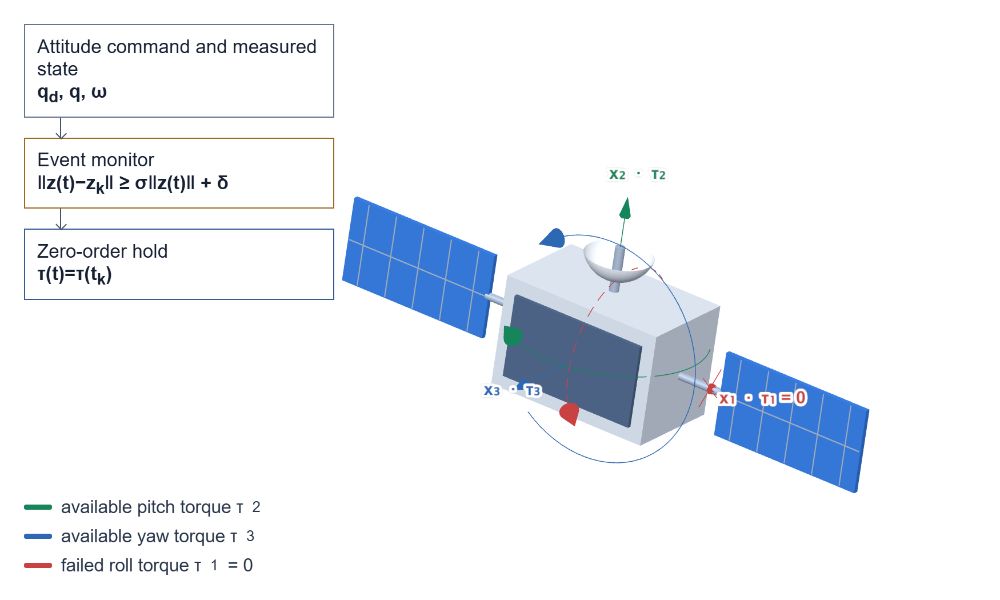
This paper presents an event-triggered attitude control method for an underactuated spacecraft with only two bounded body-axis torques. Gyroscopic coupling supplies the missing control action: two periodic angular-rate references generate the average gyroscopic rate product required to regulate the unactuated axis. A relative-plus-absolute event condition updates the bounded torque command, while a zero-order hold and a timeout provide implementable inter-event intervals. An elementary energy argument establishes asymptotic stability of the explicitly defined nominal averaged local error model, while a nonlinear simulation assesses the complete implementation. Under a 2 N$\cdot$m torque limit, an initial attitude error of $32.6^\circ$ is reduced to $0.108^\circ$ at 200 s. The event implementation performs 295 full control-law evaluations, and its completed inter-update intervals range from 0.2 to 1.0 s. This corresponds to 70.5% fewer full control-law evaluations and torque-command updates than a 5 Hz periodic implementation.
Graphical Abstract
Keywords
Data Availability Statement
Funding
Conflicts of Interest
AI Use Statement
Ethical Approval and Consent to Participate
References
- Forbes, J. R. (2015). Fundamentals of spacecraft attitude determination and control [bookshelf]. IEEE Control Systems Magazine, 35(4), 56-58.
[CrossRef] [Google Scholar] - Krishnan, H., Reyhanoglu, M., & McClamroch, H. (1994). Attitude stabilization of a rigid spacecraft using two control torques: A nonlinear control approach based on the spacecraft attitude dynamics. Automatica, 30(6), 1023-1027.
[CrossRef] [Google Scholar] - Frias, A., de Ruiter, A. H., & Kumar, K. D. (2019). Velocity-free spacecraft attitude stabilization using two control torques. Automatica, 109, 108553.
[CrossRef] [Google Scholar] - Hughes, P. C. (1986). Spacecraft Attitude Dynamics. New York: Wiley. (ISBN 0-471-81842-9; reprinted by Dover Publications, Mineola, NY, 2004.) https://archive.org/details/spacecraftattitu0000hugh
[Google Scholar] - Sanyal, A., Fosbury, A., Chaturvedi, N., & Bernstein, D. S. (2009). Inertia-free spacecraft attitude tracking with disturbance rejection and almost global stabilization. Journal of guidance, control, and dynamics, 32(4), 1167-1178.
[CrossRef] [Google Scholar] - Mayhew, C. G., Sanfelice, R. G., & Teel, A. R. (2011). Quaternion-based hybrid control for robust global attitude tracking. IEEE Transactions on Automatic control, 56(11), 2555-2566.
[CrossRef] [Google Scholar] - Yin, S., Xiao, B., Ding, S. X., & Zhou, D. (2016). A review on recent development of spacecraft attitude fault tolerant control system. IEEE Transactions on Industrial Electronics, 63(5), 3311-3320.
[CrossRef] [Google Scholar] - BoÏskovic, J. D., Li, S. M., & Mehra, R. K. (2001). Robust adaptive variable structure control of spacecraft under control input saturation. Journal of Guidance, Control, and Dynamics, 24(1), 14-22.
[CrossRef] [Google Scholar] - Hu, Q., Xiao, B., Wang, D., & Poh, E. K. (2013). Attitude control of spacecraft with actuator uncertainty. Journal of Guidance, Control, and Dynamics, 36(6), 1771-1776.
[CrossRef] [Google Scholar] - Shao, X., Hu, Q., Shi, Y., & Jiang, B. (2018). Fault-tolerant prescribed performance attitude tracking control for spacecraft under input saturation. IEEE Transactions on Control Systems Technology, 28(2), 574-582.
[CrossRef] [Google Scholar] - Wu, B., & Cao, X. (2017). Robust attitude tracking control for spacecraft with quantized torques. IEEE transactions on Aerospace and Electronic Systems, 54(2), 1020-1028.
[CrossRef] [Google Scholar] - Zhu, Z., Xia, Y., & Fu, M. (2011). Attitude stabilization of rigid spacecraft with finite‐time convergence. International Journal of Robust and Nonlinear Control, 21(6), 686-702.
[CrossRef] [Google Scholar] - Gui, H., Vukovich, G., & Xu, S. (2015). Attitude tracking of a rigid spacecraft using two internal torques. IEEE Transactions on Aerospace and Electronic Systems, 51(4), 2900-2913.
[CrossRef] [Google Scholar] - Tabuada, P. (2007). Event-triggered real-time scheduling of stabilizing control tasks. IEEE Transactions on Automatic control, 52(9), 1680-1685.
[CrossRef] [Google Scholar] - Heemels, W. P., Johansson, K. H., & Tabuada, P. (2012, December). An introduction to event-triggered and self-triggered control. In 2012 ieee 51st ieee conference on decision and control (cdc) (pp. 3270-3285). IEEE.
[CrossRef] [Google Scholar] - Wu, B., Shen, Q., & Cao, X. (2018). Event-triggered attitude control of spacecraft. Advances in Space Research, 61(3), 927-934.
[CrossRef] [Google Scholar] - Zhang, C., Wang, J., Zhang, D., & Shao, X. (2018). Learning observer based and event-triggered control to spacecraft against actuator faults. Aerospace Science and Technology, 78, 522-530.
[CrossRef] [Google Scholar] - Zou, A. M., Kumar, K. D., & de Ruiter, A. H. (2017). Spacecraft attitude control using two control torques. Information Sciences, 408, 23-40.
[CrossRef] [Google Scholar] - Wang, C., Guo, L., Wen, C., Hu, Q., & Qiao, J. (2019). Event-triggered adaptive attitude tracking control for spacecraft with unknown actuator faults. IEEE Transactions on Industrial Electronics, 67(3), 2241-2250.
[CrossRef] [Google Scholar]
Cite This Article
TY  - JOUR
AU  - Zhang, Chengxi
PY  - 2026
DA  - 2026/09/21
TI  - Event-Triggered Attitude Control of Underactuated Spacecraft
JO  - Aerospace Engineering Communications
T2  - Aerospace Engineering Communications
JF  - Aerospace Engineering Communications
VL  - 1
IS  - 3
SP  - 110
EP  - 118
DO  - 10.62762/AEC.2026.732691
UR  - https://www.icck.org/article/abs/AEC.2026.732691
KW  - underactuated spacecraft
KW  - attitude control
KW  - event-triggered control
AB  - This paper presents an event-triggered attitude control method for an underactuated spacecraft with only two bounded body-axis torques. Gyroscopic coupling supplies the missing control action: two periodic angular-rate references generate the average gyroscopic rate product required to regulate the unactuated axis. A relative-plus-absolute event condition updates the bounded torque command, while a zero-order hold and a timeout provide implementable inter-event intervals. An elementary energy argument establishes asymptotic stability of the explicitly defined nominal averaged local error model, while a nonlinear simulation assesses the complete implementation. Under a 2 N$\cdot$m torque limit, an initial attitude error of $32.6^\circ$ is reduced to $0.108^\circ$ at 200 s. The event implementation performs 295 full control-law evaluations, and its completed inter-update intervals range from 0.2 to 1.0 s. This corresponds to 70.5% fewer full control-law evaluations and torque-command updates than a 5 Hz periodic implementation.
SN  - 3071-1967
PB  - Institute of Central Computation and Knowledge
LA  - English
ER  -
@article{Zhang2026EventTrigg,
  author = {Chengxi Zhang},
  title = {Event-Triggered Attitude Control of Underactuated Spacecraft},
  journal = {Aerospace Engineering Communications},
  year = {2026},
  volume = {1},
  number = {3},
  pages = {110-118},
  doi = {10.62762/AEC.2026.732691},
  url = {https://www.icck.org/article/abs/AEC.2026.732691},
  abstract = {This paper presents an event-triggered attitude control method for an underactuated spacecraft with only two bounded body-axis torques. Gyroscopic coupling supplies the missing control action: two periodic angular-rate references generate the average gyroscopic rate product required to regulate the unactuated axis. A relative-plus-absolute event condition updates the bounded torque command, while a zero-order hold and a timeout provide implementable inter-event intervals. An elementary energy argument establishes asymptotic stability of the explicitly defined nominal averaged local error model, while a nonlinear simulation assesses the complete implementation. Under a 2 N\$\cdot\$m torque limit, an initial attitude error of \$32.6^\circ\$ is reduced to \$0.108^\circ\$ at 200 s. The event implementation performs 295 full control-law evaluations, and its completed inter-update intervals range from 0.2 to 1.0 s. This corresponds to 70.5\% fewer full control-law evaluations and torque-command updates than a 5 Hz periodic implementation.},
  keywords = {underactuated spacecraft, attitude control, event-triggered control},
  issn = {3071-1967},
  publisher = {Institute of Central Computation and Knowledge}
}
Article Metrics
Publisher's Note
ICCK stays neutral with regard to jurisdictional claims in published maps and institutional affiliations.
Rights and Permissions
 Copyright © 2026 by the Author(s). Published by Institute of Central Computation and Knowledge. This article is an open access article distributed under the terms and conditions of the Creative Commons Attribution (CC BY) license (https://creativecommons.org/licenses/by/4.0/), which permits use, sharing, adaptation, distribution and reproduction in any medium or format, as long as you give appropriate credit to the original author(s) and the source, provide a link to the Creative Commons licence, and indicate if changes were made.


Portico
