Volume 1, Issue 3, Biomedical Informatics and Smart Healthcare
Volume 1, Issue 3, 2025
Submit Manuscript Edit a Special Issue
Article QR Code
Article QR Code
Scan the QR code for reading
Popular articles
Biomedical Informatics and Smart Healthcare, Volume 1, Issue 3, 2025: 138-148

Open Access | Research Article | 28 December 2025
Empirical Analysis of the Performance of Machine Learning Algorithms in Classifying 2D MR Images from PCA Reduced HOG and LBP Features
1 Department of Computer Science & IT, Bhaderwah Campus, University of Jammu, Bhaderwah 182222, India
2 Department of Computer Languages and Systems, University of Seville, Seville 41004, Spain
* Corresponding Author: Neeraj Kumar, [email protected]
ARK: ark:/57805/bish.2025.993395
Received: 08 September 2025, Accepted: 22 December 2025, Published: 28 December 2025  
Abstract
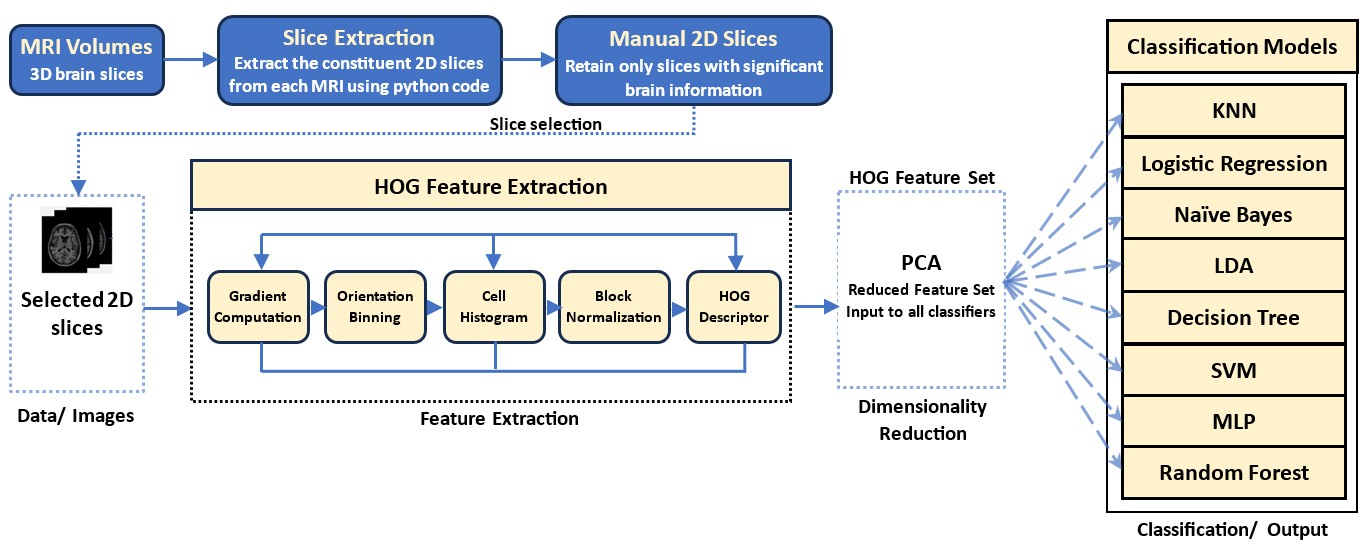
This study investigates the role of feature extraction and dimensionality reduction techniques in addressing high-dimensional image data, with a particular focus on Alzheimer's disease classification using 2D magnetic resonance imaging (MRI). Histogram of Oriented Gradients (HOG) and Local Binary Patterns (LBP) are employed to extract discriminative features from MRI images; however, due to the high dimensionality of the extracted features, dimensionality reduction is required. Principal Component Analysis (PCA) is utilized to reduce feature dimensionality while preserving most of the relevant information, as reflected in the improved performance of the underlying machine learning (ML) classifiers. Two feature extraction pipelines are evaluated: (i) HOG combined with PCA, and (ii) LBP combined with PCA. The reduced feature sets are subsequently used for classification. Experimental results demonstrate that ML algorithms consistently achieve superior performance using features derived from the HOG+PCA pipeline compared to those obtained from the LBP+PCA pipeline. Although the LBP+PCA approach exhibits certain advantages, HOG+PCA proves to be more effective for the problem under consideration, while acknowledging that performance may vary across applications. Furthermore, the study confirms that ensemble learning methods generally outperform individual classifiers by leveraging complementary strengths, and that larger datasets tend to enhance model performance by enabling the learning of richer patterns. In contrast, memory-intensive algorithms such as k-nearest neighbors (KNN) may be suitable for smaller datasets but are typically less scalable for large-scale applications.

Graphical Abstract
Empirical Analysis of the Performance of Machine Learning Algorithms in Classifying 2D MR Images from PCA Reduced HOG and LBP Features

Keywords
medical imaging
feature extraction
ensemble techniques
histogram of oriented gradients
local binary patterns
PCA

Data Availability Statement
Data will be made available on request.

Funding
This work was supported by FEDER, the Ministry of Science, Innovation and Universities, the Junta de Andalucía, the State Research Agency, and CDTI under Grants PID2022-138486OB-I00 (Data-pl), PLSQ\_00162 (SENSOLIVE), and DGP\_PIDI\_2024\_01144 (PLANT), and by the University of Seville under Grant VI PPIT-US 2020. The authors also acknowledge the Alzheimer’s Disease Neuroimaging Initiative (ADNI) for providing the MRI dataset used in this study.

Conflicts of Interest
The authors declare no conflicts of interest.

Ethical Approval and Consent to Participate
This study used anonymized data from the ADNI database. The original ADNI study was approved by the IRBs of all participating institutions, with informed consent from participants. No additional ethical approval was required for this secondary analysis.

References
  1. Dalal, N., & Triggs, B. (2005, June). Histograms of oriented gradients for human detection. In 2005 IEEE computer society conference on computer vision and pattern recognition (CVPR'05) (Vol. 1, pp. 886-893). Ieee.
    [CrossRef]   [Google Scholar]
  2. Molla, Y. K., & Mitiku, E. A. (2025). CNN-HOG based hybrid feature mining for classification of coffee bean varieties using image processing. Multimedia Tools and Applications, 84(2), 749-764.
    [CrossRef]   [Google Scholar]
  3. Youssef, D., Atef, H., Gamal, S., El-Azab, J., & Ismail, T. (2025). Early Breast Cancer Prediction using Thermal Images and Hybrid Feature Extraction Based System. IEEE Access.
    [CrossRef]   [Google Scholar]
  4. Khan, S., Arunnehru, J., Basha, A., Albarrak, A. M., & Ali, A. (2025). An MRI based Histogram Oriented Gradient (HOG) and Deep Learning Approach for Accurate Classification of Mild Cognitive Impairment and Alzheimer's Disease. Frontiers in Medicine, 12, 1529761.
    [CrossRef]   [Google Scholar]
  5. Ojala, T., Pietikainen, M., & Maenpaa, T. (2002). Multiresolution gray-scale and rotation invariant texture classification with local binary patterns. IEEE Transactions on pattern analysis and machine intelligence, 24(7), 971-987.
    [CrossRef]   [Google Scholar]
  6. Fang, X., Xin, B., Zhan, Z., Newton, M. A. A., Yan, F., & Jin, Z. (2025). Classification of wool and cashmere fiber based on LBP and DWT features: performance comparison of random forest, AdaBoost, and KNN classifiers. The Journal of The Textile Institute, 1-13.
    [CrossRef]   [Google Scholar]
  7. Kumar, J., Pandey, V., & Tiwari, R. K. (2025). Optimizing Oral Cancer Detection: A Hybrid Feature Fusion using Local Binary Pattern and CNN. Procedia Computer Science, 258, 476-486.
    [CrossRef]   [Google Scholar]
  8. Jolliffe, I. T., & Cadima, J. (2016). Principal component analysis: a review and recent developments. Philosophical transactions of the royal society A: Mathematical, Physical and Engineering Sciences, 374(2065), 20150202.
    [CrossRef]   [Google Scholar]
  9. Chen, T., Gao, T., Li, S., Zhang, X., Cao, J., Yao, D., & Li, Y. (2021). A novel face recognition method based on fusion of LBP and HOG. IET Image Processing, 15(14), 3559-3572.
    [CrossRef]   [Google Scholar]
  10. Greeshma, K. V., & Gripsy, J. V. (2025). RadientFusion-XR: A Hybrid LBP-HOG Model for COVID-19 Detection Using Machine Learning. Biotechnology and applied biochemistry.
    [CrossRef]   [Google Scholar]
  11. Greeshma, K. V., & Gripsy, J. V. (2020). Image classification using HOG and LBP feature descriptors with SVM and CNN. Int J Eng Res Technol, 8(4), 1-4.
    [Google Scholar]
  12. Souza, T. (2025). Principal Component Analysis (PCA). In Advanced Statistical Analysis for Soil Scientists (pp. 43-56). Cham: Springer Nature Switzerland.
    [CrossRef]   [Google Scholar]
  13. Ebrahimzadeh, R., & Jampour, M. (2014). Efficient handwritten digit recognition based on histogram of oriented gradients and SVM. International Journal of Computer Applications, 104(9).
    [CrossRef]   [Google Scholar]
  14. Khan, H. A. (2017). MCS HOG features and SVM based handwritten digit recognition system. Journal of Intelligent Learning Systems and Applications, 9(2), 21-33.
    [CrossRef]   [Google Scholar]
  15. Ozturk, A. I., & n Yildirim, O. (2025). A comparative analysis of HOG and LBP feature extraction techniques in AdaBoost for image recognition. INTERNATIONAL JOURNAL, 8(2), 696-703.
    [CrossRef]   [Google Scholar]
  16. Ramanathan, N., Chellappa, R., & Biswas, S. (2009). Computational methods for modeling facial aging: A survey. Journal of Visual Languages & Computing, 20(3), 131-144.
    [CrossRef]   [Google Scholar]
  17. Hayashi, J. I., Yasumoto, M., Ito, H., Niwa, Y., & Koshimizu, H. (2002, August). Age and gender estimation from facial image processing. In Proceedings of the 41st SICE Annual Conference. SICE 2002. (Vol. 1, pp. 13-18). IEEE.
    [CrossRef]   [Google Scholar]
  18. Kass, M., Witkin, A., & Terzopoulos, D. (1988). Snakes: Active contour models. International journal of computer vision, 1(4), 321-331.
    [CrossRef]   [Google Scholar]
  19. Lanitis, A., Draganova, C., & Christodoulou, C. (2004). Comparing different classifiers for automatic age estimation. IEEE Transactions on Systems, Man, and Cybernetics, Part B (Cybernetics), 34(1), 621-628.
    [CrossRef]   [Google Scholar]
  20. Cootes, T. F., Edwards, G. J., & Taylor, C. J. (2002). Active appearance models. IEEE Transactions on pattern analysis and machine intelligence, 23(6), 681-685.
    [CrossRef]   [Google Scholar]
  21. Ojala, T., Pietikäinen, M., & Harwood, D. (1996). A comparative study of texture measures with classification based on featured distributions. Pattern recognition, 29(1), 51-59.
    [CrossRef]   [Google Scholar]
  22. Khalifa, T., & Sengul, G. (2018). The integrated usage of LBP and HOG transformations and machine learning algorithms for age range prediction from facial images. Tehnički vjesnik, 25(5), 1356-1362.
    [CrossRef]   [Google Scholar]
  23. Bhushan, M., Singal, M., & Negi, A. (2024). Impact of Machine Learning and Deep Learning Techniques in Autism. In Future of AI in Medical Imaging (pp. 116-136). IGI Global Scientific Publishing.
    [CrossRef]   [Google Scholar]
  24. Bhushan, M., Krishna, R., Haldar, M., Garg, P., Umrao, S., & Rajpoot, T. (2023, May). Machine Learning based Prediction of Liver Disease. In 2023 Third International Conference on Secure Cyber Computing and Communication (ICSCCC) (pp. 720-725). IEEE.
    [CrossRef]   [Google Scholar]

Cite This Article
APA Style
Kumar, N., Akram, W., Bhushan, M., Lakhnotra, A., & Manhas, J. (2025). Empirical Analysis of the Performance of Machine Learning Algorithms in Classifying 2D MR Images from PCA Reduced HOG and LBP Features. Biomedical Informatics and Smart Healthcare, 1(3), 138–148. https://doi.org/10.62762/BISH.2025.993395
Export Citation
RIS Format
Compatible with EndNote, Zotero, Mendeley, and other reference managers
RIS format data for reference managers
TY  - JOUR
AU  - Kumar, Neeraj
AU  - Akram, Waseem
AU  - Bhushan, Megha
AU  - Lakhnotra, Ajay
AU  - Manhas, Jatinder
PY  - 2025
DA  - 2025/12/28
TI  - Empirical Analysis of the Performance of Machine Learning Algorithms in Classifying 2D MR Images from PCA Reduced HOG and LBP Features
JO  - Biomedical Informatics and Smart Healthcare
T2  - Biomedical Informatics and Smart Healthcare
JF  - Biomedical Informatics and Smart Healthcare
VL  - 1
IS  - 3
SP  - 138
EP  - 148
DO  - 10.62762/BISH.2025.993395
UR  - https://www.icck.org/article/abs/BISH.2025.993395
KW  - medical imaging
KW  - feature extraction
KW  - ensemble techniques
KW  - histogram of oriented gradients
KW  - local binary patterns
KW  - PCA
AB  - This study investigates the role of feature extraction and dimensionality reduction techniques in addressing high-dimensional image data, with a particular focus on Alzheimer's disease classification using 2D magnetic resonance imaging (MRI). Histogram of Oriented Gradients (HOG) and Local Binary Patterns (LBP) are employed to extract discriminative features from MRI images; however, due to the high dimensionality of the extracted features, dimensionality reduction is required. Principal Component Analysis (PCA) is utilized to reduce feature dimensionality while preserving most of the relevant information, as reflected in the improved performance of the underlying machine learning (ML) classifiers. Two feature extraction pipelines are evaluated: (i) HOG combined with PCA, and (ii) LBP combined with PCA. The reduced feature sets are subsequently used for classification. Experimental results demonstrate that ML algorithms consistently achieve superior performance using features derived from the HOG+PCA pipeline compared to those obtained from the LBP+PCA pipeline. Although the LBP+PCA approach exhibits certain advantages, HOG+PCA proves to be more effective for the problem under consideration, while acknowledging that performance may vary across applications. Furthermore, the study confirms that ensemble learning methods generally outperform individual classifiers by leveraging complementary strengths, and that larger datasets tend to enhance model performance by enabling the learning of richer patterns. In contrast, memory-intensive algorithms such as k-nearest neighbors (KNN) may be suitable for smaller datasets but are typically less scalable for large-scale applications.
SN  - 3068-5524
PB  - Institute of Central Computation and Knowledge
LA  - English
ER  - 
BibTeX Format
Compatible with LaTeX, BibTeX, and other reference managers
BibTeX format data for LaTeX and reference managers
@article{Kumar2025Empirical,
  author = {Neeraj Kumar and Waseem Akram and Megha Bhushan and Ajay Lakhnotra and Jatinder Manhas},
  title = {Empirical Analysis of the Performance of Machine Learning Algorithms in Classifying 2D MR Images from PCA Reduced HOG and LBP Features},
  journal = {Biomedical Informatics and Smart Healthcare},
  year = {2025},
  volume = {1},
  number = {3},
  pages = {138-148},
  doi = {10.62762/BISH.2025.993395},
  url = {https://www.icck.org/article/abs/BISH.2025.993395},
  abstract = {This study investigates the role of feature extraction and dimensionality reduction techniques in addressing high-dimensional image data, with a particular focus on Alzheimer's disease classification using 2D magnetic resonance imaging (MRI). Histogram of Oriented Gradients (HOG) and Local Binary Patterns (LBP) are employed to extract discriminative features from MRI images; however, due to the high dimensionality of the extracted features, dimensionality reduction is required. Principal Component Analysis (PCA) is utilized to reduce feature dimensionality while preserving most of the relevant information, as reflected in the improved performance of the underlying machine learning (ML) classifiers. Two feature extraction pipelines are evaluated: (i) HOG combined with PCA, and (ii) LBP combined with PCA. The reduced feature sets are subsequently used for classification. Experimental results demonstrate that ML algorithms consistently achieve superior performance using features derived from the HOG+PCA pipeline compared to those obtained from the LBP+PCA pipeline. Although the LBP+PCA approach exhibits certain advantages, HOG+PCA proves to be more effective for the problem under consideration, while acknowledging that performance may vary across applications. Furthermore, the study confirms that ensemble learning methods generally outperform individual classifiers by leveraging complementary strengths, and that larger datasets tend to enhance model performance by enabling the learning of richer patterns. In contrast, memory-intensive algorithms such as k-nearest neighbors (KNN) may be suitable for smaller datasets but are typically less scalable for large-scale applications.},
  keywords = {medical imaging, feature extraction, ensemble techniques, histogram of oriented gradients, local binary patterns, PCA},
  issn = {3068-5524},
  publisher = {Institute of Central Computation and Knowledge}
}

Article Metrics
Citations:

Crossref

0

Scopus

0

Web of Science

0
Article Access Statistics:
Views: 177
PDF Downloads: 66

Publisher's Note
ICCK stays neutral with regard to jurisdictional claims in published maps and institutional affiliations.

Rights and Permissions
CC BY Copyright © 2025 by the Author(s). Published by Institute of Central Computation and Knowledge. This article is an open access article distributed under the terms and conditions of the Creative Commons Attribution (CC BY) license (https://creativecommons.org/licenses/by/4.0/), which permits use, sharing, adaptation, distribution and reproduction in any medium or format, as long as you give appropriate credit to the original author(s) and the source, provide a link to the Creative Commons licence, and indicate if changes were made.
Biomedical Informatics and Smart Healthcare

Biomedical Informatics and Smart Healthcare

ISSN: 3068-5524 (Online)

Email: [email protected]

Portico

Portico

All published articles are preserved here permanently:
https://www.portico.org/publishers/icck/