A High-Efficiency Two-Layer Path Planning Method for UAVs in Vast Airspace
Research Article  ·  Published: 27 September 2024
Issue cover
Chinese Journal of Information Fusion
Volume 1, Issue 2, 2024: 109-125
Research Article Open Access

A High-Efficiency Two-Layer Path Planning Method for UAVs in Vast Airspace

1 School of Information and Communication Engineering, North University of China, Taiyuan 030051, China
* Corresponding Author: Fengbao Yang, [email protected]
Volume 1, Issue 2
You have full access to this open access article · CC BY 4.0 License

Article Information

Abstract

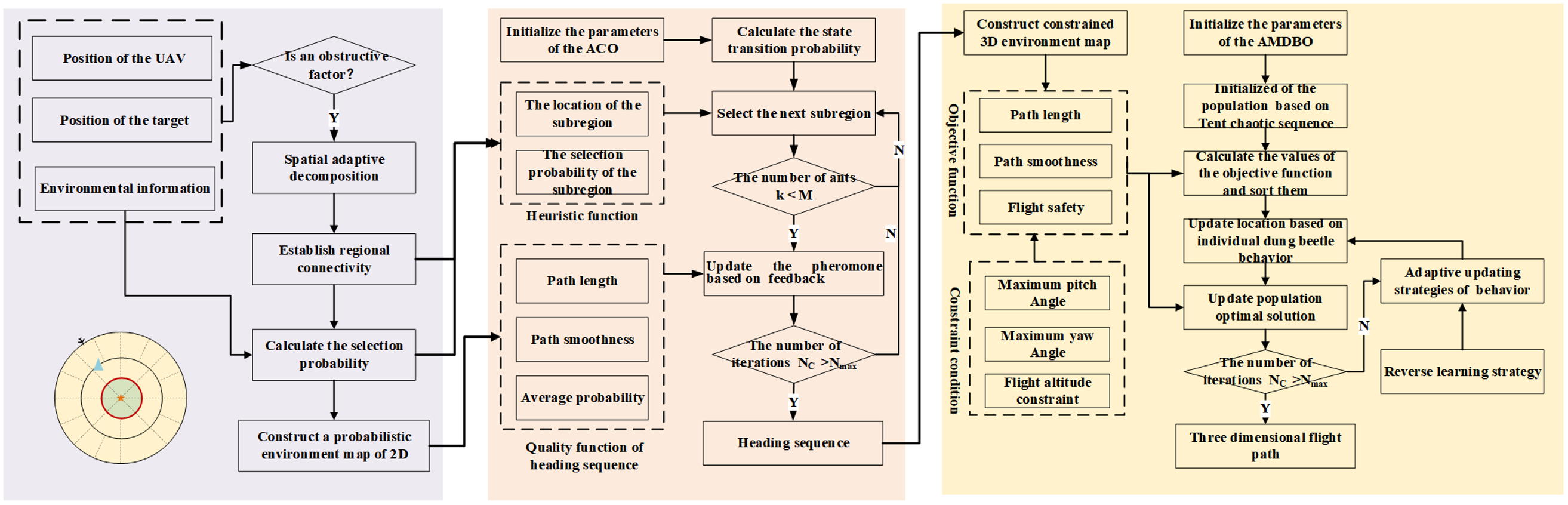
Facing the challenges of low efficiency and poor quality in UAV 3D path planning within large-scale airspace complex environments, this paper introduces a divide-and-conquer approach, proposing a dual-layer path planning method based on multi-source information fusion. The method decomposes traditional path planning into two steps: heading planning and trajectory planning, ensuring both planning efficiency and path quality. This method segregates the solution process into two distinct stages: heading planning and path planning, thereby ensuring the planning of both efficiency and path quality. Firstly, the path planning phase is formulated as a multi-objective optimization problem, taking into account the environmental constraints of the UAV mission and path safety. A heading planning layer is then designed, which incorporates multiple information sources and represents the multidimensional airspace environmental data through an adaptive 2D probabilistic map via information fusion. An improved ant colony algorithm is proposed to efficiently generate high-quality sets of headings, facilitating the preliminary heading planning for UAVs. Then, the three-dimensional environment of the heading regions is extracted, and an improved Dung Beetle algorithm with multiple strategies is proposed to optimize the three-dimensional path in the secondary layer accurately. The efficacy and quality of the proposed path planning methodology are substantiated through comprehensive simulation analysis.

Graphical Abstract

A High-Efficiency Two-Layer Path Planning Method for UAVs in Vast Airspace

Keywords

two-dimensional probabilistic map information fusion trajectory planning optimization algorithm two-Layer path planning

Data Availability Statement

Data will be made available on request.

Funding

This work was supported by the National Natural Science Foundation of China under Grant 61972363 and Grant 61672472.

Conflicts of Interest

The authors declare no conflicts of interest.

Ethical Approval and Consent to Participate

Not applicable.

References

  1. Sepulveda, E., & Smith, H. (2017). Technology challenges of stealth unmanned combat aerial vehicles. The Aeronautical Journal, 121(1243), 1261-1295.
    [CrossRef] [Google Scholar]
  2. Qin, J., & Wu, X. (2016, October). Modeling and simulation on the earliest launch time of ship-to-air missile of warship formation in cooperative air-defense. In 2016 IEEE Advanced Information Management, Communicates, Electronic and Automation Control Conference (IMCEC) (pp. 375-379). IEEE.
    [CrossRef] [Google Scholar]
  3. Gao, Y., Li, D. S., & Zhong, H. (2020). A novel target threat assessment method based on three-way decisions under intuitionistic fuzzy multi-attribute decision making environment. Engineering Applications of Artificial Intelligence, 87, 103276.
    [CrossRef] [Google Scholar]
  4. Zhang, R., Chai, R., Chai, S., Xia, Y., & Tsourdos, A. (2023). Design and practical implementation of a high efficiency two-layer trajectory planning method for AGV. IEEE transactions on industrial electronics, 71(2), 1811-1822.
    [CrossRef] [Google Scholar]
  5. Bashir, N., Boudjit, S., Dauphin, G., & Zeadally, S. (2023). An obstacle avoidance approach for UAV path planning. Simulation modelling practice and theory, 129, 102815.
    [CrossRef] [Google Scholar]
  6. Ren, Z., Rathinam, S., Likhachev, M., & Choset, H. (2022). Multi-objective path-based D* lite. IEEE Robotics and Automation Letters, 7(2), 3318-3325.
    [CrossRef] [Google Scholar]
  7. Chong, L., Jian, L., & XueQuan, L. (2020). Static rectangle expansion A* algorithm for pathfinding. IEEE Transactions on Games, 14(1), 23-35.
    [CrossRef] [Google Scholar]
  8. Ali, H., Xiong, G., Haider, M. H., Tamir, T. S., Dong, X., & Shen, Z. (2023). Feature selection-based decision model for UAV path planning on rough terrains. Expert Systems with Applications, 232, 120713.
    [CrossRef] [Google Scholar]
  9. Diao, Q., Zhang, J., Liu, M., & Yang, J. (2023). A Disaster Relief UAV Path Planning Based on APF-IRRT* Fusion Algorithm. Drones, 7(5), 323.
    [CrossRef] [Google Scholar]
  10. Zhang, J., An, Y., Cao, J., Ouyang, S., & Wang, L. (2023). UAV trajectory planning for complex open storage environments based on an improved RRT algorithm. IEEE Access, 11, 23189-23204.
    [CrossRef] [Google Scholar]
  11. Hao, G., Lv, Q., Huang, Z., Zhao, H., & Chen, W. (2023). Uav path planning based on improved artificial potential field method. Aerospace, 10(6), 562.
    [CrossRef] [Google Scholar]
  12. Liu, J., Yan, Y., Yang, Y., & Li, J. (2024). An Improved Artificial Potential Field UAV Path Planning Algorithm Guided by RRT Under Environment-aware Modeling: Theory and Simulation. IEEE Access.
    [CrossRef] [Google Scholar]
  13. Wu, J., Wang, H., Wang, Y., & Liu, Y. (2021). UAV reactive interfered fluid path planning. Acta Automatica Sinica, 47(1), 1-16.
    [Google Scholar]
  14. Yang, T., Yang, F., & Li, D. (2024). A New Autonomous Method of Drone Path Planning Based on Multiple Strategies for Avoiding Obstacles with High Speed and High Density. Drones, 8(5), 205.
    [CrossRef] [Google Scholar]
  15. Dewangan, R. K., Shukla, A., & Godfrey, W. W. (2019). Three dimensional path planning using Grey wolf optimizer for UAVs. Applied Intelligence, 49, 2201-2217. https://link.springer.com/article/10.1007/s10489-018-1384-y
    [Google Scholar]
  16. Hu, K., & Mo, Y. (2024). A novel unmanned aerial vehicle path planning approach: sand cat optimization algorithm incorporating learned behaviour. Measurement Science and Technology, 35(4), 046203. https://iopscience.iop.org/article/10.1088/1361-6501/ad1977/meta
    [Google Scholar]
  17. Zheng, R. Z., Zhang, Y., & Yang, K. (2022). A transfer learning-based particle swarm optimization algorithm for travelling salesman problem. Journal of Computational Design and Engineering, 9(3), 933-948.
    [CrossRef] [Google Scholar]
  18. Xue, J., & Shen, B. (2023). Dung beetle optimizer: A new meta-heuristic algorithm for global optimization. The Journal of Supercomputing, 79(7), 7305-7336. https://link.springer.com/article/10.1007/s11227-022-04959-6
    [Google Scholar]
  19. Miao, C., Chen, G., Yan, C., & Wu, Y. (2021). Path planning optimization of indoor mobile robot based on adaptive ant colony algorithm. Computers & Industrial Engineering, 156, 107230.
    [CrossRef] [Google Scholar]
  20. Shen, Q., Zhang, D., Xie, M., & He, Q. (2023). Multi-strategy enhanced dung beetle optimizer and its application in three-dimensional UAV path planning. Symmetry, 15(7), 1432.
    [CrossRef] [Google Scholar]
  21. Lyu, L., Jiang, H., & Yang, F. (2024). Improved Dung Beetle Optimizer Algorithm with Multi-Strategy for global optimization and UAV 3D path planning. IEEE Access.
    [CrossRef] [Google Scholar]
  22. Jiachen, H., & Li-hui, F. (2024). Robot path planning based on improved dung beetle optimizer algorithm. Journal of the Brazilian Society of Mechanical Sciences and Engineering, 46(4), 235. https://link.springer.com/article/10.1007/s40430-024-04768-3
    [Google Scholar]
  23. Wai, R. J., & Prasetia, A. S. (2019). Adaptive neural network control and optimal path planning of UAV surveillance system with energy consumption prediction. IEEE Access, 7, 126137-126153.
    [CrossRef] [Google Scholar]
  24. Liu, Y., Zheng, Z., Qin, F., Zhang, X., & Yao, H. (2022). A residual convolutional neural network based approach for real-time path planning. Knowledge-Based Systems, 242, 108400.
    [CrossRef] [Google Scholar]
  25. Luo, X., Wang, Q., Gong, H., & Tang, C. (2024). UAV path planning based on the average TD3 algorithm with prioritized experience replay. IEEE Access.
    [CrossRef] [Google Scholar]
  26. Zhou, C., Gu, S., Wen, Y., Du, Z., Xiao, C., Huang, L., & Zhu, M. (2020). The review unmanned surface vehicle path planning: Based on multi-modality constraint. Ocean Engineering, 200, 107043.
    [CrossRef] [Google Scholar]
  27. Huang, Z. M., Chen, W. N., Li, Q., Luo, X. N., Yuan, H. Q., & Zhang, J. (2020). Ant colony evacuation planner: An ant colony system with incremental flow assignment for multipath crowd evacuation. IEEE Transactions on Cybernetics, 51(11), 5559-5572.
    [CrossRef] [Google Scholar]
  28. Yang, T., Yang, F., & Li, D. (2022). An Air Target Course Prediction Method Based on Sub-Regions Divide and Conquer With Double Variable Weight. IEEE Access, 10, 117871-117885.
    [CrossRef] [Google Scholar]

Cited By (3)

  1. Pingyu Wei, Ying Zhang, He Cai, Youfeng Su. . 2026 38th Chinese Control and Decision Conference (CCDC), 2026 .
    [CrossRef]
  2. Kaining Zhang, Yuxin Deng, Jiayi Ma, Paolo Favaro. . 2025 IEEE/CVF Conference on Computer Vision and Pattern Recognition (CVPR), 2025 .
    [CrossRef]
  3. Jianquan Zhang, Fangting Huang, Shuqing Zhu, Xiao Xiao. A Resource Allocation Strategy in Internet of Vehicles Based on Multi-Task Federated Learning and Incentive Mechanism. IEEE Transactions on Intelligent Transportation Systems, 2025 , 26 (10).
    [CrossRef]
* Citation data provided by Crossref Cited-by.

Cite This Article

APA Style
Yang, T. & Yang, F. (2024). A High-Efficiency Two-Layer Path Planning Method for UAVs in Vast airspace. Chinese Journal of Information Fusion, 1(2), 109–125. https://doi.org/10.62762/CJIF.2024.596648
Export Citation
RIS Format
Compatible with EndNote, Zotero, Mendeley, and other reference managers
TY  - JOUR
AU  - Yang, Tongyao
AU  - Yang, Fengbao
PY  - 2024
DA  - 2024/09/27
TI  - A High-Efficiency Two-Layer Path Planning Method for UAVs in Vast Airspace
JO  - Chinese Journal of Information Fusion
T2  - Chinese Journal of Information Fusion
JF  - Chinese Journal of Information Fusion
VL  - 1
IS  - 2
SP  - 109
EP  - 125
DO  - 10.62762/CJIF.2024.596648
UR  - https://www.icck.org/article/abs/CJIF.2024.596648
KW  - two-dimensional probabilistic map
KW  - information fusion
KW  - trajectory planning
KW  - optimization algorithm
KW  - two-Layer path planning
AB  - Facing the challenges of low efficiency and poor quality in UAV 3D path planning within large-scale airspace complex environments, this paper introduces a divide-and-conquer approach, proposing a dual-layer path planning method based on multi-source information fusion. The method decomposes traditional path planning into two steps: heading planning and trajectory planning, ensuring both planning efficiency and path quality. This method segregates the solution process into two distinct stages: heading planning and path planning, thereby ensuring the planning of both efficiency and path quality. Firstly, the path planning phase is formulated as a multi-objective optimization problem, taking into account the environmental constraints of the UAV mission and path safety. A heading planning layer is then designed, which incorporates multiple information sources and represents the multidimensional airspace environmental data through an adaptive 2D probabilistic map via information fusion. An improved ant colony algorithm is proposed to efficiently generate high-quality sets of headings, facilitating the preliminary heading planning for UAVs. Then, the three-dimensional environment of the heading regions is extracted, and an improved Dung Beetle algorithm with multiple strategies is proposed to optimize the three-dimensional path in the secondary layer accurately. The efficacy and quality of the proposed path planning methodology are substantiated through comprehensive simulation analysis.
SN  - 2998-3371
PB  - Institute of Central Computation and Knowledge
LA  - English
ER  - 
BibTeX Format
Compatible with LaTeX, BibTeX, and other reference managers
@article{Yang2024A,
  author = {Tongyao Yang and Fengbao Yang},
  title = {A High-Efficiency Two-Layer Path Planning Method for UAVs in Vast Airspace},
  journal = {Chinese Journal of Information Fusion},
  year = {2024},
  volume = {1},
  number = {2},
  pages = {109-125},
  doi = {10.62762/CJIF.2024.596648},
  url = {https://www.icck.org/article/abs/CJIF.2024.596648},
  abstract = {Facing the challenges of low efficiency and poor quality in UAV 3D path planning within large-scale airspace complex environments, this paper introduces a divide-and-conquer approach, proposing a dual-layer path planning method based on multi-source information fusion. The method decomposes traditional path planning into two steps: heading planning and trajectory planning, ensuring both planning efficiency and path quality. This method segregates the solution process into two distinct stages: heading planning and path planning, thereby ensuring the planning of both efficiency and path quality. Firstly, the path planning phase is formulated as a multi-objective optimization problem, taking into account the environmental constraints of the UAV mission and path safety. A heading planning layer is then designed, which incorporates multiple information sources and represents the multidimensional airspace environmental data through an adaptive 2D probabilistic map via information fusion. An improved ant colony algorithm is proposed to efficiently generate high-quality sets of headings, facilitating the preliminary heading planning for UAVs. Then, the three-dimensional environment of the heading regions is extracted, and an improved Dung Beetle algorithm with multiple strategies is proposed to optimize the three-dimensional path in the secondary layer accurately. The efficacy and quality of the proposed path planning methodology are substantiated through comprehensive simulation analysis.},
  keywords = {two-dimensional probabilistic map, information fusion, trajectory planning, optimization algorithm, two-Layer path planning},
  issn = {2998-3371},
  publisher = {Institute of Central Computation and Knowledge}
}

Article Metrics

Citations
Views
4324
PDF Downloads
681

Publisher's Note

ICCK stays neutral with regard to jurisdictional claims in published maps and institutional affiliations.

Rights and Permissions

CC BY Copyright © 2024 by the Author(s). Published by Institute of Central Computation and Knowledge. This article is an open access article distributed under the terms and conditions of the Creative Commons Attribution (CC BY) license (https://creativecommons.org/licenses/by/4.0/), which permits use, sharing, adaptation, distribution and reproduction in any medium or format, as long as you give appropriate credit to the original author(s) and the source, provide a link to the Creative Commons licence, and indicate if changes were made.
Chinese Journal of Information Fusion
ISSN: 2998-3371 (Online) | ISSN: 2998-3363 (Print)
Portico
Preserved at
Portico