Explainable Classification of Remote Sensing Ship Images Based on Graph Network







Article Information
Abstract
Remote sensing image plays an important role in maritime surveillance, and as a result there is increasingly becoming a prominent focus on the detection and recognition of maritime objects. However, most existing studies in remote sensing image classification pay more attention on the performance of model, thus neglecting the transparency and explainability in it. To address the issue, an explainable classification method based on graph network is proposed in the present study, which seeks to make use of the relationship between objects' regions to infer the category information. First, the local visual attention module is designed to focus on different but important regions of the object. Then, graph network is used to explore the underlying relationships between them and further to get the discriminative feature through feature fusion. Finally, the loss function is constructed to provide a supervision signal to explicitly guide the attention maps and overall learning process of the model. Through these designs, the model could not only utilize the underlying relationships between regions but also provide explainable visual attention for people's understanding. Rigorous experiments on two public fine-grained ship classification datasets indicate that the classification performance and explainable ability of the designed method is highly competitive.
Graphical Abstract
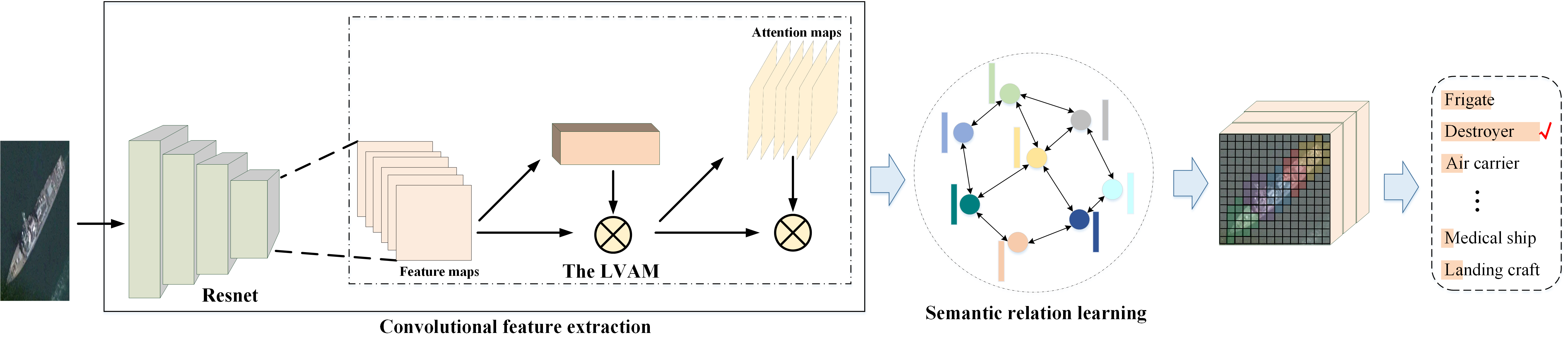
Keywords
Data Availability Statement
Funding
Conflicts of Interest
Ethical Approval and Consent to Participate
References
- Zhang, X., Lv, Y., Yao, L., Xiong, W., & Fu, C. (2020). A New Benchmark and an Attribute-Guided Multilevel Feature Representation Network for Fine-Grained Ship Classification in Optical Remote Sensing Images. IEEE Journal of Selected Topics in Applied Earth Observations and Remote Sensing, 13, 1271-1285.
[CrossRef] [Google Scholar] - Li, D., Liu, R., Tang, Y., & Liu, Y. (2024). PSCLI-TF: Position-Sensitive Cross-Layer Interactive Transformer Model for Remote Sensing Image Scene Classification. IEEE Geoscience and Remote Sensing Letters, 21, 1-5.
[CrossRef] [Google Scholar] - Lan, J., & Wan, L. (2009). Automatic ship target classification based on aerial images. In 2008 International Conference on Optical Instruments and Technology: Optical Systems and Optoelectronic Instruments (Vol. 7156, p. 715612). SPIE.
[CrossRef] [Google Scholar] - Xiong, W., Xiong, Z., Cui, Y., & Lv, Y. (2020). A Discriminative Distillation Network for Cross-Source Remote Sensing Image Retrieval. IEEE Journal of Selected Topics in Applied Earth Observations and Remote Sensing, 13, 1234-1247.
[CrossRef] [Google Scholar] - Chen, J., Chen, K., Chen, H., Li, W., Zou, Z., & Shi, Z. (2022). Contrastive Learning for Fine-Grained Ship Classification in Remote Sensing Images. IEEE Transactions on Geoscience and Remote Sensing, 60, 1-16.
[CrossRef] [Google Scholar] - Chen, Y., Zhang, Z., Chen, Z., Zhang, Y., & Wang, J. (2022). Fine-Grained Classification of Optical Remote Sensing Ship Images Based on Deep Convolution Neural Network. Remote Sensing, 14(18), Article 18.
[CrossRef] [Google Scholar] - Xiong, W., Xiong, Z., & Cui, Y. (2022). An Explainable Attention Network for Fine-Grained Ship Classification Using Remote-Sensing Images. IEEE Transactions on Geoscience and Remote Sensing, 60, 1-14.
[CrossRef] [Google Scholar] - Zheng, H., Fu, J., Mei, T., & Luo, J. (2017). Learning Multi-attention Convolutional Neural Network for Fine-Grained Image Recognition. In 2017 IEEE International Conference on Computer Vision (ICCV), 5219-5227.
[CrossRef] [Google Scholar] - Kipf, T. N., & Welling, M. (2016). Semi-Supervised Classification with Graph Convolutional Networks. arxiv preprint arxiv:1609.02907. http://arxiv.org/abs/1609.02907
[Google Scholar] - Guo, Y., Bo, D., Yang, C., Lu, Z., Zhang, Z., Liu, J., Peng, Y., & Shi, C. (2023). Data-centric Graph Learning: A Survey. arxiv preprint arxiv:2310.04987.
[CrossRef] [Google Scholar] - Yang, Y., Tang, X., Cheung, Y.-M., Zhang, X., & Jiao, L. (2023). SAGN: Semantic-Aware Graph Network for Remote Sensing Scene Classification. IEEE Transactions on Image Processing, 32, 1011-1025.
[CrossRef] [Google Scholar] - Ge, Y., Xiao, Y., Xu, Z., Zheng, M., Karanam, S., Chen, T., Itti, L., & Wu, Z. (2021). A Peek Into the Reasoning of Neural Networks: Interpreting with Structural Visual Concepts. In 2021 IEEE/CVF Conference on Computer Vision and Pattern Recognition (CVPR), 2195-2204.
[CrossRef] [Google Scholar] - Hu, H., Yao, M., He, F., & Zhang, F. (2022). Graph Neural Network via Edge Convolution for Hyperspectral Image Classification. IEEE Geoscience and Remote Sensing Letters, 19, 1-5. IEEE Geoscience and Remote Sensing Letters.
[CrossRef] [Google Scholar] - Di, Y., Jiang, Z., & Zhang, H. (2021). A Public Dataset for Fine-Grained Ship Classification in Optical Remote Sensing Images. Remote Sensing, 13(4), Article 4.
[CrossRef] [Google Scholar] - He, K., Zhang, X., Ren, S., & Sun, J. (2016). Deep Residual Learning for Image Recognition. In 2016 IEEE Conference on Computer Vision and Pattern Recognition (CVPR), 770-778.
[CrossRef] [Google Scholar] - Szegedy, C., Vanhoucke, V., Ioffe, S., Shlens, J., & Wojna, Z. (2016). Rethinking the Inception Architecture for Computer Vision. 2016 IEEE Conference on Computer Vision and Pattern Recognition (CVPR), 2818-2826.
[CrossRef] [Google Scholar] - Huang, G., Liu, Z., van der Maaten, L., & Weinberger, K. Q. (2017). Densely Connected Convolutional Networks. In 2017 IEEE Conference on Computer Vision and Pattern Recognition (CVPR), 2261-2269.
[CrossRef] [Google Scholar] - Howard, A. G., Zhu, M., Chen, B., Kalenichenko, D., Wang, W., Weyand, T., Andreetto, M., & Adam, H. (2017). MobileNets: Efficient Convolutional Neural Networks for Mobile Vision Applications. arxiv preprint arxiv:1704.04861.
[Google Scholar] - Chollet, F. (2017). Xception: Deep Learning with Depthwise Separable Convolutions. In 2017 IEEE Conference on Computer Vision and Pattern Recognition (CVPR), 1800-1807.
[CrossRef] [Google Scholar] - Simonyan, K., & Zisserman, A. (2014). Very Deep Convolutional Networks for Large-Scale Image Recognition. arxiv preprint arxiv:1409.1556. http://arxiv.org/abs/1409.1556
[Google Scholar] - Xie, S., Girshick, R., Dollár, P., Tu, Z., & He, K. (2017). Aggregated residual transformations for deep neural networks. In Proceedings of the IEEE conference on computer vision and pattern recognition (pp. 1492-1500).
[CrossRef] [Google Scholar] - Lin, T.-Y., RoyChowdhury, A., & Maji, S. (2015). Bilinear CNN Models for Fine-Grained Visual Recognition. In 2015 IEEE International Conference on Computer Vision (ICCV), 1449-1457.
[CrossRef] [Google Scholar] - Fu, J., Zheng, H., & Mei, T. (2017). Look Closer to See Better: Recurrent Attention Convolutional Neural Network for Fine-Grained Image Recognition. In 2017 IEEE Conference on Computer Vision and Pattern Recognition (CVPR), 4476-4484.
[CrossRef] [Google Scholar] - Chen, Y., Bai, Y., Zhang, W., & Mei, T. (2019). Destruction and Construction Learning for Fine-Grained Image Recognition. In 2019 IEEE/CVF Conference on Computer Vision and Pattern Recognition (CVPR), 5152-5161.
[CrossRef] [Google Scholar] - Zheng, H., Fu, J., Zha, Z.-J., & Luo, J. (2019). Looking for the Devil in the Details: Learning Trilinear Attention Sampling Network for Fine-Grained Image Recognition. In 2019 IEEE/CVF Conference on Computer Vision and Pattern Recognition (CVPR), 5007-5016.
[CrossRef] [Google Scholar] - Sun, H., He, X., & Peng, Y. (2022). SIM-Trans: Structure Information Modeling Transformer for Fine-grained Visual Categorization. In Proceedings of the 30th ACM International Conference on Multimedia, 5853-5861.
[CrossRef] [Google Scholar] - Shi, Q., Li, W., & Tao, R. (2018). 2D-DFrFT Based Deep Network for Ship Classification in Remote Sensing Imagery. In 2018 10th IAPR Workshop on Pattern Recognition in Remote Sensing (PRRS), 1-5.
[CrossRef] [Google Scholar] - Shi, Q., Li, W., Tao, R., Sun, X., & Gao, L. (2019). Ship Classification Based on Multifeature Ensemble with Convolutional Neural Network. Remote Sensing, 11(4), Article 4.
[CrossRef] [Google Scholar]
Cited By (5)
-
Ying Guo, Bin Fan, Yuchao Dai, Yan Feng, Mingyi He. Boosting Few-Shot Hyperspectral Image Classification Through Dynamic Fusion and Hierarchical Enhancement.
IEEE Transactions on Neural Networks and Learning Systems, 2026 , 37 (3).
[CrossRef] -
Moath Alluwaici, Shweta Chaku, Chakka Rajesh, Revathi V, Ravi Gangadharolla, Siva Sunasundram. .
2026 International Conference on Recent Innovation in Science, Engineering and Technology (ICRISET), 2026 .
[CrossRef] -
Mengjie Qian, Yunfei Chen, Jing Li. HGDCN: A Multi-Scale Representation Learning Method for Knowledge Discovery and Social Networks.
IEEE Transactions on Consumer Electronics, 2025 , 71 (2).
[CrossRef] -
Cuiwei Liu, Shengyu Liu, Huaijun Qiu, Zhaokui Li. Adaptive Part-Level Embedding GCN: Toward Robust Skeleton-Based One-Shot Action Recognition.
IEEE Transactions on Instrumentation and Measurement, 2025 , 74 .
[CrossRef] -
Jairo Orozco, Sergio Manzanarez, Vidya Manian. Supervised Spatially Spectrally Coherent Local Linear Embedding—Wasserstein Graph Convolutional Network for Hyperspectral Image Classification.
IEEE Transactions on Geoscience and Remote Sensing, 2025 , 63 .
[CrossRef]
Cite This Article
TY  - JOUR
AU  - Li, Haoran
AU  - Xiong, Wei
AU  - Cui, Yaqi
AU  - Xiong, Zhenyu
PY  - 2024
DA  - 2024/09/29
TI  - Explainable Classification of Remote Sensing Ship Images Based on Graph Network
JO  - Chinese Journal of Information Fusion
T2  - Chinese Journal of Information Fusion
JF  - Chinese Journal of Information Fusion
VL  - 1
IS  - 2
SP  - 126
EP  - 133
DO  - 10.62762/CJIF.2024.932552
UR  - https://www.icck.org/article/abs/cjif.2024.932552
KW  - explainable visual feature
KW  - remote sensing image
KW  - ship classification
AB  - Remote sensing image plays an important role in maritime surveillance, and as a result there is increasingly becoming a prominent focus on the detection and recognition of maritime objects. However, most existing studies in remote sensing image classification pay more attention on the performance of model, thus neglecting the transparency and explainability in it. To address the issue, an explainable classification method based on graph network is proposed in the present study, which seeks to make use of the relationship between objects' regions to infer the category information. First, the local visual attention module is designed to focus on different but important regions of the object. Then, graph network is used to explore the underlying relationships between them and further to get the discriminative feature through feature fusion. Finally, the loss function is constructed to provide a supervision signal to explicitly guide the attention maps and overall learning process of the model. Through these designs, the model could not only utilize the underlying relationships between regions but also provide explainable visual attention for people's understanding. Rigorous experiments on two public fine-grained ship classification datasets indicate that the classification performance and explainable ability of the designed method is highly competitive.
SN  - 2998-3371
PB  - Institute of Central Computation and Knowledge
LA  - English
ER  -
@article{Li2024Explainabl,
  author = {Haoran Li and Wei Xiong and Yaqi Cui and Zhenyu Xiong},
  title = {Explainable Classification of Remote Sensing Ship Images Based on Graph Network},
  journal = {Chinese Journal of Information Fusion},
  year = {2024},
  volume = {1},
  number = {2},
  pages = {126-133},
  doi = {10.62762/CJIF.2024.932552},
  url = {https://www.icck.org/article/abs/cjif.2024.932552},
  abstract = {Remote sensing image plays an important role in maritime surveillance, and as a result there is increasingly becoming a prominent focus on the detection and recognition of maritime objects. However, most existing studies in remote sensing image classification pay more attention on the performance of model, thus neglecting the transparency and explainability in it. To address the issue, an explainable classification method based on graph network is proposed in the present study, which seeks to make use of the relationship between objects' regions to infer the category information. First, the local visual attention module is designed to focus on different but important regions of the object. Then, graph network is used to explore the underlying relationships between them and further to get the discriminative feature through feature fusion. Finally, the loss function is constructed to provide a supervision signal to explicitly guide the attention maps and overall learning process of the model. Through these designs, the model could not only utilize the underlying relationships between regions but also provide explainable visual attention for people's understanding. Rigorous experiments on two public fine-grained ship classification datasets indicate that the classification performance and explainable ability of the designed method is highly competitive.},
  keywords = {explainable visual feature, remote sensing image, ship classification},
  issn = {2998-3371},
  publisher = {Institute of Central Computation and Knowledge}
}
Publisher's Note
ICCK stays neutral with regard to jurisdictional claims in published maps and institutional affiliations.
Rights and Permissions
 Copyright © 2024 by the Author(s). Published by Institute of Central Computation and Knowledge. This article is an open access article distributed under the terms and conditions of the Creative Commons Attribution (CC BY) license (https://creativecommons.org/licenses/by/4.0/), which permits use, sharing, adaptation, distribution and reproduction in any medium or format, as long as you give appropriate credit to the original author(s) and the source, provide a link to the Creative Commons licence, and indicate if changes were made.


Portico