A Few-shot Learning Method Using Relation Graph





Article Information
Abstract
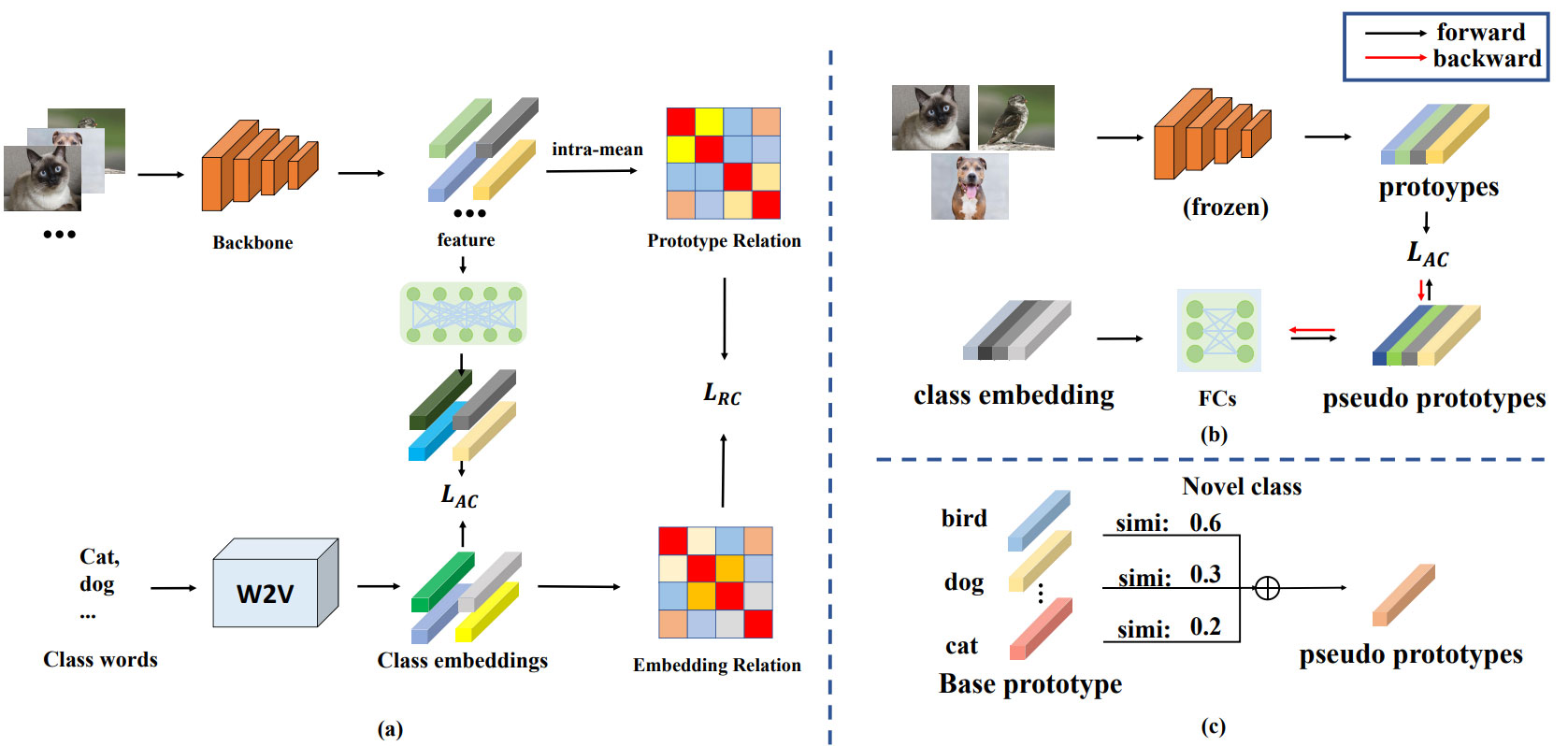
Few-shot learning aims to recognize new-class items under the circumstances with a few labeled support samples. However, many methods may suffer from poor guidance of limited new-class samples that are not suitable for being regarded as class centers. Recent works use word embedding to enrich the new-class distribution message but only use simple mapping between visual and semantic features during training. To solve the aforementioned problems, we propose a fusion method that constructs a class relation graph by semantic meaning as guidance for feature extraction and fusion, to help the learning of the second-order relation information, with a light training request. In addition, we introduce two ways to generate pseudo prototypes for augmentation to resolve the lack of representation due to limited samples in novel classes: 1) A Generation Module(GM) that trains a small structure to generate visual features by using word embedding; 2) A Relation Module(RM) for training-free scenario that uses class relations in semantics to generate visual features. Extensive experiments on benchmarks including miniImageNet, CIFAR-FS and FC-100 prove that our fusion method achieves state-of-the-art results.
Graphical Abstract
Keywords
Data Availability Statement
Funding
Conflicts of Interest
Ethical Approval and Consent to Participate
References
- Kim, J., Oh, T.-H., Lee, S., Pan, F., & Kweon, I. S. (2019). Variational prototyping-encoder: One-shot learning with prototypical images. In IEEE Conference on Computer Vision and Pattern Recognition (pp. 9462–9470).
[Google Scholar] - Sung, F., Yang, Y., Zhang, L., Xiang, T., Torr, P. H. S., & Hospedales, T. M. (2018). Learning to compare: Relation network for few-shot learning. In IEEE Conference on Computer Vision and Pattern Recognition (pp. 1199–1208).
[Google Scholar] - Vinyals, O., Blundell, C., Lillicrap, T., & Wierstra, D. (2016). Matching networks for one shot learning. Advances in neural information processing systems, 29.
[Google Scholar] - Snell, J., Swersky, K., & Zemel, R. (2017). Prototypical networks for few-shot learning. Advances in neural information processing systems, 30.
[Google Scholar] - Huang, J., Chen, F., Wang, K., Lin, L., & Zhang, D. (2022). Enhancing prototypical few-shot learning by leveraging the local-level strategy. In IEEE International Conference on Acoustics, Speech and Signal Processing (pp. 1660–1664). IEEE.
[CrossRef] [Google Scholar] - Chen, Y., Liu, Z., Xu, H., Darrell, T., & Wang, X. (2021). Meta-baseline: Exploring simple meta-learning for few-shot learning. In Proceedings of the IEEE/CVF international conference on computer vision (pp. 9062-9071).
[Google Scholar] - Schwartz, E., Karlinsky, L., Feris, R., Giryes, R., & Bronstein, A. M. (2022). Baby steps towards few-shot learning with multiple semantics. Pattern Recognition Letters, 160, 142–147.
[CrossRef] [Google Scholar] - Li, A., Huang, W., Lan, X., Feng, J., Li, Z., & Wang, L. (2020). Boosting few-shot learning with adaptive margin loss. In Proceedings of the IEEE/CVF conference on computer vision and pattern recognition (pp. 12576-12584).
[Google Scholar] - Xing, C., Rostamzadeh, N., Oreshkin, B., & O Pinheiro, P. O. (2019). Adaptive cross-modal few-shot learning. Advances in neural information processing systems, 32.
[Google Scholar] - Xu, J., & Le, H. (2022). Generating representative samples for few-shot classification. In Proceedings of the IEEE/CVF conference on computer vision and pattern recognition (pp. 9003-9013).
[Google Scholar] - Chen, Z., Fu, Y., Zhang, Y., Jiang, Y.-G., Xue, X., & Sigal, L. (2019). Multi-level semantic feature augmentation for one-shot learning. IEEE Transactions on Image Processing, 28(9), 4594–4605.
[CrossRef] [Google Scholar] - Peng, Z., Li, Z., Zhang, J., Li, Y., Qi, G. J., & Tang, J. (2019). Few-shot image recognition with knowledge transfer. In Proceedings of the IEEE/CVF international conference on computer vision (pp. 441-449).
[Google Scholar] - Tokmakov, P., Wang, Y. X., & Hebert, M. (2019). Learning compositional representations for few-shot recognition. In Proceedings of the IEEE/CVF International Conference on Computer Vision (pp. 6372-6381).
[Google Scholar] - Zhang, B., Li, X., Ye, Y., Huang, Z., & Zhang, L. (2021). Prototype completion with primitive knowledge for few-shot learning. In Proceedings of the IEEE/CVF conference on computer vision and pattern recognition (pp. 3754-3762).
[Google Scholar] - Bendou, Y., Hu, Y., Lafargue, R., Lioi, G., Pasdeloup, B., Pateux, S., & Gripon, V. (2022). Easy—ensemble augmented-shot-y-shaped learning: State-of-the-art few-shot classification with simple components. Journal of Imaging, 8(7), 179.
[CrossRef] [Google Scholar] - Finn, C., Abbeel, P., & Levine, S. (2017, July). Model-agnostic meta-learning for fast adaptation of deep networks. In International conference on machine learning (pp. 1126-1135). PMLR.
[Google Scholar] - Wang, Y., Chao, W. L., Weinberger, K. Q., & Van Der Maaten, L. (2019). Simpleshot: Revisiting nearest-neighbor classification for few-shot learning. arXiv preprint arXiv:1911.04623.
[Google Scholar] - Mangla, P., Kumari, N., Sinha, A., Singh, M., Krishnamurthy, B., & Balasubramanian, V. N. (2020). Charting the right manifold: Manifold mixup for few-shot learning. In Proceedings of the IEEE/CVF winter conference on applications of computer vision (pp. 2218-2227).
[Google Scholar] - Deng, J., Dong, W., Socher, R., Li, L. J., Li, K., & Fei-Fei, L. (2009, June). Imagenet: A large-scale hierarchical image database. In 2009 IEEE conference on computer vision and pattern recognition (pp. 248-255). Ieee.
[Google Scholar] - Rong, X. (2014). word2vec parameter learning explained. arXiv preprint arXiv:1411.2738.
[Google Scholar] - Bertinetto, L., Henriques, J. F., Torr, P. H., & Vedaldi, A. (2018). Meta-learning with differentiable closed-form solvers. arXiv preprint arXiv:1805.08136.
[Google Scholar] - Krizhevsky, A., & Hinton, G. (2009). Learning multiple layers of features from tiny images. Technical Report, University of Toronto.
[Google Scholar] - Oreshkin, B., Rodríguez López, P., & Lacoste, A. (2018). Tadam: Task dependent adaptive metric for improved few-shot learning. Advances in neural information processing systems, 31.
[Google Scholar] - Zhang, C., Cai, Y., Lin, G., & Shen, C. (2020). DeepEMD: Few-shot image classification with differentiable earth mover's distance and structured classifiers. In Proceedings of the IEEE/CVF conference on computer vision and pattern recognition (pp. 12203-12213).
[Google Scholar] - Simon, C., Koniusz, P., Nock, R., & Harandi, M. (2020). Adaptive subspaces for few-shot learning. In Proceedings of the IEEE/CVF conference on computer vision and pattern recognition (pp. 4136-4145).
[Google Scholar] - Lee, K., Maji, S., Ravichandran, A., & Soatto, S. (2019). Meta-learning with differentiable convex optimization. In Proceedings of the IEEE/CVF conference on computer vision and pattern recognition (pp. 10657-10665).
[Google Scholar] - Tian, Y., Wang, Y., Krishnan, D., Tenenbaum, J. B., & Isola, P. (2020). Rethinking few-shot image classification: a good embedding is all you need?. In Computer Vision–ECCV 2020: 16th European Conference, Glasgow, UK, August 23–28, 2020, Proceedings, Part XIV 16 (pp. 266-282). Springer International Publishing.
[Google Scholar] - Rizve, M. N., Khan, S., Khan, F. S., & Shah, M. (2021). Exploring complementary strengths of invariant and equivariant representations for few-shot learning. In Proceedings of the IEEE/CVF conference on computer vision and pattern recognition (pp. 10836-10846).
[Google Scholar] - Liu, J., Chao, F., & Lin, C. M. (2020). Task augmentation by rotating for meta-learning. arXiv preprint arXiv:2003.00804.
[Google Scholar] - Hiller, M., Ma, R., Harandi, M., & Drummond, T. (2022). Rethinking generalization in few-shot classification. Advances in neural information processing systems, 35, 3582-3595.
[Google Scholar] - He, Y., Liang, W., Zhao, D., Zhou, H. Y., Ge, W., Yu, Y., & Zhang, W. (2022). Attribute surrogates learning and spectral tokens pooling in transformers for few-shot learning. In Proceedings of the IEEE/CVF Conference on Computer Vision and Pattern Recognition (pp. 9119-9129).
[Google Scholar]
Cited By (1)
-
Jiaying Wu, Jingyu Chen, Jia Luo, Jinglu Hu. Compact Semantic‐Aware Priors for Large‐Margin Few‐Shot Classification.
IEEJ Transactions on Electrical and Electronic Engineering, 2026 , 21 (12).
[CrossRef]
Cite This Article
TY  - JOUR
AU  - Liu, Zijing
AU  - Wang, Chenggang
PY  - 2025
DA  - 2025/03/27
TI  - A Few-shot Learning Method Using Relation Graph
JO  - Chinese Journal of Information Fusion
T2  - Chinese Journal of Information Fusion
JF  - Chinese Journal of Information Fusion
VL  - 2
IS  - 1
SP  - 70
EP  - 78
DO  - 10.62762/CJIF.2025.146072
UR  - https://www.icck.org/article/abs/cjif.2025.146072
KW  - few-shot learning
KW  - graph fusion
KW  - relation graph
AB  - Few-shot learning aims to recognize new-class items under the circumstances with a few labeled support samples. However, many methods may suffer from poor guidance of limited new-class samples that are not suitable for being regarded as class centers. Recent works use word embedding to enrich the new-class distribution message but only use simple mapping between visual and semantic features during training. To solve the aforementioned problems, we propose a fusion method that constructs a class relation graph by semantic meaning as guidance for feature extraction and fusion, to help the learning of the second-order relation information, with a light training request. In addition, we introduce two ways to generate pseudo prototypes for augmentation to resolve the lack of representation due to limited samples in novel classes: 1) A Generation Module(GM) that trains a small structure to generate visual features by using word embedding; 2) A Relation Module(RM) for training-free scenario that uses class relations in semantics to generate visual features. Extensive experiments on benchmarks including miniImageNet, CIFAR-FS and FC-100 prove that our fusion method achieves state-of-the-art results.
SN  - 2998-3371
PB  - Institute of Central Computation and Knowledge
LA  - English
ER  -
@article{Liu2025A,
  author = {Zijing Liu and Chenggang Wang},
  title = {A Few-shot Learning Method Using Relation Graph},
  journal = {Chinese Journal of Information Fusion},
  year = {2025},
  volume = {2},
  number = {1},
  pages = {70-78},
  doi = {10.62762/CJIF.2025.146072},
  url = {https://www.icck.org/article/abs/cjif.2025.146072},
  abstract = {Few-shot learning aims to recognize new-class items under the circumstances with a few labeled support samples. However, many methods may suffer from poor guidance of limited new-class samples that are not suitable for being regarded as class centers. Recent works use word embedding to enrich the new-class distribution message but only use simple mapping between visual and semantic features during training. To solve the aforementioned problems, we propose a fusion method that constructs a class relation graph by semantic meaning as guidance for feature extraction and fusion, to help the learning of the second-order relation information, with a light training request. In addition, we introduce two ways to generate pseudo prototypes for augmentation to resolve the lack of representation due to limited samples in novel classes: 1) A Generation Module(GM) that trains a small structure to generate visual features by using word embedding; 2) A Relation Module(RM) for training-free scenario that uses class relations in semantics to generate visual features. Extensive experiments on benchmarks including miniImageNet, CIFAR-FS and FC-100 prove that our fusion method achieves state-of-the-art results.},
  keywords = {few-shot learning, graph fusion, relation graph},
  issn = {2998-3371},
  publisher = {Institute of Central Computation and Knowledge}
}
Publisher's Note
ICCK stays neutral with regard to jurisdictional claims in published maps and institutional affiliations.
Rights and Permissions
 Copyright © 2025 by the Author(s). Published by Institute of Central Computation and Knowledge. This article is an open access article distributed under the terms and conditions of the Creative Commons Attribution (CC BY) license (https://creativecommons.org/licenses/by/4.0/), which permits use, sharing, adaptation, distribution and reproduction in any medium or format, as long as you give appropriate credit to the original author(s) and the source, provide a link to the Creative Commons licence, and indicate if changes were made.


Portico