Distributed Group Target Tracking under Limited Field-of-View Sensors Using Belief Propagation
Research Article  ·  Published: 20 July 2025
Issue cover
Chinese Journal of Information Fusion
Volume 2, Issue 3, 2025: 194-211
Research Article Open Access

Distributed Group Target Tracking under Limited Field-of-View Sensors Using Belief Propagation

1 School of Mathematics, Sichuan University, Chengdu, Sichuan 610064, China
2 Science and Technology on Electronic Information Control Laboratory, Chengdu 610036, China
* Corresponding Author: Xuqi Zhang, [email protected]
Volume 2, Issue 3
You have full access to this open access article · CC BY 4.0 License

Article Information

Abstract

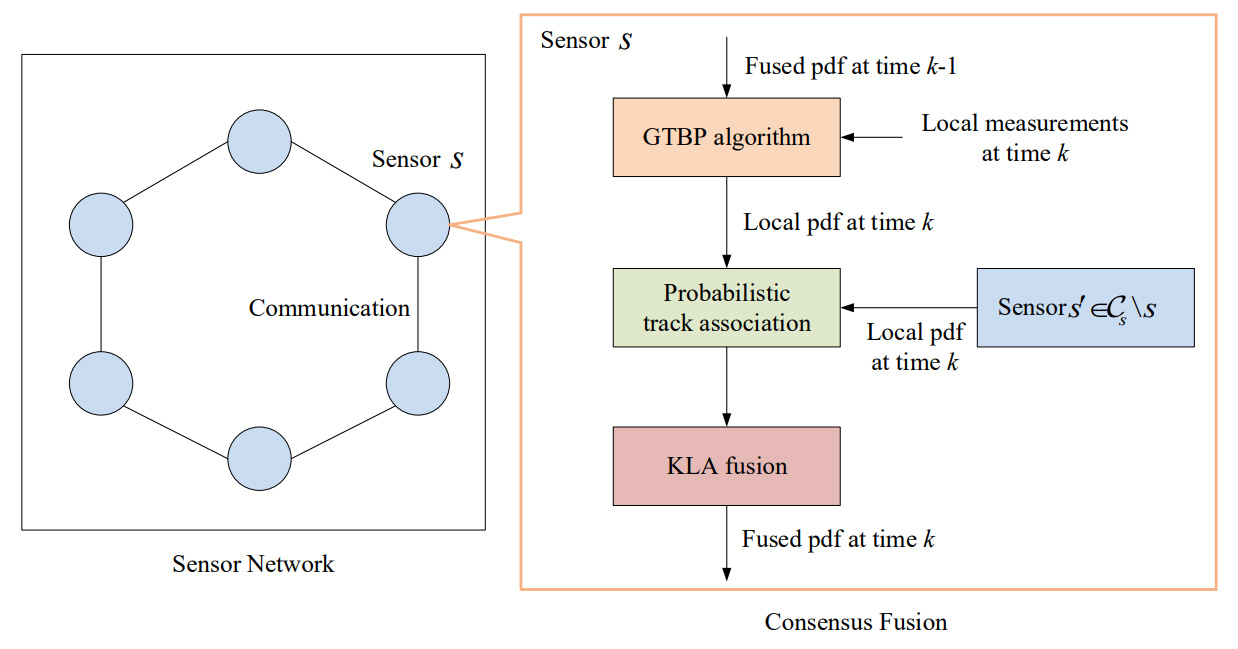
This paper considers the distributed group target tracking (DGTT) problem under sensors with limited and different field of views (FoVs). Usually, for the tracking of groups, targets within groups are closely spaced and move in a coordinated manner. These groups can split or merge, and the numbers of targets in groups may be large, which lead to more challenging issues related to data association, filtering and computational complexities. Particularly, these challenges may be further complicated in distributed fusion system architectures. To deal with these difficulties, we propose a consensus-based DGTT method within the belief propagation (BP) framework, which introduces undetected targets inside the FoV or new targets outside the FoV and performs the probabilistic track association via BP. Meanwhile, the obtained track association probabilities make it possible to exploit a probabilistic consensus fusion scheme for fusing local target densities. Furthermore, the proposed method exhibits computational scalability scaling only linearly on the numbers of group partitions, local measurements and neighboring sensors, and scaling quadratically on the number of targets. Numerical results validate the performance of the proposed method.

Graphical Abstract

Distributed Group Target Tracking under Limited Field-of-View Sensors Using Belief Propagation

Keywords

group target tracking distributed sensor network consensus fusion scalability belief propagation

Data Availability Statement

Data will be made available on request.

Funding

This work was supported by the Natural Science Foundation of Sichuan Province under Grant 2025ZNSFSC0821 and the Special Fund for Postdoctoral Research Projects of Sichuan Province under Grant TB2024075.

Conflicts of Interest

The authors declare no conflicts of interest.

Ethical Approval and Consent to Participate

Not applicable.

References

  1. Gadaleta, S., Poore, A. B., Roberts, S., & Slocumb, B. J. (2004, August). Multiple hypothesis clustering and multiple frame assignment tracking. In Signal and Data Processing of Small Targets 2004 (Vol. 5428, pp. 294-307). SPIE.
    [CrossRef] [Google Scholar]
  2. Mihaylova, L., Carmi, A. Y., Septier, F., Gning, A., Pang, S. K., & Godsill, S. (2014). Overview of Bayesian sequential Monte Carlo methods for group and extended object tracking. Digital Signal Processing, 25, 1-16.
    [CrossRef] [Google Scholar]
  3. Wang, Y., Shan, M., Yue, Y., & Wang, D. (2019). Vision-based flexible leader–follower formation tracking of multiple nonholonomic mobile robots in unknown obstacle environments. IEEE Transactions on Control Systems Technology, 28(3), 1025-1033.
    [CrossRef] [Google Scholar]
  4. Li, Q., Ahmad, B. I., & Godsill, S. J. (2021). Sequential dynamic leadership inference using Bayesian Monte Carlo methods. IEEE Transactions on Aerospace and Electronic Systems, 57(4), 2039-2052.
    [CrossRef] [Google Scholar]
  5. Mallick, M., Krishnamurthy, V., & Vo, B. N. (Eds.). (2012). Integrated tracking, classification, and sensor management: theory and applications. John Wiley & Sons.
    [Google Scholar]
  6. Zhu, Y. (2003). Multisensor Decision and Estimation Fusion. Kluwer Academic Publishers.
    [Google Scholar]
  7. Gning, A., Mihaylova, L., Maskell, S., Pang, S. K., & Godsill, S. (2010). Group object structure and state estimation with evolving networks and Monte Carlo methods. IEEE Transactions on Signal Processing, 59(4), 1383-1396.
    [CrossRef] [Google Scholar]
  8. Chong, C. Y. (1990). Distributed multitarget multisensor tracking. Multitarget-multisensor tracking: Advanced applications, 247-296.
    [Google Scholar]
  9. Battistelli, G., & Chisci, L. (2014). Kullback–Leibler average, consensus on probability densities, and distributed state estimation with guaranteed stability. Automatica, 50(3), 707-718.
    [CrossRef] [Google Scholar]
  10. Mahler, R. P. (2000, August). Optimal/robust distributed data fusion: a unified approach. In Signal Processing, Sensor Fusion, and Target Recognition IX (Vol. 4052, pp. 128-138). SPIE.
    [CrossRef] [Google Scholar]
  11. Hurley, M. B. (2002, July). An information theoretic justification for covariance intersection and its generalization. In Proceedings of the fifth international conference on Information Fusion. FUSION 2002.(IEEE Cat. No. 02EX5997) (Vol. 1, pp. 505-511). IEEE.
    [CrossRef] [Google Scholar]
  12. Julier, S. J., Bailey, T., & Uhlmann, J. K. (2006, September). Using exponential mixture models for suboptimal distributed data fusion. In 2006 IEEE Nonlinear Statistical Signal Processing Workshop (pp. 160-163). IEEE.
    [CrossRef] [Google Scholar]
  13. Ueney, M., Clark, D. E., & Julier, S. J. (2013). Distributed fusion of PHD filters via exponential mixture densities. IEEE Journal of Selected Topics in Signal Processing, 7(3), 521-531.
    [CrossRef] [Google Scholar]
  14. Li, T., Corchado, J. M., & Sun, S. (2018). Partial consensus and conservative fusion of Gaussian mixtures for distributed PHD fusion. IEEE Transactions on Aerospace and Electronic Systems, 55(5), 2150-2163.
    [CrossRef] [Google Scholar]
  15. Li, T., & Hlawatsch, F. (2021). A distributed particle-PHD filter using arithmetic-average fusion of Gaussian mixture parameters. Information Fusion, 73, 111-124.
    [CrossRef] [Google Scholar]
  16. Koliander, G., El-Laham, Y., Djurić, P. M., & Hlawatsch, F. (2022). Fusion of probability density functions. Proceedings of the IEEE, 110(4), 404-453.
    [CrossRef] [Google Scholar]
  17. Battistelli, G., Chisci, L., Fantacci, C., Farina, A., & Graziano, A. (2013). Consensus CPHD filter for distributed multitarget tracking. IEEE Journal of Selected Topics in Signal Processing, 7(3), 508-520.
    [CrossRef] [Google Scholar]
  18. Li, S., Battistelli, G., Chisci, L., Yi, W., Wang, B., & Kong, L. (2018). Computationally eff i cient multi-agent multi-object tracking with labeled random finite sets. IEEE Transactions on Signal Processing, 67(1), 260-275.
    [CrossRef] [Google Scholar]
  19. Üney, M., Houssineau, J., Delande, E., Julier, S. J., & Clark, D. E. (2019). Fusion of finite-set distributions: Pointwise consistency and global cardinality. IEEE Transactions on Aerospace and Electronic Systems, 55(6), 2759-2773.
    [CrossRef] [Google Scholar]
  20. Shen, K., Dong, P., Jing, Z., & Leung, H. (2021). Consensus-based labeled multi-Bernoulli filter for multitarget tracking in distributed sensor network. IEEE Transactions on Cybernetics, 52(12), 12722-12733.
    [CrossRef] [Google Scholar]
  21. Van Nguyen, H., Rezatofighi, H., Vo, B. N., & Ranasinghe, D. C. (2021). Distributed multi-object tracking under limited field of view sensors. IEEE Transactions on Signal Processing, 69, 5329-5344.
    [CrossRef] [Google Scholar]
  22. Kschischang, F. R., Frey, B. J., & Loeliger, H. A. (2002). Factor graphs and the sum-product algorithm. IEEE Transactions on information theory, 47(2), 498-519.
    [CrossRef] [Google Scholar]
  23. Meyer, F., Kropfreiter, T., Williams, J. L., Lau, R., Hlawatsch, F., Braca, P., & Win, M. Z. (2018). Message passing algorithms for scalable multitarget tracking. Proceedings of the IEEE, 106(2), 221-259.
    [CrossRef] [Google Scholar]
  24. Meyer, F., Braca, P., Willett, P., & Hlawatsch, F. (2017). A scalable algorithm for tracking an unknown number of targets using multiple sensors. IEEE Transactions on Signal Processing, 65(13), 3478-3493.
    [CrossRef] [Google Scholar]
  25. Soldi, G., Meyer, F., Braca, P., & Hlawatsch, F. (2019). Self-tuning algorithms for multisensor-multitarget tracking using belief propagation. IEEE Transactions on Signal Processing, 67(15), 3922-3937.
    [CrossRef] [Google Scholar]
  26. Sun, M., Davies, M. E., Proudler, I. K., & Hopgood, J. R. (2022). Adaptive kernel Kalman filter based belief propagation algorithm for maneuvering multi-target tracking. IEEE Signal Processing Letters, 29, 1452-1456.
    [CrossRef] [Google Scholar]
  27. Sharma, P., Saucan, A. A., Bucci, D. J., & Varshney, P. K. (2019). Decentralized Gaussian filters for cooperative self-localization and multi-target tracking. IEEE Transactions on Signal Processing, 67(22), 5896-5911.
    [CrossRef] [Google Scholar]
  28. Kropfreiter, T., & Hlawatsch, F. (2020, July). A probabilistic label association algorithm for distributed labeled multi-Bernoulli filtering. In 2020 IEEE 23rd International Conference on Information Fusion (FUSION) (pp. 1-8). IEEE.
    [CrossRef] [Google Scholar]
  29. Meyer, F., & Williams, J. L. (2020, May). Scalable detection and tracking of extended objects. In ICASSP 2020-2020 IEEE International Conference on Acoustics, Speech and Signal Processing (ICASSP) (pp. 8916-8920). IEEE.
    [CrossRef] [Google Scholar]
  30. Meyer, F., & Williams, J. L. (2021). Scalable detection and tracking of geometric extended objects. IEEE Transactions on Signal Processing, 69, 6283-6298.
    [CrossRef] [Google Scholar]
  31. Lau, R. A., & Williams, J. L. (2013, April). Tracking a coordinated group using expectation maximisation. In 2013 IEEE eighth international conference on intelligent sensors, sensor networks and information processing (pp. 282-287). IEEE.
    [CrossRef] [Google Scholar]
  32. Zhang, X., Liu, H., Zhong, J., & Shen, X. (2023). A scalable group target tracking method via belief propagation. Acta Aeronautica et Astronautica Sinica, 44(S2), 729761.
    [Google Scholar]
  33. Gordon, N. T., Salmond, D. J., & Fisher, D. J. (1997, October). Bayesian target tracking after group pattern distortion. In Signal and Data Processing of Small Targets 1997 (Vol. 3163, pp. 238-248). SPIE.
    [CrossRef] [Google Scholar]
  34. Mahler, R. P. S. (2007). Statistical Multisource-Multitarget Information Fusion. Artech House.
    [Google Scholar]
  35. Pang, S. K., Li, J., & Godsill, S. J. (2011). Detection and tracking of coordinated groups. IEEE Transactions on Aerospace and Electronic Systems, 47(1), 472-502.
    [CrossRef] [Google Scholar]
  36. Ristic, B., & Arulampalam, S. (2012). Bernoulli particle filter with observer control for bearings-only tracking in clutter. IEEE Transactions on Aerospace and Electronic systems, 48(3), 2405-2415.
    [CrossRef] [Google Scholar]
  37. Xiao, L., Boyd, S., & Lall, S. (2005, April). A scheme for robust distributed sensor fusion based on average consensus. In IPSN 2005. Fourth International Symposium on Information Processing in Sensor Networks, 2005. (pp. 63-70). IEEE.
    [CrossRef] [Google Scholar]
  38. Schuhmacher, D., Vo, B. T., & Vo, B. N. (2008). A consistent metric for performance evaluation of multi-object filters. IEEE transactions on signal processing, 56(8), 3447-3457.
    [CrossRef] [Google Scholar]
  39. Beard, M., Vo, B. T., & Vo, B. N. (2017, October). OSPA (2): Using the OSPA metric to evaluate multi-target tracking performance. In 2017 international conference on control, automation and information sciences (ICCAIS) (pp. 86-91). IEEE.
    [CrossRef] [Google Scholar]

Cite This Article

APA Style
Liu, H., Zhang, X., Zhou, B., Liu, B., & Shen, X. (2025). Distributed Group Target Tracking under Limited Field-of-View Sensors Using Belief Propagation. Chinese Journal of Information Fusion, 2(3), 194–211. https://doi.org/10.62762/CJIF.2025.314716
Export Citation
RIS Format
Compatible with EndNote, Zotero, Mendeley, and other reference managers
TY  - JOUR
AU  - Liu, Haiqi
AU  - Zhang, Xuqi
AU  - Zhou, Bin
AU  - Liu, Bing
AU  - Shen, Xiaojing
PY  - 2025
DA  - 2025/07/20
TI  - Distributed Group Target Tracking under Limited Field-of-View Sensors Using Belief Propagation
JO  - Chinese Journal of Information Fusion
T2  - Chinese Journal of Information Fusion
JF  - Chinese Journal of Information Fusion
VL  - 2
IS  - 3
SP  - 194
EP  - 211
DO  - 10.62762/CJIF.2025.314716
UR  - https://www.icck.org/article/abs/CJIF.2025.314716
KW  - group target tracking
KW  - distributed sensor network
KW  - consensus fusion
KW  - scalability
KW  - belief propagation
AB  - This paper considers the distributed group target tracking (DGTT) problem under sensors with limited and different field of views (FoVs). Usually, for the tracking of groups, targets within groups are closely spaced and move in a coordinated manner. These groups can split or merge, and the numbers of targets in groups may be large, which lead to more challenging issues related to data association, filtering and computational complexities. Particularly, these challenges may be further complicated in distributed fusion system architectures. To deal with these difficulties, we propose a consensus-based DGTT method within the belief propagation (BP) framework, which introduces undetected targets inside the FoV or new targets outside the FoV and performs the probabilistic track association via BP. Meanwhile, the obtained track association probabilities make it possible to exploit a probabilistic consensus fusion scheme for fusing local target densities. Furthermore, the proposed method exhibits computational scalability scaling only linearly on the numbers of group partitions, local measurements and neighboring sensors, and scaling quadratically on the number of targets. Numerical results validate the performance of the proposed method.
SN  - 2998-3371
PB  - Institute of Central Computation and Knowledge
LA  - English
ER  - 
BibTeX Format
Compatible with LaTeX, BibTeX, and other reference managers
@article{Liu2025Distribute,
  author = {Haiqi Liu and Xuqi Zhang and Bin Zhou and Bing Liu and Xiaojing Shen},
  title = {Distributed Group Target Tracking under Limited Field-of-View Sensors Using Belief Propagation},
  journal = {Chinese Journal of Information Fusion},
  year = {2025},
  volume = {2},
  number = {3},
  pages = {194-211},
  doi = {10.62762/CJIF.2025.314716},
  url = {https://www.icck.org/article/abs/CJIF.2025.314716},
  abstract = {This paper considers the distributed group target tracking (DGTT) problem under sensors with limited and different field of views (FoVs). Usually, for the tracking of groups, targets within groups are closely spaced and move in a coordinated manner. These groups can split or merge, and the numbers of targets in groups may be large, which lead to more challenging issues related to data association, filtering and computational complexities. Particularly, these challenges may be further complicated in distributed fusion system architectures. To deal with these difficulties, we propose a consensus-based DGTT method within the belief propagation (BP) framework, which introduces undetected targets inside the FoV or new targets outside the FoV and performs the probabilistic track association via BP. Meanwhile, the obtained track association probabilities make it possible to exploit a probabilistic consensus fusion scheme for fusing local target densities. Furthermore, the proposed method exhibits computational scalability scaling only linearly on the numbers of group partitions, local measurements and neighboring sensors, and scaling quadratically on the number of targets. Numerical results validate the performance of the proposed method.},
  keywords = {group target tracking, distributed sensor network, consensus fusion, scalability, belief propagation},
  issn = {2998-3371},
  publisher = {Institute of Central Computation and Knowledge}
}

Article Metrics

Citations
Crossref
0
Scopus
0
Views
3454
PDF Downloads
665

Publisher's Note

ICCK stays neutral with regard to jurisdictional claims in published maps and institutional affiliations.

Rights and Permissions

CC BY Copyright © 2025 by the Author(s). Published by Institute of Central Computation and Knowledge. This article is an open access article distributed under the terms and conditions of the Creative Commons Attribution (CC BY) license (https://creativecommons.org/licenses/by/4.0/), which permits use, sharing, adaptation, distribution and reproduction in any medium or format, as long as you give appropriate credit to the original author(s) and the source, provide a link to the Creative Commons licence, and indicate if changes were made.
Chinese Journal of Information Fusion
ISSN: 2998-3371 (Online) | ISSN: 2998-3363 (Print)
Portico
Preserved at
Portico