Knowledge Graph Reasoning with Quantum-Inspired Reinforcement Learning
Article Information
Abstract
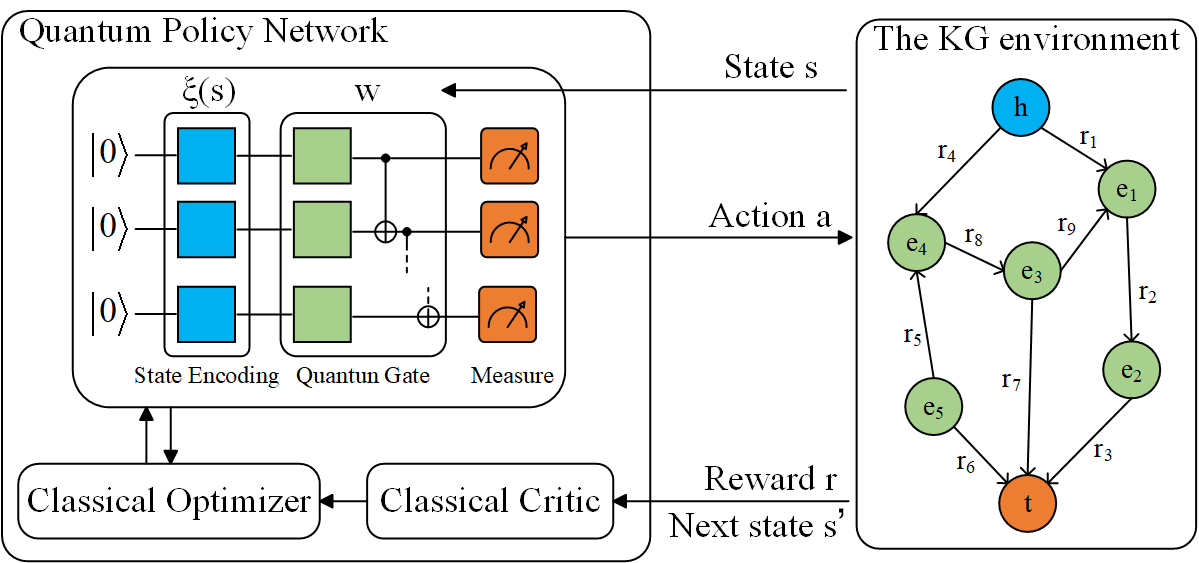
Knowledge reasoning is a critical task in information fusion systems, and its core step is reasoning missing information from existing facts to improve the knowledge graphs. Embedding-based reasoning methods and path-based reasoning methods are two mainstream knowledge reasoning methods. Embedding-based reasoning methods enable fast and direct reasoning but are limited to simple relationships between entities and exhibit poor performance in reasoning complex logical relationships. Path-based reasoning methods perform better in complex reasoning tasks, but suffer from high computational complexity, a large number of model parameters, and low reasoning efficiency. To address the aforementioned issues, this paper introduces a knowledge reasoning model called Quantum-Inspired Reinforcement Learning (QIRL). QIRL leverages quantum reinforcement learning to train a strategy network via a quantum circuit, aiming to generate and optimize reasoning paths. Quantum circuit achieves complex nonlinear operations through limited quantum reasoning paths gate operations, reducing computational complexity. In addition, this article utilizes the quantum entanglement property to encode high-dimensional data, reducing the number of model training parameters. This article evaluates the QIRL method on entity prediction task and proves that the QIRL method can effectively reduce the number of model training parameters.
Graphical Abstract
Keywords
Data Availability Statement
Funding
Conflicts of Interest
Ethical Approval and Consent to Participate
References
- Chen, Y., Li, H., Li, H., Liu, W., Wu, Y., Huang, Q., & Wan, S. (2022). An overview of knowledge graph reasoning: key technologies and applications. Journal of Sensor and Actuator Networks, 11(4), 78.
[CrossRef] [Google Scholar] - Chen, S., Yang, X., & Li, Z. (2023). Improving semantic segmentation with knowledge reasoning network. Journal of Visual Communication and Image Representation, 96, 103923.
[CrossRef] [Google Scholar] - Zhang, Y., & Yao, Q. (2022). Knowledge graph reasoning with relational digraph. Proceedings of the ACM Web Conference 2022, 912–924.
[CrossRef] [Google Scholar] - Chen, S. Y. C. (2023). Asynchronous training of quantum reinforcement learning. Procedia Computer Science, 222, 321–330.
[CrossRef] [Google Scholar] - Kim, G. S., Chung, J., & Park, S. (2024). Realizing Stabilized Landing for Computation-Limited Reusable Rockets: A Quantum Reinforcement Learning Approach. IEEE Transactions on Vehicular Technology, 73(8), 12252–12257.
[CrossRef] [Google Scholar] - Ansere, J. A., Gyamfi, E., Sharma, V., Shin, H., Dobre, O. A., & Duong, T. Q. (2024). Quantum Deep Reinforcement Learning for Dynamic Resource Allocation in Mobile Edge Computing-Based IoT Systems. IEEE Transactions on Wireless Communications, 23(6), 6221–6233.
[CrossRef] [Google Scholar] - Arute, F., Arya, K., Babbush, R., Bacon, D., Bardin, J. C., Barends, R., ... & Boixo, S. (2019). Quantum supremacy using a programmable superconducting processor. Nature, 574(7779), 505–510.
[CrossRef] [Google Scholar] - Kruse, G., Dragan, T., Wille, R., & Lorenz, J. M. (2023). Variational Quantum Circuit Design for Quantum Reinforcement Learning on Continuous Environments. International Conference on Agents and Artificial Intelligence.
[CrossRef] [Google Scholar] - Guo, T., Yang, Q., Wang, C., Liu, Y., Li, P., Tang, J., Li, D., & Wen, Y. (2024). Knowledgenavigator: Leveraging large language models for enhanced reasoning over knowledge graph. Complex & Intelligent Systems, 10(5), 7063–7076.
[CrossRef] [Google Scholar] - Chen, S. Y. C., Yang, C. H. H., Qi, J., Chen, P. Y., Ma, X., & Goan, H. S. (2020). Variational quantum circuits for deep reinforcement learning. IEEE Access, 8, 141007–141024.
[CrossRef] [Google Scholar] - Bordes, A., Usunier, N., Garcia-Duran, A., Weston, J., & Yakhnenko, O. (2013). Translating embeddings for modeling multi-relational data. Advances in Neural Information Processing Systems, 26.
[Google Scholar] - Wang, Z., Zhang, J., Feng, J., & Chen, Z. (2014). Knowledge graph embedding by translating on hyperplanes. Proceedings of the AAAI Conference on Artificial Intelligence, 28(1).
[CrossRef] [Google Scholar] - Yang, B., Yih, W. T., He, X., Gao, J., & Deng, L. (2014). Embedding Entities and Relations for Learning and Inference in Knowledge Bases. International Conference on Learning Representations.
[CrossRef] [Google Scholar] - Lu, H., Hu, H., & Lin, X. (2022). DensE: An enhanced non-commutative representation for knowledge graph embedding with adaptive semantic hierarchy. Neurocomputing, 476, 115–125.
[CrossRef] [Google Scholar] - Pavlović, A., & Sallinger, E. (2023). ExpressivE: A Spatio-Functional Embedding For Knowledge Graph Completion. The Eleventh International Conference on Learning Representations.
[CrossRef] [Google Scholar] - Dettmers, T., Minervini, P., Stenetorp, P., & Riedel, S. (2018). Convolutional 2d knowledge graph embeddings. Proceedings of the AAAI Conference on Artificial Intelligence, 32(1).
[CrossRef] [Google Scholar] - Yang, J., Jiang, X., Gao, Y., Yang, L. T., & Yang, J. (2024). Generalize to Fully Unseen Graphs: Learn Transferable Hyper-Relation Structures for Inductive Link Prediction. Proceedings of the 32nd ACM International Conference on Multimedia, 1274–1282.
[Google Scholar] - Xiong, W., Hoang, T., & Wang, W. Y. (2017). DeepPath: A Reinforcement Learning Method for Knowledge Graph Reasoning. Proceedings of the 2017 Conference on Empirical Methods in Natural Language Processing, 564–573.
[CrossRef] [Google Scholar] - Sun, Z., Deng, Z. H., Nie, J. Y., & Tang, J. (2019). RotatE: Knowledge Graph Embedding by Relational Rotation in Complex Space. International Conference on Learning Representations.
[Google Scholar] - Trouillon, T., Welbl, J., Riedel, S., Gaussier, E., & Bouchard, G. (2016). Complex embeddings for simple link prediction. International Conference on Machine Learning, 2071–2080.
[CrossRef] [Google Scholar] - Yang, F., Yang, Z., & Cohen, W. W. (2017). Differentiable learning of logical rules for knowledge base reasoning. Advances in Neural Information Processing Systems, 30.
[CrossRef] [Google Scholar] - Sadeghian, A., Armandpour, M., Ding, P., & Wang, D. Z. (2019). Drum: End-to-end differentiable rule mining on knowledge graphs. Advances in Neural Information Processing Systems, 32.
[CrossRef] [Google Scholar] - Tang, X., Zhu, S. C., Liang, Y., & Zhang, M. (2024). RulE: Knowledge Graph Reasoning with Rule Embedding. Findings of the Association for Computational Linguistics: ACL 2024, 4316–4335.
[CrossRef] [Google Scholar] - Cheng, K., Ahmed, N., & Sun, Y. (2023). Neural Compositional Rule Learning for Knowledge Graph Reasoning. The Eleventh International Conference on Learning Representations.
[Google Scholar] - Lao, N., & Cohen, W. W. (2010). Relational retrieval using a combination of path-constrained random walks. Machine Learning, 81, 53–67.
[CrossRef] [Google Scholar] - Buluta, I., & Nori, F. (2009). Quantum Simulators. Science, 326(5949), 108–111.
[CrossRef] [Google Scholar] - Zhou, Y., Stoudenmire, E. M., & Waintal, X. (2020). What Limits the Simulation of Quantum Computers? Phys. Rev. X, 10(4), 041038.
[CrossRef] [Google Scholar]
Cite This Article
TY - JOUR AU - Chen, Junliang AU - Zhang, Xianchao AU - Sun, Fengsong AU - Lu, Jun PY - 2025 DA - 2025/05/25 TI - Knowledge Graph Reasoning with Quantum-Inspired Reinforcement Learning JO - Chinese Journal of Information Fusion T2 - Chinese Journal of Information Fusion JF - Chinese Journal of Information Fusion VL - 2 IS - 2 SP - 144 EP - 156 DO - 10.62762/CJIF.2025.552445 UR - https://www.icck.org/article/abs/CJIF.2025.552445 KW - knowledge graph KW - knowledge reasoning KW - semantic information fusion KW - reinforcement learning KW - quantum circuit AB - Knowledge reasoning is a critical task in information fusion systems, and its core step is reasoning missing information from existing facts to improve the knowledge graphs. Embedding-based reasoning methods and path-based reasoning methods are two mainstream knowledge reasoning methods. Embedding-based reasoning methods enable fast and direct reasoning but are limited to simple relationships between entities and exhibit poor performance in reasoning complex logical relationships. Path-based reasoning methods perform better in complex reasoning tasks, but suffer from high computational complexity, a large number of model parameters, and low reasoning efficiency. To address the aforementioned issues, this paper introduces a knowledge reasoning model called Quantum-Inspired Reinforcement Learning (QIRL). QIRL leverages quantum reinforcement learning to train a strategy network via a quantum circuit, aiming to generate and optimize reasoning paths. Quantum circuit achieves complex nonlinear operations through limited quantum reasoning paths gate operations, reducing computational complexity. In addition, this article utilizes the quantum entanglement property to encode high-dimensional data, reducing the number of model training parameters. This article evaluates the QIRL method on entity prediction task and proves that the QIRL method can effectively reduce the number of model training parameters. SN - 2998-3371 PB - Institute of Central Computation and Knowledge LA - English ER -
@article{Chen2025Knowledge,
author = {Junliang Chen and Xianchao Zhang and Fengsong Sun and Jun Lu},
title = {Knowledge Graph Reasoning with Quantum-Inspired Reinforcement Learning},
journal = {Chinese Journal of Information Fusion},
year = {2025},
volume = {2},
number = {2},
pages = {144-156},
doi = {10.62762/CJIF.2025.552445},
url = {https://www.icck.org/article/abs/CJIF.2025.552445},
abstract = {Knowledge reasoning is a critical task in information fusion systems, and its core step is reasoning missing information from existing facts to improve the knowledge graphs. Embedding-based reasoning methods and path-based reasoning methods are two mainstream knowledge reasoning methods. Embedding-based reasoning methods enable fast and direct reasoning but are limited to simple relationships between entities and exhibit poor performance in reasoning complex logical relationships. Path-based reasoning methods perform better in complex reasoning tasks, but suffer from high computational complexity, a large number of model parameters, and low reasoning efficiency. To address the aforementioned issues, this paper introduces a knowledge reasoning model called Quantum-Inspired Reinforcement Learning (QIRL). QIRL leverages quantum reinforcement learning to train a strategy network via a quantum circuit, aiming to generate and optimize reasoning paths. Quantum circuit achieves complex nonlinear operations through limited quantum reasoning paths gate operations, reducing computational complexity. In addition, this article utilizes the quantum entanglement property to encode high-dimensional data, reducing the number of model training parameters. This article evaluates the QIRL method on entity prediction task and proves that the QIRL method can effectively reduce the number of model training parameters.},
keywords = {knowledge graph, knowledge reasoning, semantic information fusion, reinforcement learning, quantum circuit},
issn = {2998-3371},
publisher = {Institute of Central Computation and Knowledge}
}
Article Metrics
Publisher's Note
ICCK stays neutral with regard to jurisdictional claims in published maps and institutional affiliations.
Rights and Permissions
Copyright © 2025 by the Author(s). Published by Institute of Central Computation and Knowledge. This article is an open access article distributed under the terms and conditions of the Creative Commons Attribution (CC BY) license (https://creativecommons.org/licenses/by/4.0/), which permits use, sharing, adaptation, distribution and reproduction in any medium or format, as long as you give appropriate credit to the original author(s) and the source, provide a link to the Creative Commons licence, and indicate if changes were made.
Portico