
An Improved YOLOv8-Based Detection Model for Multi-Scale Sea Ice in Satellite Imagery




Article Information
Abstract
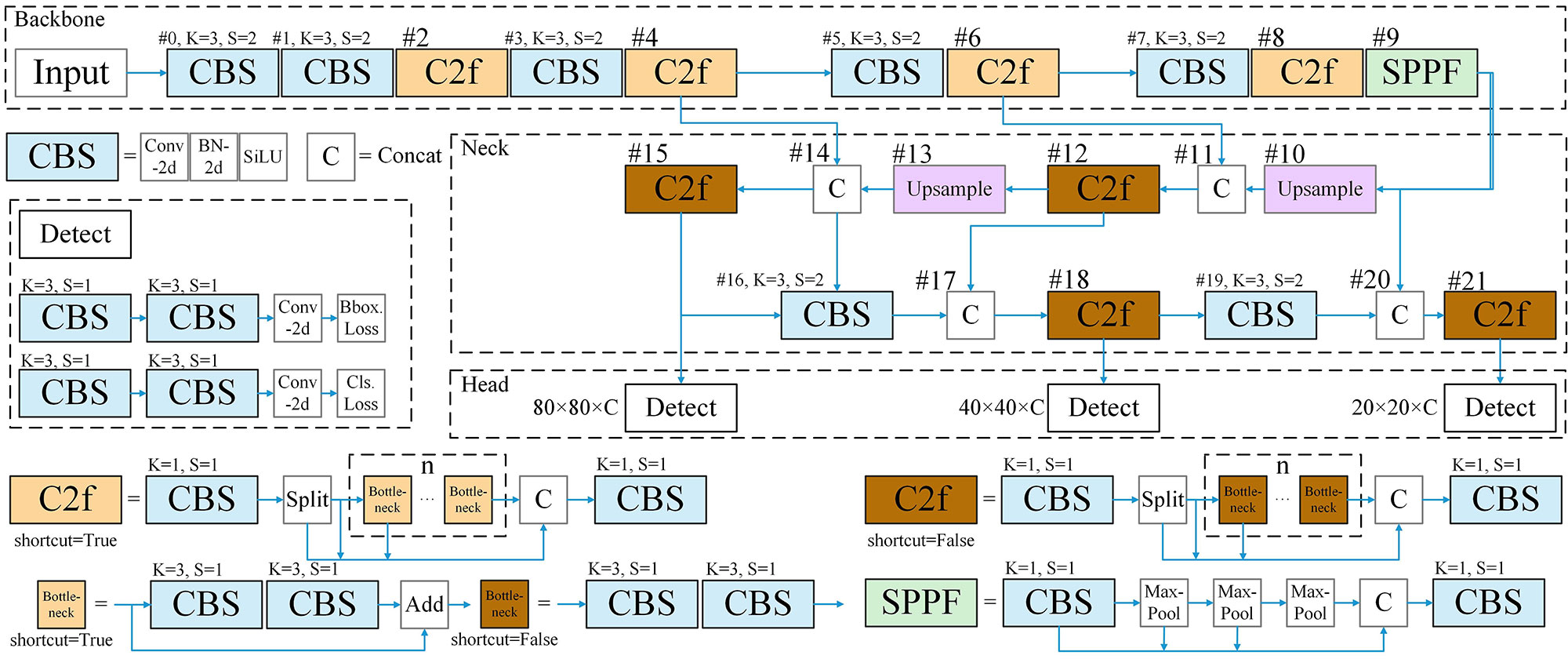
Sea ice detection is of vital importance for maritime navigation. Satellite imagery is a crucial medium for conveying information about sea ice. Currently, most sea ice detection models mainly rely on texture information to identify sea ice in satellite imagery, while ignoring sea ice size information. This research presents an improved YOLOv8-Based detection algorithm for multi-scale sea ice. First, we propose a fusion module based on the attention mechanism and use it to replace the Concat module in the YOLOv8 network structure. Second, we conduct an applicability analysis of the bounding box regression loss function in YOLOv8 and ultimately select Shape-IoU, which is more suitable for sea ice, as the loss function for bounding box regression. Third, we analyze the distribution characteristics of sea ice with different sizes in the NWPU-RESISC45 dataset. Based on these distribution characteristics, the bounding box information predicted by YOLOv8 are converted into evidence vectors for uncertainty quantification. Subsequently, information fusion is achieved by fusing these vectors with the probability of sea ice categories. Compared to YOLOv8 and other detection algorithm, our improved YOLOv8 achieves better detection accuracy on both the NWPU-RESISC45 and the Landsat-8-derived Sea Ice datasets.
Graphical Abstract
Keywords
Data Availability Statement
Funding
Conflicts of Interest
Ethical Approval and Consent to Participate
References
- Samset, B. H., Zhou, C., Fuglestvedt, J. S., Lund, M. T., Marotzke, J., & Zelinka, M. D. (2023). Steady global surface warming from 1973 to 2022 but increased warming rate after 1990. Communications Earth & Environment, 4(1), 400.
[CrossRef] [Google Scholar] - McKay, D. I. A., Staal, A., Abrams, J. F., Winkelmann, R., Sakschewski, B., Loriani, S., ... & Lenton, T. M. (2022). Exceeding 1.5°C global warming could trigger multiple climate tipping points. Science, 377(6611), eabn7950.
[CrossRef] [Google Scholar] - Screen, J. A., Deser, C., Smith, D. M., Zhang, X., Blackport, R., Kushner, P. J., ... & Sun, L. (2018). Consistency and discrepancy in the atmospheric response to Arctic sea-ice loss across climate models. Nature Geoscience, 11(3), 155-163.
[CrossRef] [Google Scholar] - Li, H., & Fedorov, A. (2021). Persistent freshening of the Arctic Ocean and changes in the North Atlantic salinity caused by Arctic sea ice decline. Climate Dynamics, 57(11), 2995-3013.
[CrossRef] [Google Scholar] - Cao, Y., Liang, S., Sun, L., Liu, J., Cheng, X., Wang, D., ... & Feng, K. (2022). Trans-Arctic shipping routes expanding faster than the model projections. Global Environmental Change, 73, 102488.
[CrossRef] [Google Scholar] - Min, C., Zhou, X., Luo, H., Yang, Y., Wang, Y., Zhang, J., & Yang, Q. (2023). Toward quantifying the increasing accessibility of the Arctic Northeast Passage in the past four decades. Advances in Atmospheric Sciences, 40(12), 2378-2390.
[CrossRef] [Google Scholar] - Kapsar, K., Gunn, G., Brigham, L., & Liu, J. (2023). Mapping vessel traffic patterns in the ice-covered waters of the Pacific Arctic. Climatic Change, 176(7), 94.
[CrossRef] [Google Scholar] - Rodriguez Alvarez, N., Holt, B., Jaruwatanadilok, S., Podest, E., & Cavanaugh, K. (2019). An Arctic sea ice multi-step classification based on GNSS-R data from the TDS-1 mission. Remote Sensing of Environment, 230, 111201.
[CrossRef] [Google Scholar] - Cai, Y., Wan, F., Hu, S., & Lang, S. (2022). Accurate prediction of ice surface and bottom boundary based on multi-scale feature fusion network. Applied Intelligence, 52(14), 16370-16381.
[CrossRef] [Google Scholar] - Qaraqe, M., Yang, Y. D., Varghese, E. B., Elzein, A., & Basaran, E. (2024). Crowd behavior detection: Leveraging video swin transformer for crowd size and violence level analysis. Applied Intelligence, 54(21), 10709-10730.
[CrossRef] [Google Scholar] - Li, X., Zhou, Y., Du, P., Lang, G., Xu, M., & Wu, W. (2021). A deep learning system that generates quantitative CT reports for diagnosing pulmonary Tuberculosis. Applied Intelligence, 51(6), 4082-4093.
[CrossRef] [Google Scholar] - Knausgård, K., Wiklund, A., Sørdalen, T., Halvorsen, K., Kleiven, A., Jiao, L., & Goodwin, M. (2022). Temperate fish detection and classification: A deep learning based approach. Applied Intelligence, 52(6), 6988-7001.
[CrossRef] [Google Scholar] - Girshick, R., Donahue, J., Darrell, T., & Malik, J. (2014). Rich feature hierarchies for accurate object detection and semantic segmentation. In 2014 IEEE Conference on Computer Vision and Pattern Recognition (pp. 580-587).
[CrossRef] [Google Scholar] - Girshick, R. (2015). Fast R-CNN. In 2015 IEEE International Conference on Computer Vision (pp. 1440-1448).
[CrossRef] [Google Scholar] - Ren, S., He, K., Girshick, R., & Sun, J. (2017). Faster R-CNN: Towards real-time object detection with region proposal networks. IEEE Transactions on Pattern Analysis and Machine Intelligence, 39(6), 1137-1149.
[CrossRef] [Google Scholar] - He, K., Gkioxari, G., Dollár, P., & Girshick, R. (2017). Mask R-CNN. In 2017 IEEE International Conference on Computer Vision (pp. 2961-2969).
[CrossRef] [Google Scholar] - Liu, W., Anguelov, D., Erhan, D., Szegedy, C., Reed, S., Fu, C. Y., & Berg, A. C. (2016). Ssd: Single shot multibox detector. In Computer Vision–ECCV 2016: 14th European Conference, Amsterdam, The Netherlands, October 11–14, 2016, Proceedings, Part I 14 (pp. 21-37). Springer International Publishing.
[CrossRef] [Google Scholar] - Redmon, J., Divvala, S., Girshick, R., & Farhadi, A. (2016). You only look once: Unified, real-time object detection. In 2016 IEEE Conference on Computer Vision and Pattern Recognition (pp. 779-788).
[CrossRef] [Google Scholar] - Redmon, J., & Farhadi, A. (2017). YOLO9000: Better, faster, stronger. In 2017 IEEE Conference on Computer Vision and Pattern Recognition (pp. 7263-7271).
[CrossRef] [Google Scholar] - Redmon, J., & Farhadi, A. (2018). YOLOv3: An incremental improvement. arXiv preprint arXiv:1804.02767.
[Google Scholar] - Bochkovskiy, A., Wang, C. Y., & Liao, H. Y. M. (2020). YOLOv4: Optimal speed and accuracy of object detection. arXiv preprint arXiv:2004.10934.
[Google Scholar] - Jocher, G., Stoken, A., Borovec, J., Changyu, L., Hogan, A., Diaconu, L., ... & Dave, P. (2020). ultralytics/yolov5: v3. 0. Zenodo. Retrieved from https://ui.adsabs.harvard.edu/link_gateway/2020zndo...3983579J/doi:10.5281/zenodo.3983579
[Google Scholar] - Li, C., Li, L., Geng, Y., Jiang, H., Cheng, M., Zhang, B., ... & Chu, X. (2023). YOLOv6 v3.0: A full-scale reloading. arXiv preprint arXiv:2301.05586.
[Google Scholar] - Wang, C. Y., Bochkovskiy, A., & Liao, H. Y. M. (2023). YOLOv7: Trainable bag-of-freebies sets new state-of-the-art for real-time object detectors. In 2023 IEEE/CVF Conference on Computer Vision and Pattern Recognition (pp. 7464-7475).
[CrossRef] [Google Scholar] - Jocher, G., Chaurasia, A., & Qiu, J. (2023). Ultralytics YOLOv8. GitHub repository. Retrieved from https://github.com/ultralytics/ultralytics
[Google Scholar] - Wang, C. Y., Yeh, I. H., & Liao, H. (2024). YOLOv9: Learning what you want to learn using programmable gradient information. arXiv preprint arXiv:2402.13616.
[Google Scholar] - Wang, A., Chen, H., Liu, L., Chen, K., Lin, Z., Han, J., & Ding, G. (2024). YOLOv10: Real-time end-to-end object detection. arXiv preprint arXiv:2405.14458.
[Google Scholar] - Li, W., Hsu, C. Y., & Tedesco, M. (2024). Advancing Arctic sea ice remote sensing with AI and deep learning: Opportunities and challenges. Remote Sensing, 16(20), 3764.
[CrossRef] [Google Scholar] - Cheng, G., Han, J., & Lu, X. (2017). Remote sensing image scene classification: Benchmark and state of the art. Proceedings of the IEEE, 105(10), 1865-1883.
[CrossRef] [Google Scholar] - Rogers, M., Fox, M., Fleming, A., Zeeland, L., Wilkinson, J., & Hosking, S. (2024). Sea ice detection using concurrent multispectral and synthetic aperture radar imagery. Remote Sensing of Environment, 305, 114073.
[CrossRef] [Google Scholar] - Sandven, S., Spreen, G., Heygster, G., Girard-Ardhuin, F., Farrell, S., Dierking, W., & Allard, R. (2023). Sea ice remote sensing—Recent developments in methods and climate data sets. Surveys in Geophysics, 44(5), 1653-1689.
[CrossRef] [Google Scholar] - Hu, Y., Hua, X., Yan, Q., Liu, W., Jiang, Z., & Wickert, J. (2024). Sea ice detection from GNSS-R data based on local linear embedding. Remote Sensing, 16(14), 2621.
[CrossRef] [Google Scholar] - Liu, L., Dong, X., Lin, W., & Lang, S. (2023). Polar sea ice detection using a rotating fan beam scatterometer. Remote Sensing, 15(20), 5063.
[CrossRef] [Google Scholar] - Jafari, Z., Bobby, P., Karami, E., & Taylor, R. (2025). Machine learning-based detection of icebergs in sea ice and open water using SAR imagery. Remote Sensing, 17(4), 702.
[CrossRef] [Google Scholar] - Xiong, Y., Wang, D., Fu, D., & Huang, H. (2023). Ice identification with error-accumulation enhanced neural dynamics in optical remote sensing images. Remote Sensing, 15(23), 5555.
[CrossRef] [Google Scholar] - Chai, Y., Ren, J., Hwang, B., Wang, J., Fan, D., Yan, Y., & Zhu, S. (2021). Texture-sensitive superpixeling and adaptive thresholding for effective segmentation of sea ice floes in high-resolution optical images. IEEE Journal of Selected Topics in Applied Earth Observations and Remote Sensing, 14, 577-586.
[CrossRef] [Google Scholar] - Qiu, Y., Li, X. M., & Guo, H. (2023). Spaceborne thermal infrared observations of Arctic sea ice leads at 30 m resolution. The Cryosphere, 17(7), 2829-2849.
[CrossRef] [Google Scholar] - Liang, S., Zeng, J. Y., Li, Z., Chen, K. S., & Zhang, P. (2020). Assessment of four passive microwave sea ice concentrations by using automatic MODIS sea ice classification. In IGARSS 2020-2020 IEEE International Geoscience and Remote Sensing Symposium (pp. 3039-3042).
[CrossRef] [Google Scholar] - Ding, S., Zeng, D., Zhou, L., Han, S., Li, F., & Wang, Q. (2023). Multi-scale polar object detection based on computer vision. Water, 15(19), 3431.
[CrossRef] [Google Scholar] - Hu, J., Shen, L., & Sun, G. (2018). Squeeze-and-excitation networks. In 2018 IEEE/CVF Conference on Computer Vision and Pattern Recognition (pp. 7132-7141).
[CrossRef] [Google Scholar] - Zhang, H., & Zhang, S. (2023). Shape-IoU: More accurate metric considering bounding box shape and scale. arXiv preprint arXiv:2312.17663.
[Google Scholar] - Guo, Q., Pan, X. & Tang, T. (2023). DSmT-DS Multi-Source Uncertainty Reasoning Methodology. Multi-source Uncertain Information Reasoning Technology, (pp. 59-60).
[Google Scholar] - Bahdanau, D., Cho, K., & Bengio, Y. (2014). Neural machine translation by jointly learning to align and translate. arXiv preprint arXiv:1409.0473.
[Google Scholar] - Jaderberg, M., Simonyan, K., Zisserman, A., & Kavukcuoglu, K. (2015). Spatial transformer networks. arXiv preprint arXiv:1506.02025.
[Google Scholar] - Woo, S., Park, J., Lee, J. Y., & Kweon, I. S. (2018). CBAM: Convolutional block attention module. In Proceedings of the European Conference on Computer Vision (pp. 3-19).
[CrossRef] [Google Scholar] - Wang, C. Y., Liao, H. Y. M., Wu, Y. H., Chen, P. Y., Hsieh, J. W., & Yeh, I. H. (2020). CSPNet: A new backbone that can enhance learning capability of CNN. In 2020 IEEE/CVF Conference on Computer Vision and Pattern Recognition Workshops (pp. 1571-1580).
[CrossRef] [Google Scholar] - Zhang, X., Zeng, H., Guo, S., & Zhang, L. (2022). Efficient long-range attention network for image super-resolution. In European Conference on Computer Vision (pp. 649-667).
[CrossRef] [Google Scholar] - Yu, J., Jiang, Y., Wang, Z., Cao, Z., & Huang, T. S. (2016). UnitBox: An advanced object detection network. In Proceedings of the 24th ACM International Conference on Multimedia (pp. 516-520).
[CrossRef] [Google Scholar] - Rezatofighi, H., Tsoi, N., Gwak, J. Y., Sadeghian, A., Reid, I., & Savarese, S. (2019). Generalized intersection over union: A metric and a loss for bounding box regression. In 2019 IEEE/CVF Conference on Computer Vision and Pattern Recognition (pp. 658-666).
[CrossRef] [Google Scholar] - Zheng, Z., Wang, P., Liu, W., Li, J., Ye, R., & Ren, D. (2020). Distance-IoU loss: Faster and better learning for bounding box regression. Proceedings of the AAAI Conference on Artificial Intelligence, 34(07), 12993-13000.
[CrossRef] [Google Scholar] - Zhang, Y. F., Ren, W., Zhang, Z., Jia, Z., Wang, L., & Tan, T. (2022). Focal and efficient IOU loss for accurate bounding box regression. Neurocomputing, 506, 146-157.
[CrossRef] [Google Scholar] - Gevorgyan, Z. (2022). SIoU loss: More powerful learning for bounding box regression. arXiv preprint arXiv:2205.12740.
[Google Scholar] - Tong, Z., Chen, Y., Xu, Z., & Yu, R. (2023). Wise-IoU: Bounding box regression loss with dynamic focusing mechanism. arXiv preprint arXiv:2301.10051.
[Google Scholar] - Zhang, H., Xu, C., & Zhang, S. (2023). Inner-IoU: More effective intersection over union loss with auxiliary bounding box. arXiv preprint arXiv:2311.02877.
[Google Scholar] - Tzutalin. (2021). LabelImg. PyPI. Retrieved from https://pypi.org/project/labelImg/
[Google Scholar]
Cited By (3)
-
Yang Zhao, Zhendong Cui, Yihan Xu, Chengming Song, Qianqian Yu. Enhancing small target detection for marine ships using an MS-YOLOv10s-based efficient recognition method.
Ships and Offshore Structures, 2026 .
[CrossRef] -
Shangwu Shen, Yue Yuan. Forecasting the development trend of the green finance market based on long short-term memory and transformer models.
Scientific Reports, 2026 , 16 (1).
[CrossRef] -
Qian Yan, Mengqi Yin, Yongchao Hou, Chunxiao Mu, Tianyu Wang, Haokun Chi. Oil Spill Detection and Identification on Coastal Sandy Beaches: Application of Field Spectroscopy and CMOS Sensor Imagery.
Remote Sensing, 2025 , 17 (23).
[CrossRef]
Cite This Article
TY  - JOUR
AU  - Liu, Yang
AU  - Guo, Qiang
AU  - Dong, Chengguo
AU  - Luo, Yiping
PY  - 2025
DA  - 2025/03/29
TI  - An Improved YOLOv8-Based Detection Model for Multi-Scale Sea Ice in Satellite Imagery
JO  - Chinese Journal of Information Fusion
T2  - Chinese Journal of Information Fusion
JF  - Chinese Journal of Information Fusion
VL  - 2
IS  - 1
SP  - 79
EP  - 99
DO  - 10.62762/CJIF.2025.695812
UR  - https://www.icck.org/article/abs/cjif.2025.695812
KW  - satellite imagery
KW  - YOLO
KW  - attention mechanism
KW  - loss function
KW  - information fusion
KW  - evidential reasoning
AB  - Sea ice detection is of vital importance for maritime navigation. Satellite imagery is a crucial medium for conveying information about sea ice. Currently, most sea ice detection models mainly rely on texture information to identify sea ice in satellite imagery, while ignoring sea ice size information. This research presents an improved YOLOv8-Based detection algorithm for multi-scale sea ice. First, we propose a fusion module based on the attention mechanism and use it to replace the Concat module in the YOLOv8 network structure. Second, we conduct an applicability analysis of the bounding box regression loss function in YOLOv8 and ultimately select Shape-IoU, which is more suitable for sea ice, as the loss function for bounding box regression. Third, we analyze the distribution characteristics of sea ice with different sizes in the NWPU-RESISC45 dataset. Based on these distribution characteristics, the bounding box information predicted by YOLOv8 are converted into evidence vectors for uncertainty quantification. Subsequently, information fusion is achieved by fusing these vectors with the probability of sea ice categories. Compared to YOLOv8 and other detection algorithm, our improved YOLOv8 achieves better detection accuracy on both the NWPU-RESISC45 and the Landsat-8-derived Sea Ice datasets.
SN  - 2998-3371
PB  - Institute of Central Computation and Knowledge
LA  - English
ER  -
@article{Liu2025An,
  author = {Yang Liu and Qiang Guo and Chengguo Dong and Yiping Luo},
  title = {An Improved YOLOv8-Based Detection Model for Multi-Scale Sea Ice in Satellite Imagery},
  journal = {Chinese Journal of Information Fusion},
  year = {2025},
  volume = {2},
  number = {1},
  pages = {79-99},
  doi = {10.62762/CJIF.2025.695812},
  url = {https://www.icck.org/article/abs/cjif.2025.695812},
  abstract = {Sea ice detection is of vital importance for maritime navigation. Satellite imagery is a crucial medium for conveying information about sea ice. Currently, most sea ice detection models mainly rely on texture information to identify sea ice in satellite imagery, while ignoring sea ice size information. This research presents an improved YOLOv8-Based detection algorithm for multi-scale sea ice. First, we propose a fusion module based on the attention mechanism and use it to replace the Concat module in the YOLOv8 network structure. Second, we conduct an applicability analysis of the bounding box regression loss function in YOLOv8 and ultimately select Shape-IoU, which is more suitable for sea ice, as the loss function for bounding box regression. Third, we analyze the distribution characteristics of sea ice with different sizes in the NWPU-RESISC45 dataset. Based on these distribution characteristics, the bounding box information predicted by YOLOv8 are converted into evidence vectors for uncertainty quantification. Subsequently, information fusion is achieved by fusing these vectors with the probability of sea ice categories. Compared to YOLOv8 and other detection algorithm, our improved YOLOv8 achieves better detection accuracy on both the NWPU-RESISC45 and the Landsat-8-derived Sea Ice datasets.},
  keywords = {satellite imagery, YOLO, attention mechanism, loss function, information fusion, evidential reasoning},
  issn = {2998-3371},
  publisher = {Institute of Central Computation and Knowledge}
}
Publisher's Note
ICCK stays neutral with regard to jurisdictional claims in published maps and institutional affiliations.
Rights and Permissions
 Copyright © 2025 by the Author(s). Published by Institute of Central Computation and Knowledge. This article is an open access article distributed under the terms and conditions of the Creative Commons Attribution (CC BY) license (https://creativecommons.org/licenses/by/4.0/), which permits use, sharing, adaptation, distribution and reproduction in any medium or format, as long as you give appropriate credit to the original author(s) and the source, provide a link to the Creative Commons licence, and indicate if changes were made.


Portico

