Volume 3, Issue 1, Chinese Journal of Information Fusion
Volume 3, Issue 1, 2026
Submit Manuscript Edit a Special Issue
Academic Editor
Jiayi Ma
Jiayi Ma
Wuhan University, China
Article QR Code
Article QR Code
Scan the QR code for reading
Popular articles
Chinese Journal of Information Fusion, Volume 3, Issue 1, 2026: 46-61

Open Access | Research Article | 06 March 2026
Sequential Information Fusion for Resilient Estimation: Dynamic Observation Scheduling against Intermittent DoS Attacks
1 Key Laboratory of Smart Manufacturing in Energy Chemical Process, Ministry of Education, Shanghai 200237, China
2 Department of Automation, School of Information Science and Engineering, East China University of Science and Technology, Shanghai 200237, China
* Corresponding Author: Chao Yang, [email protected]
ARK: ark:/57805/cjif.2025.922221
Received: 06 November 2025, Accepted: 09 January 2026, Published: 06 March 2026  
Abstract
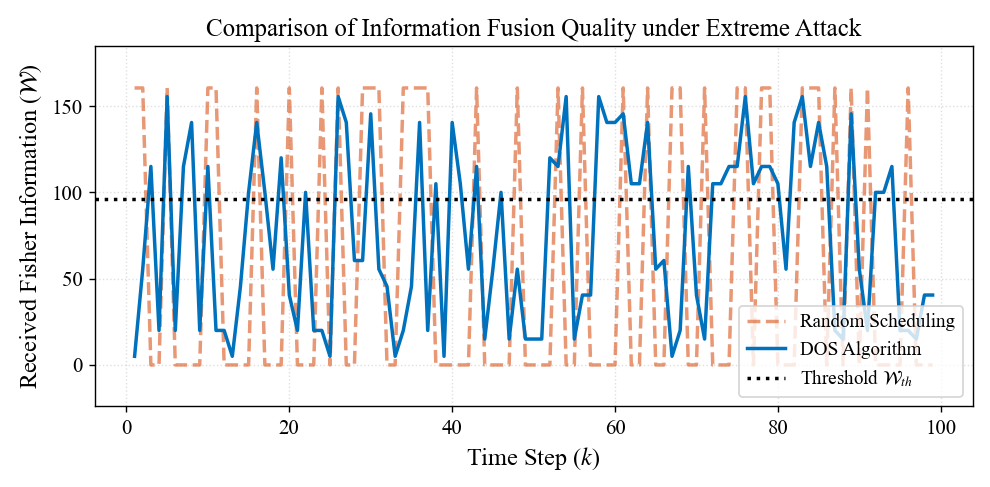
In this paper, we consider the state estimation problem in a cyber-physical system (CPS) against intermittent denial-of-service (DoS) attacks, which are usually difficult to defend due to their concealment and unpredictability. To address this issue, this paper proposes a dynamic observation scheduling method based on Fisher information to achieve efficient and resilient state estimation. Specifically, a sliding window mechanism is first employed to predict the successful transmission probability for each time window. Subsequently, the method constructs a scheduling sequence by aligning these predicted probabilities with the Fisher information of the observation's components. This strategy effectively achieves the co-optimization of message quality and transmission risk. Theoretical analysis shows that the scheduling method can be viewed as a risk-avoidance weighted maximization problem, which can achieve single-step optimality through same-direction matching. Simulations compare the proposed approach with fixed-order and random scheduling strategies. The results show that the proposed algorithm significantly improves the estimation accuracy under standard attacks and maintains effective estimation even under extreme attacks.

Graphical Abstract
Sequential Information Fusion for Resilient Estimation: Dynamic Observation Scheduling against Intermittent DoS Attacks

Keywords
dynamic observation scheduling
fisher information
information fusion
intermittent DoS attacks

Data Availability Statement
Data will be made available on request.

Funding
This work was supported by the National Natural Science Foundation of China under Grant 62336005.

Conflicts of Interest
The authors declare no conflicts of interest.

AI Use Statement
The authors declare that generative AI tools were used in the preparation of this manuscript. Specifically, ChatGPT-5 and Deepseek-R1 were employed to polish the English writing of several paragraphs. The authors reviewed and edited the content as needed and take full responsibility for the final content of the publication.

Ethical Approval and Consent to Participate
Not applicable.

References
  1. Liu, B., Feng, Q., Zhong, L., & Chen, Y. (2025). Physical-information-functional architecture for Internet of Things. IEEE Internet of Things Journal, 12(20), 42456–42483.
    [CrossRef]   [Google Scholar]
  2. Hu, Y., Jia, Q., Yao, Y., Lee, Y., Lee, M., Wang, C., ... & Yu, F. R. (2024). Industrial internet of things intelligence empowering smart manufacturing: A literature review. IEEE Internet of Things Journal, 11(11), 19143-19167.
    [CrossRef]   [Google Scholar]
  3. Packianathan, R., Arumugam, G., Malaiarasan, A., & Natarajan, S. K. (2025). Integrating industrial robotics and internet of things (IoT) in smart transportation system. In Driving Green Transportation System Through Artificial Intelligence and Automation: Approaches, Technologies and Applications (pp. 379-395). Cham: Springer Nature Switzerland.
    [CrossRef]   [Google Scholar]
  4. Sobhiyeh, S., & Naraghi-Pour, M. (2017). Estimation and detection based on correlated observations from a heterogeneous sensor network. In 2017 IEEE International Conference on Communications (ICC) (pp. 1–6). IEEE.
    [CrossRef]   [Google Scholar]
  5. Jung, R., & Weiss, S. (2021). Modular multi-sensor fusion: A collaborative state estimation perspective. IEEE Robotics and Automation Letters, 6(4), 6891-6898.
    [CrossRef]   [Google Scholar]
  6. Trimpe, S., & D’Andrea, R. (2014). Event-based state estimation with variance-based triggering. IEEE Transactions on Automatic Control, 59(12), 3266–3281.
    [CrossRef]   [Google Scholar]
  7. Hespanha, J. P., Naghshtabrizi, P., & Xu, Y. (2007). A survey of recent results in networked control systems. Proceedings of the IEEE, 95(1), 138-162.
    [CrossRef]   [Google Scholar]
  8. Xu, D., Liu, L., Zhang, N., Dong, M., Leung, V. C. M., & Ritcey, J. A. (2023). Nested hash access with post quantum encryption for mission-critical IoT communications. IEEE Internet of Things Journal, 10(14), 12204–12218.
    [CrossRef]   [Google Scholar]
  9. Bai, X., Yan, W., & Ge, S. S. (2021). Distributed task assignment for multiple robots under limited communication range. IEEE Transactions on Systems, Man, and Cybernetics: Systems, 52(7), 4259–4271.
    [CrossRef]   [Google Scholar]
  10. Yang, C., Yang, W., & Shi, H. (2022). Privacy preservation by local design in cooperative networked control systems. arXiv preprint arXiv:2207.03904.
    [Google Scholar]
  11. Gao, X., Zhang, D., Bao, W., Zhu, X., & Yan, H. (2020, July). Energy-efficient Cooperative Storage Scheduling for Mobile Edge Cloud under Unstable Communication Conditions. In 2020 IEEE 10th International Conference on Electronics Information and Emergency Communication (ICEIEC) (pp. 39–42). IEEE.
    [CrossRef]   [Google Scholar]
  12. Jin, M., Lavaei, J., & Johansson, K. H. (2018). Power grid AC-based state estimation: Vulnerability analysis against cyber attacks. IEEE Transactions on Automatic Control, 64(5), 1784-1799.
    [CrossRef]   [Google Scholar]
  13. Taha, A. F., Qi, J., Wang, J., & Panchal, J. H. (2016). Risk mitigation for dynamic state estimation against cyber attacks and unknown inputs. IEEE Transactions on Smart Grid, 9(2), 886-899.
    [CrossRef]   [Google Scholar]
  14. Sharafian, A., Naeem, H. Y., Ullah, I., Ali, A., Qiu, L., & Bai, X. (2025). Resilience to deception attacks in consensus tracking control of incommensurate fractional-order power systems via adaptive RBF neural network. Expert Systems with Applications, 270, 127763.
    [CrossRef]   [Google Scholar]
  15. Qiu, L., Shao, Z., Dong, L., & Bai, X. (2025). Dual-mode model predictive control for constrained networked control system with DoS attacks and disturbances. IEEE Transactions on Automation Science and Engineering. Advance online publication.
    [CrossRef]   [Google Scholar]
  16. Zhao, N., Shi, P., Xing, W., & Chambers, J. (2020). Observer-based event-triggered approach for stochastic networked control systems under denial of service attacks. IEEE Transactions on Control of Network Systems, 8(1), 158-167.
    [CrossRef]   [Google Scholar]
  17. Yuan, H., Xia, Y., & Yang, H. (2020). Resilient state estimation of cyber-physical system with multichannel transmission under DoS attack. IEEE Transactions on Systems, Man, and Cybernetics: Systems, 51(11), 6926-6937.
    [CrossRef]   [Google Scholar]
  18. Zhang, Z., Xue, L., Liu, J., & Wu, Y. (2023, August). Aperiodically Intermittent Control for Fixed-Time Stability Under Denial-of-Service Attack. In 2023 38th Youth Academic Annual Conference of Chinese Association of Automation (YAC) (pp. 832-837). IEEE.
    [CrossRef]   [Google Scholar]
  19. An, L., & Yang, G. H. (2018). Decentralized adaptive fuzzy secure control for nonlinear uncertain interconnected systems against intermittent DoS attacks. IEEE Transactions on Cybernetics, 49(3), 827–838.
    [CrossRef]   [Google Scholar]
  20. Lu, W., Yin, X., Fu, Y., & Gao, Z. (2020). Observer-based event-triggered predictive control for networked control systems under DoS attacks. Sensors, 20(23), 6866.
    [CrossRef]   [Google Scholar]
  21. Wang, Y., Yan, H., Park, J. H., Zhang, H., & Shen, H. (2025). Resilient control of networked control systems with hidden DoS attacks and unknown observation probability. IEEE Transactions on Control of Network Systems.
    [CrossRef]   [Google Scholar]
  22. Wakaiki, M., Cetinkaya, A., & Ishii, H. (2019). Stabilization of networked control systems under DoS attacks and output quantization. IEEE Transactions on Automatic Control, 65(8), 3560–3575.
    [CrossRef]   [Google Scholar]
  23. Farokhi, F., Shames, I., & Batterham, N. (2016). Secure and private cloud-based control using semi-homomorphic encryption. IFAC-PapersOnLine, 49(22), 163–168.
    [CrossRef]   [Google Scholar]
  24. Lin, Y., Farokhi, F., Shames, I., & Nešić, D. (2018, December). Secure control of nonlinear systems using semi-homomorphic encryption. In 2018 IEEE Conference on Decision and Control (CDC) (pp. 5002–5007). IEEE.
    [CrossRef]   [Google Scholar]
  25. Pan, J., Sui, T., Liu, W., Wang, J., Kong, L., Zhao, Y., & Wei, Z. (2023). Secure control of linear controllers using fully homomorphic encryption. Applied Sciences, 13(24), 13071.
    [CrossRef]   [Google Scholar]
  26. Lesjak, C., Hein, D., Hofmann, M., Maritsch, M., Aldrian, A., Priller, P., … & Pregartner, G. (2015, July). Securing smart maintenance services: Hardware-security and TLS for MQTT. In 2015 IEEE 13th International Conference on Industrial Informatics (INDIN) (pp. 1243–1250). IEEE.
    [CrossRef]   [Google Scholar]
  27. Wang, D., Zhang, L., Zhao, N., Liu, Y., & Song, G. (2023, July). Resilient Event-Triggered Control of Networked Markov Jump Systems Under Denial-of-Service Attacks. In 2023 42nd Chinese Control Conference (CCC) (pp. 1131–1136). IEEE.
    [CrossRef]   [Google Scholar]
  28. Dolk, V. S., Tesi, P., De Persis, C., & Heemels, W. P. M. H. (2016). Event-triggered control systems under denial-of-service attacks. IEEE Transactions on Control of Network Systems, 4(1), 93–105.
    [CrossRef]   [Google Scholar]
  29. Zhao, N., Shi, P., Xing, W., & Lim, C. P. (2021). Event-triggered control for networked systems under denial of service attacks and applications. IEEE Transactions on Circuits and Systems I: Regular Papers, 69(2), 811–820.
    [CrossRef]   [Google Scholar]
  30. Xu, Y., Mu, X., & Cheng, G. (2023). Event-triggered $H_{\infty$ control for switched systems under multiple attacks. International Journal of Control, Automation and Systems, 21(4), 1089–1097.
    [CrossRef]   [Google Scholar]
  31. Wang, X., Park, J. H., Liu, H., & Zhang, X. (2020). Cooperative output-feedback secure control of distributed linear cyber-physical systems resist intermittent DoS attacks. IEEE Transactions on Cybernetics, 51(10), 4924–4933.
    [CrossRef]   [Google Scholar]
  32. Freschi, V., & Lattanzi, E. (2019). A study on the impact of packet length on communication in low power wireless sensor networks under interference. IEEE Internet of Things Journal, 6(2), 3820-3830.
    [CrossRef]   [Google Scholar]
  33. Rios, V. D. M., Inácio, P. R. M., Magoni, D., & Freire, M. M. (2022). Detection and mitigation of low-rate denial-of-service attacks: A survey. IEEE Access, 10, 76648–76668.
    [CrossRef]   [Google Scholar]
  34. Cetinkaya, A., Ishii, H., & Hayakawa, T. (2017). Networked control under random and malicious packet losses. IEEE Transactions on Automatic Control, 62(5), 2434–2449.
    [CrossRef]   [Google Scholar]
  35. Krejčí, J., Babiuch, M., Suder, J., Krys, V., & Bobovský, Z. (2025). Latency-sensitive wireless communication in dynamically moving robots for urban mobility applications. Smart Cities, 8(4), 105.
    [CrossRef]   [Google Scholar]
  36. Lei, M., Baehr, C., & Del Moral, P. (2010, June). Fisher information matrix-based nonlinear system conversion for state estimation. In IEEE ICCA 2010 (pp. 837–841). IEEE.
    [CrossRef]   [Google Scholar]
  37. Ruiz-Gonzalez, M., & Furenlid, L. R. (2015, October). Fisher information analysis of digital pulse timing. In 2015 IEEE Nuclear Science Symposium and Medical Imaging Conference (NSS/MIC) (pp. 1–3). IEEE.
    [CrossRef]   [Google Scholar]
  38. Huang, J., Gu, K., Wang, Y., Zhang, T., Liang, J., & Luo, S. (2020). Connectivity-based localization in ultra-dense networks: CRLB, theoretical variance, and MLE. IEEE Access, 8, 35136–35149.
    [CrossRef]   [Google Scholar]

Cite This Article
APA Style
Lu, J., Lin, W., & Yang, C. (2026). Sequential Information Fusion for Resilient Estimation: Dynamic Observation Scheduling against Intermittent DoS Attacks. Chinese Journal of Information Fusion, 3(1), 46–61. https://doi.org/10.62762/CJIF.2025.922221
Export Citation
RIS Format
Compatible with EndNote, Zotero, Mendeley, and other reference managers
RIS format data for reference managers
TY  - JOUR
AU  - Lu, Jie
AU  - Lin, Wenhao
AU  - Yang, Chao
PY  - 2026
DA  - 2026/03/06
TI  - Sequential Information Fusion for Resilient Estimation: Dynamic Observation Scheduling against Intermittent DoS Attacks
JO  - Chinese Journal of Information Fusion
T2  - Chinese Journal of Information Fusion
JF  - Chinese Journal of Information Fusion
VL  - 3
IS  - 1
SP  - 46
EP  - 61
DO  - 10.62762/CJIF.2025.922221
UR  - https://www.icck.org/article/abs/CJIF.2025.922221
KW  - dynamic observation scheduling
KW  - fisher information
KW  - information fusion
KW  - intermittent DoS attacks
AB  - In this paper, we consider the state estimation problem in a cyber-physical system (CPS) against intermittent denial-of-service (DoS) attacks, which are usually difficult to defend due to their concealment and unpredictability. To address this issue, this paper proposes a dynamic observation scheduling method based on Fisher information to achieve efficient and resilient state estimation. Specifically, a sliding window mechanism is first employed to predict the successful transmission probability for each time window. Subsequently, the method constructs a scheduling sequence by aligning these predicted probabilities with the Fisher information of the observation's components. This strategy effectively achieves the co-optimization of message quality and transmission risk. Theoretical analysis shows that the scheduling method can be viewed as a risk-avoidance weighted maximization problem, which can achieve single-step optimality through same-direction matching. Simulations compare the proposed approach with fixed-order and random scheduling strategies. The results show that the proposed algorithm significantly improves the estimation accuracy under standard attacks and maintains effective estimation even under extreme attacks.
SN  - 2998-3371
PB  - Institute of Central Computation and Knowledge
LA  - English
ER  - 
BibTeX Format
Compatible with LaTeX, BibTeX, and other reference managers
BibTeX format data for LaTeX and reference managers
@article{Lu2026Sequential,
  author = {Jie Lu and Wenhao Lin and Chao Yang},
  title = {Sequential Information Fusion for Resilient Estimation: Dynamic Observation Scheduling against Intermittent DoS Attacks},
  journal = {Chinese Journal of Information Fusion},
  year = {2026},
  volume = {3},
  number = {1},
  pages = {46-61},
  doi = {10.62762/CJIF.2025.922221},
  url = {https://www.icck.org/article/abs/CJIF.2025.922221},
  abstract = {In this paper, we consider the state estimation problem in a cyber-physical system (CPS) against intermittent denial-of-service (DoS) attacks, which are usually difficult to defend due to their concealment and unpredictability. To address this issue, this paper proposes a dynamic observation scheduling method based on Fisher information to achieve efficient and resilient state estimation. Specifically, a sliding window mechanism is first employed to predict the successful transmission probability for each time window. Subsequently, the method constructs a scheduling sequence by aligning these predicted probabilities with the Fisher information of the observation's components. This strategy effectively achieves the co-optimization of message quality and transmission risk. Theoretical analysis shows that the scheduling method can be viewed as a risk-avoidance weighted maximization problem, which can achieve single-step optimality through same-direction matching. Simulations compare the proposed approach with fixed-order and random scheduling strategies. The results show that the proposed algorithm significantly improves the estimation accuracy under standard attacks and maintains effective estimation even under extreme attacks.},
  keywords = {dynamic observation scheduling, fisher information, information fusion, intermittent DoS attacks},
  issn = {2998-3371},
  publisher = {Institute of Central Computation and Knowledge}
}

Article Metrics
Citations:

Crossref

0

Scopus

0

Web of Science

0
Article Access Statistics:
Views: 45
PDF Downloads: 8

Publisher's Note
ICCK stays neutral with regard to jurisdictional claims in published maps and institutional affiliations.

Rights and Permissions
CC BY Copyright © 2026 by the Author(s). Published by Institute of Central Computation and Knowledge. This article is an open access article distributed under the terms and conditions of the Creative Commons Attribution (CC BY) license (https://creativecommons.org/licenses/by/4.0/), which permits use, sharing, adaptation, distribution and reproduction in any medium or format, as long as you give appropriate credit to the original author(s) and the source, provide a link to the Creative Commons licence, and indicate if changes were made.
Chinese Journal of Information Fusion

Chinese Journal of Information Fusion

ISSN: 2998-3371 (Online) | ISSN: 2998-3363 (Print)

Email: [email protected]

Portico

Portico

All published articles are preserved here permanently:
https://www.portico.org/publishers/icck/