


Construction and Application Performance of a Smart Farm Technology System for Plateau Cold-Season Vegetables: A Case Study in Huangzhong District, Qinghai Province, China


Article Information
Abstract
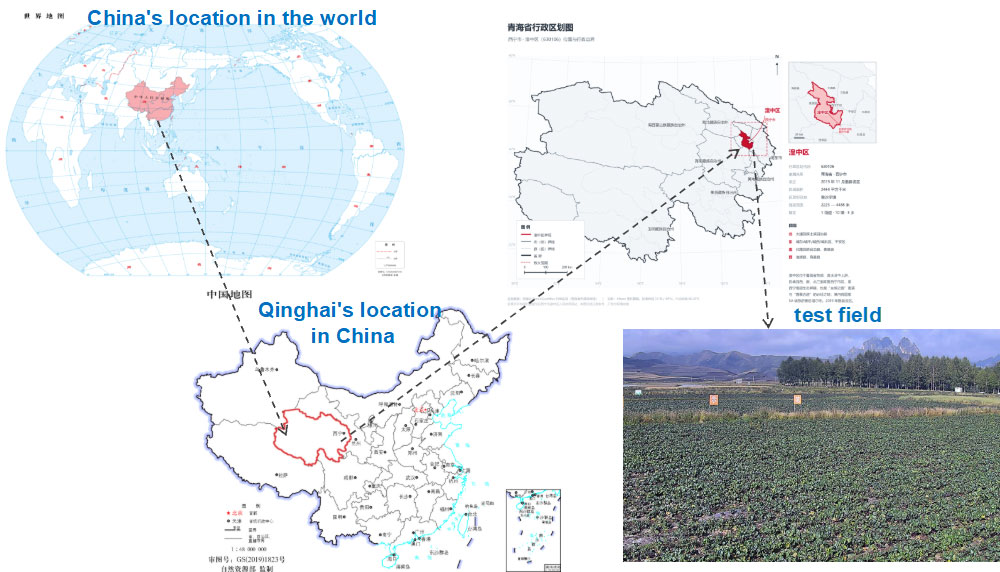
Open-field vegetable production in the cold plateau regions of Northwest China faces labor shortages, extensive management, meteorological risks, and inefficient use of agricultural inputs. Taking a 6.67 ha smart farm in Huangzhong District, Xining, Qinghai Province, China, as a case study, this study developed a four-tier smart agriculture system comprising perception, transmission, platform, and application layers. The system integrates agricultural Internet of Things (IoT) monitoring, BeiDou Navigation Satellite System (BDS)-based intelligent machinery, precision water and fertilizer management, and a big-data decision-making platform, all adapted to plateau conditions. Field trials and operational data from a complete production season showed that the system increased labor productivity and output per unit area by 18.2% and 11.7%, respectively, while reducing labor cost per unit area by 16.3%. The irrigation water use coefficient reached 0.82, pesticide use efficiency increased to 43.5%, and annual net income increased by 18\,000 CNY ha$^{-1}$. These results demonstrate that the locally adapted system improves production efficiency, resource utilization, and economic performance, providing a practical framework for smart agriculture in Northwest China and other high-altitude cold regions.
Graphical Abstract
Keywords
Data Availability Statement
Funding
Conflicts of Interest
AI Use Statement
Ethical Approval and Consent to Participate
References
- Ministry of Agriculture and Rural Affairs of the People's Republic of China. (2022). The 14th Five-Year Plan for National Agricultural and Rural Informatization Development (Document No. Nong Shi Fa [2022] 4) [In Chinese]. https://www.moa.gov.cn/govpublic/SCYJJXXS/202203/t20220309_6391175.htm
[Google Scholar] - Zhao, C. (2021). Current situations and prospects of smart agriculture (in Chinese). Journal of South China Agricultural University, 42(6), 1-7.
[CrossRef] [Google Scholar] - Pivoto, D., Waquil, P. D., Talamini, E., Finocchio, C. P. S., Dalla Corte, V. F., & de Vargas Mores, G. (2018). Scientific development of smart farming technologies and their application in Brazil. Information processing in agriculture, 5(1), 21-32.
[CrossRef] [Google Scholar] - Ji, L., You, L., See, L., Fritz, S., Li, C., Zhang, S., & Li, G. (2018). Spatial and temporal changes of vegetable production in China. Journal of Land Use Science, 13(5), 494-507.
[CrossRef] [Google Scholar] - Wang, H., He, J., Aziz, N., & Wang, Y. (2022). Spatial distribution and driving forces of the vegetable industry in China. Land, 11(7), 981.
[CrossRef] [Google Scholar] - Wang, X., Yamauchi, F., & Huang, J. (2016). Rising wages, mechanization, and the substitution between capital and labor: Evidence from small scale farm system in China. Agricultural economics, 47(3), 309-317.
[CrossRef] [Google Scholar] - Ju, X. T., Xing, G. X., Chen, X. P., Zhang, S. L., Zhang, L. J., Liu, X. J., ... & Zhang, F. S. (2009). Reducing environmental risk by improving N management in intensive Chinese agricultural systems. Proceedings of the National Academy of Sciences, 106(9), 3041-3046.
[CrossRef] [Google Scholar] - Lesk, C., Rowhani, P., & Ramankutty, N. (2016). Influence of extreme weather disasters on global crop production. Nature, 529(7584), 84-87.
[CrossRef] [Google Scholar] - Gebbers, R., & Adamchuk, V. I. (2010). Precision agriculture and food security. Science, 327(5967), 828-831.
[CrossRef] [Google Scholar] - Wolfert, S., Ge, L., Verdouw, C., & Bogaardt, M. J. (2017). Big data in smart farming -- A review. Agricultural Systems, 153, 69-80.
[CrossRef] [Google Scholar] - Kamilaris, A., Kartakoullis, A., & Prenafeta-Bold{\'u, F. X. (2017). A review on the practice of big data analysis in agriculture. Computers and Electronics in Agriculture, 143, 23-37.
[CrossRef] [Google Scholar] - Li, D. (2020). System analysis and development prospect of unmanned farming. Transactions of the Chinese Society of Agricultural Machinery, 51(7). https://nyjxxb.net/index.php/journal/article/view/1011
[Google Scholar] - Yin, Y., Meng, Z., Zhao, C., Wang, H., Wen, C., Chen, J., ... & Wu, G. (2022). State-of-the-art and prospect of research on key technical for unmanned farms of field crop. Smart Agriculture, 4(4), 1-25.
[CrossRef] [Google Scholar] - Liu, L., Zhang, H., Zhang, Z., Zhang, Z., Wang, J., Li, X., ... & Liu, P. (2025). Key technologies and construction model for unmanned smart farms: Taking the ``1.5-ton grain per mu'' unmanned farm as an example. Smart Agriculture, 7(1), 70-84.
[CrossRef] [Google Scholar] - Villa-Henriksen, A., Edwards, G. T. C., Pesonen, L. A., Green, O., & S{\orensen, C. A. G. (2020). Internet of Things in arable farming: Implementation, applications, challenges and potential. Biosystems Engineering, 191, 60-84.
[CrossRef] [Google Scholar] - Ayaz, M., Ammad-Uddin, M., Sharif, Z., Mansour, A., & Aggoune, E. H. M. (2019). Internet-of-Things (IoT)-based smart agriculture: Toward making the fields talk. IEEE Access, 7, 129551-129583.
[CrossRef] [Google Scholar] - Tang, Y., Dananjayan, S., Hou, C., Guo, Q., Luo, S., & He, Y. (2021). A survey on the 5G network and its impact on agriculture: Challenges and opportunities. Computers and Electronics in Agriculture, 180, 105895.
[CrossRef] [Google Scholar] - Luo, X., Liao, J., Zang, Y., Ou, Y., & Wang, P. (2022). Developing from mechanized to smart agricultural production in China. Strategic Study of Chinese Academy of Engineering, 24(1), 46.
[CrossRef] [Google Scholar] - Robinson, D. A., Campbell, C. S., Hopmans, J. W., Hornbuckle, B. K., Jones, S. B., Knight, R., ... & Wendroth, O. (2008). Soil moisture measurement for ecological and hydrological watershed‐scale observatories: A review. Vadose zone journal, 7(1), 358-389.
[CrossRef] [Google Scholar] - Liu, J., & Wang, X. (2021). Plant diseases and pests detection based on deep learning: A review. Plant Methods, 17, 22.
[CrossRef] [Google Scholar] - Preti, M., Verheggen, F., & Angeli, S. (2021). Insect pest monitoring with camera-equipped traps: Strengths and limitations. Journal of Pest Science, 94(2), 203-217.
[CrossRef] [Google Scholar] - He, X. (2019). Research and development of crop protection machinery and chemical application technology in China (in Chinese). Chinese Journal of Pesticide Science, 21(5-6), 921-930. http://www.nyxxb.cn/en/article/doi/10.16801/j.issn.1008-7303.2019.0089
[Google Scholar] - Zhao, X., Zheng, S., Yi, K., Wang, X., Zou, W., & Zhai, C. (2022). Design and experiment of the target-oriented spraying system for field vegetable considering spray height (in Chinese). Transactions of the Chinese Society of Agricultural Engineering, 38(11), 1-11. http://www.tcsae.org/en/article/doi/10.11975/j.issn.1002-6819.2022.11.001
[Google Scholar] - Tsouros, D. C., Bibi, S., & Sarigiannidis, P. G. (2019). A review on UAV-based applications for precision agriculture. Information, 10(11), 349.
[CrossRef] [Google Scholar] - Hu, J., Gao, L., Bai, X., Li, T., & Liu, X. (2015). Review of research on automatic guidance of agricultural vehicles. Transactions of the Chinese Society of Agricultural Engineering, 31(10), 1-10.
[CrossRef] [Google Scholar] - Zhang, B., Chen, X., Zhu, J., Kang, J., Pan, W., & Zhao, Y. (2021). Design and experiment of integrated water and fertilizer system based on Internet of Things. Journal of Intelligent Agricultural Mechanization, 2(1), 57-63.
[CrossRef] [Google Scholar] - Allen, R. G., Pereira, L. S., Raes, D., & Smith, M. (1998). Crop evapotranspiration-Guidelines for computing crop water requirements-FAO Irrigation and drainage paper 56. Fao, rome, 300(9), D05109. https://www.avwatermaster.org/filingdocs/195/70653/172618e_5xAGWAx8.pdf
[Google Scholar] - Pereira, L. S., Paredes, P., L{\'opez-Urrea, R., Hunsaker, D. J., Mota, M., & Mohammadi Shad, Z. (2021). Standard single and basal crop coefficients for vegetable crops, an update of FAO56 crop water requirements approach. Agricultural Water Management, 243, 106196.
[CrossRef] [Google Scholar] - Gutiérrez, F., Htun, N. N., Schlenz, F., Kasimati, A., & Verbert, K. (2019). A review of visualisations in agricultural decision support systems: An HCI perspective. Computers and Electronics in Agriculture, 163, 104844.
[CrossRef] [Google Scholar]
Cite This Article
TY  - JOUR
AU  - Zhou, Changxian
AU  - Chen, Shuang
AU  - Ma, Jinyu
AU  - Ba, Sanjie
AU  - Feng, Xinxin
AU  - Luan, Pengcheng
AU  - Shen, Jianbo
PY  - 2026
DA  - 2026/09/23
TI  - Construction and Application Performance of a Smart Farm Technology System for Plateau Cold-Season Vegetables: A Case Study in Huangzhong District, Qinghai Province, China
JO  - Digital Intelligence in Agriculture
T2  - Digital Intelligence in Agriculture
JF  - Digital Intelligence in Agriculture
VL  - 2
IS  - 3
SP  - 168
EP  - 178
DO  - 10.62762/DIA.2026.880326
UR  - https://www.icck.org/article/abs/DIA.2026.880326
KW  - plateau cold region
KW  - open-field vegetables
KW  - smart farm
KW  - IoT-based sensing
KW  - precision water and fertilizer management
KW  - intelligent agricultural machinery
KW  - Northwest China
AB  - Open-field vegetable production in the cold plateau regions of Northwest China faces labor shortages, extensive management, meteorological risks, and inefficient use of agricultural inputs. Taking a 6.67 ha smart farm in Huangzhong District, Xining, Qinghai Province, China, as a case study, this study developed a four-tier smart agriculture system comprising perception, transmission, platform, and application layers. The system integrates agricultural Internet of Things (IoT) monitoring, BeiDou Navigation Satellite System (BDS)-based intelligent machinery, precision water and fertilizer management, and a big-data decision-making platform, all adapted to plateau conditions. Field trials and operational data from a complete production season showed that the system increased labor productivity and output per unit area by 18.2% and 11.7%, respectively, while reducing labor cost per unit area by 16.3%. The irrigation water use coefficient reached 0.82, pesticide use efficiency increased to 43.5%, and annual net income increased by 18\,000 CNY ha$^{-1}$. These results demonstrate that the locally adapted system improves production efficiency, resource utilization, and economic performance, providing a practical framework for smart agriculture in Northwest China and other high-altitude cold regions.
SN  - 3069-3187
PB  - Institute of Central Computation and Knowledge
LA  - English
ER  -
@article{Zhou2026Constructi,
  author = {Changxian Zhou and Shuang Chen and Jinyu Ma and Sanjie Ba and Xinxin Feng and Pengcheng Luan and Jianbo Shen},
  title = {Construction and Application Performance of a Smart Farm Technology System for Plateau Cold-Season Vegetables: A Case Study in Huangzhong District, Qinghai Province, China},
  journal = {Digital Intelligence in Agriculture},
  year = {2026},
  volume = {2},
  number = {3},
  pages = {168-178},
  doi = {10.62762/DIA.2026.880326},
  url = {https://www.icck.org/article/abs/DIA.2026.880326},
  abstract = {Open-field vegetable production in the cold plateau regions of Northwest China faces labor shortages, extensive management, meteorological risks, and inefficient use of agricultural inputs. Taking a 6.67 ha smart farm in Huangzhong District, Xining, Qinghai Province, China, as a case study, this study developed a four-tier smart agriculture system comprising perception, transmission, platform, and application layers. The system integrates agricultural Internet of Things (IoT) monitoring, BeiDou Navigation Satellite System (BDS)-based intelligent machinery, precision water and fertilizer management, and a big-data decision-making platform, all adapted to plateau conditions. Field trials and operational data from a complete production season showed that the system increased labor productivity and output per unit area by 18.2\% and 11.7\%, respectively, while reducing labor cost per unit area by 16.3\%. The irrigation water use coefficient reached 0.82, pesticide use efficiency increased to 43.5\%, and annual net income increased by 18\,000 CNY ha\$^{-1}\$. These results demonstrate that the locally adapted system improves production efficiency, resource utilization, and economic performance, providing a practical framework for smart agriculture in Northwest China and other high-altitude cold regions.},
  keywords = {plateau cold region, open-field vegetables, smart farm, IoT-based sensing, precision water and fertilizer management, intelligent agricultural machinery, Northwest China},
  issn = {3069-3187},
  publisher = {Institute of Central Computation and Knowledge}
}
Article Metrics
Publisher's Note
ICCK stays neutral with regard to jurisdictional claims in published maps and institutional affiliations.
Rights and Permissions
 Copyright © 2026 by the Author(s). Published by Institute of Central Computation and Knowledge. This article is an open access article distributed under the terms and conditions of the Creative Commons Attribution (CC BY) license (https://creativecommons.org/licenses/by/4.0/), which permits use, sharing, adaptation, distribution and reproduction in any medium or format, as long as you give appropriate credit to the original author(s) and the source, provide a link to the Creative Commons licence, and indicate if changes were made.

