Volume 1, Issue 1, Frontiers in Biomedical Signal Processing
Volume 1, Issue 1, 2026
Submit Manuscript Edit a Special Issue
Article QR Code
Article QR Code
Scan the QR code for reading
Popular articles
Frontiers in Biomedical Signal Processing, Volume 1, Issue 1, 2026: 71-78

Open Access | Research Article | 01 March 2026
NES-Net: Neuro-Synergy Based Alzheimer’s Detection Using MRI Images
1 Department of Electronics and Communication Engineering, Tirumala Institute of Technology and Sciences, Satuluru, Narasaraopet 522549, India
2 Department of Electronics and Communication Engineering, Tirumala Engineering College, Jonnalagadda, Narasaraopet 522601, India
* Corresponding Authors: Pravallika Aluri, [email protected] ; Venu Kumari Parella, [email protected] ; Jagadeesh Thati, [email protected]
ARK: ark:/57805/fbsp.2025.463290
Received: 21 November 2025, Accepted: 08 December 2025, Published: 01 March 2026  
Abstract
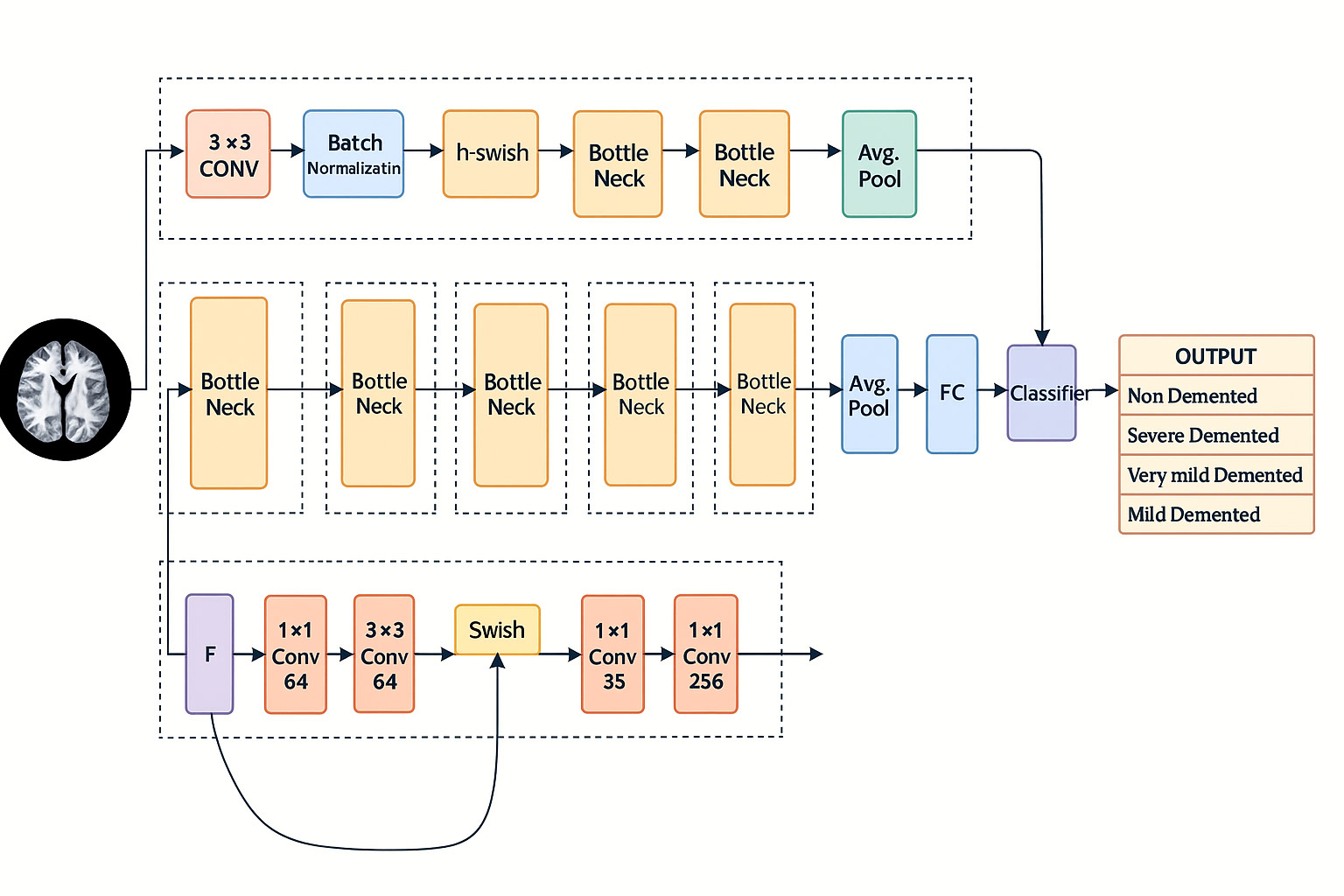
Alzheimer disease (AD) is a progressive neurodegenerative disorder that impairs memory and cognitive function in older adults, placing a substantial burden on global healthcare systems. Early and accurate diagnosis is crucial for timely intervention, yet manual interpretation of magnetic resonance imaging (MRI) scans is often subjective, time-consuming, and prone to inter-observer variability and bias. To overcome these challenges, we propose NES-Net (Neuro-Synergy Network), a novel deep learning model for automated Alzheimer's detection from MRI data. NES-Net employs a multi-branch hybrid architecture that simultaneously captures structural, spatial, and semantic features of brain images. By integrating convolutional neural network (CNN) modules for local pattern extraction with transformer-based attention mechanisms for global contextual understanding, the model effectively models both fine-grained details and long-range dependencies. These complementary representations are fused through a dedicated synergy fusion layer, inspired by inter-regional connectivity in human brain networks. Evaluated on benchmark public datasets including ADNI and OASIS, NES-Net outperforms traditional CNNs and state-of-the-art transformer-based models, achieving an overall accuracy of 94.83%, recall (sensitivity) of 93.92%, and AUC of 0.963. These results demonstrate that NES-Net, through its neuro-synergistic learning paradigm, offers a powerful, interpretable, and clinically valuable tool for early AD detection and decision support.

Graphical Abstract
NES-Net: Neuro-Synergy Based Alzheimer’s Detection Using MRI Images

Keywords
Alzheimer’s disease
MRI
deep learning
neuro-synergy network
CNN
transformer
attention mechanism
medical image analysis

Data Availability Statement
Data will be made available on request.

Funding
This work was supported without any funding.

Conflicts of Interest
The authors declare no conflicts of interest.

AI Use Statement
The authors declare that no generative AI was used in the preparation of this manuscript.

Ethical Approval and Consent to Participate
Not applicable. This study is a secondary analysis of publicly available, de-identified datasets.

References
  1. Frisoni, G. B., Fox, N. C., Jack Jr, C. R., Scheltens, P., & Thompson, P. M. (2010). The clinical use of structural MRI in Alzheimer disease. Nature reviews neurology, 6(2), 67-77.
    [CrossRef]   [Google Scholar]
  2. Alzheimer's Association. (2021). 2021 Alzheimer's disease facts and figures. Alzheimer's & Dementia, 17(3), 327-406.
    [CrossRef]   [Google Scholar]
  3. Gi, Y., Park, S., Lim, H., Lee, J., Jung, A. H., Baek, S. H., ... & Yoon, M. (2025). Anatomically refined entorhinal cortex segmentation improves MRI-based early diagnosis of Alzheimer’s disease. Frontiers in Aging Neuroscience, 17, 1682106.
    [CrossRef]   [Google Scholar]
  4. Qiao, H., Chen, L., & Zhu, F. (2021, November). A fusion of multi-view 2D and 3D convolution neural network based MRI for Alzheimer’s disease diagnosis. In 2021 43rd Annual International Conference of the IEEE Engineering in Medicine & Biology Society (EMBC) (pp. 3317-3321). IEEE.
    [CrossRef]   [Google Scholar]
  5. He, C., Zhou, Y., Chen, Y., & Jing, Y. (2025). Research on interpretable machine learning models for diagnosis and staging of mild cognitive impairment. Frontiers in Neurology, 16, 1708525.
    [CrossRef]   [Google Scholar]
  6. Yousafzai, S., Shah, I. A., Ahmad, A., Yousafzai, K., Khan, K., & Nawab, I. (2025). Machine and Deep Learning Approaches for Alzheimer's Disease Classification with EEG Signals and MRI Images. VFAST Transactions on Software Engineering, 13(4), 26-35.
    [CrossRef]   [Google Scholar]
  7. Ahmed, F., Akan, T., Gelir, F., Carmichael, O. T., Disbrow, E. A., Conrad, S. A., & Bhuiyan, M. A. (2025). 3D-TDA--Topological feature extraction from 3D images for Alzheimer's disease classification. arXiv preprint arXiv:2511.08663.
    [Google Scholar]
  8. Islam, J., Furqon, E. N., Farady, I., Lung, C. W., & Lin, C. Y. (2023, June). Early alzheimer’s disease detection through YOLO-based detection of hippocampus region in MRI images. In 2023 Sixth International Symposium on Computer, Consumer and Control (IS3C) (pp. 32-35). IEEE.
    [CrossRef]   [Google Scholar]
  9. Mandal, P. K., & Mahto, R. V. (2023). Deep multi-branch CNN architecture for early Alzheimer’s detection from brain MRIs. Sensors, 23(19), 8192.
    [CrossRef]   [Google Scholar]
  10. Venkatraman, S., PR, J. D., & Kavitha, M. S. (2025). Hierarchical graph-guided contextual representation learning for Neurodegenerative pattern recognition in MRI. Computers in Biology and Medicine, 199, 111276.
    [CrossRef]   [Google Scholar]
  11. Haq, M. I. U., Bangyal, W. H., Jaffar, A., Alfayez, A. A., Ashraf, A., Alazmi, M., & Hussain, M. (2025). Gender-based Alzheimer's detection using ResNet-50 and binary dragonfly algorithm on neuroimaging. Frontiers in Artificial Intelligence, 8, 1717913.
    [CrossRef]   [Google Scholar]
  12. Alp, S., Akan, T., Bhuiyan, M. S., Disbrow, E. A., Conrad, S. A., Vanchiere, J. A., ... & Bhuiyan, M. A. (2024). Joint transformer architecture in brain 3D MRI classification: its application in Alzheimer’s disease classification. Scientific Reports, 14(1), 8996.
    [CrossRef]   [Google Scholar]
  13. Navin, A. H., & Shamsi, M. (2025). Regional attention-enhanced vision transformer for accurate Alzheimer's disease classification using sMRI data. Computers in Biology and Medicine, 197, 111065.
    [CrossRef]   [Google Scholar]
  14. Zhu, M., Zeng, X., Gong, J., & Xiang, Y. (2026). Cross-graph Attention Neural Network for disease diagnosis in Alzheimer’s disease. Biomedical Signal Processing and Control, 113, 109105.
    [CrossRef]   [Google Scholar]

Cite This Article
APA Style
Aluri, P., Parella, V. K., & Thati, J. (2026). NES-Net: Neuro-Synergy Based Alzheimer’s Detection Using MRI Images. Frontiers in Biomedical Signal Processing, 1(1), 71–78. https://doi.org/10.62762/FBSP.2025.463290
Export Citation
RIS Format
Compatible with EndNote, Zotero, Mendeley, and other reference managers
RIS format data for reference managers
TY  - JOUR
AU  - Aluri, Pravallika
AU  - Parella, Venu Kumari
AU  - Thati, Jagadeesh
PY  - 2026
DA  - 2026/03/01
TI  - NES-Net: Neuro-Synergy Based Alzheimer’s Detection Using MRI Images
JO  - Frontiers in Biomedical Signal Processing
T2  - Frontiers in Biomedical Signal Processing
JF  - Frontiers in Biomedical Signal Processing
VL  - 1
IS  - 1
SP  - 71
EP  - 78
DO  - 10.62762/FBSP.2025.463290
UR  - https://www.icck.org/article/abs/FBSP.2025.463290
KW  - Alzheimer’s disease
KW  - MRI
KW  - deep learning
KW  - neuro-synergy network
KW  - CNN
KW  - transformer
KW  - attention mechanism
KW  - medical image analysis
AB  - Alzheimer disease (AD) is a progressive neurodegenerative disorder that impairs memory and cognitive function in older adults, placing a substantial burden on global healthcare systems. Early and accurate diagnosis is crucial for timely intervention, yet manual interpretation of magnetic resonance imaging (MRI) scans is often subjective, time-consuming, and prone to inter-observer variability and bias. To overcome these challenges, we propose NES-Net (Neuro-Synergy Network), a novel deep learning model for automated Alzheimer's detection from MRI data. NES-Net employs a multi-branch hybrid architecture that simultaneously captures structural, spatial, and semantic features of brain images. By integrating convolutional neural network (CNN) modules for local pattern extraction with transformer-based attention mechanisms for global contextual understanding, the model effectively models both fine-grained details and long-range dependencies. These complementary representations are fused through a dedicated synergy fusion layer, inspired by inter-regional connectivity in human brain networks. Evaluated on benchmark public datasets including ADNI and OASIS, NES-Net outperforms traditional CNNs and state-of-the-art transformer-based models, achieving an overall accuracy of 94.83%, recall (sensitivity) of 93.92%, and AUC of 0.963. These results demonstrate that NES-Net, through its neuro-synergistic learning paradigm, offers a powerful, interpretable, and clinically valuable tool for early AD detection and decision support.
SN  - request pending
PB  - Institute of Central Computation and Knowledge
LA  - English
ER  - 
BibTeX Format
Compatible with LaTeX, BibTeX, and other reference managers
BibTeX format data for LaTeX and reference managers
@article{Aluri2026NESNet,
  author = {Pravallika Aluri and Venu Kumari Parella and Jagadeesh Thati},
  title = {NES-Net: Neuro-Synergy Based Alzheimer’s Detection Using MRI Images},
  journal = {Frontiers in Biomedical Signal Processing},
  year = {2026},
  volume = {1},
  number = {1},
  pages = {71-78},
  doi = {10.62762/FBSP.2025.463290},
  url = {https://www.icck.org/article/abs/FBSP.2025.463290},
  abstract = {Alzheimer disease (AD) is a progressive neurodegenerative disorder that impairs memory and cognitive function in older adults, placing a substantial burden on global healthcare systems. Early and accurate diagnosis is crucial for timely intervention, yet manual interpretation of magnetic resonance imaging (MRI) scans is often subjective, time-consuming, and prone to inter-observer variability and bias. To overcome these challenges, we propose NES-Net (Neuro-Synergy Network), a novel deep learning model for automated Alzheimer's detection from MRI data. NES-Net employs a multi-branch hybrid architecture that simultaneously captures structural, spatial, and semantic features of brain images. By integrating convolutional neural network (CNN) modules for local pattern extraction with transformer-based attention mechanisms for global contextual understanding, the model effectively models both fine-grained details and long-range dependencies. These complementary representations are fused through a dedicated synergy fusion layer, inspired by inter-regional connectivity in human brain networks. Evaluated on benchmark public datasets including ADNI and OASIS, NES-Net outperforms traditional CNNs and state-of-the-art transformer-based models, achieving an overall accuracy of 94.83\%, recall (sensitivity) of 93.92\%, and AUC of 0.963. These results demonstrate that NES-Net, through its neuro-synergistic learning paradigm, offers a powerful, interpretable, and clinically valuable tool for early AD detection and decision support.},
  keywords = {Alzheimer’s disease, MRI, deep learning, neuro-synergy network, CNN, transformer, attention mechanism, medical image analysis},
  issn = {request pending},
  publisher = {Institute of Central Computation and Knowledge}
}

Article Metrics
Citations:

Crossref

0

Scopus

0

Web of Science

0
Article Access Statistics:
Views: 13
PDF Downloads: 3

Publisher's Note
ICCK stays neutral with regard to jurisdictional claims in published maps and institutional affiliations.

Rights and Permissions
CC BY Copyright © 2026 by the Author(s). Published by Institute of Central Computation and Knowledge. This article is an open access article distributed under the terms and conditions of the Creative Commons Attribution (CC BY) license (https://creativecommons.org/licenses/by/4.0/), which permits use, sharing, adaptation, distribution and reproduction in any medium or format, as long as you give appropriate credit to the original author(s) and the source, provide a link to the Creative Commons licence, and indicate if changes were made.
Frontiers in Biomedical Signal Processing

Frontiers in Biomedical Signal Processing

ISSN: request pending (Online) | ISSN: request pending (Print)

Email: [email protected]

Portico

Portico

All published articles are preserved here permanently:
https://www.portico.org/publishers/icck/