Volume 2, Issue 1, ICCK Journal of Applied Mathematics
Volume 2, Issue 1, 2026
Submit Manuscript Edit a Special Issue
Article QR Code
Article QR Code
Scan the QR code for reading
Popular articles
ICCK Journal of Applied Mathematics, Volume 2, Issue 1, 2026: 44-63

Open Access | Research Article | 17 January 2026
Influence of Darcy-Forchheimer Effects on 3D MHD Rotating Flow of Casson Hybrid Nanofluid with Velocity Slip and Convective Boundary Conditions
1 Department of Physical and Numerical Sciences, Qurtuba University of Science and Information Technology, Peshawar 25100, Pakistan
* Corresponding Author: Waqas Ahmad, [email protected]
ARK: ark:/57805/jam.2025.945696
Received: 13 November 2025, Accepted: 25 November 2025, Published: 17 January 2026  
Abstract
In order to improve heat transfer efficiency, it is essential to examine that MHD hybrid nanofluid flows behave under convective and slip boundary conditions. Researchers have looked at a variety of factors when adding hybrid nanofluids to these flows, including Forchheimer number, radiation, magnetic fields, Biot number, and the Joule heating. The novelty of the current study lies in investigating the consequences of Casson fluid in the Darcy Forchheimer flow of a three-dimensional rotating hybrid nanofluid, which have not been thoroughly covered in the literature. This includes combinations of heat sources/sinks, magnetic parameters, and radiation absorption as well as convective conditions, slip boundary conditions, and Joule heating. By shedding light on these specific components, this endeavor seeks to bridge this knowledge gap. Hybrid nanofluids disperse two distinct nanoparticles in a fluid to increase heat conductivity for industrial purposes. The bvp5c approach may be used to, after converting non-linear PDEs into non-linear ODEs with similarity variables. The velocity pattern falls with increasing magnetic, suction, and slip parameters, however the sheet temperature profile rises with increasing Eckert and radiative values. The research discovered that a stretched sheet's temperature increases with a larger magnetic field, whereas a shrinking sheet has the reverse effect. Detailed explanations of the numerical data accompanying the skin friction coefficient and local Nusselt number graphs for various parameter values are provided. This work uses a new non-Newtonian three-dimensional model that offers more authentic and precise visualizations of heat transport and fluid movement than traditional two-dimensional simulations. This study, in contrast to other studies, considers the dispersion of Hybrid nanofluid, three-dimensional flow, and water as the regular fluid.

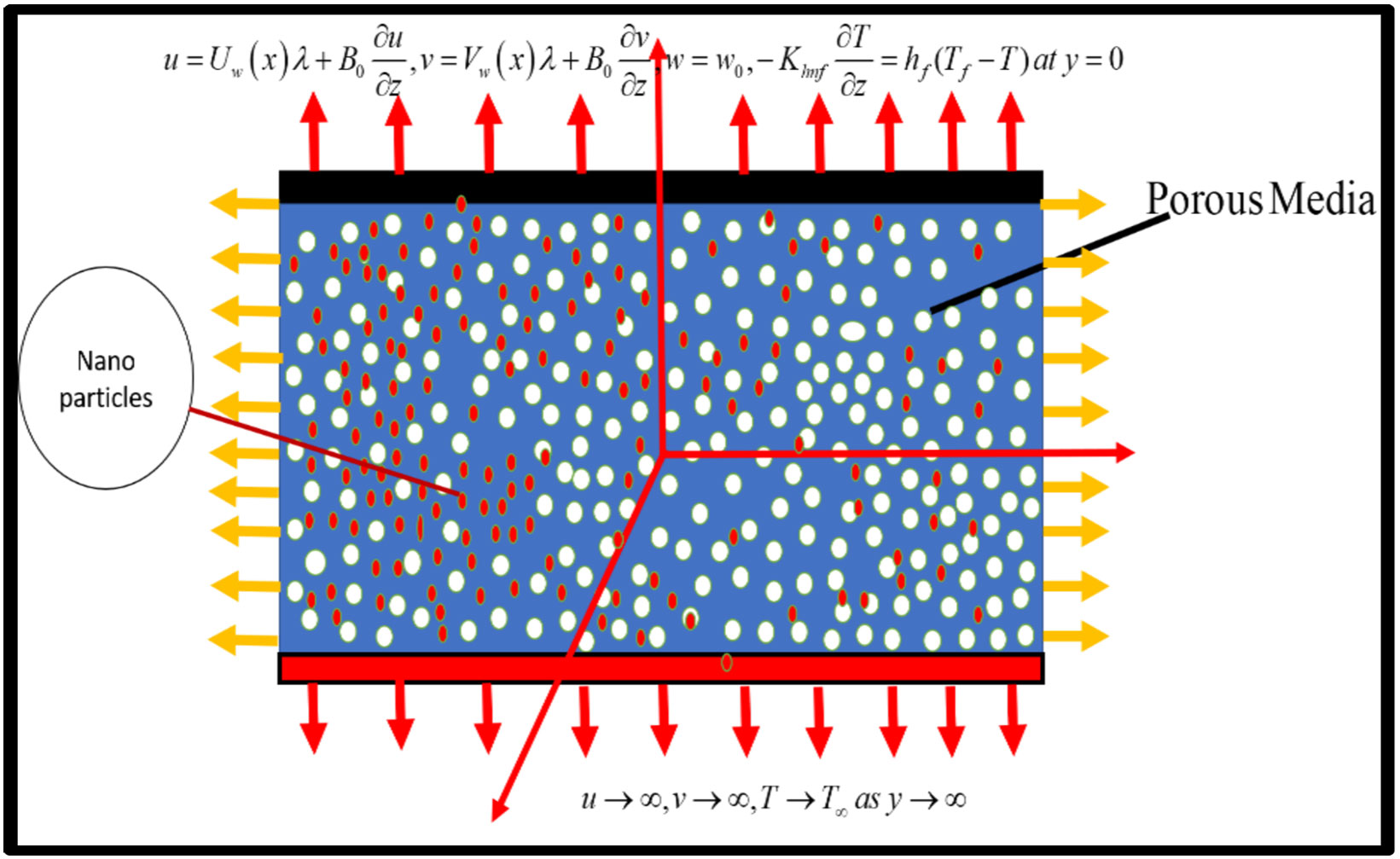
Graphical Abstract
Influence of Darcy-Forchheimer Effects on 3D MHD Rotating Flow of Casson Hybrid Nanofluid with Velocity Slip and Convective Boundary Conditions

Keywords
hybrid nanofluids
casson fluid
MHD
velocity slip
Joule heating
darcy-forchheimer

Data Availability Statement
Data will be made available on request.

Funding
This work was supported without any funding.

Conflicts of Interest
The author declares no conflicts of interest.

AI Use Statement
The author declares that no generative AI was used in the preparation of this manuscript.

Ethical Approval and Consent to Participate
Not applicable.

References
  1. Dey, D., Kumar, P., & Samantaray, S. (2017). A review of nanofluid preparation, stability, and thermo‐physical properties. Heat Transfer—Asian Research, 46(8), 1413-1442.
    [CrossRef]   [Google Scholar]
  2. Makinde, O. D., & Aziz, A. (2011). Boundary layer flow of a nanofluid past a stretching sheet with a convective boundary condition. International Journal of Thermal Sciences, 50(7), 1326-1332.
    [CrossRef]   [Google Scholar]
  3. Malvandi, A., Heysiattalab, S., & Ganji, D. D. (2016). Thermophoresis and Brownian motion effects on heat transfer enhancement at film boiling of nanofluids over a vertical cylinder. Journal of Molecular Liquids, 216, 503-509.
    [CrossRef]   [Google Scholar]
  4. Ullah, R., Ali, F., Sheikh, N. A., Alqahtani, S., & Khan, I. (2024). Viscoelastic Dusty Nanofluids containing Nanodiamond in a Rotating Porous Channel. BioNanoScience, 14(2), 1456-1472.
    [CrossRef]   [Google Scholar]
  5. Ishak, S. S., Mazlan, N. N., Ilias, M. R., Osman, R., Kasim, A. R. M., & Mohammad, N. F. (2022). Radiation effects on inclined magnetohydrodynamics mixed convection boundary layer flow of hybrid nanofluids over a moving and static wedge. Journal of Advanced Research in Applied Sciences and Engineering Technology, 28, 68-84.
    [CrossRef]   [Google Scholar]
  6. Waqas, M., Hayat, T., & Alsaedi, A. (2019). A theoretical analysis of SWCNT–MWCNT and H2O nanofluids considering Darcy–Forchheimer relation. Applied Nanoscience, 9(5), 1183-1191.
    [CrossRef]   [Google Scholar]
  7. Mahian, O., Bellos, E., Markides, C. N., Taylor, R. A., Alagumalai, A., Yang, L., ... & Wongwises, S. (2021). Recent advances in using nanofluids in renewable energy systems and the environmental implications of their uptake. Nano Energy, 86, 106069.
    [CrossRef]   [Google Scholar]
  8. Daniel, Y. S., Aziz, Z. A., Ismail, Z., & Salah, F. (2018). Effects of slip and convective conditions on MHD flow of nanofluid over a porous nonlinear stretching/shrinking sheet. Australian Journal of Mechanical Engineering, 16(3), 213-229.
    [CrossRef]   [Google Scholar]
  9. Nandy, S. K., & Mahapatra, T. R. (2013). Effects of slip and heat generation/absorption on MHD stagnation flow of nanofluid past a stretching/shrinking surface with convective boundary conditions. International Journal of Heat and Mass Transfer, 64, 1091-1100.
    [CrossRef]   [Google Scholar]
  10. Sundar, L. S., Sharma, K. V., Singh, M. K., & Sousa, A. C. M. (2017). Hybrid nanofluids preparation, thermal properties, heat transfer and friction factor–a review. Renewable and Sustainable Energy Reviews, 68, 185-198.
    [CrossRef]   [Google Scholar]
  11. Aly, E. H., & Pop, I. (2019). MHD flow and heat transfer over a permeable stretching/shrinking sheet in a hybrid nanofluid with a convective boundary condition. International Journal of Numerical Methods for Heat & Fluid Flow, 29(9), 3012-3038.
    [CrossRef]   [Google Scholar]
  12. Waini, I., Ishak, A., & Pop, I. (2020). Hybrid nanofluid flow induced by an exponentially shrinking sheet. Chinese Journal of Physics, 68, 468-482.
    [CrossRef]   [Google Scholar]
  13. Waini, I., Ishak, A., & Pop, I. (2019). Unsteady flow and heat transfer past a stretching/shrinking sheet in a hybrid nanofluid. International journal of heat and mass transfer, 136, 288-297.
    [CrossRef]   [Google Scholar]
  14. Anuar, N. S., Bachok, N., & Pop, I. (2020). Cu-Al2O3/water hybrid nanofluid stagnation point flow past MHD stretching/shrinking sheet in presence of homogeneous-heterogeneous and convective boundary conditions. Mathematics, 8(8), 1237.
    [CrossRef]   [Google Scholar]
  15. Ishak, A., Merkin, J. H., Nazar, R., & Pop, I. (2008). Mixed convection boundary layer flow over a permeable vertical surface with prescribed wall heat flux. Zeitschrift für angewandte Mathematik und Physik, 59(1), 100-123.
    [CrossRef]   [Google Scholar]
  16. Abdollahi, S. A., Alizadeh, A. A., Zarinfar, M., & Pasha, P. (2023). Investigating heat transfer and fluid flow betwixt parallel surfaces under the influence of hybrid nanofluid suction and injection with numerical analytical technique. Alexandria Engineering Journal, 70, 423-439.
    [CrossRef]   [Google Scholar]
  17. Alreshidi, N. A., Shah, Z., Dawar, A., Kumam, P., Shutaywi, M., & Watthayu, W. (2020). Brownian motion and thermophoresis effects on MHD three dimensional nanofluid flow with slip conditions and Joule dissipation due to porous rotating disk. Molecules, 25(3), 729.
    [CrossRef]   [Google Scholar]
  18. Kataria, H. R., & Mittal, A. S. (2017). Velocity, mass and temperature analysis of gravity-driven convection nanofluid flow past an oscillating vertical plate in the presence of magnetic field in a porous medium. Applied Thermal Engineering, 110, 864-874.
    [CrossRef]   [Google Scholar]
  19. Shah, Z., Sulaiman, M., Dawar, A., Alshehri, M. H., & Vrinceanu, N. (2024). Darcy–Forchheimer MHD rotationally symmetric micropolar hybrid-nanofluid flow with melting heat transfer over a radially stretchable porous rotating disk. Journal of Thermal Analysis and Calorimetry, 149(24), 14625-14641.
    [CrossRef]   [Google Scholar]
  20. Waini, I., Ishak, A., & Pop, I. (2020). Flow and heat transfer of a hybrid nanofluid past a permeable moving surface. Chinese Journal of Physics, 66, 606-619.
    [CrossRef]   [Google Scholar]
  21. Manjunatha, N., Reddy, M. G., Aloqaily, A., Aljohani, S., Reddy, A. R., Ali, F., & Mlaiki, N. (2025). Radiation effects on rotating system free convective nanofluid unsteady flow with heat source and magnetic field. Partial Differential Equations in Applied Mathematics, 13, 101083.
    [CrossRef]   [Google Scholar]
  22. Krishna, M. V., & Reddy, M. G. (2018). MHD free convective boundary layer flow through porous medium past a moving vertical platewith heat source and chemical reaction. Materials Today: Proceedings, 5(1), 91-98.
    [CrossRef]   [Google Scholar]
  23. Ali, G., Kumam, P., Sitthithakerngkiet, K., & Jarad, F. (2024). Heat transfer analysis of unsteady MHD slip flow of ternary hybrid Casson fluid through nonlinear stretching disk embedded in a porous medium. Ain Shams Engineering Journal, 15(2), 102419.
    [CrossRef]   [Google Scholar]
  24. Hussain, Z., Aljuaydi, F., Ayaz, M., & Islam, S. (2024). Significance of slips and convective conditions towards the non-Newtonian hybrid nanofluid flow over a bi-directional stretching surface. International Journal of Thermofluids, 21, 100537.
    [CrossRef]   [Google Scholar]
  25. Ahmad, W., Saqib, M., Khan, I., Oqilat, O., & Khan, M. S. (2025). Significance of Soret Dufour Effects on MHD Mixed Convective Flow of Maxwell Hybrid Nanofluid in Porous Medium with Activation Energy. International Journal of Thermofluids, 101278.
    [CrossRef]   [Google Scholar]
  26. Ibrahim, W., & Anbessa, T. (2020). Three‐dimensional MHD mixed convection flow of Casson nanofluid with Hall and ion slip effects. Mathematical Problems in Engineering, 2020(1), 8656147.
    [CrossRef]   [Google Scholar]
  27. Alnahdi, A. S., & Gul, T. (2023). Hybrid nanofluid flow over a slippery surface for thermal exploration. Advances in Mechanical Engineering, 15(8), 16878132231190060.
    [CrossRef]   [Google Scholar]
  28. Zainal, N. A., Nazar, R., Naganthran, K., & Pop, I. (2022). Slip effects on unsteady mixed convection of hybrid nanofluid flow near the stagnation point. Applied Mathematics and Mechanics, 43(4), 547-556.
    [CrossRef]   [Google Scholar]
  29. Asghar, A., Chandio, A. F., Shah, Z., Vrinceanu, N., Deebani, W., Shutaywi, M., & Lund, L. A. (2023). Magnetized mixed convection hybrid nanofluid with effect of heat generation/absorption and velocity slip condition. Heliyon, 9(2).
    [CrossRef]   [Google Scholar]
  30. Usman, M., Amin, S., & Saeed, A. (2022). Magnetohydrodynamic hybrid nanofluid flow with the effect of Darcy–Forchheimer theory and slip conditions over an exponential stretchable sheet. Advances in Mechanical Engineering, 14(8), 16878132221116479.
    [CrossRef]   [Google Scholar]
  31. Haider, F., Hayat, T., & Alsaedi, A. (2021). Flow of hybrid nanofluid through Darcy-Forchheimer porous space with variable characteristics. Alexandria Engineering Journal, 60(3), 3047-3056.
    [CrossRef]   [Google Scholar]
  32. Abu Bakar, S., Wahid, N. S., Arifin, N. M., & Khashi’ie, N. S. (2025). The flow of hybrid nanofluid past a permeable shrinking sheet in a Darcy–Forchheimer porous medium with second-order velocity slip. Waves in random and complex media, 35(1), 46-63.
    [CrossRef]   [Google Scholar]
  33. Ali, F., Zaib, A., Abbas, M., Anitha, G., Loganathan, K., & Reddy, G. R. (2024). Radiative flow of cross ternary hybrid nanofluid (MoS2, TiO2, Ag/CMC-water) in a Darcy Forchheimer porous medium over a stretching cylinder with entropy minimization. Heliyon, 10(14).
    [CrossRef]   [Google Scholar]
  34. Ganesh, N. V., Hakeem, A. A., & Ganga, B. (2018). Darcy–Forchheimer flow of hydromagnetic nanofluid over a stretching/shrinking sheet in a thermally stratified porous medium with second order slip, viscous and Ohmic dissipations effects. Ain Shams Engineering Journal, 9(4), 939-951.
    [CrossRef]   [Google Scholar]
  35. Seddeek, M. A. (2006). Influence of viscous dissipation and thermophoresis on Darcy–Forchheimer mixed convection in a fluid saturated porous media. Journal of Colloid and interface Science, 293(1), 137-142.
    [CrossRef]   [Google Scholar]
  36. Saeed, A., Tassaddiq, A., Khan, A., Jawad, M., Deebani, W., Shah, Z., & Islam, S. (2020). Darcy-Forchheimer MHD hybrid nanofluid flow and heat transfer analysis over a porous stretching cylinder. Coatings, 10(4), 391.
    [CrossRef]   [Google Scholar]
  37. Alzahrani, A. K., Ullah, M. Z., Alshomrani, A. S., & Gul, T. (2021). Hybrid nanofluid flow in a Darcy-Forchheimer permeable medium over a flat plate due to solar radiation. Case Studies in Thermal Engineering, 26, 100955.
    [CrossRef]   [Google Scholar]
  38. Alrabaiah, H., Iftikhar, S., Saeed, A., Bilal, M., Eldin, S. M., & Galal, A. M. (2023). Numerical calculation of Darcy Forchheimer radiative hybrid nanofluid flow across a curved slippery surface. South African Journal of Chemical Engineering, 45, 172-181.
    [CrossRef]   [Google Scholar]
  39. Devi, S. A., & Devi, S. S. U. (2016). Numerical investigation of hydromagnetic hybrid Cu–Al2O3/water nanofluid flow over a permeable stretching sheet with suction. International Journal of Nonlinear Sciences and Numerical Simulation, 17(5), 249-257.
    [CrossRef]   [Google Scholar]
  40. Khashi'ie, N. S., Arifin, N. M., Pop, I., Nazar, R., Hafidzuddin, E. H., & Wahi, N. (2020). Three-dimensional hybrid nanofluid flow and heat transfer past a permeable stretching/shrinking sheet with velocity slip and convective condition. Chinese Journal of Physics, 66, 157-171.
    [CrossRef]   [Google Scholar]
  41. Kumar, K. G., Ramesh, G. K., Gireesha, B. J., & Gorla, R. S. R. (2018). Characteristics of Joule heating and viscous dissipation on three-dimensional flow of Oldroyd B nanofluid with thermal radiation. Alexandria Engineering Journal, 57(3), 2139-2149.
    [CrossRef]   [Google Scholar]
  42. Ahmed, S., Badak, K., & Sharma, R. P. (2024). Three dimensional hybrid nanofluid along a stretching/shrinking sheet: application of $Al_2O_3-Cu$. Latin American Applied Research-An international journal, 54(2), 277-285.
    [CrossRef]   [Google Scholar]
  43. Iqbal, M. A., Usman, M., Allehiany, F. M., Hussain, M., & Khan, K. A. (2023). Rotating MHD Williamson nanofluid flow in 3D over exponentially stretching sheet with variable thermal conductivity and diffusivity. Heliyon, 9(11).
    [CrossRef]   [Google Scholar]
  44. Aldhafeeri, A. A., & Yasmin, H. (2024). A numerical analysis of the rotational flow of a hybrid nanofluid past a unidirectional extending surface with velocity and thermal slip conditions. Reviews on Advanced Materials Science, 63(1), 20240052.
    [CrossRef]   [Google Scholar]
  45. Wahid, N. S., Arifin, N. M., Khashi’ie, N. S., Pop, I., Bachok, N., & Hafidzuddin, M. E. H. (2022). Unsteady mixed convective stagnation point flow of hybrid nanofluid in porous medium. Neural Computing and Applications, 34(17), 14699-14715.
    [CrossRef]   [Google Scholar]
  46. Mahanthesh, B., Gireesha, B. J., & Gorla, R. S. R. (2016). Heat and mass transfer effects on the mixed convective flow of chemically reacting nanofluid past a moving/stationary vertical plate. Alexandria engineering journal, 55(1), 569-581.
    [CrossRef]   [Google Scholar]
  47. Shampine, L. F., Kierzenka, J., & Reichelt, M. W. (2000). Solving boundary value problems for ordinary differential equations in MATLAB with bvp4c. Tutorial notes, 2000(1-27), 4.
    [Google Scholar]
  48. Esfandiari, R. S. (2017). Numerical methods for engineers and scientists using MATLAB®. Crc Press.
    [CrossRef]   [Google Scholar]
  49. Hale, N. P. (2006). A sixth-order extension to the matlab bvp4c software of j. kierzenka and l. shampine. Department of Mathematics, Imperial College London.
    [Google Scholar]
  50. Kierzenka, J., & Shampine, L. F. (2001). A BVP solver based on residual control and the Maltab PSE. ACM Transactions on Mathematical Software (TOMS), 27(3), 299-316.
    [CrossRef]   [Google Scholar]

Cite This Article
APA Style
Ahmad, W. (2026). Influence of Darcy-Forchheimer Effects on 3DMHDRotating Flow of Casson Hybrid Nanofluid with Velocity Slip and Convective Boundary Conditions. ICCK Journal of Applied Mathematics, 2(1), 44–63. https://doi.org/10.62762/JAM.2025.945696
Export Citation
RIS Format
Compatible with EndNote, Zotero, Mendeley, and other reference managers
RIS format data for reference managers
TY  - JOUR
AU  - Ahmad, Waqas
PY  - 2026
DA  - 2026/01/17
TI  - Influence of Darcy-Forchheimer Effects on 3D MHD Rotating Flow of Casson Hybrid Nanofluid with Velocity Slip and Convective Boundary Conditions
JO  - ICCK Journal of Applied Mathematics
T2  - ICCK Journal of Applied Mathematics
JF  - ICCK Journal of Applied Mathematics
VL  - 2
IS  - 1
SP  - 44
EP  - 63
DO  - 10.62762/JAM.2025.945696
UR  - https://www.icck.org/article/abs/JAM.2025.945696
KW  - hybrid nanofluids
KW  - casson fluid
KW  - MHD
KW  - velocity slip
KW  - Joule heating
KW  - darcy-forchheimer
AB  - In order to improve heat transfer efficiency, it is essential to examine that MHD hybrid nanofluid flows behave under convective and slip boundary conditions. Researchers have looked at a variety of factors when adding hybrid nanofluids to these flows, including Forchheimer number, radiation, magnetic fields, Biot number, and the Joule heating. The novelty of the current study lies in investigating the consequences of Casson fluid in the Darcy Forchheimer flow of a three-dimensional rotating hybrid nanofluid, which have not been thoroughly covered in the literature. This includes combinations of heat sources/sinks, magnetic parameters, and radiation absorption as well as convective conditions, slip boundary conditions, and Joule heating. By shedding light on these specific components, this endeavor seeks to bridge this knowledge gap. Hybrid nanofluids disperse two distinct nanoparticles in a fluid to increase heat conductivity for industrial purposes. The bvp5c approach may be used to, after converting non-linear PDEs into non-linear ODEs with similarity variables. The velocity pattern falls with increasing magnetic, suction, and slip parameters, however the sheet temperature profile rises with increasing Eckert and radiative values. The research discovered that a stretched sheet's temperature increases with a larger magnetic field, whereas a shrinking sheet has the reverse effect. Detailed explanations of the numerical data accompanying the skin friction coefficient and local Nusselt number graphs for various parameter values are provided. This work uses a new non-Newtonian three-dimensional model that offers more authentic and precise visualizations of heat transport and fluid movement than traditional two-dimensional simulations. This study, in contrast to other studies, considers the dispersion of Hybrid nanofluid, three-dimensional flow, and water as the regular fluid.
SN  - 3068-5656
PB  - Institute of Central Computation and Knowledge
LA  - English
ER  - 
BibTeX Format
Compatible with LaTeX, BibTeX, and other reference managers
BibTeX format data for LaTeX and reference managers
@article{Ahmad2026Influence,
  author = {Waqas Ahmad},
  title = {Influence of Darcy-Forchheimer Effects on 3D MHD Rotating Flow of Casson Hybrid Nanofluid with Velocity Slip and Convective Boundary Conditions},
  journal = {ICCK Journal of Applied Mathematics},
  year = {2026},
  volume = {2},
  number = {1},
  pages = {44-63},
  doi = {10.62762/JAM.2025.945696},
  url = {https://www.icck.org/article/abs/JAM.2025.945696},
  abstract = {In order to improve heat transfer efficiency, it is essential to examine that MHD hybrid nanofluid flows behave under convective and slip boundary conditions. Researchers have looked at a variety of factors when adding hybrid nanofluids to these flows, including Forchheimer number, radiation, magnetic fields, Biot number, and the Joule heating. The novelty of the current study lies in investigating the consequences of Casson fluid in the Darcy Forchheimer flow of a three-dimensional rotating hybrid nanofluid, which have not been thoroughly covered in the literature. This includes combinations of heat sources/sinks, magnetic parameters, and radiation absorption as well as convective conditions, slip boundary conditions, and Joule heating. By shedding light on these specific components, this endeavor seeks to bridge this knowledge gap. Hybrid nanofluids disperse two distinct nanoparticles in a fluid to increase heat conductivity for industrial purposes. The bvp5c approach may be used to, after converting non-linear PDEs into non-linear ODEs with similarity variables. The velocity pattern falls with increasing magnetic, suction, and slip parameters, however the sheet temperature profile rises with increasing Eckert and radiative values. The research discovered that a stretched sheet's temperature increases with a larger magnetic field, whereas a shrinking sheet has the reverse effect. Detailed explanations of the numerical data accompanying the skin friction coefficient and local Nusselt number graphs for various parameter values are provided. This work uses a new non-Newtonian three-dimensional model that offers more authentic and precise visualizations of heat transport and fluid movement than traditional two-dimensional simulations. This study, in contrast to other studies, considers the dispersion of Hybrid nanofluid, three-dimensional flow, and water as the regular fluid.},
  keywords = {hybrid nanofluids, casson fluid, MHD, velocity slip, Joule heating, darcy-forchheimer},
  issn = {3068-5656},
  publisher = {Institute of Central Computation and Knowledge}
}

Article Metrics
Citations:

Crossref

0

Scopus

0

Web of Science

0
Article Access Statistics:
Views: 129
PDF Downloads: 55

Publisher's Note
ICCK stays neutral with regard to jurisdictional claims in published maps and institutional affiliations.

Rights and Permissions
CC BY Copyright © 2026 by the Author(s). Published by Institute of Central Computation and Knowledge. This article is an open access article distributed under the terms and conditions of the Creative Commons Attribution (CC BY) license (https://creativecommons.org/licenses/by/4.0/), which permits use, sharing, adaptation, distribution and reproduction in any medium or format, as long as you give appropriate credit to the original author(s) and the source, provide a link to the Creative Commons licence, and indicate if changes were made.
ICCK Journal of Applied Mathematics

ICCK Journal of Applied Mathematics

ISSN: 3068-5656 (Online)

Email: [email protected]

Portico

Portico

All published articles are preserved here permanently:
https://www.portico.org/publishers/icck/