


Impact of Joule Heating and Viscous Dissipation on MHD Slip Flow of Tangent Hyperbolic Aluminum Alloys (AA7072-AA7075/H$_2$O) in a Porous Medium with Activation Energy


Article Information
Abstract
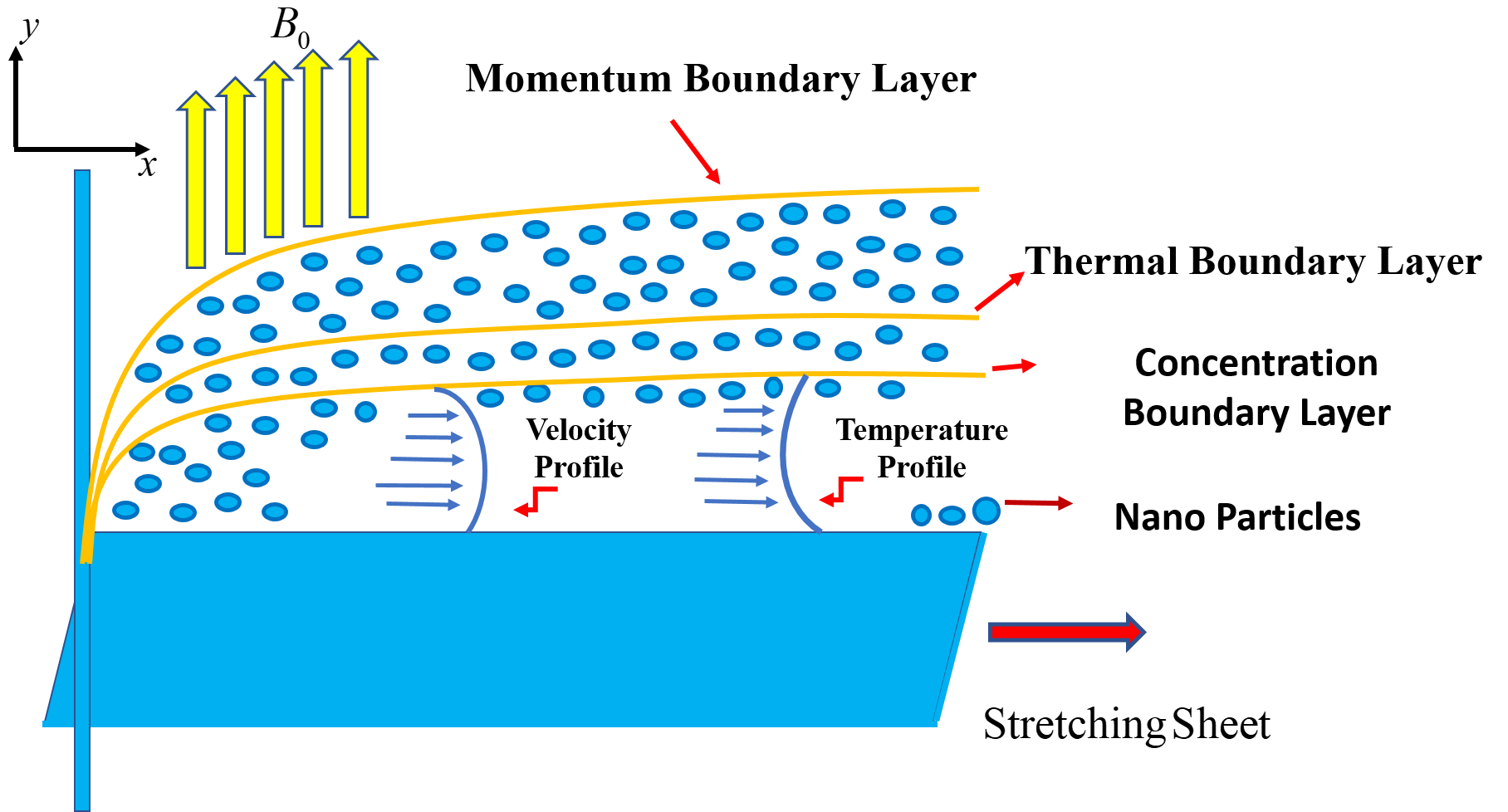
This study investigates the two-dimensional magnetohydrodynamic (MHD) slip flow of a tangent-hyperbolic (TGH) aluminum-alloy hybrid nanofluid over a stretching surface in a porous medium. The model incorporates magnetic effects, velocity and thermal slip, thermal radiation, heat generation, viscous dissipation, chemical reaction, and activation energy. The governing nonlinear partial differential equations are transformed into ordinary differential equations using similarity transformations and solved numerically in MATLAB using the bvp4c solver. The effects of key parameters on the velocity, temperature, and concentration profiles are analyzed, together with the skin-friction coefficient, Nusselt number, and Sherwood number. The results show that velocity decreases with increasing velocity-slip, porous-medium, and magnetic parameters, but increases with the fluid-thickness parameter. Temperature increases with nanoparticle volume fraction, magnetic parameter, Eckert number, velocity-slip parameter, and porous-medium parameter, whereas thermal radiation and the thermophoresis parameter reduce temperature. Concentration decreases with increasing activation energy, chemical-reaction parameter, velocity-slip parameter, and Schmidt number, but increases with the Lewis number. Comparison with previously published limiting-case results demonstrates good agreement and validates the numerical solution. These findings highlight the importance of controlling physical parameters in regulating momentum, heat, and mass transfer in MHD hybrid nanofluids, with potential applications in heat exchangers, enhanced oil recovery, environmental remediation, thermal management, and materials processing.
Graphical Abstract
Keywords
Data Availability Statement
Funding
Conflicts of Interest
AI Use Statement
Ethical Approval and Consent to Participate
References
- Senthilvadivu, K., Loganathan, K., Abbas, M., & Alqahtani, M. S. (2024). Numerical study of blood-based MHD tangent hyperbolic hybrid nanofluid flow over a permeable stretching sheet with variable thermal conductivity and cross-diffusion. Open Physics, 22(1), 20240018.
[CrossRef] [Google Scholar] - Amjad, M., Khan, M. N., Ahmed, K., Ahmed, I., Akbar, T., & Eldin, S. M. (2023). Magnetohydrodynamics tangent hyperbolic nanofluid flow over an exponentially stretching sheet: Numerical investigation. Case Studies in Thermal Engineering, 45, 102900.
[CrossRef] [Google Scholar] - Jawad, M., Alam, M., & Nisar, K. S. (2023). Investigation of thermal radiative tangent hyperbolic nanofluid flow due to stretched sheet. East European Journal of Physics, (3), 233-239.
[CrossRef] [Google Scholar] - Alqahtani, A. M., Bilal, M., Riaz, M. B., Chammam, W., Shafi, J., Rahman, M. U., & Adnan. (2024). Forced convective tangent hyperbolic nanofluid flow subject to heat source/sink and Lorentz force over a permeable wedge: Numerical exploration. Nanotechnology Reviews, 13(1), 20240014.
[CrossRef] [Google Scholar] - Siddique, I., Abdal, S., Din, I. S. U., Awrejcewicz, J., Pawłowski, W., & Hussain, S. (2022). Significance of concentration-dependent viscosity on the dynamics of tangent hyperbolic nanofluid subject to motile microorganisms over a non-linear stretching surface. Scientific Reports, 12(1), 12765.
[CrossRef] [Google Scholar] - Moltot, A. T., Gorfie, E. H., Zergaw, G. A., & Dessie, H. (2025). Unsteady MHD flow of tangent hyperbolic ternary hybrid nanofluid in a darcy-forchheimer porous medium over a permeable stretching sheet with variable thermal conductivity. F1000Research, 14, 152.
[CrossRef] [Google Scholar] - Choudhary, S., Choudhary, P., Alessa, N., & Loganathan, K. (2023). MHD thermal and solutal stratified stagnation flow of tangent hyperbolic fluid induced by stretching cylinder with dual convection. Mathematics, 11(9), 2182.
[CrossRef] [Google Scholar] - Moatimid, G. M., Mohamed, M. A., Gaber, A. A., & Mostafa, D. M. (2023). Numerical analysis for tangent-hyperbolic micropolar nanofluid flow over an extending layer through a permeable medium. Scientific Reports, 13(1), 13522.
[CrossRef] [Google Scholar] - Alhefthi, R. K., Shahzadi, I., Khan, H. A., & Khan, N. (2024). Convective boundary layer flow of MHD tangent hyperbolic nanofluid over stratified sheet with chemical reaction. AIMS Mathematics, 9(7), 16901-16923.
[CrossRef] [Google Scholar] - Ahmed, I., Alghamdi, M., Amjad, M., Aziz, F., Akbar, T., & Muhammad, T. (2023). Numerical investigation of MHD flow of hyperbolic tangent nanofluid over a non-linear stretching sheet. Heliyon, 9(7).
[CrossRef] [Google Scholar] - Das, U. J., & Majumdar, N. M. (2025). Bio-convective magnetohydrodynamic flow of tangent hyperbolic nanofluid over a stretching surface with convective heat and slip conditions. Journal of Heat and Mass Transfer Research, 12(1), 91-102.
[CrossRef] [Google Scholar] - Kumar, P., Poonia, H., Ali, L., & Areekara, S. (2022). The numerical simulation of nanoparticle size and thermal radiation with the magnetic field effect based on tangent hyperbolic nanofluid flow. Case Studies in Thermal Engineering, 37, 102247.
[CrossRef] [Google Scholar] - Nadeem, M., Siddique, I., Riaz, Z., Makhdoum, B. M., Zulqarnain, R. M., & Sallah, M. (2023). Numerical study of unsteady tangent hyperbolic fuzzy hybrid nanofluid over an exponentially stretching surface. Scientific Reports, 13(1), 15551.
[CrossRef] [Google Scholar] - Wu, Y., Chaudhry, M., Maqbool, N., Tahir, M., Basit, M. A., & Imran, M. (2024). Entropy generation in radiative motion of tangent hyperbolic nanofluid in the presence of gyrotactic microorganisms and activation energy. Frontiers in Physics, 12, 1409318.
[CrossRef] [Google Scholar] - Panda, S., Nayak, B., Baithalu, R., & Mishra, S. R. (2024). Synergistic influence of gyrotactic microorganisms and bimolecular reaction on bidirectional tangent hyperbolic fluid with Nield boundary conditions: a biomathematical model. Partial Differential Equations in Applied Mathematics, 12, 100994.
[CrossRef] [Google Scholar] - Ahemd, M. F., Ali, F., Sidi, M. O., Zafar, S. S., & Saeed, A. M. (2026). The Darcy–Forchheimer tangent hyperbolic bioconvection flow of a nanofluid caused by a convective sheet: numerical study of the stagnation point. Pramana, 100(2), 43.
[CrossRef] [Google Scholar] - Riaz, A., DilNawaz, M., Akram, S., & Khan, S. U. (2026). Effects of multiple slips on tangent hyperbolic-nanofluid with peristaltic flow having gyrotactic microorganisms under electromagnetic fields: a numerical approach. International Journal of Ambient Energy, 47(1), 2660197.
[CrossRef] [Google Scholar] - Lakshmi, R., Gireesha, B. J., & Venkatesh, P. (2026). Numerical evaluation of thermal and diffusive processes in magnetically induced tangent hyperbolic fluid flow with Dufour and Soret effects in a rotating channel. Proceedings of the Institution of Mechanical Engineers, Part C: Journal of Mechanical Engineering Science, 240(1), 264-284.
[CrossRef] [Google Scholar] - Irfan, M., Khan, M., Muhammad, T., Waqas, M., & Khan, W. A. (2022). Analysis of energy transport considering Arrhenius activation energy and chemical reaction in radiative Maxwell nanofluid flow. Chemical Physics Letters, 793, 139323.
[CrossRef] [Google Scholar] - Hamad, N. H. (2023). Numerical investigation of MHD tangent hyperbolic nanofluid flow across a vertical stretching surface subject to activation energy. Journal of Thermal Analysis and Calorimetry, 148(22), 12687-12697.
[CrossRef] [Google Scholar] - Ahmad, W. (2026). Three Dimensional Maxwell Tetra Hybrid Nanofluids Flow over a Riga Plate: Effect of Couple stress, Thermal Radiation, and Joule Heating. Thermal Advances, 100201.
[CrossRef] [Google Scholar] - Irfan, M., Khan, M., Muhammad, T., & Azeem Khan, W. (2025). Theory of activation energy and thermophoretic dispersion of nanoparticles in nonlinear radiative Maxwell nanofluid. Waves in Random and Complex Media, 35(2), 3996-4007.
[CrossRef] [Google Scholar] - Shahzad, F., Sagheer, M., & Hussain, S. (2019). MHD tangent hyperbolic nanofluid with chemical reaction, viscous dissipation and Joule heating effects. AIP advances, 9(2).
[CrossRef] [Google Scholar] - Qaiser, D., Zheng, Z., Riaz Khan, M., & Galal, A. M. (2026). Significance of activation energy and entropy optimization in radiative stagnation point flow of nanofluid with cross-diffusion and viscous dissipation. Waves in Random and Complex Media, 35(7), 14431-14452 .
[CrossRef] [Google Scholar] - Hussain, S., Haq, F., Ghazwani, H. A., Saleem, M., & Hussain, A. (2024). Entropy optimization in bio-convective chemically reactive flow of micropolar nanomaterial with activation energy and gyrotactic microorganisms. Case Studies in Thermal Engineering, 55, 104131.
[CrossRef] [Google Scholar] - Asjad, M. I., Sarwar, N., Ali, B., Hussain, S., Sitthiwirattham, T., & Reunsumrit, J. (2021). Impact of bioconvection and chemical reaction on MHD nanofluid flow due to exponential stretching sheet. Symmetry, 13(12), 2334.
[CrossRef] [Google Scholar] - Çolak, A. B. (2022). Analysis of the effect of Arrhenius activation energy and temperature dependent viscosity on non-Newtonian Maxwell nanofluid bio-convective flow with partial slip by artificial intelligence approach. Chemical Thermodynamics and Thermal Analysis, 6, 100039.
[CrossRef] [Google Scholar] - Ali, N. B., Mahmood, Z., Rafique, K., Khan, U., Adnan, Muhammad, T., & Kolsi, L. (2024). Exploring concentration-dependent transport properties on an unsteady Riga plate by incorporating thermal radiation with activation energy and gyrotactic microorganisms. Applied Rheology, 34(1), 20240019.
[CrossRef] [Google Scholar] - Khan, N. S., Shah, Z., Shutaywi, M., Kumam, P., & Thounthong, P. (2020). A comprehensive study to the assessment of Arrhenius activation energy and binary chemical reaction in swirling flow. Scientific reports, 10(1), 7868.
[CrossRef] [Google Scholar] - Irshad, S., Jahan, S., Sohail, M., & Ali, M. H. (2025). Exploring slip-enhanced MHD Williamson nanofluid dynamics: interplay of a permeable stretching sheet with thermal radiation and chemical reaction. Pramana, 99(1), 20.
[CrossRef] [Google Scholar] - Zeb, S., Gul, S., Shah, K., Santina, D., & Mlaiki, N. (2023). Melting heat transfer and thermal radiation effects on MHD tangent hyperbolic nanofluid flow with chemical reaction and activation energy. Thermal Science, 27(Spec. issue 1), 253-261.
[CrossRef] [Google Scholar] - Ahmad, W., Saqib, M., Khan, I., Oqilat, O., & Khan, M. S. (2025). Significance of Soret Dufour effects on MHD mixed convective flow of Maxwell hybrid nanofluid in porous medium with activation energy. International Journal of Thermofluids, 28, 101278.
[CrossRef] [Google Scholar] - Irfan, M. (2023). Energy transport phenomenon via Joule heating and aspects of Arrhenius activation energy in Maxwell nanofluid. Waves in Random and Complex Media, 1-16.
[CrossRef] [Google Scholar] - Jameel, M., Shah, Z., Rooman, M., Alshehri, M. H., Vrinceanu, N., & Antonescu, E. (2024). Entropy driven optimization of non-linear radiative chemically reactive sutterby nanofluid flow in presence of gyrotactic micro-organism with Hall effect and activation energy. Scientific Reports, 14(1), 30338.
[CrossRef] [Google Scholar] - Rashid, M., Alasiri, A., & Irfan, M. (2026). Entropy Generation Analysis on Magnetohydrodynamics (MHD) Blood Flow of Hybrid Nanofluid With Nonlinear Radiative Heat Flux. ZAMM‐Journal of Applied Mathematics and Mechanics/Zeitschrift für Angewandte Mathematik und Mechanik, 106(7), e70508.
[CrossRef] [Google Scholar] - Alatawi, A., Alshaban, E., Aldhabani, M. S., & Alrihieli, H. (2025). Dynamic-behavior of Casson-type hybrid nanofluids due to a stretching sheet under the coupled impacts of boundary slip and reaction-diffusion processes. Nanotechnology Reviews, 14(1), 20250244.
[CrossRef] [Google Scholar] - Alsenafi, A., & Ferdows, M. (2021). Effects of thermal slip and chemical reaction on free convective nanofluid from a horizontal plate embedded in a porous media. Mathematical Biosciences and Engineering, 18, 4817-4833.
[CrossRef] [Google Scholar] - Prajapati, V. J., & Meher, R. (2024). Analysis of MHD tangent hyperbolic hybrid nanofluid flow with different base fluids over a porous stretched sheet. Journal of Taibah University for Science, 18(1), 2300851.
[CrossRef] [Google Scholar] - Ahmad, W. (2026). Influence of Darcy-Forchheimer effects on 3D MHD rotating flow of casson hybrid nanofluid with velocity slip and convective boundary conditions. ICCK Journal of Applied Mathematics, 2(1), 44-63.
[CrossRef] [Google Scholar] - Yusuf, A., Akolade, M. T., & Tijani, Y. O. (2024). Nonlinear mixed convective analysis of Thomson and Troian slip flow conditions for Ag-Cu-TiO$_2$/H$_2$O hybrid nanofluid over a Riga plate. Journal of Computational and Theoretical Transport, 53(7), 553-574.
[CrossRef] [Google Scholar] - Revathi, G., Sajja, V. S., Babu, M. J., Srinivasa Babu, K. S., Suneel Kumar, A., Raju, C. S. K., & Yook, S. J. (2026). Multiple linear regression analysis on the flow of ternary hybrid nanofluid by a quadratically radiated stretching surface with and second order slip. Waves in Random and Complex Media, 36(3), 3774-3791.
[CrossRef] [Google Scholar] - Bilal, S., & Yasir, M. (2025). Mass transpiration impact on effectiveness of heat transport of ternary hybrid nanofluid with velocity slip. Case Studies in Thermal Engineering, 73, 106530.
[CrossRef] [Google Scholar] - Amer, A. M., Al Rashdi, S. A., Ghoneim, N. I., & Megahed, A. M. (2023). Tangent hyperbolic nanofluid flowing over a stretching sheet through a porous medium with the inclusion of magnetohydrodynamic and slip impact. Results in Engineering, 19, 101370.
[CrossRef] [Google Scholar] - Sheri, S. R., Kallem, S. R., Perli, A. P., & Gollapalli, S. (2025). Magnetohydrodynamic flow of hyperbolic tangent fluid in a porous medium in the presence of slip, radiation and heat source effects. Journal of Thermal Analysis and Calorimetry, 150(20), 16569-16584.
[CrossRef] [Google Scholar] - Shampine, L. F., Gladwell, I., Thompson, S., & Gladwell, I. (2003). Solving ODEs with matlab (Vol. 70). Cambridge: Cambridge university press. https://library.iigm.res.in/bib/6148
[Google Scholar] - Hale, N. (2006). A sixth-order extension to the MATLAB \texttt{bvp4c software of J. Kierzenka and L. Shampine. Department of Mathematics, Imperial College London, 12-60. https://ora.ox.ac.uk/objects/uuid:8a565484-8be4-40a6-a5d3-b3d96d0e6859
[Google Scholar] - Ahmad, W. (2026). Significance of Riga plate on Marangoni convective flow of Casson hybrid nanofluid over a stretching/shrinking sheet with suction and Darcy-Forchheimer effects. International Journal of Thermo-Fluid Systems and Sustainable Energy, 2(2), 30-50.
[CrossRef] [Google Scholar] - Ali, B., Jubair, S., Garayev, M., Khalifa, H. A. E. W., Kumar, A., & Shaaban, A. A. (2025). Energy and mass transfer through hybrid nanofluids flow comprised of AA7072-AA7075 nanoparticles subject to magnetic and thermal radiation on stretching surface. Journal of Radiation Research and Applied Sciences, 18(1), 101250.
[CrossRef] [Google Scholar]
Cite This Article
TY  - JOUR
AU  - Ahmad, Waqas
PY  - 2026
DA  - 2026/09/05
TI  - Impact of Joule Heating and Viscous Dissipation on MHD Slip Flow of Tangent Hyperbolic Aluminum Alloys (AA7072-AA7075/H$_2$O) in a Porous Medium with Activation Energy
JO  - ICCK Journal of Applied Mathematics
T2  - ICCK Journal of Applied Mathematics
JF  - ICCK Journal of Applied Mathematics
VL  - 2
IS  - 4
SP  - 251
EP  - 265
DO  - 10.62762/JAM.2026.103707
UR  - https://www.icck.org/article/abs/JAM.2026.103707
KW  - Tangent hyperbolic hybrid nanofluid
KW  - Joule heating
KW  - Slip flow
KW  - Viscous dissipation
KW  - Thermal radiation
KW  - Activation energy
KW  - Porous medium
AB  - This study investigates the two-dimensional magnetohydrodynamic (MHD) slip flow of a tangent-hyperbolic (TGH) aluminum-alloy hybrid nanofluid over a stretching surface in a porous medium. The model incorporates magnetic effects, velocity and thermal slip, thermal radiation, heat generation, viscous dissipation, chemical reaction, and activation energy. The governing nonlinear partial differential equations are transformed into ordinary differential equations using similarity transformations and solved numerically in MATLAB using the bvp4c solver. The effects of key parameters on the velocity, temperature, and concentration profiles are analyzed, together with the skin-friction coefficient, Nusselt number, and Sherwood number. The results show that velocity decreases with increasing velocity-slip, porous-medium, and magnetic parameters, but increases with the fluid-thickness parameter. Temperature increases with nanoparticle volume fraction, magnetic parameter, Eckert number, velocity-slip parameter, and porous-medium parameter, whereas thermal radiation and the thermophoresis parameter reduce temperature. Concentration decreases with increasing activation energy, chemical-reaction parameter, velocity-slip parameter, and Schmidt number, but increases with the Lewis number. Comparison with previously published limiting-case results demonstrates good agreement and validates the numerical solution. These findings highlight the importance of controlling physical parameters in regulating momentum, heat, and mass transfer in MHD hybrid nanofluids, with potential applications in heat exchangers, enhanced oil recovery, environmental remediation, thermal management, and materials processing.
SN  - 3068-5656
PB  - Institute of Central Computation and Knowledge
LA  - English
ER  -
@article{Ahmad2026Impact,
  author = {Waqas Ahmad},
  title = {Impact of Joule Heating and Viscous Dissipation on MHD Slip Flow of Tangent Hyperbolic Aluminum Alloys (AA7072-AA7075/H\$\_2\$O) in a Porous Medium with Activation Energy},
  journal = {ICCK Journal of Applied Mathematics},
  year = {2026},
  volume = {2},
  number = {4},
  pages = {251-265},
  doi = {10.62762/JAM.2026.103707},
  url = {https://www.icck.org/article/abs/JAM.2026.103707},
  abstract = {This study investigates the two-dimensional magnetohydrodynamic (MHD) slip flow of a tangent-hyperbolic (TGH) aluminum-alloy hybrid nanofluid over a stretching surface in a porous medium. The model incorporates magnetic effects, velocity and thermal slip, thermal radiation, heat generation, viscous dissipation, chemical reaction, and activation energy. The governing nonlinear partial differential equations are transformed into ordinary differential equations using similarity transformations and solved numerically in MATLAB using the bvp4c solver. The effects of key parameters on the velocity, temperature, and concentration profiles are analyzed, together with the skin-friction coefficient, Nusselt number, and Sherwood number. The results show that velocity decreases with increasing velocity-slip, porous-medium, and magnetic parameters, but increases with the fluid-thickness parameter. Temperature increases with nanoparticle volume fraction, magnetic parameter, Eckert number, velocity-slip parameter, and porous-medium parameter, whereas thermal radiation and the thermophoresis parameter reduce temperature. Concentration decreases with increasing activation energy, chemical-reaction parameter, velocity-slip parameter, and Schmidt number, but increases with the Lewis number. Comparison with previously published limiting-case results demonstrates good agreement and validates the numerical solution. These findings highlight the importance of controlling physical parameters in regulating momentum, heat, and mass transfer in MHD hybrid nanofluids, with potential applications in heat exchangers, enhanced oil recovery, environmental remediation, thermal management, and materials processing.},
  keywords = {Tangent hyperbolic hybrid nanofluid, Joule heating, Slip flow, Viscous dissipation, Thermal radiation, Activation energy, Porous medium},
  issn = {3068-5656},
  publisher = {Institute of Central Computation and Knowledge}
}
Article Metrics
Publisher's Note
ICCK stays neutral with regard to jurisdictional claims in published maps and institutional affiliations.
Rights and Permissions
 Copyright © 2026 by the Author(s). Published by Institute of Central Computation and Knowledge. This article is an open access article distributed under the terms and conditions of the Creative Commons Attribution (CC BY) license (https://creativecommons.org/licenses/by/4.0/), which permits use, sharing, adaptation, distribution and reproduction in any medium or format, as long as you give appropriate credit to the original author(s) and the source, provide a link to the Creative Commons licence, and indicate if changes were made.

