


Mathematical Formulation and Computational Implementation of a Fisher-KPP Model for Glioblastoma Invasion under Fractionated Radiotherapy



Article Information
Abstract
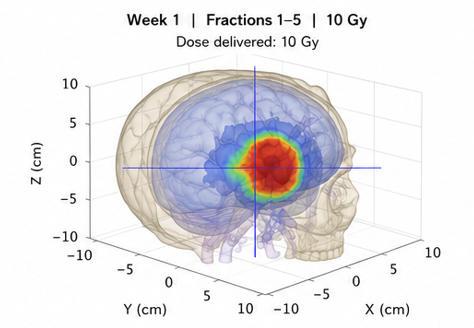
Glioblastoma (GBM) is a highly infiltrative primary brain tumor, and reaction-diffusion models are widely used to describe how its cells spread and proliferate. We derive the classical Fisher-KPP equation from mass conservation, Fickian diffusion, and logistic growth, and extend it to fractionated radiotherapy through a linear-quadratic survival update applied to the tumor-density field at each fraction. The Fisher-KPP equation is solved by finite differences on a three-dimensional voxel grid with 0.5-mm spacing; Geant4 is used only for Monte Carlo photon transport and dose calculation. The schedule of 60~Gy in 30 fractions from the clinical case reported by Roda et al. is reproduced, and the simulated evolution is compared qualitatively with the clinical course as a demonstration only, without quantitative validation against patient-specific imaging data. The case report gives lesion dimensions at three time points but no serial pretreatment imaging, so the diffusion and proliferation parameters cannot be estimated for this patient and are taken from the literature. The results are a qualitative demonstration of the coupled model and do not constitute patient-specific validation.
Graphical Abstract
Keywords
Data Availability Statement
Funding
Conflicts of Interest
AI Use Statement
Ethical Approval and Consent to Participate
References
- Price, M., Ballard, C. A. P., Benedetti, J. R., Kruchko, C., Barnholtz-Sloan, J. S., & Ostrom, Q. T. (2025). CBTRUS statistical report: primary brain and other central nervous system tumors diagnosed in the United States in 2018–2022. Neuro-oncology, 27(Supplement\_4), iv1-iv66.
[CrossRef] [Google Scholar] - Grochans, S., Cybulska, A. M., Simińska, D., Korbecki, J., Kojder, K., Chlubek, D., & Baranowska-Bosiacka, I. (2022). Epidemiology of glioblastoma multiforme–literature review. Cancers, 14(10), 2412.
[CrossRef] [Google Scholar] - Christian, E., & Wenske, M. (2021). Estimating the extent of glioblastoma invasion. Journal of Mathematical Biology, 82(1-2).
[CrossRef] [Google Scholar] - Rockne, R., Rockhill, J. K., Mrugala, M., Spence, A. M., Kalet, I., Hendrickson, K., ... & Swanson, K. R. (2010). Predicting the efficacy of radiotherapy in individual glioblastoma patients in vivo: a mathematical modeling approach. Physics in Medicine & Biology, 55(12), 3271-3285.
[CrossRef] [Google Scholar] - Swanson, K. R., Bridge, C., Murray, J. D., & Alvord Jr, E. C. (2003). Virtual and real brain tumors: using mathematical modeling to quantify glioma growth and invasion. Journal of the neurological sciences, 216(1), 1-10.
[CrossRef] [Google Scholar] - Tracqui, P., Cruywagen, G. C., Woodward, D. E., Bartoo, G. T., Murray, J. D., & Alvord Jr, E. C. (1995). A mathematical model of glioma growth: the effect of chemotherapy on spatio‐temporal growth. Cell proliferation, 28(1), 17-31.
[CrossRef] [Google Scholar] - Swan, A., Hillen, T., Bowman, J. C., & Murtha, A. D. (2018). A patient-specific anisotropic diffusion model for brain tumour spread. Bulletin of mathematical biology, 80(5), 1259-1291.
[CrossRef] [Google Scholar] - Roda, D., Oliveira, F., Veiga, P., Santos, L., Abreu, P., Nascimento, A., ... & Ribeiro, I. P. P. (2026). Treatment challenges in glioblastoma: a case report. Frontiers in Oncology, 15, 1651939.
[CrossRef] [Google Scholar] - Agostinelli, S., Allison, J., Amako, K., Apostolakis, J., Araujo, H., Arce, P., ... & Zschiesche, D. (2003). Geant4--a simulation toolkit. Nuclear Instruments and Methods in Physics Research Section A: Accelerators, Spectrometers. Detectors and Associated Equipment, 506(3), 250-303.
[CrossRef] [Google Scholar] - Fisher, R. A. (1937). The wave of advance of advantageous genes. Annals of Eugenics, 7(4), 355-369.
[CrossRef] [Google Scholar] - Kolmogorov, A. N., Petrovskii, I. G., & Piskunov, N. S. A Study of the Diffusion Equation with Increase in the Amount of Substance, and Its Application to a Biological Problem. Selected Works of AN Kolmogorov, vol. 1, 242-270.
[CrossRef] [Google Scholar] - Yates, F., & Mather, K. (1963). Ronald Aylmer Fisher, 1890-1962. Biographical Memoirs of Fellows of the Royal Society, 9, 91-129.
[CrossRef] [Google Scholar] - Box, J. F. (1978). R. A. Fisher: The life of a scientist. Wiley, New York. https://openlibrary.org/books/OL4715361M/R._A._Fisher_the_life_of_a_scientist
[Google Scholar] - Gu, S., Chakraborty, G., Champley, K., Alessio, A. M., Claridge, J., Rockne, R., ... & Swanson, K. R. (2012). Applying a patient-specific bio-mathematical model of glioma growth to develop virtual [18F]-FMISO-PET images. Mathematical medicine and biology: a journal of the IMA, 29(1), 31-48.
[CrossRef] [Google Scholar] - Sandström, H., Dasu, A., & Toma-Dasu, I. (2013). Radiobiological framework for the evaluation of stereotactic radiosurgery plans for invasive brain tumours. International Scholarly Research Notices, 2013(1), 527251.
[CrossRef] [Google Scholar] - Stupp, R., Mason, W. P., Van Den Bent, M. J., Weller, M., Fisher, B., Taphoorn, M. J., ... & Mirimanoff, R. O. (2005). Radiotherapy plus concomitant and adjuvant temozolomide for glioblastoma. New England journal of medicine, 352(10), 987-996.
[CrossRef] [Google Scholar]
Cite This Article
TY  - JOUR
AU  - Farias, Matheus dos Santos
AU  - Ferreira, Joiciane Sousa de Carvalho
AU  - Batista, Juciene dos Santos
PY  - 2026
DA  - 2026/10/07
TI  - Mathematical Formulation and Computational Implementation of a Fisher-KPP Model for Glioblastoma Invasion under Fractionated Radiotherapy
JO  - ICCK Journal of Applied Mathematics
T2  - ICCK Journal of Applied Mathematics
JF  - ICCK Journal of Applied Mathematics
VL  - 2
IS  - 4
SP  - 283
EP  - 292
DO  - 10.62762/JAM.2026.576302
UR  - https://www.icck.org/article/abs/JAM.2026.576302
KW  - Fisher-KPP equation
KW  - glioblastoma
KW  - Geant4
KW  - Monte Carlo simulation
KW  - radiotherapy
KW  - mathematical oncology
AB  - Glioblastoma (GBM) is a highly infiltrative primary brain tumor, and reaction-diffusion models are widely used to describe how its cells spread and proliferate. We derive the classical Fisher-KPP equation from mass conservation, Fickian diffusion, and logistic growth, and extend it to fractionated radiotherapy through a linear-quadratic survival update applied to the tumor-density field at each fraction. The Fisher-KPP equation is solved by finite differences on a three-dimensional voxel grid with 0.5-mm spacing; Geant4 is used only for Monte Carlo photon transport and dose calculation. The schedule of 60~Gy in 30 fractions from the clinical case reported by Roda et al. is reproduced, and the simulated evolution is compared qualitatively with the clinical course as a demonstration only, without quantitative validation against patient-specific imaging data. The case report gives lesion dimensions at three time points but no serial pretreatment imaging, so the diffusion and proliferation parameters cannot be estimated for this patient and are taken from the literature. The results are a qualitative demonstration of the coupled model and do not constitute patient-specific validation.
SN  - 3068-5656
PB  - Institute of Central Computation and Knowledge
LA  - English
ER  -
@article{Farias2026Mathematic,
  author = {Matheus dos Santos Farias and Joiciane Sousa de Carvalho Ferreira and Juciene dos Santos Batista},
  title = {Mathematical Formulation and Computational Implementation of a Fisher-KPP Model for Glioblastoma Invasion under Fractionated Radiotherapy},
  journal = {ICCK Journal of Applied Mathematics},
  year = {2026},
  volume = {2},
  number = {4},
  pages = {283-292},
  doi = {10.62762/JAM.2026.576302},
  url = {https://www.icck.org/article/abs/JAM.2026.576302},
  abstract = {Glioblastoma (GBM) is a highly infiltrative primary brain tumor, and reaction-diffusion models are widely used to describe how its cells spread and proliferate. We derive the classical Fisher-KPP equation from mass conservation, Fickian diffusion, and logistic growth, and extend it to fractionated radiotherapy through a linear-quadratic survival update applied to the tumor-density field at each fraction. The Fisher-KPP equation is solved by finite differences on a three-dimensional voxel grid with 0.5-mm spacing; Geant4 is used only for Monte Carlo photon transport and dose calculation. The schedule of 60~Gy in 30 fractions from the clinical case reported by Roda et al. is reproduced, and the simulated evolution is compared qualitatively with the clinical course as a demonstration only, without quantitative validation against patient-specific imaging data. The case report gives lesion dimensions at three time points but no serial pretreatment imaging, so the diffusion and proliferation parameters cannot be estimated for this patient and are taken from the literature. The results are a qualitative demonstration of the coupled model and do not constitute patient-specific validation.},
  keywords = {Fisher-KPP equation, glioblastoma, Geant4, Monte Carlo simulation, radiotherapy, mathematical oncology},
  issn = {3068-5656},
  publisher = {Institute of Central Computation and Knowledge}
}
Article Metrics
Publisher's Note
ICCK stays neutral with regard to jurisdictional claims in published maps and institutional affiliations.
Rights and Permissions
 Copyright © 2026 by the Author(s). Published by Institute of Central Computation and Knowledge. This article is an open access article distributed under the terms and conditions of the Creative Commons Attribution (CC BY) license (https://creativecommons.org/licenses/by/4.0/), which permits use, sharing, adaptation, distribution and reproduction in any medium or format, as long as you give appropriate credit to the original author(s) and the source, provide a link to the Creative Commons licence, and indicate if changes were made.

