

Toward a Theory of Granular Digital Twins: Mathematical Foundations for Adaptive Digital Twin Systems



Article Information
Abstract
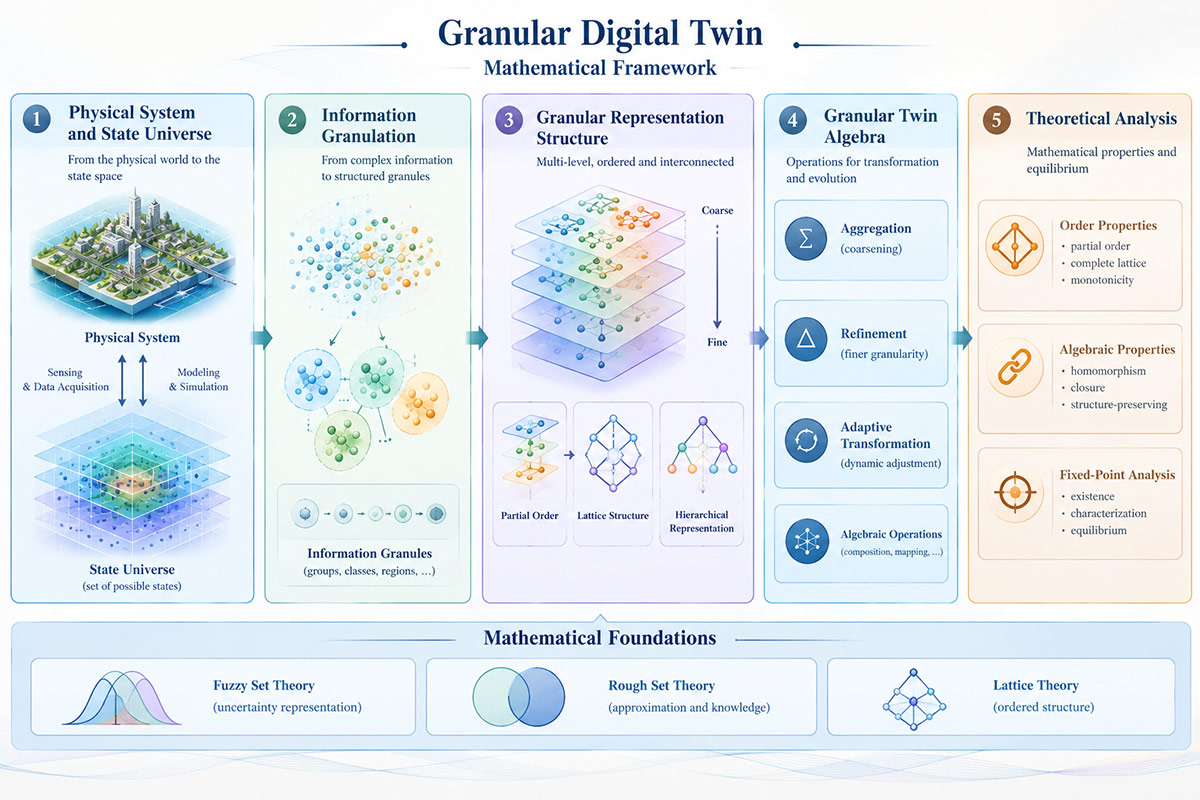
Digital Twin (DT) technology models and synchronizes physical systems through virtual counterparts. Existing mathematical formulations of DTs concentrate on physical-virtual synchronization and say little about how representations of the same system at different levels of detail should be related. This paper builds a mathematical foundation for Granular Digital Twins (GDTs) by combining Granular Computing with DT theory. We introduce information granules, the Granular Representation Mapping, the Granular Twin Space, and the Granular Digital Twin, and then construct a Granular Twin Algebra whose aggregation, refinement, and adaptive transformation operators act on an ordered family of granular representations. The structure is analyzed through lattice properties, Granular Twin Homomorphisms, adaptive granular evolution, and granular equilibrium. When the representation family is a complete lattice and the adaptive transformation is order-preserving, the Knaster-Tarski theorem guarantees that the set of granular equilibria is non-empty and is itself a complete lattice; each equilibrium is invariant under repeated adaptive transformation. These results are existence and invariance results only; uniqueness, convergence, and dynamical stability are not claimed. The framework moves DT theory from state-oriented synchronization toward adaptive granular representation and gives a formal basis for organizing hierarchical information in DT systems.
Graphical Abstract
Keywords
Data Availability Statement
Funding
Conflicts of Interest
AI Use Statement
Ethical Approval and Consent to Participate
References
- Barricelli, B. R., Casiraghi, E., & Fogli, D. (2019). A survey on digital twin: Definitions, characteristics, applications, and design implications. IEEE Access, 7, 167653-167671.
[CrossRef] [Google Scholar] - Tao, F., Zhang, H., Liu, A., & Nee, A. Y. (2018). Digital twin in industry: State-of-the-art. IEEE Transactions on industrial informatics, 15(4), 2405-2415.
[CrossRef] [Google Scholar] - Fuller, A., Fan, Z., Day, C., & Barlow, C. (2020). Digital twin: Enabling technologies, challenges and open research. IEEE Access, 8, 108952-108971.
[CrossRef] [Google Scholar] - Grieves, M., & Vickers, J. (2016). Digital twin: Mitigating unpredictable, undesirable emergent behavior in complex systems. In Transdisciplinary perspectives on complex systems: New findings and approaches (pp. 85-113). Cham: Springer International Publishing.
[CrossRef] [Google Scholar] - Rasheed, A., San, O., & Kvamsdal, T. (2020). Digital twin: Values, challenges and enablers from a modeling perspective. IEEE Access, 8, 21980-22012.
[CrossRef] [Google Scholar] - Jones, D., Snider, C., Nassehi, A., Yon, J., & Hicks, B. (2020). Characterising the digital twin: A systematic literature review. CIRP Journal of Manufacturing Science and Technology, 29, 36-52.
[CrossRef] [Google Scholar] - Semeraro, C., Lezoche, M., Panetto, H., & Dassisti, M. (2021). Digital twin paradigm: A systematic literature review. Computers in Industry, 130, 103469.
[CrossRef] [Google Scholar] - Jiang, F., Ma, L., Broyd, T., & Chen, K. (2021). Digital twin and its implementations in the civil engineering sector. Automation in Construction, 130, 103838.
[CrossRef] [Google Scholar] - Qi, Q., Tao, F., Hu, T., Anwer, N., Liu, A., Wei, Y., Wang, L., & Nee, A. Y. C. (2021). Enabling technologies and tools for digital twin. Journal of Manufacturing Systems, 58, 3-21.
[CrossRef] [Google Scholar] - Tao, F., Xiao, B., Qi, Q., Cheng, J., & Ji, P. (2022). Digital twin modeling. Journal of Manufacturing Systems, 64, 372-389.
[CrossRef] [Google Scholar] - Zadeh, L. A. (1997). Toward a theory of fuzzy information granulation and its centrality in human reasoning and fuzzy logic. Fuzzy Sets and Systems, 90(2), 111-127.
[CrossRef] [Google Scholar] - Yao, J. T., Vasilakos, A. V., & Pedrycz, W. (2013). Granular computing: perspectives and challenges. IEEE transactions on cybernetics, 43(6), 1977-1989.
[CrossRef] [Google Scholar] - Skowron, A., & Stepaniuk, J. (2001). Information granules: Towards foundations of granular computing. International Journal of Intelligent Systems, 16(1), 57-85.
[CrossRef] [Google Scholar] - Yao, Y., & Zhong, N. (2007). Granular computing. In Wiley Encyclopedia of Computer Science and Engineering. Wiley.
[CrossRef] [Google Scholar] - Yao, Y. (2016). A triarchic theory of granular computing. Granular Computing, 1(2), 145-157.
[CrossRef] [Google Scholar] - Pedrycz, W., Skowron, A., & Kreinovich, V. (Eds.). (2008). Handbook of Granular Computing. Wiley.
[CrossRef] [Google Scholar] - Pawlak, Z. (1982). Rough sets. International Journal of Computer & Information Sciences, 11(5), 341-356.
[CrossRef] [Google Scholar] - Pawlak, Z. (1991). Rough Sets: Theoretical Aspects of Reasoning about Data. Kluwer Academic Publishers. http://dx.doi.org/10.1007/978-94-011-3534-4
[Google Scholar] - Järvinen, J. (2007). Lattice theory for rough sets. In Transactions on Rough Sets VI: Commemorating the Life and Work of Zdzisław Pawlak, Part I (pp. 400-498). Berlin, Heidelberg: Springer Berlin Heidelberg.
[CrossRef] [Google Scholar] - Pawlak, Z., Polkowski, L., & Skowron, A. (2007). Rough set theory. In Wiley Encyclopedia of Computer Science and Engineering. Wiley.
[CrossRef] [Google Scholar] - Estaji, A. A., Hooshmandasl, M. R., & Davvaz, B. (2012). Rough set theory applied to lattice theory. Information Sciences, 200, 108-122.
[CrossRef] [Google Scholar] - Li, X., Yi, H., & Liu, S. (2016). Rough sets and matroids from a lattice-theoretic viewpoint. Information Sciences, 342, 37-52.
[CrossRef] [Google Scholar] - Davey, B. A., & Priestley, H. A. (2002). Introduction to Lattices and Order (2nd ed.). Cambridge University Press.
[CrossRef] [Google Scholar] - Schröder, B. S. (2012). The fixed point property for ordered sets. Arabian Journal of Mathematics, 1(4), 529-547.
[CrossRef] [Google Scholar] - Tarski, A. (1955). A lattice-theoretical fixpoint theorem and its applications. Pacific Journal of Mathematics, 5(2), 285-309.
[CrossRef] [Google Scholar] - Yang, X. B., Qian, Y. H., & Yang, J. Y. (2012). Hierarchical structures on multigranulation spaces. Journal of Computer Science and Technology, 27(6), 1169-1183.
[CrossRef] [Google Scholar] - Qian, Y., Zhang, H., Li, F., Hu, Q., & Liang, J. (2014). Set-based granular computing: a lattice model. International Journal of Approximate Reasoning, 55(3), 834-852.
[CrossRef] [Google Scholar] - Chiaselotti, G., Ciucci, D., Gentile, T., & Infusino, F. G. (2016). The granular partition lattice of an information table. Information Sciences, 373, 57-78.
[CrossRef] [Google Scholar]
Cite This Article
TY  - JOUR
AU  - Li, Jinghan
PY  - 2026
DA  - 2026/10/19
TI  - Toward a Theory of Granular Digital Twins: Mathematical Foundations for Adaptive Digital Twin Systems
JO  - ICCK Journal of Applied Mathematics
T2  - ICCK Journal of Applied Mathematics
JF  - ICCK Journal of Applied Mathematics
VL  - 2
IS  - 4
SP  - 302
EP  - 314
DO  - 10.62762/JAM.2026.667211
UR  - https://www.icck.org/article/abs/JAM.2026.667211
KW  - digital twin
KW  - granular computing
KW  - information granules
KW  - granular twin algebra
KW  - lattice theory
KW  - fixed-point theory
KW  - adaptive systems
AB  - Digital Twin (DT) technology models and synchronizes physical systems through virtual counterparts. Existing mathematical formulations of DTs concentrate on physical-virtual synchronization and say little about how representations of the same system at different levels of detail should be related. This paper builds a mathematical foundation for Granular Digital Twins (GDTs) by combining Granular Computing with DT theory. We introduce information granules, the Granular Representation Mapping, the Granular Twin Space, and the Granular Digital Twin, and then construct a Granular Twin Algebra whose aggregation, refinement, and adaptive transformation operators act on an ordered family of granular representations. The structure is analyzed through lattice properties, Granular Twin Homomorphisms, adaptive granular evolution, and granular equilibrium. When the representation family is a complete lattice and the adaptive transformation is order-preserving, the Knaster-Tarski theorem guarantees that the set of granular equilibria is non-empty and is itself a complete lattice; each equilibrium is invariant under repeated adaptive transformation. These results are existence and invariance results only; uniqueness, convergence, and dynamical stability are not claimed. The framework moves DT theory from state-oriented synchronization toward adaptive granular representation and gives a formal basis for organizing hierarchical information in DT systems.
SN  - 3068-5656
PB  - Institute of Central Computation and Knowledge
LA  - English
ER  -
@article{Li2026Toward,
  author = {Jinghan Li},
  title = {Toward a Theory of Granular Digital Twins: Mathematical Foundations for Adaptive Digital Twin Systems},
  journal = {ICCK Journal of Applied Mathematics},
  year = {2026},
  volume = {2},
  number = {4},
  pages = {302-314},
  doi = {10.62762/JAM.2026.667211},
  url = {https://www.icck.org/article/abs/JAM.2026.667211},
  abstract = {Digital Twin (DT) technology models and synchronizes physical systems through virtual counterparts. Existing mathematical formulations of DTs concentrate on physical-virtual synchronization and say little about how representations of the same system at different levels of detail should be related. This paper builds a mathematical foundation for Granular Digital Twins (GDTs) by combining Granular Computing with DT theory. We introduce information granules, the Granular Representation Mapping, the Granular Twin Space, and the Granular Digital Twin, and then construct a Granular Twin Algebra whose aggregation, refinement, and adaptive transformation operators act on an ordered family of granular representations. The structure is analyzed through lattice properties, Granular Twin Homomorphisms, adaptive granular evolution, and granular equilibrium. When the representation family is a complete lattice and the adaptive transformation is order-preserving, the Knaster-Tarski theorem guarantees that the set of granular equilibria is non-empty and is itself a complete lattice; each equilibrium is invariant under repeated adaptive transformation. These results are existence and invariance results only; uniqueness, convergence, and dynamical stability are not claimed. The framework moves DT theory from state-oriented synchronization toward adaptive granular representation and gives a formal basis for organizing hierarchical information in DT systems.},
  keywords = {digital twin, granular computing, information granules, granular twin algebra, lattice theory, fixed-point theory, adaptive systems},
  issn = {3068-5656},
  publisher = {Institute of Central Computation and Knowledge}
}
Article Metrics
Publisher's Note
ICCK stays neutral with regard to jurisdictional claims in published maps and institutional affiliations.
Rights and Permissions
 Copyright © 2026 by the Author(s). Published by Institute of Central Computation and Knowledge. This article is an open access article distributed under the terms and conditions of the Creative Commons Attribution (CC BY) license (https://creativecommons.org/licenses/by/4.0/), which permits use, sharing, adaptation, distribution and reproduction in any medium or format, as long as you give appropriate credit to the original author(s) and the source, provide a link to the Creative Commons licence, and indicate if changes were made.