


A Brain Uptake Constant for Mathematical Modeling of Cerebral Radiopharmaceutical Uptake: A Synthetic Computational Study



Article Information
Abstract
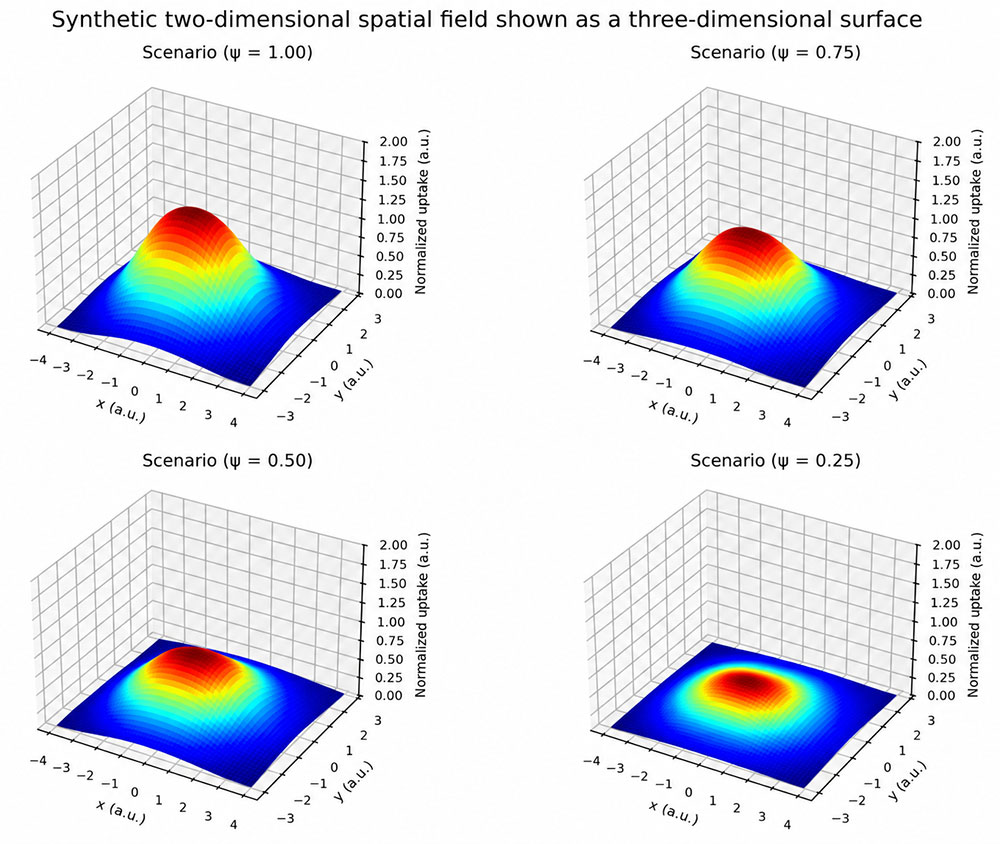
Compartmental and tracer-kinetic models are widely used to describe radiopharmaceutical uptake in brain PET and SPECT, but in simple analytical models the fraction of transferred activity that reaches the brain is seldom isolated as a parameter of its own. This study defines a dimensionless Brain Uptake Constant, $\psi$, as the uptake fraction in a two-stage first-order model of cerebral radiopharmaceutical activity and examines its behaviour in a purely synthetic setting. Activity in the systemic pool, $A(t)$, is lost at a first-order rate $k$; cerebral activity, $A_c(t)$, receives a source term $\psi k A(t)$ and is lost at an effective decay rate $\lambda$. The closed-form solution was evaluated directly for $A_0 = 100$~MBq, $k = 0.25$~min$^{-1}$, $\lambda = 0.05$~min$^{-1}$ and $\psi = 1.00$, 0.75, 0.50 and 0.25 over 0-60~min. Deterministic Gaussian fields were used to show the spatial effect of $\psi$ as surface plots and heat maps. Each curve rises, passes through a single maximum at $t_{\mathrm{peak}} = 8.047$~min and then decays. The peak time does not depend on $\psi$, whereas the peak activity (66.87~MBq for $\psi = 1$) and the 0-60~min time-integrated activity scale linearly with $\psi$. In the spatial fields, $\psi$ changes the amplitude but not the prescribed Gaussian widths. No clinical, PET or SPECT data were used, so the results say nothing about clinical validity. The model is offered as a simple parameterization that still has to be tested against measured dynamic imaging data with independently estimated kinetic parameters.
Graphical Abstract
Keywords
Data Availability Statement
Funding
Conflicts of Interest
AI Use Statement
Ethical Approval and Consent to Participate
References
- van der Weijden, C. W. J., Mossel, P., Bartels, A. L., Dierckx, R. A., Luurtsema, G., Lammertsma, A. A., Willemsen, A. T., & de Vries, E. F. (2023). Non-invasive kinetic modelling approaches for quantitative analysis of brain PET studies. European Journal of Nuclear Medicine and Molecular Imaging, 50(6), 1636-1650.
[CrossRef] [Google Scholar] - Guo, Q., Brady, M., & Gunn, R. N. (2009). A biomathematical modeling approach to central nervous system radioligand discovery and development. Journal of Nuclear Medicine, 50(10), 1715-1723.
[CrossRef] [Google Scholar] - Shevtsova, O. N., & Shevtsova, V. K. (2017). Mathematical simulation of transport kinetics of tumor-imaging radiopharmaceutical $^{99\mathrm{m$Tc-MIBI. Computational and Mathematical Methods in Medicine, 2017(1), 2414878.
[CrossRef] [Google Scholar] - Shuryak, I., & Dadachova, E. (2015). New approaches for modeling radiopharmaceutical pharmacokinetics using continuous distributions of rates. Journal of Nuclear Medicine, 56(10), 1622-1628.
[CrossRef] [Google Scholar] - Shuryak, I., & Dadachova, E. (2019). Usefulness of continuous probability distributions of rates for modelling radionuclide biokinetics in humans and animals. Scientific Reports, 9(1), 1218.
[CrossRef] [Google Scholar] - Huang, S. C., Phelps, M. E., Hoffman, E. J., Sideris, K., Selin, C. J., & Kuhl, D. E. (1980). Noninvasive determination of local cerebral metabolic rate of glucose in man. American Journal of Physiology-Endocrinology And Metabolism, 238(1), E69-E82.
[CrossRef] [Google Scholar] - Watabe, H., Ikoma, Y., Kimura, Y., Naganawa, M., & Shidahara, M. (2006). PET kinetic analysis—compartmental model. Annals of nuclear medicine, 20(9), 583-588.
[CrossRef] [Google Scholar] - Pedemonte, S., Cardoso, M. J., Arridge, S., Hutton, B. F., & Ourselin, S. (2012, October). Steady-state model of the radio-pharmaceutical uptake for MR-PET. In International Conference on Medical Image Computing and Computer-Assisted Intervention (pp. 289-297). Berlin, Heidelberg: Springer Berlin Heidelberg.
[CrossRef] [Google Scholar] - Gunn, R. N., Guo, Q., Salinas, C. A., Tziortzi, A. C., & Searle, G. E. (2011). Advances in biomathematical modeling for PET neuroreceptor imaging. Drug Discovery Today: Technologies, 8(2-4), e45-e51.
[CrossRef] [Google Scholar] - Ichise, M., Meyer, J. H., & Yonekura, Y. (2001). An introduction to PET and SPECT neuroreceptor quantification models. Journal of Nuclear Medicine, 42(5), 755-763. https://jnm.snmjournals.org/content/42/5/755
[Google Scholar] - Innis, R. B., Cunningham, V. J., Delforge, J., Fujita, M., Gjedde, A., Gunn, R. N., ... & Carson, R. E. (2007). Consensus nomenclature for in vivo imaging of reversibly binding radioligands. Journal of Cerebral Blood Flow & Metabolism, 27(9), 1533-1539.
[CrossRef] [Google Scholar]
Cite This Article
TY  - JOUR
AU  - Farias, Matheus dos Santos
PY  - 2026
DA  - 2026/10/16
TI  - A Brain Uptake Constant for Mathematical Modeling of Cerebral Radiopharmaceutical Uptake: A Synthetic Computational Study
JO  - ICCK Journal of Applied Mathematics
T2  - ICCK Journal of Applied Mathematics
JF  - ICCK Journal of Applied Mathematics
VL  - 2
IS  - 4
SP  - 293
EP  - 301
DO  - 10.62762/JAM.2026.965290
UR  - https://www.icck.org/article/abs/JAM.2026.965290
KW  - Brain Uptake Constant
KW  - radiopharmaceutical kinetics
KW  - mathematical modeling
KW  - synthetic simulation
KW  - PET
KW  - SPECT
AB  - Compartmental and tracer-kinetic models are widely used to describe radiopharmaceutical uptake in brain PET and SPECT, but in simple analytical models the fraction of transferred activity that reaches the brain is seldom isolated as a parameter of its own. This study defines a dimensionless Brain Uptake Constant, $\psi$, as the uptake fraction in a two-stage first-order model of cerebral radiopharmaceutical activity and examines its behaviour in a purely synthetic setting. Activity in the systemic pool, $A(t)$, is lost at a first-order rate $k$; cerebral activity, $A_c(t)$, receives a source term $\psi k A(t)$ and is lost at an effective decay rate $\lambda$. The closed-form solution was evaluated directly for $A_0 = 100$~MBq, $k = 0.25$~min$^{-1}$, $\lambda = 0.05$~min$^{-1}$ and $\psi = 1.00$, 0.75, 0.50 and 0.25 over 0-60~min. Deterministic Gaussian fields were used to show the spatial effect of $\psi$ as surface plots and heat maps. Each curve rises, passes through a single maximum at $t_{\mathrm{peak}} = 8.047$~min and then decays. The peak time does not depend on $\psi$, whereas the peak activity (66.87~MBq for $\psi = 1$) and the 0-60~min time-integrated activity scale linearly with $\psi$. In the spatial fields, $\psi$ changes the amplitude but not the prescribed Gaussian widths. No clinical, PET or SPECT data were used, so the results say nothing about clinical validity. The model is offered as a simple parameterization that still has to be tested against measured dynamic imaging data with independently estimated kinetic parameters.
SN  - 3068-5656
PB  - Institute of Central Computation and Knowledge
LA  - English
ER  -
@article{Farias2026A,
  author = {Matheus dos Santos Farias},
  title = {A Brain Uptake Constant for Mathematical Modeling of Cerebral Radiopharmaceutical Uptake: A Synthetic Computational Study},
  journal = {ICCK Journal of Applied Mathematics},
  year = {2026},
  volume = {2},
  number = {4},
  pages = {293-301},
  doi = {10.62762/JAM.2026.965290},
  url = {https://www.icck.org/article/abs/JAM.2026.965290},
  abstract = {Compartmental and tracer-kinetic models are widely used to describe radiopharmaceutical uptake in brain PET and SPECT, but in simple analytical models the fraction of transferred activity that reaches the brain is seldom isolated as a parameter of its own. This study defines a dimensionless Brain Uptake Constant, \$\psi\$, as the uptake fraction in a two-stage first-order model of cerebral radiopharmaceutical activity and examines its behaviour in a purely synthetic setting. Activity in the systemic pool, \$A(t)\$, is lost at a first-order rate \$k\$; cerebral activity, \$A\_c(t)\$, receives a source term \$\psi k A(t)\$ and is lost at an effective decay rate \$\lambda\$. The closed-form solution was evaluated directly for \$A\_0 = 100\$~MBq, \$k = 0.25\$~min\$^{-1}\$, \$\lambda = 0.05\$~min\$^{-1}\$ and \$\psi = 1.00\$, 0.75, 0.50 and 0.25 over 0-60~min. Deterministic Gaussian fields were used to show the spatial effect of \$\psi\$ as surface plots and heat maps. Each curve rises, passes through a single maximum at \$t\_{\mathrm{peak}} = 8.047\$~min and then decays. The peak time does not depend on \$\psi\$, whereas the peak activity (66.87~MBq for \$\psi = 1\$) and the 0-60~min time-integrated activity scale linearly with \$\psi\$. In the spatial fields, \$\psi\$ changes the amplitude but not the prescribed Gaussian widths. No clinical, PET or SPECT data were used, so the results say nothing about clinical validity. The model is offered as a simple parameterization that still has to be tested against measured dynamic imaging data with independently estimated kinetic parameters.},
  keywords = {Brain Uptake Constant, radiopharmaceutical kinetics, mathematical modeling, synthetic simulation, PET, SPECT},
  issn = {3068-5656},
  publisher = {Institute of Central Computation and Knowledge}
}
Article Metrics
Publisher's Note
ICCK stays neutral with regard to jurisdictional claims in published maps and institutional affiliations.
Rights and Permissions
 Copyright © 2026 by the Author(s). Published by Institute of Central Computation and Knowledge. This article is an open access article distributed under the terms and conditions of the Creative Commons Attribution (CC BY) license (https://creativecommons.org/licenses/by/4.0/), which permits use, sharing, adaptation, distribution and reproduction in any medium or format, as long as you give appropriate credit to the original author(s) and the source, provide a link to the Creative Commons licence, and indicate if changes were made.