


Journal of Advanced Materials Research
ISSN: 3070-5851 (Online)
Email: [email protected]

 Submit Manuscript
Edit a Special Issue
Submit Manuscript
Edit a Special Issue


TY  - JOUR
AU  - Yan, Yu
AU  - Zhou, Yichuan
AU  - Wang, Wenbin
AU  - He, Junhui
AU  - Wang, Rui
PY  - 2026
DA  - 2026/01/21
TI  - Mitigating Thermal Cracking in Mass Concrete with Temperature Rise Inhibitor: A Sustainable and Efficient Strategy
JO  - Journal of Advanced Materials Research
T2  - Journal of Advanced Materials Research
JF  - Journal of Advanced Materials Research
VL  - 2
IS  - 1
SP  - 8
EP  - 13
DO  - 10.62762/JAMR.2025.738370
UR  - https://www.icck.org/article/abs/JAMR.2025.738370
KW  - mass concrete
KW  - chemical admixture
KW  - starch
KW  - cement hydration
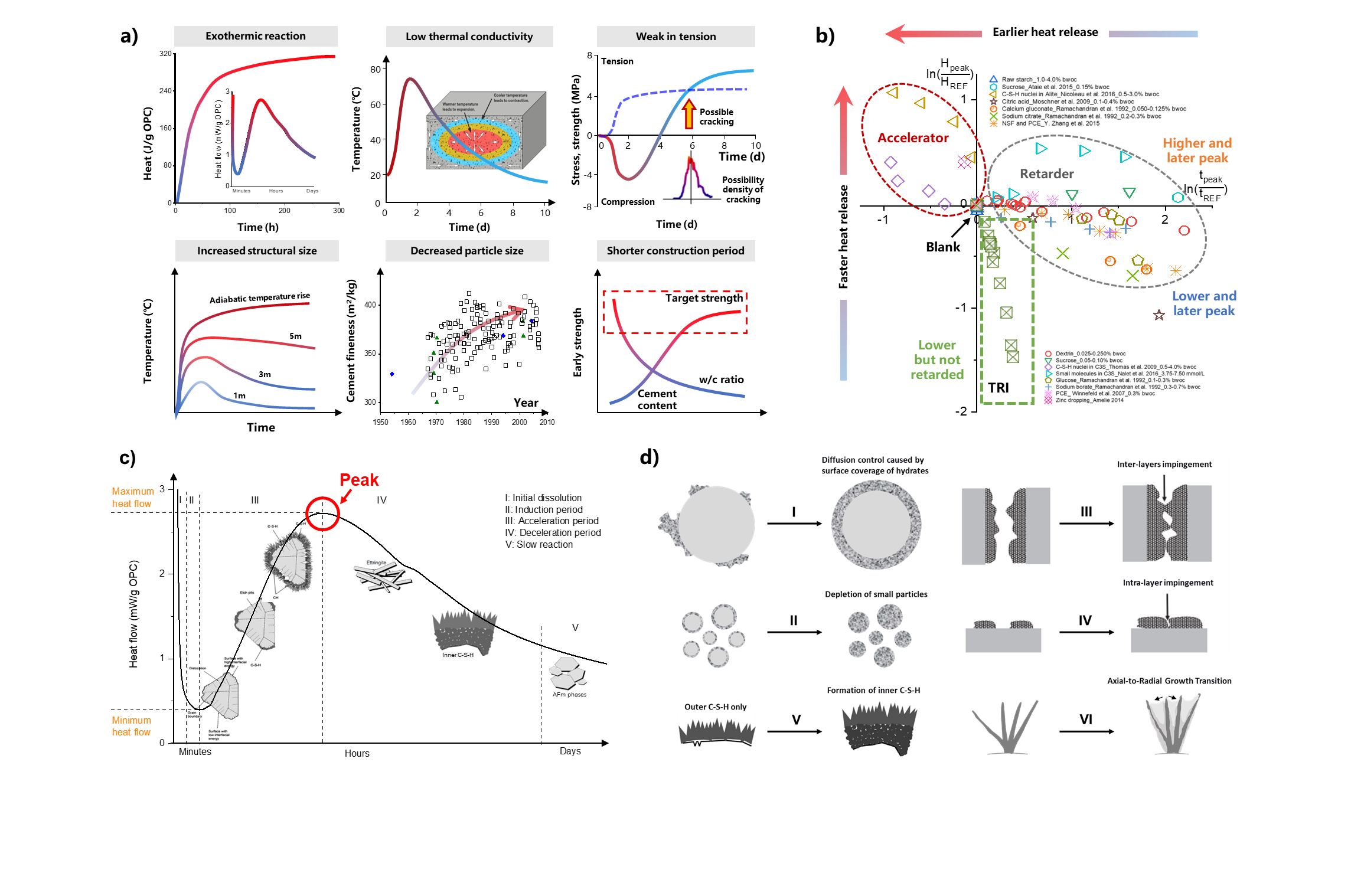
AB  - Thermal cracking poses a significant threat to the structural integrity and service life of mass concrete. The starch-based Temperature Rise Inhibitor (TRI) emerges as a sustainable and efficient bio-based solution that directly addresses the root cause - the intense heat release during early-age cement hydration. Unlike conventional chemical admixtures, TRI features a special "controlled dissolution" mechanism in the high-pH environment of cement paste. This characteristic ensures a continuous release of organic molecules that selectively inhibit the nucleation of calcium silicate hydrates (C-S-H) gel, the primary hydrates of cement hydration. Consequently, TRI significantly slow down the heat release during the first 24 hours after casting without substantially delaying the setting time or compromising long-term strength gain. Here, we highlight the exceptional efficacy of TRI in regulating exothermic process of cement hydration, discussing mechanisms in cement and blended systems and the main challenges regarding their molecular-scale interaction with C-S-H nucleation. As discussed in this perspective, TRI exemplifies the potential of sustainable materials to address fundamental engineering challenges, bridging environmental responsibility with high performance in modern concrete.
SN  - 3070-5851
PB  - Institute of Central Computation and Knowledge
LA  - English
ER  -
@article{Yan2026Mitigating,
  author = {Yu Yan and Yichuan Zhou and Wenbin Wang and Junhui He and Rui Wang},
  title = {Mitigating Thermal Cracking in Mass Concrete with Temperature Rise Inhibitor: A Sustainable and Efficient Strategy},
  journal = {Journal of Advanced Materials Research},
  year = {2026},
  volume = {2},
  number = {1},
  pages = {8-13},
  doi = {10.62762/JAMR.2025.738370},
  url = {https://www.icck.org/article/abs/JAMR.2025.738370},
  abstract = {Thermal cracking poses a significant threat to the structural integrity and service life of mass concrete. The starch-based Temperature Rise Inhibitor (TRI) emerges as a sustainable and efficient bio-based solution that directly addresses the root cause - the intense heat release during early-age cement hydration. Unlike conventional chemical admixtures, TRI features a special "controlled dissolution" mechanism in the high-pH environment of cement paste. This characteristic ensures a continuous release of organic molecules that selectively inhibit the nucleation of calcium silicate hydrates (C-S-H) gel, the primary hydrates of cement hydration. Consequently, TRI significantly slow down the heat release during the first 24 hours after casting without substantially delaying the setting time or compromising long-term strength gain. Here, we highlight the exceptional efficacy of TRI in regulating exothermic process of cement hydration, discussing mechanisms in cement and blended systems and the main challenges regarding their molecular-scale interaction with C-S-H nucleation. As discussed in this perspective, TRI exemplifies the potential of sustainable materials to address fundamental engineering challenges, bridging environmental responsibility with high performance in modern concrete.},
  keywords = {mass concrete, chemical admixture, starch, cement hydration},
  issn = {3070-5851},
  publisher = {Institute of Central Computation and Knowledge}
}
 Copyright © 2026 by the Author(s). Published by Institute of Central Computation and Knowledge. This article is an open access article distributed under the terms and conditions of the Creative Commons Attribution (CC BY) license (https://creativecommons.org/licenses/by/4.0/), which permits use, sharing, adaptation, distribution and reproduction in any medium or format, as long as you give appropriate credit to the original author(s) and the source, provide a link to the Creative Commons licence, and indicate if changes were made.

Portico
All published articles are preserved here permanently:
https://www.portico.org/publishers/icck/