
Volume 2, Issue 2, Journal of Advanced Materials Research
Volume 2, Issue 2, 2026
Submit Manuscript Edit a Special Issue
Article QR Code
Article QR Code
Scan the QR code for reading
Popular articles
Journal of Advanced Materials Research, Volume 2, Issue 2, 2026: 86-96

Open Access | Research Article | 26 February 2026
High Luminous Efficacy and Thermal Stability of LuAG:Ce Phosphor Ceramics with Porosity for High-brightness Laser Lighting
1 College of Materials Science and Engineering, Nanjing Tech University, Nanjing 211816, China
2 State Key Laboratory of High Performance Ceramics, Shanghai Institute of Ceramics, Chinese Academy of Sciences, Shanghai 201899, China
3 Center of Materials Science and Optoelectronics Engineering, University of Chinese Academy of Sciences, Beijing 100049, China
4 Far Eastern Federal University, Vladivostok 690922, Russia
5 Institute of Automation and Control Processes, Far Eastern Branch of the Russian Academy of Sciences, Vladivostok 690041, Russia
* Corresponding Authors: Duyou Lu, [email protected] ; Jiang Li, [email protected]
ARK: ark:/57805/jamr.2026.672409
Received: 06 January 2026, Accepted: 22 February 2026, Published: 26 February 2026  
Abstract
The generation of high-brightness white light in laser-illuminated devices is achieved by exciting yellow-green phosphors with a blue laser source. This configuration offers advantages such as high energy density and strong central luminous intensity. Among luminescent materials, LuAG:Ce phosphor ceramics (PCs) are notable for their high thermal stability and luminous output. In this study, LuAG:Ce PCs were produced from co-precipitated monophase nanopowders. The effects of vacuum sintering and air annealing temperatures on their porosity and luminescent properties were investigated. The sample, sintered at 1550°C and subsequently annealed at 1350°C, exhibited 3.5 vol.% porosity, highest room-temperature emission intensity in the series, and retained 96% of that intensity upon heating to 250°C. Under 450 nm laser-diode excitation, the sample achieved a luminous efficacy of 229 lm·W$^{-1}$ while maintaining excellent thermal stability. These results indicate that introducing controlled porosity to act as light-scattering centers in LuAG:Ce ceramics is a viable materials-design strategy for enhancing the luminous performance of laser-driven lighting devices.

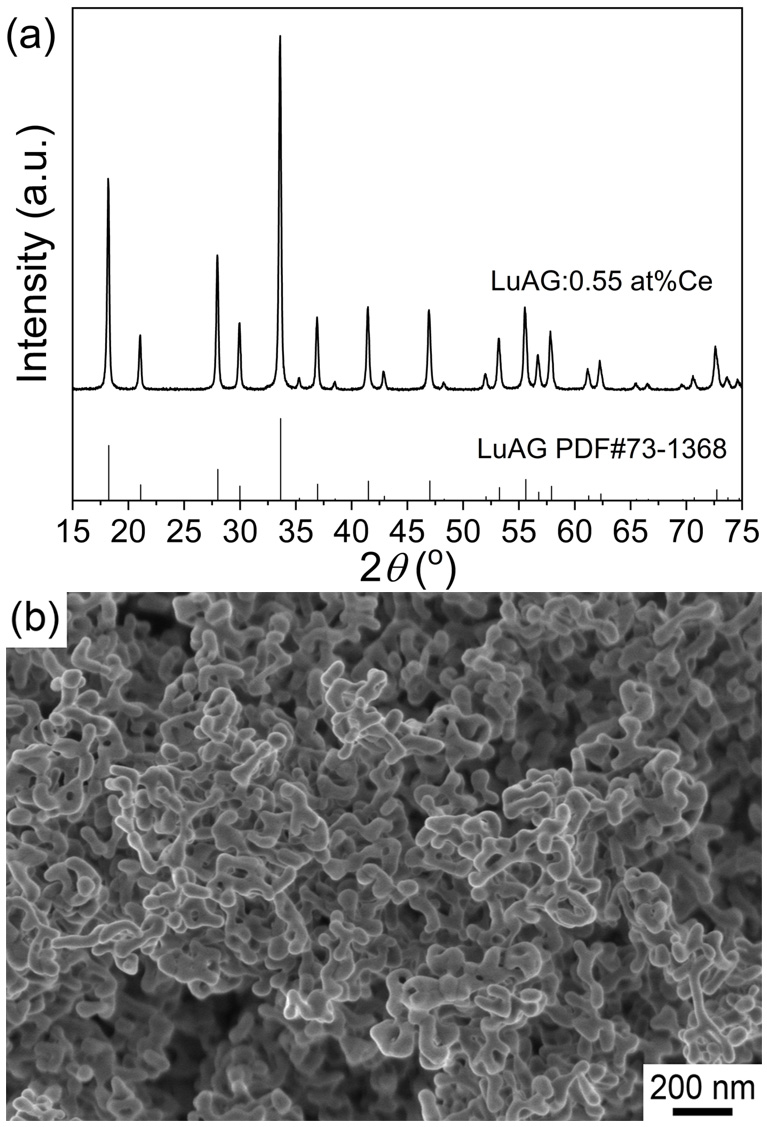
Graphical Abstract
High Luminous Efficacy and Thermal Stability of LuAG:Ce Phosphor Ceramics with Porosity for High-brightness Laser Lighting

Keywords
LuAG:Ce
co-precipitation
ceramics
porosity
luminescence properties

Data Availability Statement
Data will be made available on request.

Funding
This work was supported in part by the National Key R&D Program of China under Grant 2023YFB3506600; in part by the International Cooperation and Exchange Project of the National Natural Science Foundation of China under Grant W2512070; in part by the Shanghai Partnership Research Program under Grant 25HB2706600; in part by the Special Exchange Program of Chinese Academy of Sciences under Grant 121631GJHZ2024017TBJH; Denis Yu. Kosyanov gratefully acknowledges the support from the Russian Science Foundation under Grant 25-73-10179.

Conflicts of Interest
The authors declare no conflicts of interest.

AI Use Statement
The authors declare that no generative AI was used in the preparation of this manuscript.

Ethical Approval and Consent to Participate
Not applicable.

References
  1. Ma, C., & Cao, Y. (2021). Phosphor converters for laser driven light sources. Ma, C., & Cao, Y. (2021). Phosphor converters for laser driven light sources. Applied Physics Letters, 118(21).(21).
    [CrossRef]   [Google Scholar]
  2. Du, B., Li, W., Zhang, L., Chen, P., & Lu, F. (2024). Recent advances in preparing transparent phosphor ceramics for high-index color rendering and high-power lighting. Molecules, 29(6), 1325.
    [CrossRef]   [Google Scholar]
  3. Yang, C., Zhang, X., Kang, J., Wei, C., Sang, P., Lin, S., ... & Zhang, L. (2023). Recent progress on garnet phosphor ceramics for high power solid-state lighting. Journal of Materials Science & Technology, 166, 1-20.
    [CrossRef]   [Google Scholar]
  4. Liu, X., Yang, C., Li, Y., Min, C., Kang, J., Zhou, T., ... & Zhang, L. (2024). High recorded color rendering performance of single-structured Ce, Mn: Y3 (Al, Sc) 2Al3O12 phosphor ceramics for high-power white LEDs/LDs. J. Adv. Ceram., 13(6), 810-820.
    [CrossRef]   [Google Scholar]
  5. Xinglin, P., Shuxing, L., Zehua, L., Xiumin, Y., Rongjun, X., Zhengren, H., & Xuejian, L. (2021). Phosphor ceramics for high-power solid-state lighting. Journal of Inorganic Materials, 36(8), 807-819.
    [Google Scholar]
  6. Jin, M., Cheng, A., Xu, W., Li, Y., Zhang, H., Li, H., ... & Zhou, Y. (2023). Two-step sintered phosphor ceramics for high-power LED applications: Fine microstructure and luminescent property. Ceramics International, 49(16), 27631-27640.
    [CrossRef]   [Google Scholar]
  7. Kravtsov, A. A., Lapin, V. A., Tarala, L. V., Suprunchuk, V. E., Medyanik, E. V., Chapura, O. M., & Malyavin, F. F. (2024). Synthesis and study of the optical and spectral-luminescent properties of LuAG: Ce ceramic. Glass and Ceramics, 80(9), 364-369.
    [CrossRef]   [Google Scholar]
  8. Raukas, M., Kelso, J., Zheng, Y., Bergenek, K., Eisert, D., Linkov, A., & Jermann, F. (2013). Ceramic phosphors for light conversion in LEDs. ECS Journal of Solid State Science and Technology, 2(2), R3168-R3176.
    [CrossRef]   [Google Scholar]
  9. Zhu, Q. Q., Li, S., Yuan, Q., Zhang, H., & Wang, L. (2021). Transparent YAG: Ce ceramic with designed low light scattering for high-power blue LED and LD applications. Journal of the European Ceramic Society, 41(1), 735-740.
    [CrossRef]   [Google Scholar]
  10. Yu, Z., Li, J., Zhao, J., Zhang, H., Mou, Y., Dai, J., ... & Peng, Y. (2025). High Luminescence Saturation Y3Al5O12: Ce3+‐Diamond Composite Color Converter for High‐Brightness Laser‐Driven White Lighting. Laser & Photonics Reviews, 19(3), 2401124.
    [CrossRef]   [Google Scholar]
  11. Kang, J., Liu, X. C., Liu, Z. T., Sun, B. H., Li, Y., Strek, W., Tomala, R. A., Stefanski, M., Zhang, L., & Chen, H. (2024). Rod-shaped LuAG:Ce transparent ceramic enabling ultrahigh forward efficiency for laser lighting in a transmissive mode. Optics Letters, 49(20), 5933-5936.
    [CrossRef]   [Google Scholar]
  12. Chen, H., Zhang, X., Zhou, C., Chen, X., Li, Y., Zhou, T., ... & Zhang, L. (2024). High luminous efficiency and high saturation threshold in highly transparent LuAG: Ce phosphor ceramics for laser diodes lighting. Optics Express, 32(2), 2644-2657.
    [CrossRef]   [Google Scholar]
  13. Li, B., Wang, S., Chen, J., Li, Z., Shan, W., Wang, X., ... & Zhang, L. (2023). 3D Printing of LuAG: Ce transparent ceramics for laser-driven lighting. Ceramics International, 49(23), 38708-38716.
    [CrossRef]   [Google Scholar]
  14. Liu, S. H., Xue, B. G., Zhou, L. M., Cui, H., Liu, M. M., Chen, L., ... & Li, S. (2024). Tailoring thermal behavior and luminous performance in LuAG: Ce films via thickness control for high-power laser lighting applications. Rare Metals, 43(12), 6537-6548.
    [CrossRef]   [Google Scholar]
  15. Wang, Y., Cheng, Z., Zhou, Z., Ye, J., Luo, W., Liu, Y., ... & Li, J. (2025). Pore-coexisting BaAl 2 O 4–LuAG: Ce composite phosphor ceramics for solid-state lighting. Journal of Advanced Ceramics, 14(10), 9221156.
    [CrossRef]   [Google Scholar]
  16. Zheng, P., Li, S., Wei, R., Wang, L., Zhou, T. L., Xu, Y. R., ... & Xie, R. J. (2019). Unique design strategy for laser‐driven color converters enabling superhigh‐luminance and high‐directionality white light. Laser & Photonics Reviews, 13(10), 1900147.
    [CrossRef]   [Google Scholar]
  17. Shen, Z., Zhu, Q. Q., Tian, R., Guo, G., Xie, R. J., & Wang, L. (2024). Investigation of excitation modes in Al2O3-YAG phosphor ceramics for high-power laser-driven lighting. ECS Journal of Solid State Science and Technology, 13(4), 046002.
    [CrossRef]   [Google Scholar]
  18. Volfi, A., Esposito, L., Biasini, V., Piancastelli, A., & Hostaša, J. (2024). Industrial potential of additive manufacturing of transparent ceramics: A review. Open Ceramics, 20, 100682.
    [CrossRef]   [Google Scholar]
  19. Liu, Q., Yuan, Y., Li, J., Liu, J., Hu, C., Chen, M., ... & Guo, J. (2014). Preparation and properties of transparent Eu: YAG fluorescent ceramics with different doping concentrations. Ceramics International, 40(6), 8539-8545.
    [CrossRef]   [Google Scholar]
  20. Rastogi, V., & Chaurasia, S. (2024, October). Advances in and future perspectives on high-power ceramic lasers. In Photonics (Vol. 11, No. 10, p. 942). MDPI.
    [CrossRef]   [Google Scholar]
  21. Tokumitsu, S., Kusunoki, T., Makio, S., & Kawabe, H. (2025). Eutectic phosphor for high‐power excitation. Journal of the Society for Information Display, 33(1), 3-17.
    [CrossRef]   [Google Scholar]
  22. Yan, M., Gong, M., & Ma, J. (2023). High extraction efficiency phosphor design applied in laser lighting. Optics Express, 31(2), 1190-1201.
    [CrossRef]   [Google Scholar]
  23. Yang, Z., de Boer, T., Braun, P. M., Su, B., Zhang, Q., Moewes, A., & Xia, Z. (2023). Thermally stable red‐emitting oxide ceramics for laser lighting. Advanced Materials, 35(30), 2301837.
    [CrossRef]   [Google Scholar]
  24. Feng, T., Shi, J., & Jiang, D. (2008). Preparation of transparent Ce: YSAG ceramic and its optical properties. Journal of the European Ceramic Society, 28(13), 2539-2543.
    [CrossRef]   [Google Scholar]
  25. Wei, C., Kang, J., Shao, C., Sang, P., Zhou, T., Li, M., ... & Zhang, L. (2024). Enhanced efficiency and thermal performance of multistage gradient doping Ce: YAG transparent ceramics for laser lighting. Journal of the European Ceramic Society, 44(10), 5804-5813.
    [CrossRef]   [Google Scholar]
  26. Wang, L., Li, Y., Li, X., Zhu, Y., Zhang, C., Kang, J., ... & Zou, J. (2024). Laser light illuminant based on YAG: Ce phosphor ceramic with ultra-high luminance, stable output, and excellent heat dissipation. Optical Materials, 157, 116410.
    [CrossRef]   [Google Scholar]
  27. Sang, P. F., Zhang, L., Kang, J., Li, M. Z., Chen, S. W., Yang, P., Sun, B. H., Li, Y., Strek, W., & Chen, H. (2024). Composite structure Al\(_2\)O\(_3\)/Al\(_2\)O\(_3\)–YAG:Ce/YAG ceramics with high color spatial uniformity for white laser lighting. Journal of Advanced Ceramics, 13, 189-197.
    [CrossRef]   [Google Scholar]
  28. Wang, Y., Cheng, Z., Ye, J., Hu, C., Zhou, Z., Chen, Y., ... & Li, J. (2024). Ce: LuAG transparent ceramics for high-brightness solid-state lighting: Fabrication and effect of Ce concentration. Optical Materials, 147, 114697.
    [CrossRef]   [Google Scholar]
  29. Xu, Z., Hua, Y., Fan, Z., & Ma, H. (2024). Highly efficient and thermally robust phosphor-in-glass ceramic (PiGc) for high-brightness laser-driven lighting. Ceramics International, 50(1), 36-44.
    [CrossRef]   [Google Scholar]
  30. Wen, Q., Wang, Y., Zhao, C., Xu, L., Wang, X., Xu, Y., ... & Xiang, W. (2023). Ultrahigh power density LuAG: Ce green converters for high‐luminance laser‐driven solid state lighting. Laser & Photonics Reviews, 17(6), 2200909.
    [CrossRef]   [Google Scholar]
  31. Li, H., Zhou, D., Ling, J., Zhang, H., Xu, W., Zhou, Y., & Hong, M. (2024). Synthesis of high quality green phosphors by co-precipitation and induction heating. Ceramics International, 50(17), 30587-30594.
    [CrossRef]   [Google Scholar]
  32. Zhou, M., Sun, J., Zhang, B., Hua, Y., Huang, F., Ma, H., ... & Xu, S. (2023). Ultra-high efficiency green-emitting LuAG: Ce phosphor-in-ceramic applied for high-power laser lighting. Journal of the European Ceramic Society, 43(8), 3563-3571.
    [CrossRef]   [Google Scholar]
  33. Li, S., Guo, Y., & Xie, R. J. (2022). Laser phosphors for next-generation lighting applications. Accounts of Materials Research, 3(12), 1299-1308.
    [CrossRef]   [Google Scholar]
  34. Zhou, J. L., Zhu, W., Huang, F. F., Ma, H. P., Ye, R. R., Hua, Y. J., & Xu, S. Q. (2025). Effect of porosity on optical performance and thermal stability of LuAG:Ce phosphor-in-glass for laser lighting. Journal of Alloys and Compounds, 1018, 179206.
    [CrossRef]   [Google Scholar]
  35. Liu, B., Pang, S., Chen, X., Yuan, S., Jiang, Z., Ye, Z., ... & Jensen, O. B. (2024). Pore-existing phosphor-in-glass film realizing ultra-efficient and uniform laser lighting. Journal of Luminescence, 266, 120337.
    [CrossRef]   [Google Scholar]
  36. Cheng, Z. Q., Wang, Y. B., Li, W. Y., Liu, Q., Deng, T. L., Liu, X., Li, S. X., Zhou, G. H., Xie, R. J., & Li, J. (2023). Porous YAG:Ce ceramics with controllable microstructure for high-brightness laser lighting. Journal of the American Ceramic Society, 106(5), 2903-2910.
    [CrossRef]   [Google Scholar]
  37. Wagner, A., Ratzker, B., Kalabukhov, S., Sokol, M., & Frage, N. (2019). Residual porosity and optical properties of spark plasma sintered transparent polycrystalline cerium-doped YAG. Journal of the European Ceramic Society, 39(4), 1436-1442.
    [CrossRef]   [Google Scholar]
  38. Zhang, Y., Hu, S., Wang, Z., Zhou, G., & Wang, S. (2018). Pore-existing Lu3Al5O12: Ce ceramic phosphor: An efficient green color converter for laser light source. Journal of Luminescence, 197, 331-334.
    [CrossRef]   [Google Scholar]
  39. Yang, N., Ji, Y., Zhu, H., Qian, Y., & Wang, L. (2025). Non-spherical pore scattering-enhanced YAG: Ce 3+, Cr 3+ ceramics: efficient light converters for high-brightness laser illumination. Journal of Materials Chemistry C, 13(48), 23945-23957.
    [CrossRef]   [Google Scholar]
  40. HU, C., LIU, Z. Y., LUO, W., CHENG, Z. Q., WANG, Y. B., LI, T. S., & LI, J. (2025). Test Methods for Optical and Opto-Functional Transparent Ceramics. Advanced Ceramics, 46(3-4), 286-326.
    [CrossRef]   [Google Scholar]
  41. Ji, E. K., Song, Y. H., Bak, S. H., Jung, M. K., Jeong, B. W., Lee, D. B., & Yoon, D. H. (2015). The design of a ceramic phosphor plate with functional materials for application in high power LEDs. Journal of Materials Chemistry C, 3(48), 12390-12393.
    [CrossRef]   [Google Scholar]

Cite This Article
APA Style
Li, H., Cheng, Z., Zhou, Z., Hu, C., Ye, J., Huang, D., Wang, Y., Li, T., Kosyanov, D. Y., Lu, D., & Li, J. (2026). High Luminous Efficacy and Thermal Stability of LuAG:Ce Phosphor Ceramics with Porosity for High-brightness Laser Lighting. Journal of Advanced Materials Research, 2(1), 86–96. https://doi.org/10.62762/JAMR.2026.672409
Export Citation
RIS Format
Compatible with EndNote, Zotero, Mendeley, and other reference managers
RIS format data for reference managers
TY  - JOUR
AU  - Li, Haiming
AU  - Cheng, Ziqiu
AU  - Zhou, Zhenzhen
AU  - Hu, Chen
AU  - Ye, Junhao
AU  - Huang, Dong
AU  - Wang, Yanbin
AU  - Li, Tingsong
AU  - Yu. Kosyanov, Denis
AU  - Lu, Duyou
AU  - Li, Jiang
PY  - 2026
DA  - 2026/02/26
TI  - High Luminous Efficacy and Thermal Stability of LuAG:Ce Phosphor Ceramics with Porosity for High-brightness Laser Lighting
JO  - Journal of Advanced Materials Research
T2  - Journal of Advanced Materials Research
JF  - Journal of Advanced Materials Research
VL  - 2
IS  - 2
SP  - 86
EP  - 96
DO  - 10.62762/JAMR.2026.672409
UR  - https://www.icck.org/article/abs/JAMR.2026.672409
KW  - LuAG:Ce
KW  - co-precipitation
KW  - ceramics
KW  - porosity
KW  - luminescence properties
AB  - The generation of high-brightness white light in laser-illuminated devices is achieved by exciting yellow-green phosphors with a blue laser source. This configuration offers advantages such as high energy density and strong central luminous intensity. Among luminescent materials, LuAG:Ce phosphor ceramics (PCs) are notable for their high thermal stability and luminous output. In this study, LuAG:Ce PCs were produced from co-precipitated monophase nanopowders. The effects of vacuum sintering and air annealing temperatures on their porosity and luminescent properties were investigated. The sample, sintered at 1550°C and subsequently annealed at 1350°C, exhibited 3.5 vol.% porosity, highest room-temperature emission intensity in the series, and retained 96% of that intensity upon heating to 250°C. Under 450 nm laser-diode excitation, the sample achieved a luminous efficacy of 229 lm·W$^{-1}$ while maintaining excellent thermal stability. These results indicate that introducing controlled porosity to act as light-scattering centers in LuAG:Ce ceramics is a viable materials-design strategy for enhancing the luminous performance of laser-driven lighting devices.
SN  - 3070-5851
PB  - Institute of Central Computation and Knowledge
LA  - English
ER  - 
BibTeX Format
Compatible with LaTeX, BibTeX, and other reference managers
BibTeX format data for LaTeX and reference managers
@article{Li2026High,
  author = {Haiming Li and Ziqiu Cheng and Zhenzhen Zhou and Chen Hu and Junhao Ye and Dong Huang and Yanbin Wang and Tingsong Li and Denis Yu. Kosyanov and Duyou Lu and Jiang Li},
  title = {High Luminous Efficacy and Thermal Stability of LuAG:Ce Phosphor Ceramics with Porosity for High-brightness Laser Lighting},
  journal = {Journal of Advanced Materials Research},
  year = {2026},
  volume = {2},
  number = {2},
  pages = {86-96},
  doi = {10.62762/JAMR.2026.672409},
  url = {https://www.icck.org/article/abs/JAMR.2026.672409},
  abstract = {The generation of high-brightness white light in laser-illuminated devices is achieved by exciting yellow-green phosphors with a blue laser source. This configuration offers advantages such as high energy density and strong central luminous intensity. Among luminescent materials, LuAG:Ce phosphor ceramics (PCs) are notable for their high thermal stability and luminous output. In this study, LuAG:Ce PCs were produced from co-precipitated monophase nanopowders. The effects of vacuum sintering and air annealing temperatures on their porosity and luminescent properties were investigated. The sample, sintered at 1550°C and subsequently annealed at 1350°C, exhibited 3.5 vol.\% porosity, highest room-temperature emission intensity in the series, and retained 96\% of that intensity upon heating to 250°C. Under 450 nm laser-diode excitation, the sample achieved a luminous efficacy of 229 lm·W\$^{-1}\$ while maintaining excellent thermal stability. These results indicate that introducing controlled porosity to act as light-scattering centers in LuAG:Ce ceramics is a viable materials-design strategy for enhancing the luminous performance of laser-driven lighting devices.},
  keywords = {LuAG:Ce, co-precipitation, ceramics, porosity, luminescence properties},
  issn = {3070-5851},
  publisher = {Institute of Central Computation and Knowledge}
}

Article Metrics
Citations:

Crossref

0

Scopus

0

Web of Science

0
Article Access Statistics:
Views: 27
PDF Downloads: 8

Publisher's Note
ICCK stays neutral with regard to jurisdictional claims in published maps and institutional affiliations.

Rights and Permissions
CC BY Copyright © 2026 by the Author(s). Published by Institute of Central Computation and Knowledge. This article is an open access article distributed under the terms and conditions of the Creative Commons Attribution (CC BY) license (https://creativecommons.org/licenses/by/4.0/), which permits use, sharing, adaptation, distribution and reproduction in any medium or format, as long as you give appropriate credit to the original author(s) and the source, provide a link to the Creative Commons licence, and indicate if changes were made.
Journal of Advanced Materials Research

Journal of Advanced Materials Research

ISSN: 3070-5851 (Online)

Email: [email protected]

Portico

Portico

All published articles are preserved here permanently:
https://www.portico.org/publishers/icck/