

A Dynamic Core Modulation Strategy for Enhancing Active Sites of Polymer-Derived Carbon Electrocatalysts


Article Information
Abstract
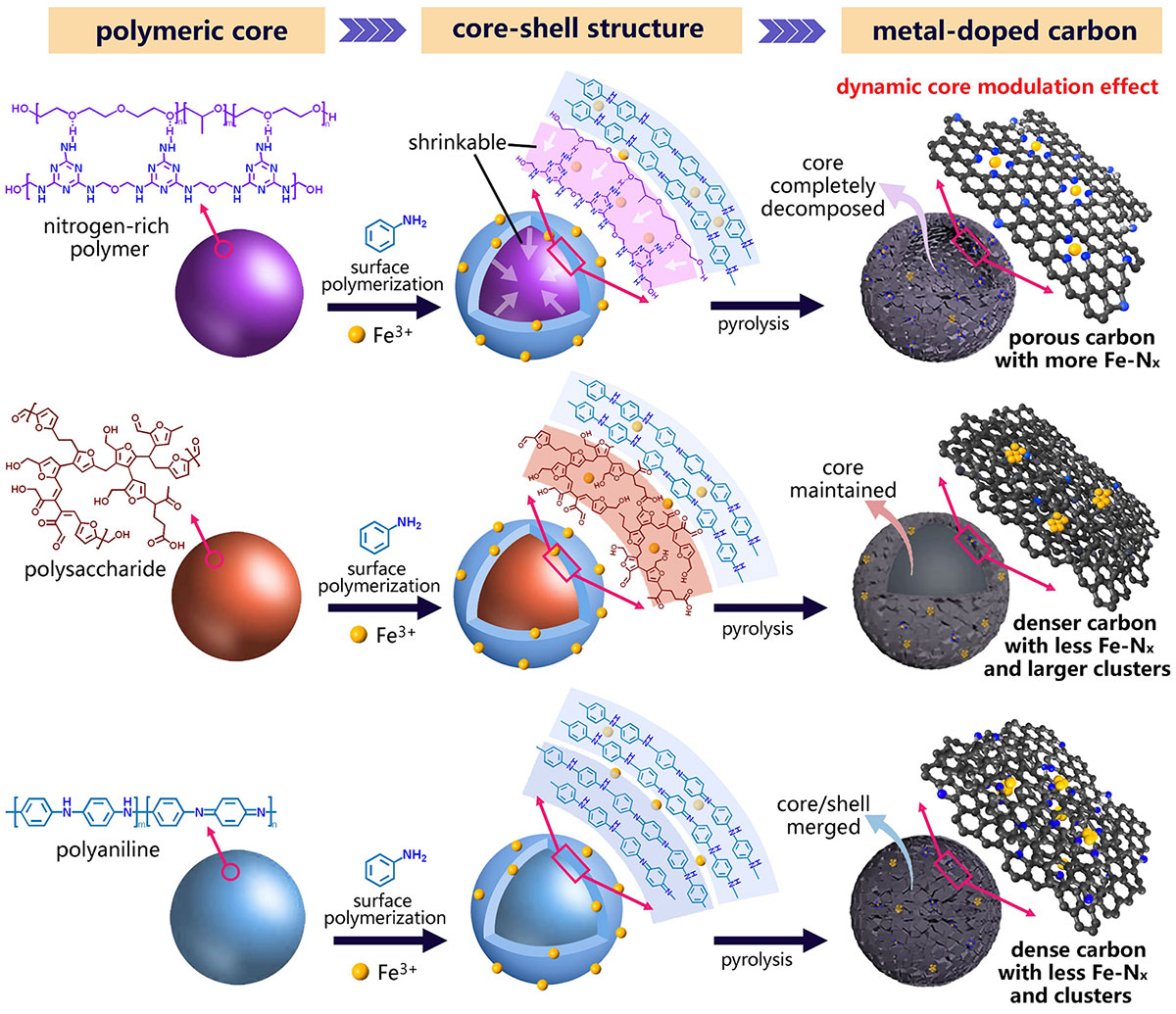
Polymer-derived carbons have emerged as efficient and economical electrocatalysts for energy-related reactions such as oxygen reduction and hydrogen evolution. However, their performance often faces an inherent trade-off between porosity and electronic conductivity, necessitating precise regulation of composition and structure at the molecular level. To enhance the formation of accessible active sites, we construct a series of core@polyaniline precursors with systematically varied organic cores (a nitrogen-rich polymer (NPS), polysaccharide (GluS), and polyaniline (PANI) itself). Metals ions are introduced during the shell polymerization. The resultant core-shell precursors were then subjected to pyrolysis, where the carbon network forms with Fe-N active sites generated inside. We propose that the core polymer remotely modulates the formation of active sites in the carbon shell during pyrolysis. Through combined structural characterization and electrocatalytic evaluation, we find that the nitrogen-rich polymeric core, which undergoes pronounced volume change during pyrolysis, promotes the formation of a more graphitized, electron-conductive carbon network with a higher density of accessible Fe-N sites. In contrast, the polysaccharide core with a mild pyrolysis profile and the chemically identical PANI core lack this dynamic templating ability and do not effectively optimize the carbon structure. Through this dynamic core modulation, a Fe/Ni co-loaded catalyst was also prepared, achieving excellent bifunctional ORR/HER performance, with an ORR half-wave potential of 0.89 V (vs RHE) and an HER overpotential of 298 mV, along with good stability. This work provides a new perspective for the rational design of polymer-derived carbon electrocatalysts, shifting attention from static precursor composition to the dynamic role of the core during pyrolysis.
Graphical Abstract
Keywords
Data Availability Statement
Funding
Conflicts of Interest
AI Use Statement
Ethical Approval and Consent to Participate
References
- Zhao, Z., Sun, L., Li, Y., & Feng, W. (2023). Polymer-derived carbon materials for energy storage devices: A mini review. Carbon, 210, 118066.
[CrossRef] [Google Scholar] - Li, W., Wang, C., & Lu, X. (2022). Conducting polymers-derived fascinating electrocatalysts for advanced hydrogen and oxygen electrocatalysis. Coordination Chemistry Reviews, 464, 214555.
[CrossRef] [Google Scholar] - Li, K., Meng, F., Li, J., Wu, H., Jia, H., & Ji, Q. (2026). Engineering accessible Fe-N sites in polypyrrole-derived-catalysts via a dynamic coordination strategy. Sustainable Energy Fuels, 10, 587-595.
[CrossRef] [Google Scholar] - Wu, H., Li, J., Ji, Q., & Ariga, K. (2024). Nanoarchitectonics for structural tailoring of yolk-shell architectures for electrochemical applications. Science and Technology of Advanced Materials, 25, 2420664.
[CrossRef] [Google Scholar] - Jones, C. F., Resina, L., Ferreira, F. C., Sanjuan-Alberte, P., & Esteves, T. (2024). Conductive core–shell nanoparticles: Synthesis and applications. Journal of Physical Chemistry C, 128(27), 11083-11100.
[CrossRef] [Google Scholar] - Das, S., Pérez-Ramírez, J., Gong, J., Dewangan, N., Hidajat, K., Gates, B. C., & Kawi, S. (2020). Core-shell structured catalysts for thermocatalytic, photocatalytic, and electrocatalytic conversion of CO2. Chemical Society Reviews, 49, 2937-3004.
[CrossRef] [Google Scholar] - Nguyen, Q. H., Im, K., & Kim, J. (2022). Synthesis of hollow Fe, Co, and N-doped carbon catalysts from conducting polymer-metal-organic-frameworks core-shell particles for their application in an oxygen reduction reaction. International Journal of Hydrogen Energy, 47, 24169-24178.
[CrossRef] [Google Scholar] - Jiao, S., Li, C., Zhang, Y., Li, Z., Liu, K., & Wang, L. (2023). ZIF-8-templated synthesis of core-shell structured IPOP@MOF hybrid-derived nitrogen-doped porous carbon for efficient oxygen reduction electrocatalysis and supercapacitor. Electrochimica Acta, 441, 141817.
[CrossRef] [Google Scholar] - Campos-Roldan, C. A., Gonzalez-Huerta, G., & Alonso-Vante, N. (2018). Experimental protocol for HOR and ORR in alkaline electrochemical measurements. Journal of The Electrochemical Society, 165, J3001.
[CrossRef] [Google Scholar] - Márquez, R. A., Kawashima, K., Son, Y. J., Castelino, G., Miller, N., Smith, L. A., Chukwuneke, C. E., & Mullins, C. B. (2023). Getting the basics right: Preparing alkaline electrolytes for electrochemical applications. ACS Energy Letters, 8(2), 1141-1146.
[CrossRef] [Google Scholar] - Ding, D., Gao, F., Wu, Y., Li, Y., Li, T., & Ren, B. (2023). Preparation and electrochemical application of melamine resin-based carbon materials. Journal of Porous Materials, 30, 1319-1335.
[CrossRef] [Google Scholar] - Rao, L., Ma, R., Liu, S., Wang, L., Wu, Z., Yang, J., & Hu, X. (2019). Nitrogen enriched porous carbons from d-glucose with excellent CO2 capture performance. Chemical Engineering Journal, 362, 794-801.
[CrossRef] [Google Scholar] - Xie, N.-H., Yan, X.-H., & Xu, B.-Q. (2016). Is ammonium peroxydisulfate indispensable for preparation of aniline-derived iron–nitrogen–carbon electrocatalysts. ChemSusChem, 9, 2301-2306.
[CrossRef] [Google Scholar] - Ullah, S., Bustam, M. A., Nadeem, M., Naz, M. Y., Tan, W. L., & Shariff, A. M. (2014). Synthesis and thermal degradation studies of melamine formaldehyde resins. Scientific World Journal, 2014, 940502.
[CrossRef] [Google Scholar] - Akula, S., & Sahu, A. K. (2020). Structurally modulated graphitic carbon nanofiber and heteroatom (N,F) engineering toward metal-free ORR electrocatalysts for polymer electrolyte membrane fuel cells. ACS Applied Materials & Interfaces, 12, 11438-11449.
[CrossRef] [Google Scholar] - Bora, N., Joshi, D. P., & Aulakh, J. S. (2024). Influence of polyaniline conducting polymer on thermal properties of phase change material for thermal energy storage. Polymer Bulletin, 81, 1597–1621.
[CrossRef] [Google Scholar] - Nobrega, M. M., Silva, H. B., Constantino, V. R. L., & Temperini, M. L. A. (2012). Spectroscopic study on the structural differences of thermally induced cross-linking segments in emeraldine salt and base forms of polyaniline. Journal of Physical Chemistry B, 116(48), 14191-14200.
[CrossRef] [Google Scholar] - Song, W., Xiao, C., Ding, J., Huang, Z., Yang, X., Zhang, T., Mitlin, D., & Hu, W. (2024). Review of carbon support coordination environments for single metal atom electrocatalysts (SACS). Advanced Materials, 36, 2301477.
[CrossRef] [Google Scholar] - Wang, J., Bai, J., Cang, Y., Li, Q., Fan, X., & Lin, H. (2023). Noble metal single-atom coordinated to nitrogen, oxygen, and carbon as electrocatalysts for oxygen evolution. Catalysts, 13(10), 1378.
[CrossRef] [Google Scholar] - Wang, W., Zuo, X., Yang, Q., Tang, H., Zhang, H., & Li, G. (2022). Constructing Fe/Fe3C nanocrystals with Fe-Nx sites in Fe–N–C electrocatalyst to achieve high performance for solar cells. Applied Catalysis B: Environmental, 300, 120726.
[CrossRef] [Google Scholar] - Tian, Y., Xu, L., Qian, J., Bao, J., Yan, C., Li, H., Li, H., & Zhang, S. (2019). Fe3C/Fe2O3 heterostructure embedded in N-doped graphene as a bifunctional catalyst for quasi-solid-state zinc–air batteries. Carbon, 146, 763-771.
[CrossRef] [Google Scholar] - Wei, J., Xia, D., Wei, Y., Zhu, X., Li, J., & Gan, L. (2022). Probing the oxygen reduction reaction intermediates and dynamic active site structures of molecular and pyrolyzed Fe–N–C electrocatalysts by in situ Raman spectroscopy. ACS Catalysis, 12, 7811–7820.
[CrossRef] [Google Scholar] - Zhou, Y., Yu, Y., Ma, D., Foucher, A. C., Xiong, L., Zhang, J., Stach, E. A., Yue, Q., & Kang, Y. (2021). Atomic Fe dispersed hierarchical mesoporous Fe–N–C nanostructures for an efficient oxygen reduction reaction. ACS Catalysis, 11, 74–81.
[CrossRef] [Google Scholar] - Xu, H., Li, R., Li, Y., Lu, X., Liu, H., Yang, P., & Bai, J. (2025). Research progress of atomically dispersed iron, nitrogen co-coordinated carbon catalysts for oxygen reduction: a mini-review. Journal of Materials Chemistry A, 13, 13675-13692.
[CrossRef] [Google Scholar] - Zhou, Y., Mao, Y., Chang, M., Wang, Z., Xie, W., Ye, C., Wei, S., Thomsen, L., & Waterhouse, G. I. N. (2026). Tuning the electronic structure and spin state of Fe-N-C catalysts using an axial oxygen ligand and Fe clusters for high-efficiency rechargeable zinc–air batteries. Advanced Functional Materials, 36, e19133.
[CrossRef] [Google Scholar] - Xu, X., Guo, Y., Bloom, B. P., Wei, J., Li, H., Li, H., Du, Y., Zeng, Z., Li, L., & Waldeck, D. H. (2020). Elemental core level shift in high entropy alloy nanoparticles via X-ray photoelectron spectroscopy analysis and first-principles calculation. ACS Nano, 14, 17704–17712.
[CrossRef] [Google Scholar] - Wu, J., Ma, Z., Yu, L., Wang, S., Yang, F., & Feng, L. (2024). Phase and chemical state tuning of FeNi oxides for oxygen evolution reaction. Science China Chemistry, 67, 2755–2766.
[CrossRef] [Google Scholar] - Zhang, W., Yi, S., Yu, Y., Liu, H., Kucernak, A., Wu, J., & Li, S. (2024). Fe-based dual-atom catalysts for the oxygen reduction reaction. Journal of Materials Chemistry A, 12, 87-112.
[CrossRef] [Google Scholar] - Zhang, L., Li, B., Xu, H.-Y., Shan, L.-W., & Dong, L.-M. (2026). Modulation strategies of d-band center for HER and AOPs applications: a comprehensive review. Inorganic Chemistry Frontiers, 13, 1739-1765.
[CrossRef] [Google Scholar] - Kuroki, S., Hosaka, Y., & Yamauchi, C. (2013). A solid-state NMR study of the carbonization of polyaniline. Carbon, 55, 160-167.
[CrossRef] [Google Scholar] - Yu, H., Liu, D., Srinivas, K., Ma, F., Zhang, Z., Wang, M., Wu, Y., Wang, Y., Li, X., & Chen, Y. (2023). Core-shell Fe/Fe3C heterostructure@carbon layers anchored on N-doped porous carbon for boosting oxygen reduction reaction. Journal of Alloys and Compounds, 949, 169863.
[CrossRef] [Google Scholar] - Zhou, J., Tang, Y., Zhang, L., Yang, H., He, X., Wu, H., Zhang, Y., & Zhou, A. (2025). F127-mediated synthesis of hierarchical core–shell Fe/N-Doped carbon catalyst for enhanced oxygen reduction reaction. Ionics, 31, 13175-13186.
[CrossRef] [Google Scholar] - Xiao, L., Yu, W., Liu, J., Luan, S., Li, S., Cui, X., & Jiang, L. (2024). Boosting Oxygen Reduction Reaction via N, S-Doped Carbon Shell Encapsulated Fe5C2: Leveraging Lateral and Axial Synergy. ACS Sustainable Chemistry & Engineering, 12, 4709-4717.
[CrossRef] [Google Scholar] - He, Y., Yang, J., Wang, Y., Jia, Y., Li, H., Liu, Y., Liu, L., & Tan, Q. (2024). Atomically dispersed dual-metal ORR catalyst with hierarchical porous structure for Zn–air batteries. ACS Applied Materials & Interfaces, 16, 12398-12406.
[CrossRef] [Google Scholar] - Song, J., Ren, Y., Li, J., Huang, X., Cheng, F., Tang, Y., & Wang, H. (2018). Core-shell Co/CoNx@C nanoparticles enfolded by Co-N doped carbon nanosheets as a highly efficient electrocatalyst for oxygen reduction reaction. Carbon, 138, 300-308.
[CrossRef] [Google Scholar] - Li, S., Miao, W., Lv, E., Cao, X., Li, X., Zhang, X., Yu, H., & Dong, X. (2022). High-performance ORR Catalyst of N-doping Carbon-coated Cobalt Nanoparticles Synthesized by DC Arc Plasma. ChemistrySelect, 7, e202201823.
[CrossRef] [Google Scholar] - Wang, D., Wang, Q., Jiang, S., Dong, K., Wang, Z., Luo, S., Liu, Y., Zhang, Y., Wang, Q., & Yi, T. (2020). NiCo alloy nanoparticles encapsulated in N-doped 3D porous carbon as efficient electrocatalysts for oxygen reduction reaction. International Journal of Hydrogen Energy, 45, 22797-22807.
[CrossRef] [Google Scholar] - Cao, X., Miao, W., Qin, M., Lv, E., Yu, H., Zhang, X., & Dong, X. (2023). N-doping carbon-coated Cu@C(N) nanocapsules synthesized by arc plasma toward high-performance ORR electrocatalyst. Journal of Alloys and Compounds, 948, 169739.
[CrossRef] [Google Scholar] - Quan, L., Yu, X., Wang, T., Yin, W., Liu, J., Wang, L., & Zhang, Y. (2019). Ultrafine Co@nitrogen-doped carbon core-shell nanostructures anchored on carbon nanotubes for highly efficient oxygen reduction. Applied Surface Science, 494, 691-699.
[CrossRef] [Google Scholar] - Wang, H., Wang, W., Xu, Y. Y., Dong, S., Xiao, J., Wang, F., Liu, H., & Xia, B. Y. (2017). Hollow nitrogen-Doped carbon spheres with Fe3O4 nanoparticles encapsulated as a highly active oxygen-reduction catalyst. ACS Applied Materials & Interfaces, 9, 10610-10617.
[CrossRef] [Google Scholar] - Wu, M., Xie, J., Liu, A., Jia, W., & Cao, Y. (2020). Iron carbide/nitrogen-doped carbon core-shell nanostructures: Solution-free synthesis and superior oxygen reduction performance. Journal of Colloid and Interface Science, 566, 194-201.
[CrossRef] [Google Scholar] - Liu, S., Wang, Z., Zhou, S., Yu, F., Yu, M., Chiang, C.-Y., Zhou, W., Zhao, J., & Qiu, J. (2017). Metal–organic-framework-derived hybrid carbon nanocages as a bifunctional electrocatalyst for oxygen reduction and evolution. Advanced Materials, 29, 1700874.
[CrossRef] [Google Scholar]
Cite This Article
TY  - JOUR
AU  - Zhang, Zidan
AU  - Wu, Huan
AU  - Jia, Boyu
AU  - Ji, Qingmin
AU  - Quan, Hengdao
PY  - 2026
DA  - 2026/07/06
TI  - A Dynamic Core Modulation Strategy for Enhancing Active Sites of Polymer-Derived Carbon Electrocatalysts
JO  - Journal of Advanced Materials Research
T2  - Journal of Advanced Materials Research
JF  - Journal of Advanced Materials Research
VL  - 2
IS  - 3
SP  - 169
EP  - 194
DO  - 10.62762/JAMR.2026.894537
UR  - https://www.icck.org/article/abs/JAMR.2026.894537
KW  - polymer-derived carbons
KW  - metal-N active sites
KW  - core-shell polymers
KW  - electrocatalysis
KW  - core-to-shell remote modulation
AB  - Polymer-derived carbons have emerged as efficient and economical electrocatalysts for energy-related reactions such as oxygen reduction and hydrogen evolution. However, their performance often faces an inherent trade-off between porosity and electronic conductivity, necessitating precise regulation of composition and structure at the molecular level. To enhance the formation of accessible active sites, we construct a series of core@polyaniline precursors with systematically varied organic cores (a nitrogen-rich polymer (NPS), polysaccharide (GluS), and polyaniline (PANI) itself). Metals ions are introduced during the shell polymerization. The resultant core-shell precursors were then subjected to pyrolysis, where the carbon network forms with Fe-N active sites generated inside. We propose that the core polymer remotely modulates the formation of active sites in the carbon shell during pyrolysis. Through combined structural characterization and electrocatalytic evaluation, we find that the nitrogen-rich polymeric core, which undergoes pronounced volume change during pyrolysis, promotes the formation of a more graphitized, electron-conductive carbon network with a higher density of accessible Fe-N sites. In contrast, the polysaccharide core with a mild pyrolysis profile and the chemically identical PANI core lack this dynamic templating ability and do not effectively optimize the carbon structure. Through this dynamic core modulation, a Fe/Ni co-loaded catalyst was also prepared, achieving excellent bifunctional ORR/HER performance, with an ORR half-wave potential of 0.89 V (vs RHE) and an HER overpotential of 298 mV, along with good stability. This work provides a new perspective for the rational design of polymer-derived carbon electrocatalysts, shifting attention from static precursor composition to the dynamic role of the core during pyrolysis.
SN  - 3070-5851
PB  - Institute of Central Computation and Knowledge
LA  - English
ER  -
@article{Zhang2026A,
  author = {Zidan Zhang and Huan Wu and Boyu Jia and Qingmin Ji and Hengdao Quan},
  title = {A Dynamic Core Modulation Strategy for Enhancing Active Sites of Polymer-Derived Carbon Electrocatalysts},
  journal = {Journal of Advanced Materials Research},
  year = {2026},
  volume = {2},
  number = {3},
  pages = {169-194},
  doi = {10.62762/JAMR.2026.894537},
  url = {https://www.icck.org/article/abs/JAMR.2026.894537},
  abstract = {Polymer-derived carbons have emerged as efficient and economical electrocatalysts for energy-related reactions such as oxygen reduction and hydrogen evolution. However, their performance often faces an inherent trade-off between porosity and electronic conductivity, necessitating precise regulation of composition and structure at the molecular level. To enhance the formation of accessible active sites, we construct a series of core@polyaniline precursors with systematically varied organic cores (a nitrogen-rich polymer (NPS), polysaccharide (GluS), and polyaniline (PANI) itself). Metals ions are introduced during the shell polymerization. The resultant core-shell precursors were then subjected to pyrolysis, where the carbon network forms with Fe-N active sites generated inside. We propose that the core polymer remotely modulates the formation of active sites in the carbon shell during pyrolysis. Through combined structural characterization and electrocatalytic evaluation, we find that the nitrogen-rich polymeric core, which undergoes pronounced volume change during pyrolysis, promotes the formation of a more graphitized, electron-conductive carbon network with a higher density of accessible Fe-N sites. In contrast, the polysaccharide core with a mild pyrolysis profile and the chemically identical PANI core lack this dynamic templating ability and do not effectively optimize the carbon structure. Through this dynamic core modulation, a Fe/Ni co-loaded catalyst was also prepared, achieving excellent bifunctional ORR/HER performance, with an ORR half-wave potential of 0.89 V (vs RHE) and an HER overpotential of 298 mV, along with good stability. This work provides a new perspective for the rational design of polymer-derived carbon electrocatalysts, shifting attention from static precursor composition to the dynamic role of the core during pyrolysis.},
  keywords = {polymer-derived carbons, metal-N active sites, core-shell polymers, electrocatalysis, core-to-shell remote modulation},
  issn = {3070-5851},
  publisher = {Institute of Central Computation and Knowledge}
}
Article Metrics
Publisher's Note
ICCK stays neutral with regard to jurisdictional claims in published maps and institutional affiliations.
Rights and Permissions
 Copyright © 2026 by the Author(s). Published by Institute of Central Computation and Knowledge. This article is an open access article distributed under the terms and conditions of the Creative Commons Attribution (CC BY) license (https://creativecommons.org/licenses/by/4.0/), which permits use, sharing, adaptation, distribution and reproduction in any medium or format, as long as you give appropriate credit to the original author(s) and the source, provide a link to the Creative Commons licence, and indicate if changes were made.


Portico
