

Evaluation of Structural Preservation Conditions for Shale Gas in Relict Syncline: A Case Study of Devonian-Carboniferous Strata in the Guizhou-Guangxi Area


Article Information
Abstract
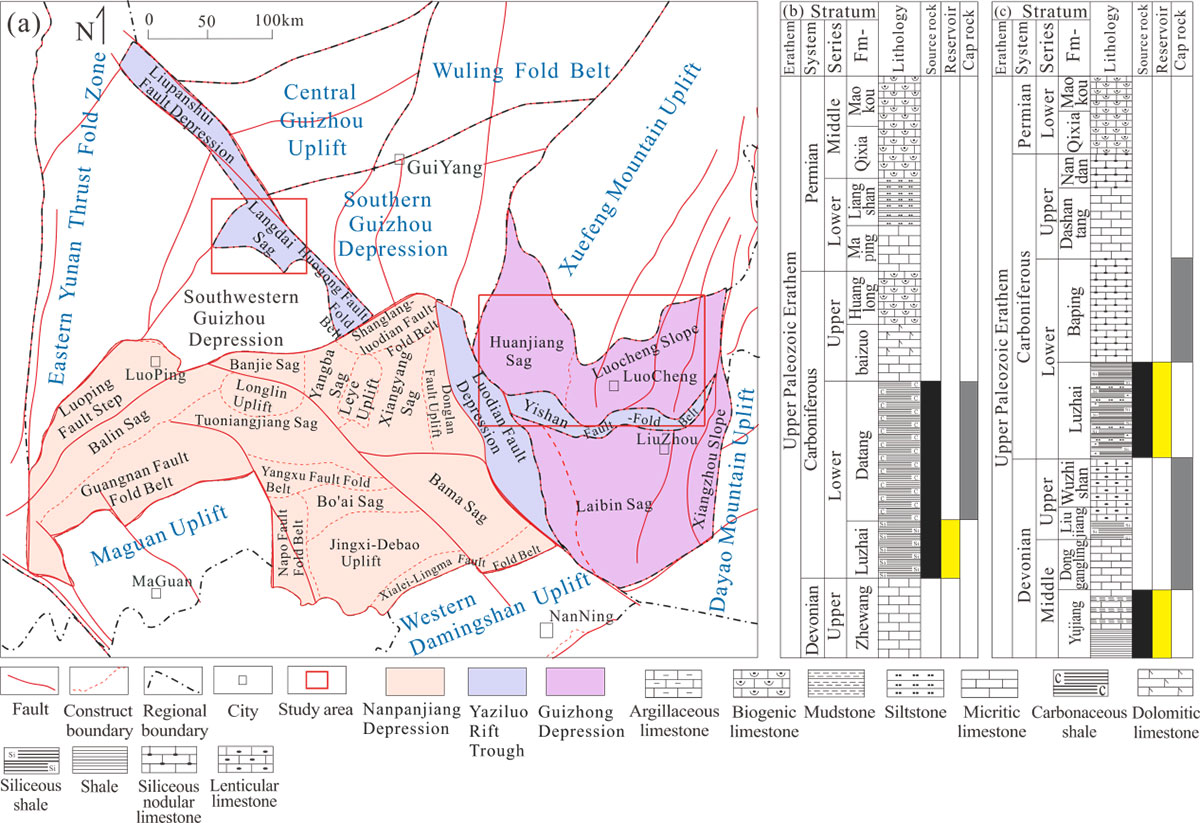
This study investigates the key factors controlling marine shale gas preservation in Devonian–Carboniferous strata, focusing on four representative synclines in the Nanpanjiang Basin and the northern margin of the Guizhong Depression: Langdai, Xinzhai, West Yizhou, and North Yizhou. Through tectonic characterization and balanced cross-section restoration, we clarify the effects of structural style, tectonic deformation intensity, and fault properties on shale gas preservation. Wide-gentle bidirectional thrust synclines (Xinzhai and West Yizhou) offer the most favorable preservation conditions, followed by the wide-gentle unidirectional thrust syncline (Langdai); the wide-gentle nappe-type thrust monocline (North Yizhou) is least favorable. The Yanshanian Period dominates tectonic shortening in three synclines, while the Indosinian Period is primary for North Yizhou. The Langdai area exhibits lower tectonic shortening rates (13.24% and 12.49% for Langdai and Xinzhai, respectively) and thinner denudation (1500–1800~m) than the Guizhong area (2500–5000~m), both conducive to preservation. Compressional reverse faults predominate throughout, enhancing lateral sealing. Quantitative evaluation identifies Type~I favorable zones within the Xinzhai and Langdai synclinal cores, whereas Middle Devonian strata in West Yizhou and North Yizhou are classified as Type~III owing to fault disruption and denudation. These findings provide a theoretical basis for shale gas exploration in the structurally complex Yunnan–Guizhou–Guangxi region.
Graphical Abstract
Keywords
Data Availability Statement
Funding
Conflicts of Interest
AI Use Statement
Ethical Approval and Consent to Participate
References
- Zou, C., Zhao, Q., Dong, D., Yang, Z., Qiu, Z., Liang, F., Wang, N., Huang, Y., Duan, A., Zhang, Q., & Hu, Z. (2018). Geological characteristics, main challenges and future prospect of shale gas. Natural Gas Geoscience, 28(12), 1781-1796.
[CrossRef] [Google Scholar] - Xu, Z., Hu, X., Wang, J., Ju, X., Xin, Y., Ma, C., ... & Wang, W. (2026). Shale characteristics and shale-gas potentials in the Lower Devonian Tangding Formation in the Tian'e area of the Nanpanjiang Basin, SW China. Petroleum Geoscience, 32(1), petgeo2024-110.
[CrossRef] [Google Scholar] - Qin, Y., Lei, Y., Jiang, S., Zhang, R., Zhang, L., Cen, W., & Lu, B. (2022). Shale gas accumulation conditions and resource potential evaluation of member 1 of the Lower Carboniferous Luzhai Formation in the northern Guizhong depression. Petroleum Science Bulletin, 7(2), 139-154.
[CrossRef] [Google Scholar] - Yao, H., Zhang, P., He, X., Gao, Y., Gao, Q.,Wan,J., & Zhou, D. (2025). Classification and exploration practices of shale gas reservoirs in the Wufeng-Longmaxi formations in the Sichuan Basin and its periphery. Oil & Gas Geology, 46(6), 1807-1822.
[CrossRef] [Google Scholar] - Bian, R., Sun, C., Nie, H., Liu, Z., Du, W., Li, P., & Wang, R. (2023). Types, characteristics, and exploration targets of deep shale gas reservoirs in the Wufeng-Longmaxi formations, southeastern Sichuan Basin. Oil & Gas Geology, 44(6), 1515-1529.
[CrossRef] [Google Scholar] - Yuan, K., Fang, X., Wen, T., Lin, T., Shi, D., Bao, S., ... & Zhang, C. (2017). Accumulation conditions of Devonian shale gas in well GY 1 in northwestern Central Guangxi Depression. China Petroleum Exploration, 22(4), 90-97.
[CrossRef] [Google Scholar] - Wang, Y. F., Zhai, G. Y., Shi, W. Z., Wang, J. Z., Zhang, J. Z., Kang, H. X., ... & Zhou, S. T. (2025). Factors controlling enrichment and accumulation of Devonian–Carboniferous shale gas in the Yaziluo rift trough in the Yunnan–Guizhou–Guangxi region. Journal of Geomechanics, 31(2), 248-266.
[CrossRef] [Google Scholar] - Hu, L., Xue, X., Du, W., Cheng, P., & Zi, J. (2022). Reservoir Characteristics of the Qiongzhusi Shales and Their Influencing Factors in the Qujing Area, Yunan Province. Geological Journal of China Universities, 28(4), 617
[CrossRef] [Google Scholar] - Jiang, Z.,Song , Y., Tang, X., Li, Z., Wang, X., Wang, G., ... & Qiu, H. (2020). Controlling factors of marine shale gas differential enrichment in southern China. Petroleum Exploration and Development, 47(3), 661-673
[CrossRef] [Google Scholar] - Zhou, W., Jiang, Z., Qiu, H., Jin, X., Wang, R., Cen, W., ... & Sun, Y. (2019). Shale gas accumulation conditions and prediction of favorable areas for the Lower Carboniferous Luzhai Formation in Guizhong depression. Acta Petrolei Sinica, 40(7), 798.
[CrossRef] [Google Scholar] - Duan, L., Meng, Q. R., Wu, G. L., Yang, Z., Wang, J., & Zhan, R. (2020). Nanpanjiang basin: A window on the tectonic development of south China during Triassic assembly of the southeastern and eastern Asia. Gondwana Research, 78, 189-209.
[CrossRef] [Google Scholar] - Jiang,H.,Wang,H.,Xiao,J.,Lin,Z.,Lv,X.,&Cai, J.(2008). Tectonic inversion and its relationship with hydrocarbon accumulation in Zhu-3 Depression of Pearl River MouthBasin. ActaPetroleiSinica, 29(3), 372.
[CrossRef] [Google Scholar] - Faure, M., Lin, W., Chu, Y., & Lepvrier, C. (2016). Triassic tectonics of the southern margin of the South China Block. Comptes Rendus Geoscience, 348(1), 5-14.
[CrossRef] [Google Scholar] - Liang, Y., Liu, Z., Chen, Y., & Liu, S. (2020). Analysis of Sequence and Sedimentary Facies in Simen Formation of Lower Carboniferous in the North-central Guizhong Depression. Northwestern Geology, 53(2), 27-41.
[CrossRef] [Google Scholar] - Liu, Y., Hu, K., Han, S., & Sun, Z. (2015). Structural evolution of the Youjiang Basin and its controlling effects on the formation of Carlin-type gold deposits. Geological Journal of China Universities, 21(1), 1.
[CrossRef] [Google Scholar] - Gu, Z., He, Y., Peng, Y., Rao, S., Du, W., & Zhang, C. (2017). Shale gas accumulation conditions of the Lower Cambrian insouthern Sichuan-central Guizhou, China. Natural Gas Geoscience, 28(4), 642-653.
[CrossRef] [Google Scholar] - Yang, W. X., Yan, D. P., Qiu, L., Wells, M. L., Dong, J. M., Gao, T., ... & Wang, F. (2021). Formation and forward propagation of the Indosinian foreland fold‐thrust belt and Nanpanjiang foreland basin in SW China. Tectonics, 40(4), e2020TC006552.
[CrossRef] [Google Scholar] - Wang, J., Jiang, L., Cang, T., Zhou, X., & Wang, B. (2025). Simulation of a Multi-Stage Stress Field and Regional Prediction of Structural Fractures in the Tucheng Syncline, Western Guizhou, China. Geosciences, 15(4), 132.
[CrossRef] [Google Scholar] - Wang, Y., Du, W., Wang, Y., Lin, R., Zhang, D., Zhao, F., ... & Wang, Y. (2022). Meso-cenozoic tectonic evolution of the ziyun-luodian fault in SW China. Frontiers in Earth Science, 10, 970944.
[CrossRef] [Google Scholar] - Yuan, K., Huang, W. H., Wang, T., Li, S. Z., Sun, X. C., Fang, X. X., ... & Guo, J. (2023). Tectonic evolution and accumulation characteristics of Carboniferous shale gas in Yadu-Ziyun-Luodian aulacogen, Guizhou Province, South China. China Geology, 6(4), 646-659.
[CrossRef] [Google Scholar] - Zhao, L., He, Y., Yang, P., Chen, H., & An, Y. (2015). Characteristics of Lower Palaeozoic hydrocarbon source strata and a primary study of the shale gas accumulation in northern Guizhou Province. Geology in China, 42(6), 1931-1943. https://dx.doi.org/10.12029/gc20150620
[Google Scholar] - Cui, X., Wang, G. H., Zhang, S. T., Quaye, J. A., Zhou, J., Zhang, Y. J., ... & Gao, X. (2024). Paleo‐stress reconstruction and implications for the Mesozoic tectonic evolution of the Guizhong Depression, South China Block. Geological Journal, 59(5), 1642-1662.
[CrossRef] [Google Scholar] - Rouby, D., Cobbold, P. R., Szatmari, P., Demercian, S., Coelho, D., & Rici, J. A. (1993). Least-squares palinspastic restoration of regions of normal faulting—application to the Campos basin (Brazil). Tectonophysics, 221(3-4), 439-452.
[CrossRef] [Google Scholar] - Hu, J. X., Xiao, C. H., Wei, C. S., Shen, Y. K., Chen, Z. L., Zhang, Y., & Zhang, D. (2023). Polyphase deformation of the Youjiang fold-and-thrust belt during the Mesozoic: Implications for the tectonic transition of the South China block. Frontiers in Earth Science, 10, 1033541.
[CrossRef] [Google Scholar] - Wu, J., Yan, D., Qiu, L., Pan, M., Lin, Y., Liao, J., & Wu, L. (2026). How was intraplate deformation in the Youjiang tectonic belt of southwestern South China influenced by marginal orogenesis?. Geological Society of America Bulletin, 138(5-6), 2023-2048.
[CrossRef] [Google Scholar] - Li, Y., Xue, X., Zhang, J., Li, J., Hu, L., Wang, L., & Chen, Z. (2025). Geological characteristics and gas-bearing control factors of shale gas in the Wufeng-Longmaxi Formation of the Shaozhai syncline in northeastern Yunnan. Coal Science and Technology, 53(5), 255-264. https://dx.doi.org/10.12438/cst.2024-0235
[Google Scholar] - Mu, D., Li, S., Wang, Q., Somerville, I., Wang, Y., Zhao, S., ... & Suo, Y. (2018). Early Paleozoic orocline in the Central China orogen. Gondwana Research, 63, 85-104.
[CrossRef] [Google Scholar] - Zhou, Y., Luo, L., Zeng, L., Liu, C., Liu, S., You, Y., & Mo, J. (2024). Deformation characteristics and shale gas accumulation model of the Baima structural belt in the Fuling shale gas field. Petroleum Science Bulletin, 9(2), 183-195.
[CrossRef] [Google Scholar] - Hu, D., Wei, Z., Liu, R., Fan, Z., & Han, J. (2019). Development characteristics and exploration potential of the lower carboniferous black shale in the Guizhong depression. Natural Gas Industry B, 6(3), 205-214.
[CrossRef] [Google Scholar] - Dong, Z., She, X., Xu, H., & Li, D. (2018). Thrust nappe tectonic characteristics and evolution during Indosinian-Yanshanian period in Dagang Wangguantun-Wumaying region. Progress in Geophysics, 33(5), 1773-1782.
[CrossRef] [Google Scholar] - Zhao, W., Jing, T., Wu, B., Zhou, Y., & Xiong, X. (2018). Controlling mechanism of faults on the preservation conditions of shale gas: A case study of Wufeng-Longmaxi Formations in Southeast Chongqing. Natural Gas Geoscience, 29(9), 11.
[CrossRef] [Google Scholar] - Liu, Y., Jin, J., Pan, R., Li, X., & Zhu, Z. (2023). Preservation condition evaluation of normal pressure shale gas in the Wufeng and Longmaxi Formations of basin margin transition zone, Southeast Chongqing. Bulletin of Geological Science and Technology, 42(1), 253-263.
[CrossRef] [Google Scholar] - Yu, G., Wei, X., Li, F., & Liu, Z. (2020). Disruptive effects of faulting on shale gas preservation in Upper Yangtze region. Petroleum Geology & Experiment, 42(3), 355-362.
[CrossRef] [Google Scholar] - Feng, Q., Qiu, N., Borjigin, T., Wu, H., Zhang, J., Shen, B., & Wang, J. (2022). Tectonic evolution revealed by thermo-kinematic and its effect on shale gas preservation. Energy, 240, 122781.
[CrossRef] [Google Scholar] - Bai, D., Xiong, X., Yang, J., Zhong, X., Ha, P., & Uhang, W. (2014). Geological structure characteristics of the middle segment of the Xuefeng orogen. Geology in China, 41(2), 399-418. https://dx.doi.org/10.12029/gc20140208
[Google Scholar] - Zhang, K., Ma, D., Xiangli, H., & Shao, K. (2016). New Progress on the Research of Formation Mechanism of Shale Gas Reservoir. Clean Coal and Energy, 4(2), 9-15. http://dx.doi.org/10.12677/cce.2016.42002
[Google Scholar] - Liang, F., Zhu, Y., Qi, L., Wang, H., Bai, W., Ma, C., Zhang, Q., & Cui, H. (2016). Accumulation condition and gas content influence factors of Niutitang Formation organic-rich shale in Changde area, Hunan Province. Natural Gas Geoscience, 27(1), 180-188.
[CrossRef] [Google Scholar] - Zhao, M., Zhang, S., Zhao, L., & Da, J. (2007). Geochemical features and genesis of the natural gas and bitumen in paleo-oil reservoirs of Nanpanjiang Basin, China. Science in China Series D: Earth Sciences, 50(5), 689-701.
[CrossRef] [Google Scholar] - Jiang, S., Zhou, Q., Li, Y., & Yang, R. (2024). A case study on preservation conditions and influencing factors of shale gas in the Lower Paleozoic Niutitang Formation, western Hubei and Hunan, middle Yangtze region, China. Geofluids, 2024(1), 6637899.
[CrossRef] [Google Scholar]
Cite This Article
TY  - JOUR
AU  - Huang, Lingying
AU  - Gu, Yifan
AU  - Jiang, Yuqiang
PY  - 2026
DA  - 2026/07/09
TI  - Evaluation of Structural Preservation Conditions for Shale Gas in Relict Syncline: A Case Study of Devonian-Carboniferous Strata in the Guizhou-Guangxi Area
JO  - Journal of Geo-Energy and Environment
T2  - Journal of Geo-Energy and Environment
JF  - Journal of Geo-Energy and Environment
VL  - 2
IS  - 4
SP  - 244
EP  - 264
DO  - 10.62762/JGEE.2026.303617
UR  - https://www.icck.org/article/abs/JGEE.2026.303617
KW  - shale gas preservation
KW  - syncline structural model
KW  - tectonic shortening rate
KW  - Nanpanjiang Basin
KW  - Guizhong depression
AB  - This study investigates the key factors controlling marine shale gas preservation in Devonian–Carboniferous strata, focusing on four representative synclines in the Nanpanjiang Basin and the northern margin of the Guizhong Depression: Langdai, Xinzhai, West Yizhou, and North Yizhou. Through tectonic characterization and balanced cross-section restoration, we clarify the effects of structural style, tectonic deformation intensity, and fault properties on shale gas preservation. Wide-gentle bidirectional thrust synclines (Xinzhai and West Yizhou) offer the most favorable preservation conditions, followed by the wide-gentle unidirectional thrust syncline (Langdai); the wide-gentle nappe-type thrust monocline (North Yizhou) is least favorable. The Yanshanian Period dominates tectonic shortening in three synclines, while the Indosinian Period is primary for North Yizhou. The Langdai area exhibits lower tectonic shortening rates (13.24% and 12.49% for Langdai and Xinzhai, respectively) and thinner denudation (1500–1800~m) than the Guizhong area (2500–5000~m), both conducive to preservation. Compressional reverse faults predominate throughout, enhancing lateral sealing. Quantitative evaluation identifies Type~I favorable zones within the Xinzhai and Langdai synclinal cores, whereas Middle Devonian strata in West Yizhou and North Yizhou are classified as Type~III owing to fault disruption and denudation. These findings provide a theoretical basis for shale gas exploration in the structurally complex Yunnan–Guizhou–Guangxi region.
SN  - 3069-3268
PB  - Institute of Central Computation and Knowledge
LA  - English
ER  -
@article{Huang2026Evaluation,
  author = {Lingying Huang and Yifan Gu and Yuqiang Jiang},
  title = {Evaluation of Structural Preservation Conditions for Shale Gas in Relict Syncline: A Case Study of Devonian-Carboniferous Strata in the Guizhou-Guangxi Area},
  journal = {Journal of Geo-Energy and Environment},
  year = {2026},
  volume = {2},
  number = {4},
  pages = {244-264},
  doi = {10.62762/JGEE.2026.303617},
  url = {https://www.icck.org/article/abs/JGEE.2026.303617},
  abstract = {This study investigates the key factors controlling marine shale gas preservation in Devonian–Carboniferous strata, focusing on four representative synclines in the Nanpanjiang Basin and the northern margin of the Guizhong Depression: Langdai, Xinzhai, West Yizhou, and North Yizhou. Through tectonic characterization and balanced cross-section restoration, we clarify the effects of structural style, tectonic deformation intensity, and fault properties on shale gas preservation. Wide-gentle bidirectional thrust synclines (Xinzhai and West Yizhou) offer the most favorable preservation conditions, followed by the wide-gentle unidirectional thrust syncline (Langdai); the wide-gentle nappe-type thrust monocline (North Yizhou) is least favorable. The Yanshanian Period dominates tectonic shortening in three synclines, while the Indosinian Period is primary for North Yizhou. The Langdai area exhibits lower tectonic shortening rates (13.24\% and 12.49\% for Langdai and Xinzhai, respectively) and thinner denudation (1500–1800~m) than the Guizhong area (2500–5000~m), both conducive to preservation. Compressional reverse faults predominate throughout, enhancing lateral sealing. Quantitative evaluation identifies Type~I favorable zones within the Xinzhai and Langdai synclinal cores, whereas Middle Devonian strata in West Yizhou and North Yizhou are classified as Type~III owing to fault disruption and denudation. These findings provide a theoretical basis for shale gas exploration in the structurally complex Yunnan–Guizhou–Guangxi region.},
  keywords = {shale gas preservation, syncline structural model, tectonic shortening rate, Nanpanjiang Basin, Guizhong depression},
  issn = {3069-3268},
  publisher = {Institute of Central Computation and Knowledge}
}
Article Metrics
Publisher's Note
ICCK stays neutral with regard to jurisdictional claims in published maps and institutional affiliations.
Rights and Permissions
 Copyright © 2026 by the Author(s). Published by Institute of Central Computation and Knowledge. This article is an open access article distributed under the terms and conditions of the Creative Commons Attribution (CC BY) license (https://creativecommons.org/licenses/by/4.0/), which permits use, sharing, adaptation, distribution and reproduction in any medium or format, as long as you give appropriate credit to the original author(s) and the source, provide a link to the Creative Commons licence, and indicate if changes were made.


Portico
