

Digital Twin-Enabled Environmentally Resilient Recovery of Geo-Energy Infrastructure after Disasters



Article Information
Abstract
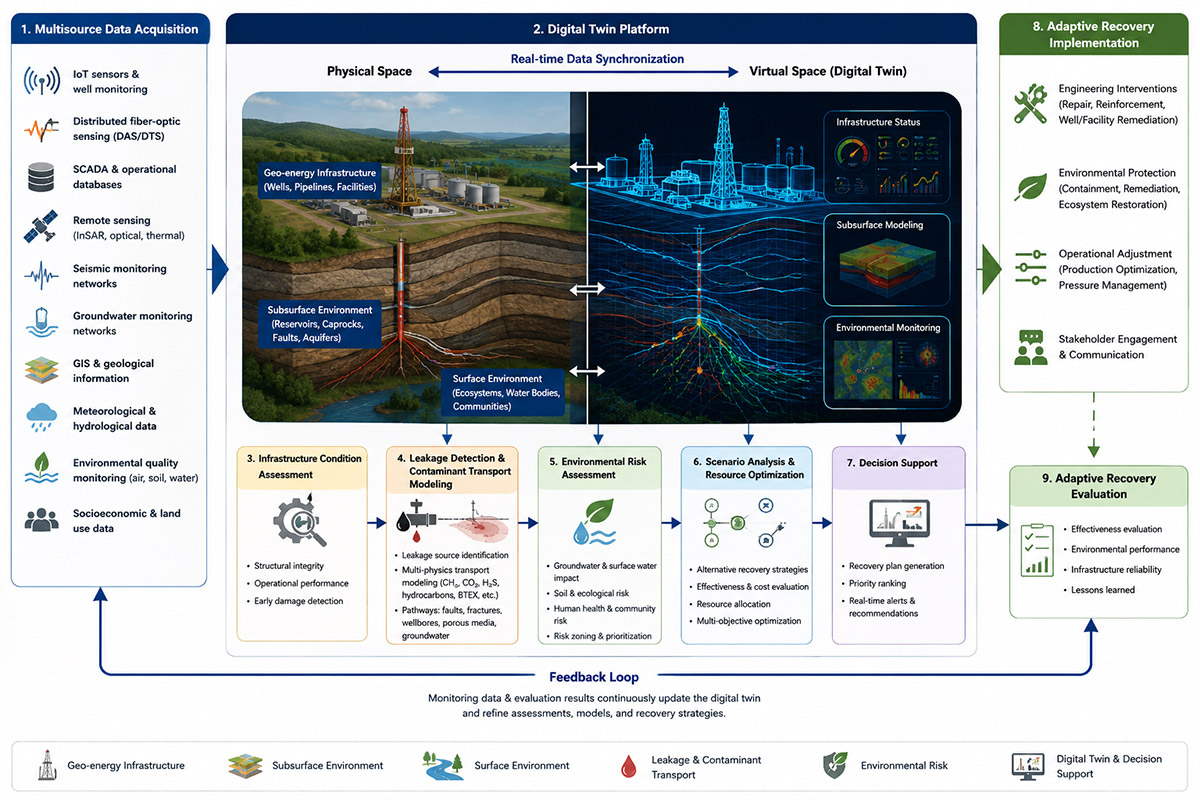
Geo-energy infrastructure—comprising oil and gas systems, CCUS, geothermal installations, and subsurface storage—is critical for energy security and low-carbon transitions. Yet disasters and engineering failures can trigger hazardous leaks and contaminant transport through complex geological media, posing cascading risks to subsurface and surface ecosystems. While urban resilience has been widely studied, environmentally resilient recovery strategies that explicitly integrate leakage risk, contaminant migration, and resource optimization remain underexplored. This review presents a digital twin framework for disaster-driven environmental recovery, unifying real-time monitoring, geological modeling, leakage-risk assessment, contaminant transport analysis, and intelligent resource optimization within a single decision-support architecture. The framework constructs an integrated system linking geo-energy infrastructure, subsurface environment, and surface receptors, enabling dynamic interaction modeling. Representative scenarios—including CH$_4$, CO$_2$, H$_2$S, hydrocarbons, and BTEX—illustrate diverse monitoring, simulation, and decision needs. Emphasis is placed on digital twins for coupling multi-source sensing, subsurface simulation, environmental risk assessment, and adaptive planning. The framework offers a conceptual foundation for embedding digital twins into resilient geo-energy management. It also outlines key challenges and future directions in data integration, geological uncertainty, transport modeling, intelligent decision support, and interdisciplinary collaboration, providing practical guidance for sustainable recovery and long-term resilience of next-generation geo-energy systems.
Graphical Abstract
Keywords
Data Availability Statement
Funding
Conflicts of Interest
AI Use Statement
Ethical Approval and Consent to Participate
References
- Bachu, S. (2008). CO2 storage in geological media: Role, means, status and barriers to deployment. Progress in Energy and Combustion Science, 34(2), 254-273.
[CrossRef] [Google Scholar] - Benson, S. M., & Cole, D. R. (2008). CO2 sequestration in deep sedimentary formations. Elements, 4(5), 325-331.
[CrossRef] [Google Scholar] - Rutqvist, J. (2012). The geomechanics of CO2 storage in deep sedimentary formations. Geotechnical and Geological Engineering, 30(3), 525-551.
[CrossRef] [Google Scholar] - Nordbotten, J. M., Celia, M. A., & Bachu, S. (2005). Injection and storage of CO2 in deep saline aquifers: Analytical solution for CO2 plume evolution during injection. Transport in Porous Media, 58(3), 339-360.
[CrossRef] [Google Scholar] - Orr Jr, F. M. (2009). Onshore geologic storage of CO2. Science, 325(5948), 1656-1658.
[CrossRef] [Google Scholar] - Zhang, Y., Oldenburg, C. M., & Finsterle, S. (2010). Percolation-theory and fuzzy rule-based probability estimation of fault leakage at geologic carbon sequestration sites. Environmental Earth Sciences, 59(7), 1447-1459.
[CrossRef] [Google Scholar] - Cimellaro, G. P., Villa, O., & Bruneau, M. (2015). Resilience-based design of natural gas distribution networks. Journal of Infrastructure Systems, 21(1), 05014005.
[CrossRef] [Google Scholar] - Girgin, S., & Krausmann, E. (2016). Historical analysis of US onshore hazardous liquid pipeline accidents triggered by natural hazards. Journal of Loss Prevention in the Process Industries, 40, 578-590.
[CrossRef] [Google Scholar] - Cruz, A. M., & Krausmann, E. (2009). Hazardous-materials releases from offshore oil and gas facilities and emergency response following Hurricanes Katrina and Rita. Journal of Loss Prevention in the Process Industries, 22(1), 59-65.
[CrossRef] [Google Scholar] - Lions, J., Humez, P., Pauwels, H., Kloppmann, W., & Czernichowski‐Lauriol, I. (2014). Tracking leakage from a natural CO2 reservoir (Montmiral, France) through the chemistry and isotope signatures of shallow groundwater. Greenhouse Gases: Science and Technology, 4(2), 225-243.
[CrossRef] [Google Scholar] - Arts, R. J., Chadwick, A., Eiken, O., Thibeau, S., & Nooner, S. (2008). Ten years' experience of monitoring CO2 injection in the Utsira Sand at Sleipner, offshore Norway. First Break, 26(1).
[CrossRef] [Google Scholar] - Michael, K., Golab, A., Shulakova, V., Ennis-King, J., Allinson, G., Sharma, S., & Aiken, T. (2010). Geological storage of CO2 in saline aquifers—A review of the experience from existing storage operations. International Journal of Greenhouse Gas Control, 4(4), 659-667.
[CrossRef] [Google Scholar] - Fuller, A., Fan, Z., Day, C., & Barlow, C. (2020). Digital twin: Enabling technologies, challenges and open research. IEEE Access, 8, 108952-108971.
[CrossRef] [Google Scholar] - Jones, D., Snider, C., Nassehi, A., Yon, J., & Hicks, B. (2020). Characterising the Digital Twin: A systematic literature review. CIRP Journal of Manufacturing Science and Technology, 29, 36-52.
[CrossRef] [Google Scholar] - Minerva, R., Lee, G. M., & Crespi, N. (2020). Digital twin in the IoT context: A survey on technical features, scenarios, and architectural models. Proceedings of the IEEE, 108(10), 1785-1824.
[CrossRef] [Google Scholar] - Rasheed, A., San, O., & Kvamsdal, T. (2020). Digital twin: Values, challenges and enablers from a modeling perspective. IEEE Access, 8, 21980-22012.
[CrossRef] [Google Scholar] - Min, Q., Lu, Y., Liu, Z., Su, C., & Wang, B. (2019). Machine learning based digital twin framework for production optimization in petrochemical industry. International Journal of Information Management, 49, 502-519.
[CrossRef] [Google Scholar] - Wanasinghe, T. R., Wroblewski, L., Petersen, B. K., Gosine, R. G., James, L. A., De Silva, O., Mann, G. K. I., & Warrian, P. J. (2020). Digital twin for the oil and gas industry: Overview, research trends, opportunities, and challenges. IEEE Access, 8, 104175-104197.
[CrossRef] [Google Scholar] - Raissi, M., Perdikaris, P., & Karniadakis, G. E. (2019). Physics-informed neural networks: A deep learning framework for solving forward and inverse problems involving nonlinear partial differential equations. Journal of Computational Physics, 378, 686-707.
[CrossRef] [Google Scholar] - Karniadakis, G. E., Kevrekidis, I. G., Lu, L., Perdikaris, P., Wang, S., & Yang, L. (2021). Physics-informed machine learning. Nature Reviews Physics, 3(6), 422-440.
[CrossRef] [Google Scholar] - Cruz, A. M., & Krausmann, E. (2013). Vulnerability of the oil and gas sector to climate change and extreme weather events. Climatic Change, 121(1), 41-53.
[CrossRef] [Google Scholar] - Mahmood, Y., Afrin, T., Huang, Y., & Yodo, N. (2023). Sustainable development for oil and gas infrastructure from risk, reliability, and resilience perspectives. Sustainability, 15(6), 4953.
[CrossRef] [Google Scholar]
Cite This Article
TY  - JOUR
AU  - Li, Jinghan
PY  - 2026
DA  - 2026/09/01
TI  - Digital Twin-Enabled Environmentally Resilient Recovery of Geo-Energy Infrastructure after Disasters
JO  - Journal of Geo-Energy and Environment
T2  - Journal of Geo-Energy and Environment
JF  - Journal of Geo-Energy and Environment
VL  - 2
IS  - 4
SP  - 300
EP  - 318
DO  - 10.62762/JGEE.2026.334943
UR  - https://www.icck.org/article/abs/JGEE.2026.334943
KW  - digital twin
KW  - Geo-Energy infrastructure
KW  - environmentally resilient recovery
KW  - leakage risk
KW  - contaminant transport
KW  - carbon capture
KW  - utilization and storage (CCUS)
KW  - geological environment
KW  - resource optimization
KW  - decision support
AB  - Geo-energy infrastructure—comprising oil and gas systems, CCUS, geothermal installations, and subsurface storage—is critical for energy security and low-carbon transitions. Yet disasters and engineering failures can trigger hazardous leaks and contaminant transport through complex geological media, posing cascading risks to subsurface and surface ecosystems. While urban resilience has been widely studied, environmentally resilient recovery strategies that explicitly integrate leakage risk, contaminant migration, and resource optimization remain underexplored. This review presents a digital twin framework for disaster-driven environmental recovery, unifying real-time monitoring, geological modeling, leakage-risk assessment, contaminant transport analysis, and intelligent resource optimization within a single decision-support architecture. The framework constructs an integrated system linking geo-energy infrastructure, subsurface environment, and surface receptors, enabling dynamic interaction modeling. Representative scenarios—including CH$_4$, CO$_2$, H$_2$S, hydrocarbons, and BTEX—illustrate diverse monitoring, simulation, and decision needs. Emphasis is placed on digital twins for coupling multi-source sensing, subsurface simulation, environmental risk assessment, and adaptive planning. The framework offers a conceptual foundation for embedding digital twins into resilient geo-energy management. It also outlines key challenges and future directions in data integration, geological uncertainty, transport modeling, intelligent decision support, and interdisciplinary collaboration, providing practical guidance for sustainable recovery and long-term resilience of next-generation geo-energy systems.
SN  - 3069-3268
PB  - Institute of Central Computation and Knowledge
LA  - English
ER  -
@article{Li2026Digital,
  author = {Jinghan Li},
  title = {Digital Twin-Enabled Environmentally Resilient Recovery of Geo-Energy Infrastructure after Disasters},
  journal = {Journal of Geo-Energy and Environment},
  year = {2026},
  volume = {2},
  number = {4},
  pages = {300-318},
  doi = {10.62762/JGEE.2026.334943},
  url = {https://www.icck.org/article/abs/JGEE.2026.334943},
  abstract = {Geo-energy infrastructure—comprising oil and gas systems, CCUS, geothermal installations, and subsurface storage—is critical for energy security and low-carbon transitions. Yet disasters and engineering failures can trigger hazardous leaks and contaminant transport through complex geological media, posing cascading risks to subsurface and surface ecosystems. While urban resilience has been widely studied, environmentally resilient recovery strategies that explicitly integrate leakage risk, contaminant migration, and resource optimization remain underexplored. This review presents a digital twin framework for disaster-driven environmental recovery, unifying real-time monitoring, geological modeling, leakage-risk assessment, contaminant transport analysis, and intelligent resource optimization within a single decision-support architecture. The framework constructs an integrated system linking geo-energy infrastructure, subsurface environment, and surface receptors, enabling dynamic interaction modeling. Representative scenarios—including CH\$\_4\$, CO\$\_2\$, H\$\_2\$S, hydrocarbons, and BTEX—illustrate diverse monitoring, simulation, and decision needs. Emphasis is placed on digital twins for coupling multi-source sensing, subsurface simulation, environmental risk assessment, and adaptive planning. The framework offers a conceptual foundation for embedding digital twins into resilient geo-energy management. It also outlines key challenges and future directions in data integration, geological uncertainty, transport modeling, intelligent decision support, and interdisciplinary collaboration, providing practical guidance for sustainable recovery and long-term resilience of next-generation geo-energy systems.},
  keywords = {digital twin, Geo-Energy infrastructure, environmentally resilient recovery, leakage risk, contaminant transport, carbon capture, utilization and storage (CCUS), geological environment, resource optimization, decision support},
  issn = {3069-3268},
  publisher = {Institute of Central Computation and Knowledge}
}
Article Metrics
Publisher's Note
ICCK stays neutral with regard to jurisdictional claims in published maps and institutional affiliations.
Rights and Permissions
 Copyright © 2026 by the Author(s). Published by Institute of Central Computation and Knowledge. This article is an open access article distributed under the terms and conditions of the Creative Commons Attribution (CC BY) license (https://creativecommons.org/licenses/by/4.0/), which permits use, sharing, adaptation, distribution and reproduction in any medium or format, as long as you give appropriate credit to the original author(s) and the source, provide a link to the Creative Commons licence, and indicate if changes were made.


Portico
